
Smart Rings Supplier Selection: 7 Checks for Importers Before You Commit
November 6, 2026 · Team Star King

Smart Rings Supplier Selection: 7 Checks for Importers Before You Commit
Smart rings supplier selection is the process of verifying a manufacturer’s technical capability, quality systems, compliance readiness, and commercial terms before placing a bulk order. For importers, the goal is to confirm that the factory can consistently produce rings that meet your specifications and target-market requirements. This guide covers seven practical checks—from factory audits to MOQ planning—that help you avoid costly mistakes and build a reliable supply chain.
Table of Contents
Table of Contents
smart rings supplier selection: Table of Contents
- Short Answer
- Key Takeaways
- Key Facts for Buyers
- Check 1: Verify the Manufacturer’s Core Competence
- Check 2: Evaluate OEM/ODM and Private Label Capabilities
- Check 3: Understand MOQ and Pricing Drivers
- Check 4: Demand Sample Testing and Validation
- Check 5: Scrutinize Quality Control and Testing Protocols
- Check 6: Confirm Certification and Compliance Readiness
- Check 7: Plan Lead Times and Production Scheduling
- Common Mistakes and Buyer Red Flags
- Practical Buyer Checklist
- FAQ
- Conclusion

Short Answer
To select a smart ring supplier, importers should verify the factory’s manufacturing experience, request samples for performance testing, review quality control documentation, confirm certification status for the target market, and clarify MOQ, lead times, and payment terms. A structured seven-step evaluation reduces risk and ensures the supplier can meet your brand’s requirements.

Key Takeaways
- Verify the supplier’s core competence: look for a track record in wearable manufacturing, not just general electronics.
- Understand the difference between OEM, ODM, and private label; choose the model that fits your brand’s resources.
- Always test samples for sensor accuracy, battery life, app integration, and comfort before committing.
- Certification is product- and market-specific; confirm which certificates apply to your configuration.
- Plan for lead times that include tooling, production, testing, and shipping—especially for lithium-ion battery products.
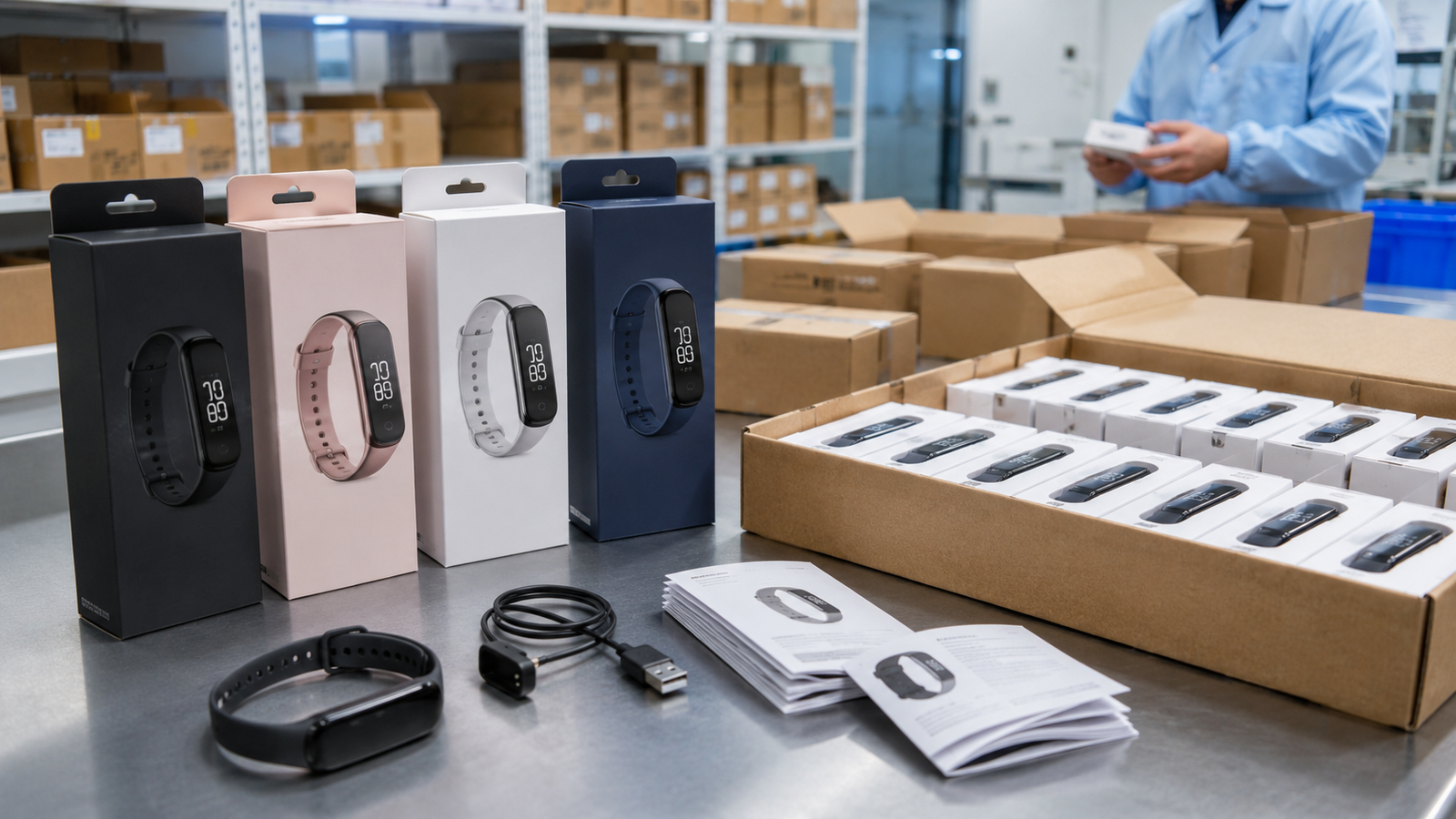
Key Facts for Buyers
| Factor | Typical Range / Consideration | Why It Matters |
|---|---|---|
| MOQ | 500–1,000 units for custom designs; lower for stock models | Affects cash flow and inventory risk |
| Sampling Time | 7–15 days for standard samples; 20–30 days for custom | Ensures product meets specs before mass production |
| Production Lead Time | 25–45 days after sample approval | Impacts launch schedules and stock availability |
| Certification | CE, FCC, RoHS, UN38.3, MSDS (depending on market) | Required for customs clearance and legal sale |
| Battery Shipping | UN38.3 test report and MSDS for lithium-ion cells | Mandatory for air/sea freight |

Check 1: Verify the Manufacturer’s Core Competence
What to look for: A smart ring supplier should have demonstrable experience in miniaturized wearables, sensor integration, and low-power design. Ask for evidence of past projects, factory floor photos, and a list of key equipment (e.g., SMT lines, calibration rigs).
How to verify: Request a video tour or schedule an in-person audit. Check if the factory has in-house engineering and quality teams, not just sales staff. A supplier that specializes in smart rings will have dedicated testing protocols for ring-specific challenges like fit, skin contact, and battery miniaturization.
For a deeper dive into STAR KING’s manufacturing capabilities, see our private label OEM/ODM solutions.
Check 2: Evaluate OEM/ODM and Private Label Capabilities
OEM (Original Equipment Manufacturing): You provide the design and specifications; the factory builds to your requirements. This requires you to have a complete technical package.
ODM (Original Design Manufacturing): The factory offers existing designs that you can customize (e.g., logo, packaging, app branding). This is faster and often more cost-effective for startups.
Private Label: A subset of ODM where the product is branded as yours, often with minimal hardware changes.
Decision tip: If you lack in-house hardware expertise, ODM/private label is usually the pragmatic choice. If you have a unique sensor or form factor, consider OEM. STAR KING supports all three models—discuss your needs via our sales team.
Check 3: Understand MOQ and Pricing Drivers
MOQ (Minimum Order Quantity) varies by supplier and customization level. For smart rings, MOQs typically range from 500 to 1,000 units for custom designs, and can be lower for stock models with standard packaging.
Pricing factors: Sensor grade, battery capacity, housing material (e.g., titanium vs. plastic), display (if any), app development, and packaging. Always request a detailed quotation that breaks down these components.
Negotiation tip: Ask about price breaks at higher volumes (e.g., 1k, 5k, 10k units). Also clarify whether tooling costs are one-time or amortized.
Check 4: Demand Sample Testing and Validation
Never skip sample testing. For smart rings, focus on:
- Sensor accuracy: Compare heart rate and SpO2 readings against a reference device.
- Battery life: Test under realistic usage (e.g., continuous heart rate monitoring).
- App integration: Ensure the companion app is stable, user-friendly, and supports your required features (e.g., data export, third-party integration).
- Comfort and fit: Ring sizing and material biocompatibility are critical for user adoption.
- Durability: Check water resistance (e.g., IP68) and scratch resistance.
Request at least 3–5 samples from different production batches if possible. Document all tests and compare against your specifications.
Check 5: Scrutinize Quality Control and Testing Protocols
A reliable supplier will have documented QC processes at incoming, in-process, and final stages. Ask for:
- IQC (Incoming Quality Control) reports for components.
- IPQC (In-Process Quality Control) checkpoints.
- FQC (Final Quality Control) and OQC (Outgoing Quality Control) procedures.
- Reliability testing: drop tests, waterproof tests, aging tests, and battery safety tests.
Also inquire about their corrective action process (e.g., 8D reports) and whether they conduct pre-shipment inspections. STAR KING’s quality approach is outlined in our OEM/ODM solutions page.
Check 6: Confirm Certification and Compliance Readiness
Certification requirements depend on the product configuration and destination market. Common certifications for smart rings include:
- CE: Required for the EU; involves EMC and safety testing.
- FCC: Required for the US; covers RF and EMC.
- RoHS: Restricts hazardous substances; applies in the EU and other regions.
- UN38.3: Mandatory for lithium-ion battery shipping.
- MSDS: Required for battery transport documentation.
Ask the supplier to provide copies of certificates and test reports for the exact model you are purchasing. Do not assume that a certificate for one model covers all. Also verify the certification body’s accreditation. For official information, refer to the FCC website and EU CE marking guidelines.
Caution: Some suppliers may claim “CE certified” without proper documentation. Always request the test report and certificate of conformity.
Check 7: Plan Lead Times and Production Scheduling
Lead time for smart rings typically consists of:
- Sample development: 7–15 days (standard) or 20–30 days (custom).
- Mass production: 25–45 days after sample approval, depending on order size and component availability.
- Testing and certification: additional 1–2 weeks if not already certified.
- Shipping: varies by mode (air/sea) and destination.
Discuss buffer time for Chinese New Year and other holidays. Also clarify Incoterms (e.g., FOB, CIF) and who handles battery shipping documentation.
Common Mistakes and Buyer Red Flags
Mistake 1: Choosing on Price Alone
Low quotes often hide compromises in sensor quality, battery, or QC. Always compare total landed cost, including certification and shipping.
Mistake 2: Skipping Sample Testing
Relying on spec sheets without hands-on testing can lead to high return rates.
Mistake 3: Ignoring Certification Specifics
Assuming a supplier’s existing certificate covers your branded product is risky; certificates are often model-specific.
Red Flags:
- Reluctance to provide factory audit or video tour.
- Vague answers about QC processes.
- No clear documentation for certifications.
- Pressuring for large orders without samples.
Practical Buyer Checklist
| Area | Checkpoint | Done? |
|---|---|---|
| Supplier Profile | Verified factory tour or audit; engineering team on-site | ☐ |
| OEM/ODM/Private Label | Clarified model and customization scope | ☐ |
| MOQ & Pricing | Received detailed quotation with price breaks | ☐ |
| Samples | Tested at least 3 samples for performance and comfort | ☐ |
| Quality Control | Reviewed QC reports and testing protocols | ☐ |
| Certification | Confirmed certificates for target market | ☐ |
| Lead Time | Agreed on production schedule and shipping terms | ☐ |
FAQ
What is the typical MOQ for smart rings?
MOQ varies by supplier and customization. For private label with standard design, MOQ can be as low as 500 units. For full OEM with custom tooling, MOQ is often 1,000 units or more. Always confirm with the supplier.
How long does it take to get a sample?
Standard samples usually ship in 7–15 days. Custom samples with your logo and packaging may take 20–30 days. Factor in shipping time.
Do I need UN38.3 for smart rings?
Yes, if the smart ring contains a lithium-ion battery (which most do), UN38.3 test report and MSDS are required for air and sea freight. This is a shipping requirement, not a market certification.
Can I use my own app with the smart ring?
Some suppliers offer SDK/API for app integration. Discuss firmware and app customization options early. STAR KING provides app customization services.
What certifications are needed for selling in the EU?
Typically CE (including EMC and safety), RoHS, and WEEE registration. For the US, FCC is required. Confirm with your supplier and a compliance consultant.
How do I verify a supplier’s quality control?
Request QC documentation, schedule a video audit of the production line, and ask for references from other importers (if available).
What are common red flags in smart ring suppliers?
Unwillingness to provide factory details, vague certification claims, pressure to order without samples, and lack of clear QC processes.
Conclusion
Smart rings supplier selection requires a structured approach that goes beyond price comparison. By following these seven checks—verifying core competence, evaluating customization models, understanding MOQ and pricing, testing samples, scrutinizing QC, confirming certifications, and planning lead times—importers can minimize risk and build a reliable supply chain. Remember that certification and compliance are product- and market-specific; always verify documentation for your exact configuration. For a partner that supports OEM/ODM and private label smart rings with transparent processes, explore STAR KING’s smart rings and private label solutions.
Ready to Start Your Smart Ring Project?
Whether you need samples for evaluation or a full OEM/ODM quotation, our team can guide you through specifications, certification, and production planning. Contact STAR KING sales to discuss your requirements and receive a tailored proposal.
Discuss Your Smart Wearable OEM/ODM Project
Planning a smart ring, smart watch, smart band, AI glasses, AI translator, or AI voice mouse project? Contact STAR KING to discuss product positioning, sample testing, customization scope, certification requirements, lead time, and quotation details.

Team Star King

Scan WhatsApp QR code
Leave a Reply