
Smart Rings for E-commerce Sellers: 7 Proven Steps to Launch a Private Label Line
October 18, 2026 · Team Star King

Smart Rings for E-commerce Sellers: 7 Proven Steps to Launch a Private Label Line
Smart rings for e-commerce are a fast-growing wearable category, but launching a private label line requires a disciplined sourcing process. This guide gives e-commerce sellers a 7-step framework to select a smart ring supplier, negotiate MOQ and lead times, verify certifications, and build a product that sells on Amazon, Shopify, or your own DTC store. Each step includes practical checks you can apply during supplier evaluation and sample testing, so you can move from product idea to purchase order with fewer surprises.
Table of Contents
Table of Contents
smart rings for e-commerce: Table of Contents
- Step 1: Validate Market Demand and Niche Positioning
- Step 2: Choose Between OEM, ODM, and Private Label
- Step 3: Source and Evaluate Smart Ring Suppliers
- Step 4: Understand MOQ, Pricing, and Cost Drivers
- Step 5: Request and Test Samples
- Step 6: Verify Certifications and Compliance for Target Markets
- Step 7: Plan Packaging, Branding, and Logistics

Short Answer
To launch a private label smart ring line as an e-commerce seller, validate demand, choose a sourcing model, screen suppliers with a structured scorecard, confirm MOQ and lead times, test samples against your use case, verify certifications for each target market, and finalize packaging and logistics. Expect a development cycle of [STAR KING TO CONFIRM] weeks and MOQs starting at [STAR KING TO CONFIRM] units, depending on customization.
Key Takeaways
- Smart rings for e-commerce succeed when you treat sourcing as a staged process, not a one-off price negotiation.
- Private label is usually the fastest entry point; full OEM requires more tooling investment and longer timelines.
- MOQ and unit price are driven by ring size range, sensor configuration, packaging, and app customization.
- Always test samples for fit, battery life, app stability, and data accuracy before committing to a PO.
- Certification needs depend on the exact product configuration and destination market; verify with your supplier and a compliance lab.
- Plan lithium battery shipping (UN38.3, MSDS) and after-sales spare parts early.
Key Facts for Buyers
| Factor | Typical Range / Consideration | Buyer Action |
|---|---|---|
| MOQ (private label) | [STAR KING TO CONFIRM] units, often lower for stock colors | Negotiate based on size mix and packaging |
| Sample lead time | [STAR KING TO CONFIRM] days | Request samples with your logo and packaging mockup |
| Mass production lead time | [STAR KING TO CONFIRM] days after PO and deposit | Plan launch and replenishment cycles |
| Certifications | Depends on configuration and market (e.g., CE, FCC, RoHS, UN38.3) | Verify test reports and scope with supplier |
| App customization | Logo, color theme, data fields; full custom app may require NRE | Confirm data ownership and update responsibilities |
| Battery shipping | UN38.3 test summary and MSDS typically required | Check carrier and destination import rules |
Step 1: Validate Market Demand and Niche Positioning
Before contacting suppliers, define the niche your smart ring will serve. E-commerce sellers often succeed by targeting a specific use case—sleep tracking, fitness recovery, or women’s health—rather than competing on generic features. Use keyword tools and marketplace data to estimate search volume for terms like “sleep tracking ring” or “fitness ring.” Review competitor listings on Amazon and Shopify to identify gaps in size ranges, app experience, and price points.
Positioning also affects your sourcing choices. A budget-focused ring may use a standard ODM module, while a premium brand may require custom sensors or app features. Write a one-page product brief covering target price, core features, size range, and brand story. This brief becomes the basis for supplier conversations and sample evaluation.
Step 2: Choose Between OEM, ODM, and Private Label
Understanding the difference between OEM, ODM, and private label is critical for cost and timeline planning.
- Private Label: You select an existing smart ring model and customize logo, packaging, and app branding. Fastest path, lowest investment.
- ODM: The manufacturer develops the product and you brand it. Some firmware or app customization may be possible. Moderate investment.
- OEM: You provide specifications and industrial design; the manufacturer builds to your requirements. Highest investment, longest timeline, but strongest differentiation.
For most e-commerce sellers entering the category, private label offers the best balance of speed and control. As your brand grows, you can transition to ODM or OEM for exclusive designs. STAR KING offers private label OEM/ODM solutions that can be tailored to your stage.
Step 3: Source and Evaluate Smart Ring Suppliers
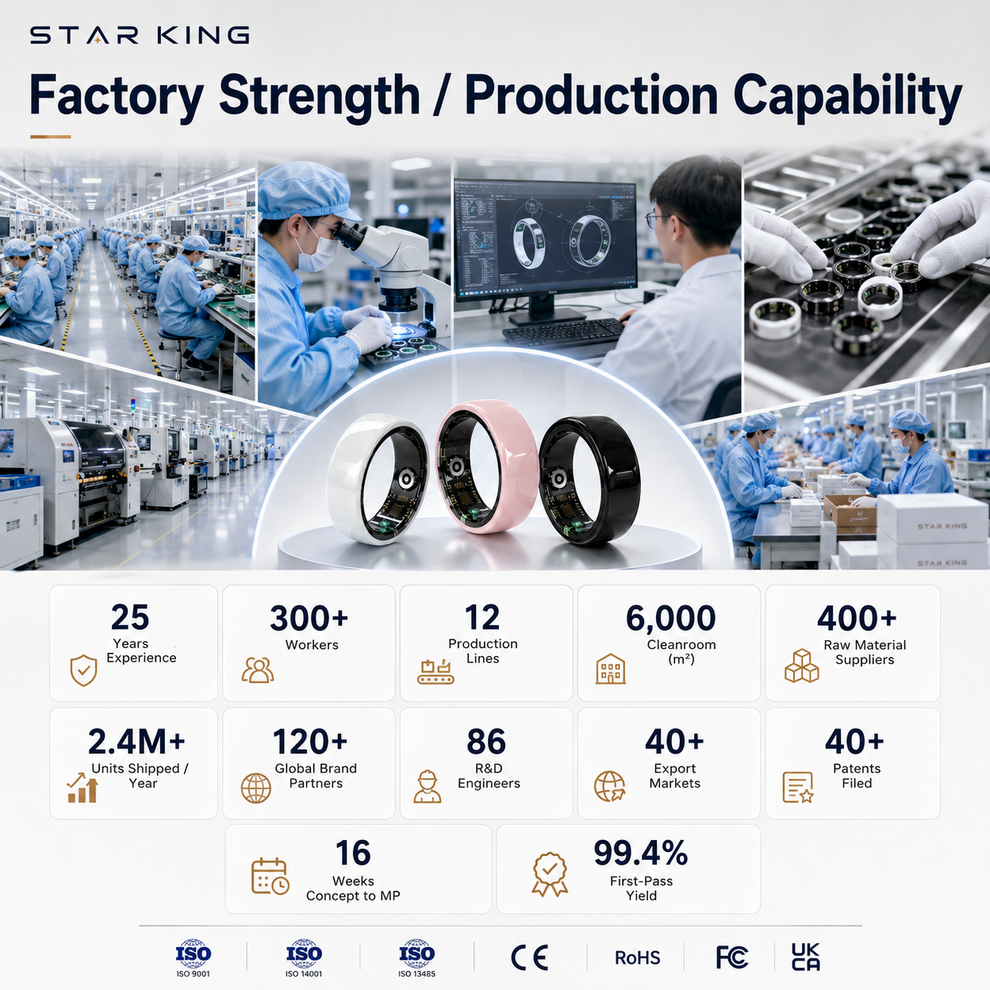
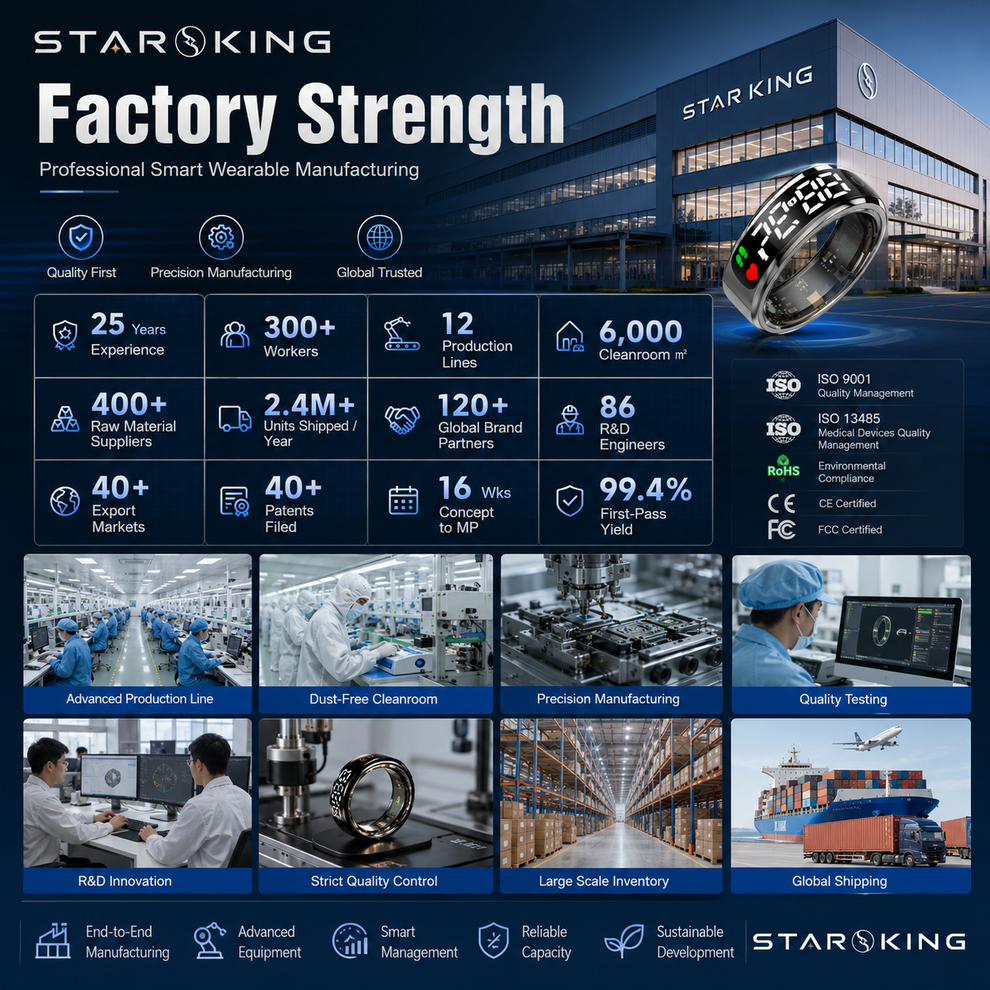
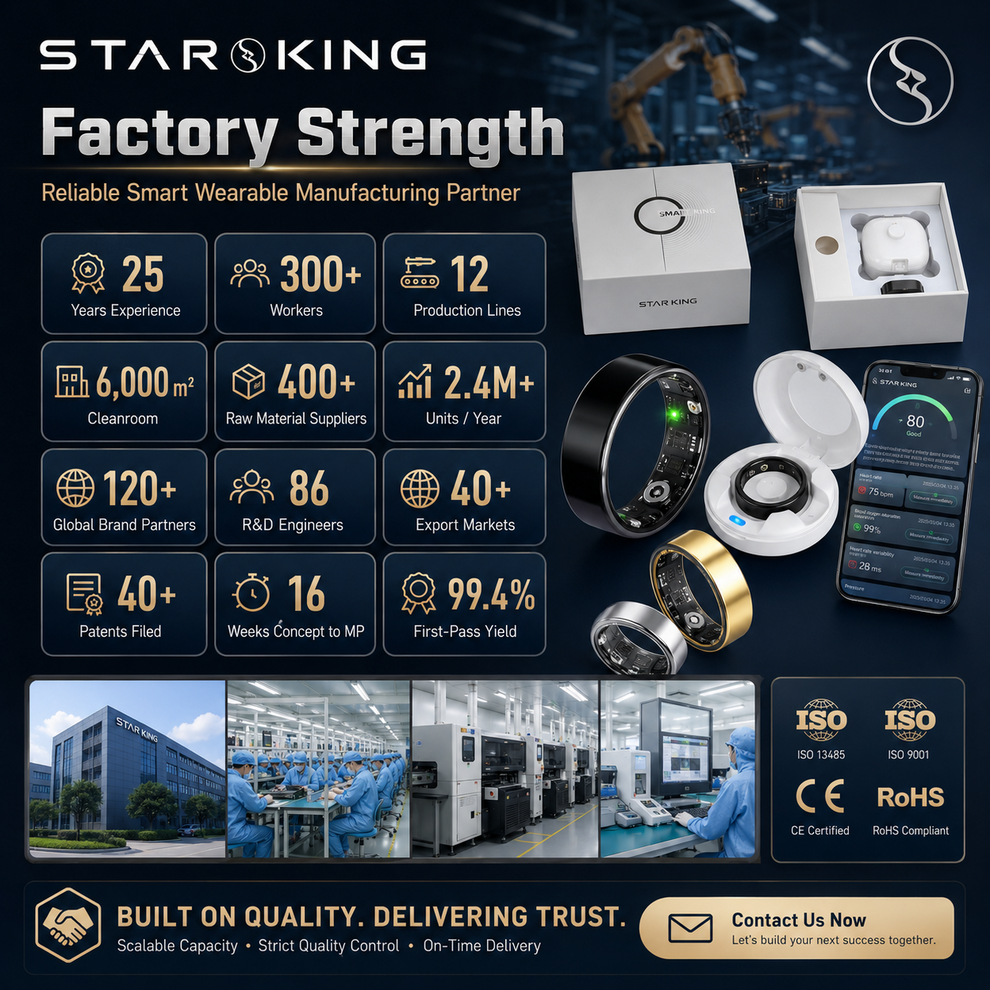
Supplier evaluation should go beyond price. Use a scorecard to compare manufacturers on capability, quality systems, communication, and compliance. Request a company profile, factory audit reports, and product test data. Verify whether the supplier manufactures in-house or sources from trading companies.
Ask potential suppliers about their experience with e-commerce brands, their ability to handle Amazon compliance requirements (e.g., product labeling, test reports), and their responsiveness. A supplier that understands marketplace rules can help you avoid listing suspensions.
If you are shortlisting suppliers, you can review STAR KING’s smart ring product line and request a specification sheet to compare against your requirements.
Step 4: Understand MOQ, Pricing, and Cost Drivers
MOQ and unit price for smart rings are influenced by several factors:
- Size range: Offering more sizes increases MOQ because each size requires separate tooling and inventory.
- Sensor configuration: Advanced sensors (e.g., SpO2, temperature) add cost.
- Packaging: Custom boxes, inserts, and manuals increase unit cost and MOQ.
- App customization: White-label app vs. custom development affects NRE and timeline.
- Order volume: Tiered pricing is common; higher volumes reduce unit cost.
Request a detailed quotation that breaks down product cost, packaging, tooling (if applicable), and shipping. Clarify what is included in the price and what triggers extra charges. Also confirm lead times for repeat orders, as e-commerce sellers need reliable replenishment.
Step 5: Request and Test Samples
Sample testing is your best opportunity to catch issues before mass production. Order samples in multiple sizes and test them against your product brief. Evaluate fit and comfort, battery life under typical use, app stability and syncing, data accuracy compared to a reference device, and charging reliability.
Document your findings with photos and notes. Share specific feedback with the supplier—this tests their responsiveness and willingness to improve. If possible, test the app’s data export and integration with platforms like Apple Health or Google Fit, as these features matter to end users.
Step 6: Verify Certifications and Compliance for Target Markets
Certification requirements vary by product configuration and destination market. For smart rings with lithium batteries, UN38.3 testing is typically required for air transport, along with an MSDS. For the EU, CE marking may apply, including RED for wireless functionality and RoHS for hazardous substances. For the US, FCC certification may be required for wireless devices. Always request copies of test reports and verify their scope covers your exact model.
Be cautious of suppliers who claim “all certifications” without documentation. Certification is product-specific; a certificate for one model may not cover another. Buyers should verify with an accredited lab or compliance consultant. STAR KING can provide [STAR KING TO CONFIRM] certification support for target markets.
Step 7: Plan Packaging, Branding, and Logistics
Packaging and branding shape the unboxing experience and can differentiate your smart ring on marketplaces. Work with your supplier on custom boxes, inserts, and user manuals. Confirm that packaging meets marketplace requirements (e.g., Amazon’s frustration-free packaging) and includes necessary labels and warnings.
Logistics for lithium battery products require attention. Confirm that the supplier provides UN38.3 test summaries and MSDS, and that the shipping method (air, sea, or courier) complies with carrier and destination regulations. Plan for potential delays and consider buffer stock for your launch.
Comparison Table: Sourcing Models for Smart Rings
| Model | Investment | Timeline | Differentiation | Best For |
|---|---|---|---|---|
| Private Label | Low | Short | Branding only | New sellers testing demand |
| ODM | Medium | Medium | Some firmware/app customization | Growing brands |
| OEM | High | Long | Full custom design | Established brands |
Common Mistakes and Buyer Red Flags
- Skipping sample testing: Relying on spec sheets alone often leads to poor fit or app issues.
- Ignoring certification scope: Assuming a certificate covers all models can cause customs or marketplace problems.
- Choosing the lowest price: Very low quotes may indicate lower quality components or hidden costs.
- Not clarifying app ownership: Ensure you understand who owns the app data and user experience.
- Underestimating logistics: Lithium battery shipping requires proper documentation; plan ahead.
Practical Buyer Checklist
- Define target market, price point, and core features.
- Request supplier profile and factory audit reports.
- Confirm MOQ, lead times, and payment terms in writing.
- Order samples in multiple sizes and test for at least [STAR KING TO CONFIRM] days.
- Verify certifications and test reports for your exact model and market.
- Clarify app customization options and data privacy policies.
- Review packaging and labeling requirements for your sales channel.
- Confirm shipping documents (UN38.3, MSDS) and Incoterms.
Useful Official References for Buyers
- FCC equipment authorization guidance
- European Commission CE marking information
- Bluetooth SIG specifications
FAQ
What is the typical MOQ for private label smart rings?
MOQ varies by supplier and customization level. For private label with standard packaging, MOQs may start at [STAR KING TO CONFIRM] units. Custom sizes and packaging can increase MOQ. Always confirm in writing.
How long does it take to get samples?
Sample lead time depends on whether you request stock samples or custom-branded samples. Stock samples may ship within [STAR KING TO CONFIRM] days, while custom samples take longer. Plan for shipping time as well.
Do smart rings require FCC certification for Amazon US?
Smart rings with wireless functionality (e.g., Bluetooth) typically require FCC certification for sale in the US. Amazon may request proof of compliance. Verify with your supplier and a testing lab.
Can I customize the app for my brand?
Many suppliers offer white-label app options with your logo and color scheme. Full custom app development is possible but usually involves additional NRE costs and longer timelines. Clarify data ownership and update responsibilities.
What are the shipping requirements for smart rings with lithium batteries?
Lithium battery products generally require UN38.3 test summaries and MSDS for transport. Air shipments may have additional restrictions. Confirm with your freight forwarder and ensure the supplier provides necessary documents.
How do I verify a supplier’s quality control?
Ask for evidence of quality management systems (e.g., ISO 9001), pre-shipment inspection reports, and testing protocols. Request a video tour or third-party audit report. Start with a small order to evaluate quality.
Conclusion
Launching a private label smart ring line as an e-commerce seller is achievable with a structured sourcing process. Focus on market validation, supplier evaluation, sample testing, and certification verification. By following these seven steps, you can reduce risk and build a product that meets customer expectations and marketplace requirements. Remember that details like MOQ, lead times, and certification scope should always be confirmed directly with your supplier.
Ready to Source Smart Rings for Your E-commerce Brand?
STAR KING supports e-commerce sellers with private label and OEM/ODM smart ring solutions. Request a quotation or discuss your project requirements with our team.
Discuss Your Smart Wearable OEM/ODM Project
Planning a smart ring, smart watch, smart band, AI glasses, AI translator, or AI voice mouse project? Contact STAR KING to discuss product positioning, sample testing, customization scope, certification requirements, lead time, and quotation details.

Team Star King

Scan WhatsApp QR code
Leave a Reply