
AI Voice Mouse for Middle East Distributors: 7 Critical Checks Before You Sign a Supply Agreement
October 18, 2026 · Team Star King
AI Voice Mouse for Middle East Distributors: 7 Critical Checks Before You Sign a Supply Agreement
An AI Voice Mouse combines a standard pointing device with voice input, real-time translation, and AI-assisted commands. For distributors in the Middle East, the right supplier should provide documented language coverage (Arabic and English at minimum), market-specific compliance evidence, clear MOQ and lead-time terms, and private-label options that do not compromise firmware stability. Buyers should verify each of these before issuing an RFQ or signing a supply agreement. This guide gives you a seven-check framework to evaluate AI Voice Mouse suppliers for GCC and wider Middle East distribution.
Table of Contents
Table of Contents
Table of Contents
- Short Answer
- Key Takeaways
- Key Facts for Buyers
- What Is an AI Voice Mouse?
- 1. Language and Dialect Coverage
- 2. Compliance and Certification for Middle East Markets
- 3. Hardware, Firmware, and Software Specifications
- 4. OEM, ODM, and Private Label Options
- 5. MOQ, Pricing, and Lead Time
- 6. Quality Control and Testing
- 7. After-Sales, Warranty, and Spare Parts
- Supplier Comparison Table
- Common Mistakes and Buyer Red Flags
- Practical Buyer Checklist
- FAQ
- Conclusion

Short Answer
The best AI Voice Mouse supplier for Middle East distributors is one that can document Arabic and English voice accuracy, provide CE and RoHS evidence (and G-Mark where applicable), offer private-label branding with stable firmware, and quote realistic MOQs and lead times. Request sample units for language testing and ask for a compliance matrix per SKU before signing any supply agreement.

Key Takeaways
- Language support is the first filter: confirm Modern Standard Arabic and Gulf dialect handling, not just translation.
- Compliance depends on destination country; GCC markets may require G-Mark, and radio modules may need local type approval.
- A good AI Voice Mouse supplier separates hardware, firmware, and app layers so private-label changes do not break updates.
- MOQ and lead time should be agreed in writing with sample approval milestones.
- Quality control should include voice recognition testing in real office noise, not only hardware drop tests.
- Distributors should secure spare parts and warranty terms before first bulk order.
Key Facts for Buyers
| Factor | What to Verify | Typical Document |
|---|---|---|
| Languages | Arabic (MSA and Gulf), English, French (optional) | Language test report or demo unit |
| Compliance | CE, RoHS, REACH; G-Mark for GCC; radio approval | Test reports, certificates, DoC |
| Connectivity | Bluetooth version, dongle support, OS compatibility | Spec sheet, Bluetooth SIG listing |
| Battery | Capacity, charging method, UN38.3 for shipping | UN38.3 report, MSDS |
| Customization | Logo, packaging, app skin, firmware strings | OEM/ODM agreement with IP clauses |
| MOQ | Per SKU, per color, per packaging | Quotation with MOQ tiers |
| Lead Time | Sample, production, shipping to Jebel Ali or Riyadh | Production schedule |
| Warranty | Duration, RMA process, spare parts availability | Warranty policy, spare parts list |
What Is an AI Voice Mouse?
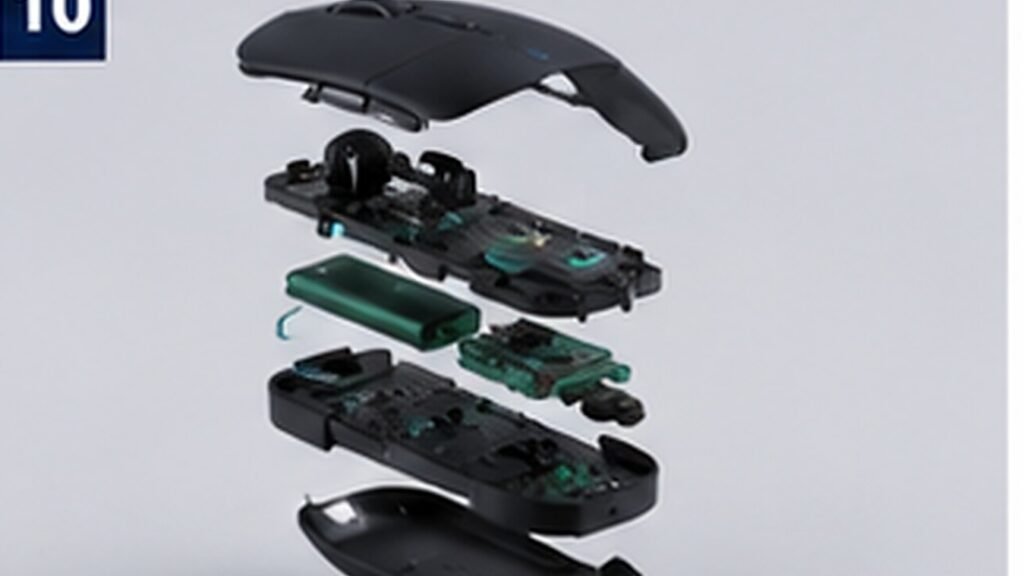
An AI Voice Mouse is a computer mouse with a built-in microphone and dedicated voice button. It captures speech, converts it to text or commands, and can translate in real time through companion software. Unlike a standard mouse, it requires firmware, a desktop app, and often a cloud service for AI processing. For distributors, this means the product is a system: hardware quality matters, but app updates and language models determine long-term customer satisfaction.
Buyers should evaluate the AI Voice Mouse as a bundled solution. A unit that types accurately in English may perform poorly with Arabic names or mixed Arabic-English phrases. Always test with real users in the target market.
1. Language and Dialect Coverage
Language is the top purchase criterion for Middle East distribution. Confirm whether the supplier supports Modern Standard Arabic, Gulf dialects, and code-switching between Arabic and English. Ask for a written language list and test sample units with local staff.
What to ask
- Which Arabic dialects are supported, and how are updates delivered?
- Does the device work offline for basic dictation, or is cloud connectivity required?
- What is the accuracy rate for Arabic dictation in office noise?
STAR KING currently offers [STAR KING TO CONFIRM] language coverage. Distributors should request a language validation report or arrange third-party testing before committing to volume.
2. Compliance and Certification for Middle East Markets
Compliance is destination-specific. CE and RoHS are common baseline requirements, but GCC countries may require G-Mark for low-voltage equipment, and radio modules may need type approval from local authorities. Buyers should request a compliance matrix per SKU and verify certificates with the issuing body.
For reference, the International Electrotechnical Commission (IEC) publishes safety standards that underpin many national schemes, and the Bluetooth SIG maintains qualification listings for wireless products. Always confirm that the certificate holder matches the manufacturer and that the product description matches the SKU you intend to import.
Do not assume that a supplier’s CE certificate covers all configurations. Custom logos, packaging, or battery changes can trigger re-testing. The Star King private label OEM/ODM solution page outlines how customization may affect compliance.
3. Hardware, Firmware, and Software Specifications
An AI Voice Mouse includes a microphone array, a processing unit, Bluetooth or 2.4 GHz connectivity, and companion software. Distributors should review the specification sheet for sensor type, battery life, charging port, and OS compatibility. Firmware update policy is equally important: ask how often updates are released and whether they are region-specific.
Specification trade-offs
- Battery life vs. always-on voice wake: always-on consumes more power.
- Cloud vs. on-device processing: cloud improves accuracy but requires stable internet.
- Dongle vs. Bluetooth-only: a dongle can improve compatibility with older PCs.
Request a demo unit and test with the operating systems common in your market, including Windows and macOS. For broader AI office hardware context, see the AI office productivity solution.
4. OEM, ODM, and Private Label Options
Distributors often need private-label branding to build local channel loyalty. Confirm the level of customization: logo printing, packaging design, app skin, and firmware strings. Ask whether the supplier owns the tooling and software IP, and how ownership transfers if you fund new molds.
An AI Voice Mouse project typically involves three layers: hardware (enclosure, PCB), firmware (voice processing), and app/cloud. Changes in one layer can affect the others. A clear ODM agreement should define who maintains the app and how updates are handled after launch. Review the AI Voice Mouse product page for baseline customization options.
5. MOQ, Pricing, and Lead Time
MOQ and lead time are often the deciding factors for distributors. Ask for MOQ per SKU, per color, and per packaging configuration. Pricing should be quoted with Incoterms and should separate product cost from tooling, certification, and shipping.
Lead time should be broken down into sample approval, mass production, and shipping to your port. For Middle East destinations, sea freight to Jebel Ali or Riyadh typically takes several weeks; air freight is faster but more expensive, especially for lithium battery products. STAR KING’s MOQ and lead time for AI Voice Mouse are [STAR KING TO CONFIRM]; request a written quotation with tiered pricing.
6. Quality Control and Testing
Quality control for an AI Voice Mouse goes beyond drop testing. It should include voice recognition testing in different noise environments, microphone sensitivity checks, battery aging, and pre-shipment inspection. Ask for the supplier’s QC process and whether third-party inspection is allowed.
Common tests include:
- Voice accuracy test with Arabic and English samples.
- Button life and scroll wheel durability.
- Battery charge-discharge cycles.
- Packaging drop test for export.
STAR KING’s specific test protocols are [STAR KING TO CONFIRM]. Buyers should request test reports and, for large orders, arrange pre-shipment inspection.
7. After-Sales, Warranty, and Spare Parts
Distributors need a clear after-sales policy. Confirm warranty duration, RMA process, and availability of spare parts such as dongles, charging cables, and replacement units. Ask whether the supplier provides firmware recovery tools and whether the app is maintained locally or centrally.
For AI hardware, software updates can be as important as hardware spares. Establish an escalation path for language model updates and bug fixes. STAR KING’s warranty terms and spare parts policy are [STAR KING TO CONFIRM]; request them as part of the RFQ package.
Supplier Comparison Table
Use this table to compare potential AI Voice Mouse suppliers during RFQ evaluation.
| Criteria | Supplier A | Supplier B | Supplier C | Your Priority |
|---|---|---|---|---|
| Arabic language support | MSA only | MSA + Gulf | MSA + Gulf + English code-switch | High |
| Compliance evidence | CE, RoHS | CE, RoHS, G-Mark | CE, RoHS, G-Mark, UN38.3 | High |
| Private label options | Logo only | Logo + packaging | Logo + packaging + app skin | Medium |
| MOQ | 1,000 | 500 | 300 | Medium |
| Lead time | 45 days | 35 days | 30 days | Medium |
| Warranty | 12 months | 12 months + spares | 18 months + spares | High |
Common Mistakes and Buyer Red Flags
- Assuming language support from a spec sheet. Test with local users before ordering.
- Accepting certificates without verifying scope. Check that the certificate covers your exact SKU and destination.
- Ignoring firmware update policy. AI products need ongoing updates; confirm who pays for them.
- Underestimating shipping requirements for lithium batteries. Confirm UN38.3 and MSDS documents and carrier acceptance.
- Signing without sample approval milestones. Tie payments to sample approval and pre-shipment inspection.
- Red flag: supplier cannot provide a compliance matrix. This suggests limited export experience.
- Red flag: MOQ quoted without packaging or color breakdown. Hidden costs may appear later.
Practical Buyer Checklist
- ☐ Request sample units and test Arabic/English voice accuracy.
- ☐ Obtain compliance matrix per SKU for target countries.
- ☐ Confirm Bluetooth SIG or radio type approval status.
- ☐ Review OEM/ODM agreement including IP and tooling ownership.
- ☐ Get written quotation with MOQ, lead time, and Incoterms.
- ☐ Ask for QC reports and pre-shipment inspection terms.
- ☐ Confirm warranty, RMA, and spare parts availability.
- ☐ Verify UN38.3 and MSDS for battery shipping.
- ☐ Agree on firmware update responsibilities.
- ☐ Plan packaging and labeling for destination market.
FAQ
What languages should an AI Voice Mouse support for Middle East distributors?
At minimum, Modern Standard Arabic and English. Gulf dialect support and Arabic-English code-switching are strongly preferred for UAE, Saudi Arabia, and Qatar markets. Test sample units with local users before committing.
Which certifications are required for AI Voice Mouse imports into GCC countries?
Requirements vary by country. CE and RoHS are common baseline; G-Mark may be required for low-voltage equipment. Radio modules may need local type approval. Buyers should verify with local authorities and request a compliance matrix from the supplier.
What is a typical MOQ for private label AI Voice Mouse orders?
MOQ depends on customization and supplier. For standard private label with logo and packaging, MOQs may range from 300 to 1,000 units. STAR KING MOQ is [STAR KING TO CONFIRM]. Request tiered pricing for planning.
How long does shipping an AI Voice Mouse order to the Middle East take?
Production lead time typically ranges from 30 to 45 days after sample approval. Sea freight to Jebel Ali or Riyadh may take several weeks; air freight is faster. Lithium battery shipping requires UN38.3 and MSDS documents.
Can I customize the app and firmware for my brand?
Many suppliers offer app skin and firmware string customization. Confirm who maintains the app and how updates are delivered. IP ownership and update responsibilities should be defined in the ODM agreement.
What warranty and spare parts should distributors expect?
Standard warranty is often 12 months, but 18 months may be negotiable for volume orders. Spare parts such as dongles and cables should be available. Establish an RMA process and firmware recovery support before launch.
Conclusion
For Middle East distributors, the right AI Voice Mouse supplier is one that proves Arabic language capability, provides a clear compliance path, and supports private-label branding without compromising firmware stability. Use the seven checks in this guide to structure your RFQ and compare suppliers on evidence, not claims. Start with sample testing and a written compliance matrix, then negotiate MOQ, lead time, and warranty terms that protect your channel investment.
Next Step
Ready to move from evaluation to RFQ? Request a quotation for AI Voice Mouse with your target configuration, languages, and estimated volumes. STAR KING can provide sample units and customization options for your market.
Discuss Your Smart Wearable OEM/ODM Project
Planning a smart ring, smart watch, smart band, AI glasses, AI translator, or AI voice mouse project? Contact STAR KING to discuss product positioning, sample testing, customization scope, certification requirements, lead time, and quotation details.

Team Star King

Scan WhatsApp QR code
Leave a Reply