
smart bands RFQ checklist: 7-Step Smart Bands RFQ Checklist for System Integrators in the EU
7-Step Smart Bands RFQ Checklist for System Integrators in the EU
When you are a system integrator planning to deploy smart bands for a corporate wellness program, a logistics tracking solution, or a remote patient monitoring pilot, your RFQ (Request for Quotation) is more than a list of specs. It is the foundation of your entire procurement. This smart bands RFQ checklist walks you through the seven critical steps to evaluate suppliers, define specifications, manage compliance, and secure a quotation that aligns with your project’s technical, regulatory, and commercial realities.
Table of Contents
Table of Contents

Direct Answer
For system integrators in the EU, a smart bands RFQ should include precise hardware specifications, firmware and app integration requirements, EU regulatory compliance documentation, and clear commercial terms such as MOQ, lead time, and post-sales support. The process involves seven steps: defining system needs, vetting supplier capabilities, specifying customization, validating compliance, negotiating MOQ and pricing, planning packaging, and establishing quality assurance. Following a structured checklist ensures your RFQ is actionable, reduces procurement risk, and leads to a quotation that truly s fits your integration project.

Key Takeaways
- Define system-level requirements before contacting suppliers.
- Verify supplier experience and manufacturing certifications.
- Detail hardware, firmware, and mobile app customization needs.
- Plan for EU certification: CE, RoHS, REACH, and battery regulations.
- Negotiate MOQ, lead times, and total landed cost.
- Specify packaging, branding, and import documentation.
- Request clear quality control and post-sales support terms.

Step 1: Define Your System Requirements
Before issuing an RFQ, define the role of the smart band within your larger system. Are you integrating it into an employee wellness platform for a European corporate client? Or are you using it to track logistics personnel in warehouses? Each use case drives different hardware, durability, and connectivity needs.
Consider these questions:
- What data must the smart band collect? (e.g., heart rate, sleep, steps, SpO2)
- What battery life is essential? (e.g., 5 days vs. 2 weeks)
- How will the band connect? (Bluetooth BLE 5.0, NFC, etc.)
- Does it need GPS for location tracking?
- What mobile operating systems must be supported (iOS, Android, or both)?
- Will you require an open API for data integration?
Document these requirements in a clear specification sheet that you can share with potential suppliers. This prevents ambiguous RFQs and ensures that quotes are comparable.
Step 2: Assess Supplier Capabilities
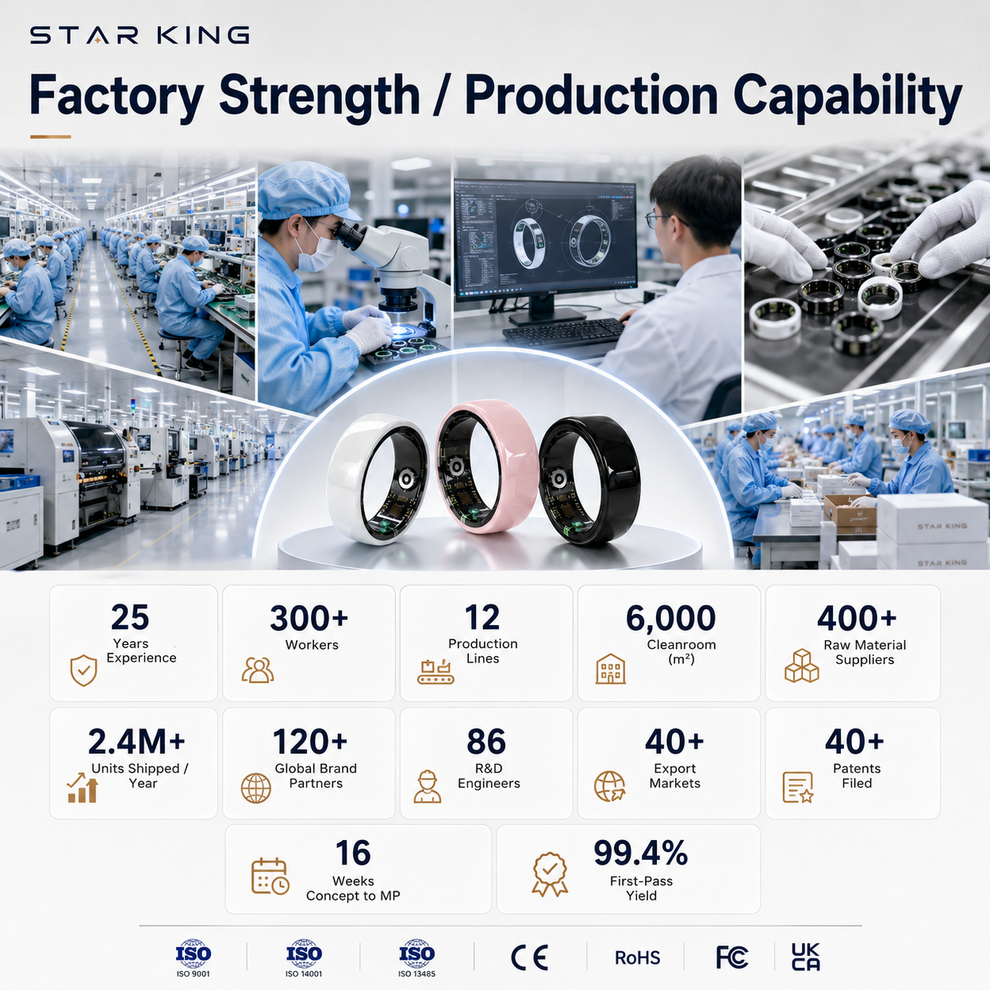
Not all smart band manufacturers are equipped to serve system integrators. Assess each potential supplier’s capabilities in three areas:
- Manufacturing scale: Does the factory have lines dedicated to smart wearables? What is their monthly output?
- OEM/ODM experience: Have they produced private-label smart bands for other brands? Can they handle hardware modifications or full ODM design?
- Quality and compliance: Do they have ISO 9001, CE, FCC, RoHS, and other relevant certifications? Are they willing to provide test reports?
Request a supplier profile and a list of existing clients (if allowed). For EU system integrators, a supplier that has shipped to Europe is preferable because they understand export and compliance requirements.
Step 3: Specify Hardware and Firmware Customization
Your RFQ must detail the level of customization you expect. Typical options include:
- Logo customization: Branding on the band strap, charging dock, and app splash screen.
- Firmware customization: Adjusting algorithms, adding specific sensor algorithms, or modifying power management.
- App customization: White-labeling the companion app, changing the UI, or integrating with your API.
For system integrators, firmware and app integration are critical. Ensure the supplier offers API documentation and developer support. Ask whether they provide SDKs for iOS and Android, and if they can support a custom API to pull data into your backend.
Step 4: Validate EU Compliance and Certification
EU market access requires conformity with specific directives. While the supplier should provide documentation, it is your responsibility to verify compliance for your target market.
Key certifications to request from your supplier:
- CE marking: Essential for most electronic products.
- RoHS compliance: Restriction of hazardous substances.
- REACH compliance: For chemical safety (though usually covered by materials declarations).
- Battery regulations: EU Battery Regulation (EU) 2023/1542 requires declarations for batteries in products.
- Radio equipment directive: If the band uses Bluetooth, you may need additional testing.
Ask the supplier for test reports from accredited labs. If the product is not yet certified, confirm whether they can assist with certification for your EU market entry. Note that some certifications may be covered by the manufacturer’s CE declaration, but specific configurations (e.g., custom firmware) might require additional testing.
Step 5: Clarify MOQ, Pricing, and Lead Times
Your RFQ should request detailed pricing based on your expected order volume. Key terms to clarify:
- MOQ: Minimum order quantity per SKU. MOQs for smart bands typically range from 300 to 1,000 units for standard models, but customs might apply.
- Unit price: Provide tiered pricing for different volumes (e.g., 500, 1,000, 10,000 units).
- Lead time: Typical lead time for sample and mass production.
- Shipping: Incoterms (EXW, FOB, DDP), and estimated freight costs.
Be aware that private label customization can increase MOQ and lead time. For system integrators, consider whether you need fully customized firmware or can use standard firmware with API access, which may reduce costs and time.
Step 6: Plan Packaging and Branding
Packaging is often overlooked but can affect import customs and brand perception. Define:
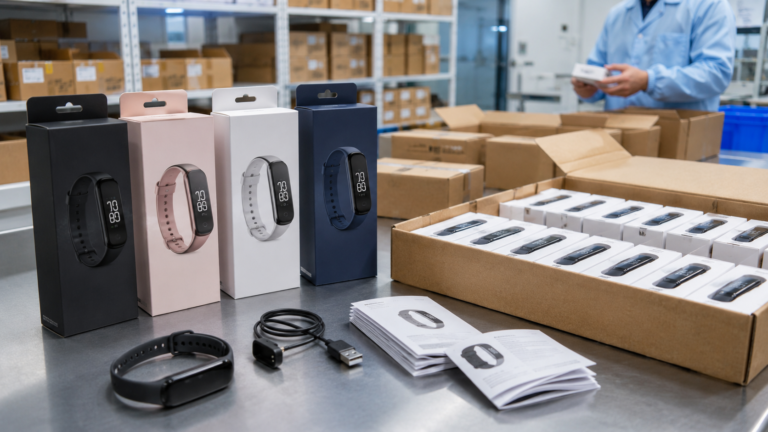
- Retail vs. bulk packaging: If you distribute to end-users, retail boxes may be required. For internal integration projects, bulk packaging may suffice.
- Language requirements: EU requires multiple language labels (e.g., English, French, German) for warnings and instructions.
- Custom logo: Logo placement on the band and packaging.
Request packaging samples during the sample phase to ensure they meet your system’s quality standards and comply with EU labeling.
Step 7: Establish Quality and Post-Sales Support
Reliability is non-negotiable for system integrators. Your RFQ must include quality requirements and post-sales support:
- Quality control: Request a pre-shipment inspection (PSI) report. Ask about failure rates and how they handle defective units.
- Warranty: Typical warranty is 12 months. Confirm replacement policy for defective bands.
- Technical support: Will the supplier provide developer support during integration? For how long?
- Firmware updates: Are updates provided and for how long?
These terms should be included in your RFQ and contract to protect your project continuity.
Common Mistakes to Avoid
- Sending an RFQ without a clear product spec – this leads to ambiguous quotes.
- Ignoring EU compliance until after purchase – costly re-engineering.
- Focusing only on unit price and forgetting total landed cost (shipping, duties, certification).
- Assuming all suppliers can provide an open API – confirm in advance.
- Skipping the sample evaluation phase, especially for customized hardware.
Practical Buyer Checklist
- Define system-level requirements (sensors, battery, connectivity, data integration).
- Shortlist suppliers with proven smart band OEM/ODM experience.
- Request detailed quotation including MOQ, pricing tiers, lead time, and incoterms.
- Verify EU compliance documents (CE, RoHS, REACH, battery regulations).
- Ask for evaluation samples to test hardware, firmware, and app.
- Clarify customization scope: logo, firmware, app, API.
- Specify packaging and labeling requirements for EU market.
- Include quality control and warranty terms in the RFQ.
- Calculate total landed cost including import duties and logistics.
- Plan for post-sales support and firmware updates.
Frequently Asked Questions
1. What is the typical MOQ for smart bands for an OEM project?
MOQs vary by manufacturer and customization level. Standard models may have MOQs around 300–500 units, while custom firmware or branding could increase it to 1,000 units. Confirm with your supplier.
2. How do I verify a smart band is CE compliant?
Ask the supplier for the CE certificate and test reports from an accredited lab. Verify that the product meets applicable directives (EMC, RED, LVD, RoHS). For custom configurations, additional testing may be needed.
3. Can I use my own mobile app with a white-label smart band?
Yes, if the supplier offers app customization or provides an open API. You can also use their white-label app and customize the branding. Discuss integration options during the RFQ stage.
4. How long does it take to develop a custom firmware version?
Firmware customization can take 4–8 weeks depending on complexity. Simple changes like algorithm tweaks may be faster. Plan your timeline accordingly.
5. What are the key differences between a smart band and a smart ring for system integration?
Smart bands are larger and offer more battery life, easier sensor placement, and simpler UI. Smart rings are more discreet but have limited battery and sensor space. Choose based on your user’s needs and wearability.
6. What import duties apply to smart bands entering the EU?
Smart bands are typically classified under HS code for radio devices, with duties around 0-4.5%. VAT applies at the country rate (e.g., 20% in many EU states). Confirm with your customs broker.
7. How do I ensure my supplier can handle quality issues during production?
Require a pre-shipment inspection by a third party and agree on acceptable defect rates in your contract. A supplier with ISO 9001 and experience with EU markets is preferable.
Conclusion
For system integrators in the EU, issuing an effective smart bands RFQ is the first step to a successful deployment. By following this 7-step checklist, you can avoid common pitfalls, secure a compliant and technically sound product, and establish a reliable supply chain. The key is to invest time upfront in defining your system requirements and vetting suppliers thoroughly.
When you are ready to move forward, compare specifications, request samples, and confirm certification documents. A well-structured RFQ not only saves time but also builds a foundation for a long-term partnership with a manufacturer that understands your needs.
Ready to issue your smart bands RFQ? Contact STAR KING to discuss your OEM/ODM project, request samples, or confirm EU compliance requirements for your target market.
Buyers can also review STAR KING Smart Bands OEM/ODM options to compare product positioning, customization scope, and sample planning.
Useful Official References for Buyers
- FCC equipment authorization guidance
- European Commission CE marking information
- Bluetooth SIG specifications
Discuss Your Smart Wearable OEM/ODM Project
Planning a smart ring, smart watch, smart band, AI glasses, AI translator, or AI voice mouse project? Contact STAR KING to discuss product positioning, sample testing, customization scope, certification requirements, lead time, and quotation details.

Team Star King

Scan WhatsApp QR code