
Smart Bands for Corporate Wellness in the EU: 7 Procurement Steps for 2026
Smart Bands for Corporate Wellness in the EU: 7 Procurement Steps for 2026
Smart bands for corporate wellness are wearable devices procured in volume to support employee wellbeing programs, typically with fleet management, anonymous health data reporting, and brand customization. For EU procurement teams, the buying decision in 2026 depends on four factors: CE-RED and GDPR compliance, realistic MOQ and lead times, verified pilot testing, and a total cost model that includes app, logistics, and service. This guide gives you a seven-step RFQ process, a vendor scoring matrix, and the paperwork to request before you issue a purchase order.
Table of Contents
Table of Contents
smart bands for corporate wellness: Short Answer
Source smart bands for corporate wellness in the EU by defining program outcomes, shortlisting CE-compliant suppliers, testing a 20-50 unit pilot for battery and app behavior, confirming GDPR-compliant data handling, and locking MOQ, tooling, lead time, and warranty terms in the RFQ. Require CE RED, RoHS, battery safety documents, and MSDS before mass production, and stage rollout by department to control duty, VAT, and reverse logistics.
Table of Contents
- Why EU Procurement Teams Are Re-Evaluating Smart Bands in 2026
- Key Takeaways
- What Buyers Should Evaluate Before Choosing a Vendor
- Step 1: Define Program Outcomes and Device Specs
- Step 2: Build the RFQ Package
- Step 3: Verify OEM/ODM and Private Label Capability
- Step 4: Run a Measurable Pilot
- Step 5: Map Compliance and Battery Documentation
- Step 6: Confirm Pricing, Landed Cost, and Total Cost of Ownership
- Step 7: Lock Production, Logistics, and Deployment
- Comparison Table: Smart Bands vs Smart Watches vs Smart Rings
- Vendor Scoring Matrix
- Common Mistakes and Buyer Red Flags
- Practical Buyer Checklist
- FAQ
- Conclusion
- STAR KING CTA
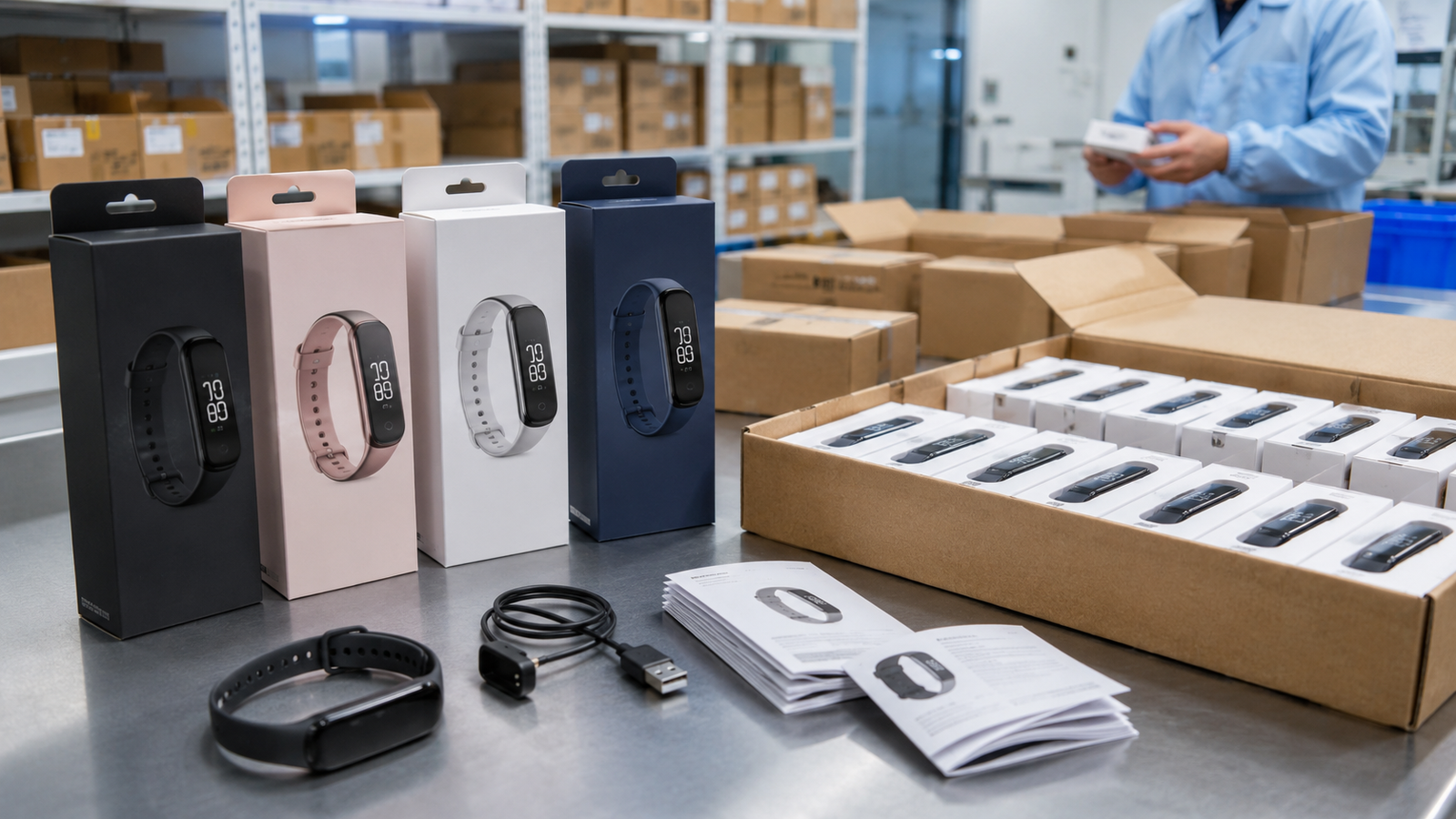
Key Takeaways
- EU corporate procurement should treat smart bands as a managed service, not a one-time hardware purchase: app hosting, data policy, and support drive long-term cost.
- CE marking for smart bands usually involves RED, RoHS, and WEEE; battery-powered wearables typically add UN38.3 and MSDS for air freight.
- GDPR handling of employee health data is frequently the gating item for EU legal sign-off, ahead of price.
- MOQ, lead time, and tooling are negotiable with the right supplier; expect flexibility on common designs and less on fully custom PCBs.
- Pilot 20-50 units before mass production to validate app stability, battery drain, sleep tracking accuracy in your workforce, and reverse logistics.
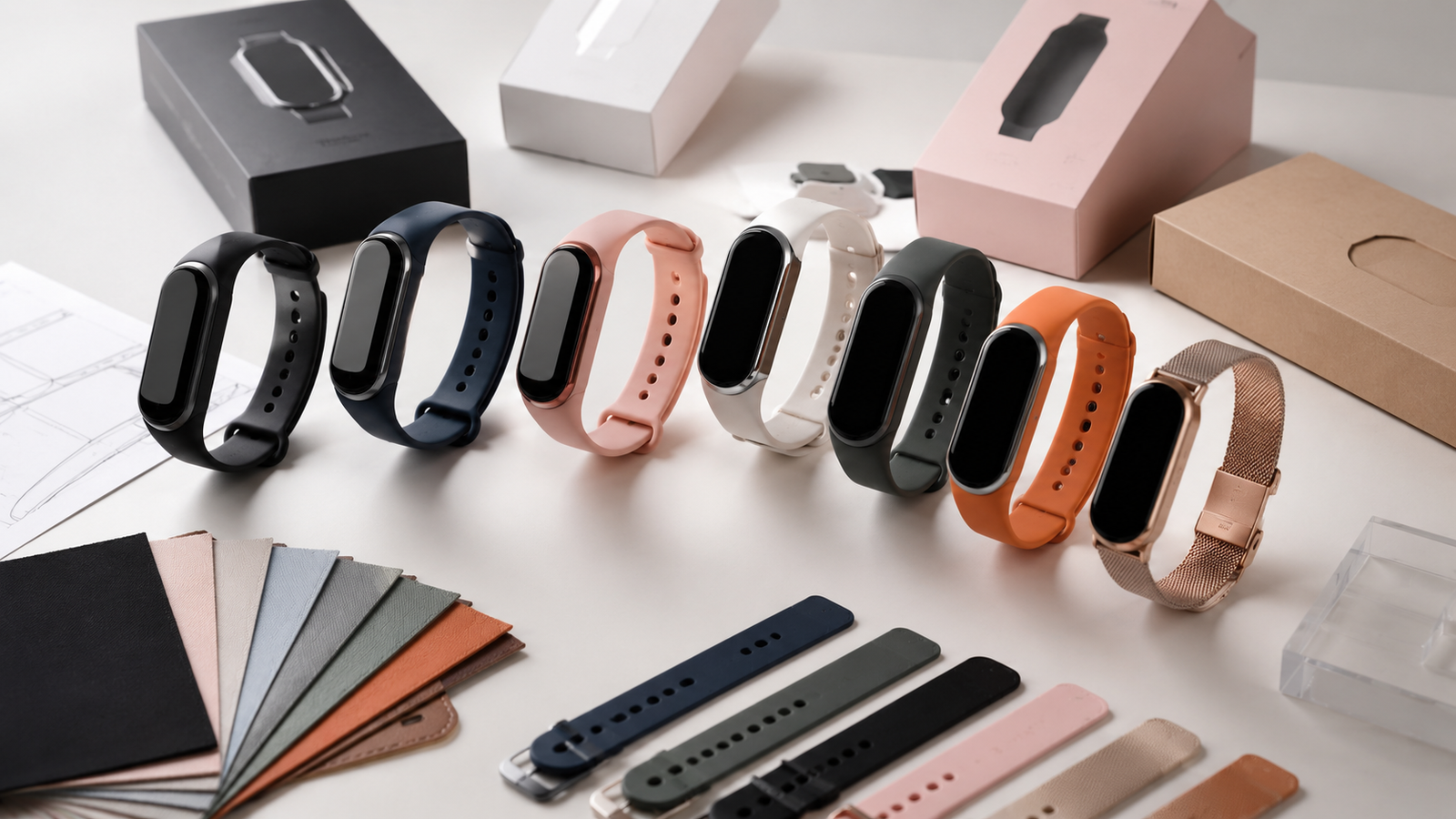
Key Facts for Buyers
| Decision Area | What to Verify | Why It Matters for RFQ |
|---|---|---|
| Compliance | CE (RED, RoHS, WEEE), battery documentation | Required for EU import and air freight |
| Data Protection | GDPR roles, consent flow, data residency | Legal sign-off for employee health data |
| MOQ | Standard vs custom, color, packaging | Drives landed cost and pilot feasibility |
| Lead Time | Sample, tooling, mass production, freight | Sets program rollout date |
| Sensors | PPG, SpO2, motion, water resistance | Matches program use case |
| App | Fleet management, anonymization, SSO | Reduces admin effort and privacy risk |
| Warranty | Terms, spares, RMA process | Protects multi-year TCO |

Why EU Procurement Teams Are Re-Evaluating Smart Bands in 2026
Three shifts are pushing smart bands for corporate wellness up the procurement agenda. First, EU employers face increasing expectations around psychosocial risk and preventive health programs, which makes anonymized activity and sleep data more actionable than one-off wellbeing days. Second, wearable hardware has matured: optical heart-rate and SpO2 sensor modules are widely available, and battery life on mainstream bands has improved, making multi-month programs realistic. Third, cost pressure on HR budgets has made bands more attractive than watches for large employee populations, because they typically cost less per unit and are easier to deploy at scale.
At the same time, EU buyers face stricter scrutiny. Procurement, legal, IT security, and works councils may all review a wearable program. That means the RFQ must answer questions about data flow, accessory disposal, battery transport, and support — not just device price. If you have not yet compared form factors, our overview of smart bands for corporate deployment outlines sensor and battery trade-offs that matter at scale.
What Buyers Should Evaluate Before Choosing a Vendor
Evaluating a smart band supplier for a corporate wellness program is different from buying consumer electronics. You are assessing a partner who will support firmware updates, app administration, spare parts, and compliance documentation across a 2-4 year device lifecycle.
Start by separating mandatory requirements from preferences. Mandatory items usually include CE marking documentation, battery safety test reports, MSDS, a stable app with fleet features, warranty, and the ability to ship to multiple EU countries. Preferences include custom colors, logo engraving, packaging inserts, and integration with existing HR or wellbeing platforms.
Then ask whether the supplier is a trading company or a manufacturer. Manufacturer verification matters because it affects tooling ownership, firmware customization, production scheduling, and the speed of corrective actions. A supplier that controls its own assembly can respond faster to a battery drain issue found during pilot testing.
Finally, check the supplier’s experience with corporate programs rather than only retail SKUs. Corporate buyers need packaging that can be kitted per employee, app onboarding at scale, and support SLAs. These requirements are often not visible in a standard product catalog, so ask directly and request evidence. [STAR KING TO CONFIRM: specific corporate program references, SLA terms, and app fleet-management features available at the time of the RFQ.]
Step 1: Define Program Outcomes and Device Specs
Start with the outcome, then the hardware
Define what success looks like before writing specs. Common outcomes include increased daily step counts, improved sleep consistency, reduced sedentary time, or higher participation in company challenges. Each outcome points to a different sensor and app feature set.
- Activity and step challenges: accelerometer accuracy, battery life, leaderboard features.
- Sleep and recovery programs: optical heart rate, SpO2 where appropriate, sleep staging.
- Stress and mindfulness: heart-rate variability trends and guided content.
- Vital-sign self-checks: heart rate and SpO2 trends, clearly presented as wellness data, not diagnosis.
Write measurable acceptance criteria
Translate outcomes into testable specs: battery life under defined usage, sync reliability over Bluetooth, water resistance rating for the intended environment, and app data refresh intervals. Acceptance criteria protect you at factory acceptance testing and pre-shipment inspection.
Decide what to customize
Corporate buyers often need logo printing, custom packaging, and a co-branded app experience. Decide early whether you need Private Label (logo, packaging, app skin) or ODM (fully custom industrial design). This choice drives MOQ, tooling, and lead time. Our Private Label OEM/ODM program details the customization tiers available to corporate buyers.
Step 2: Build the RFQ Package
A complete RFQ prevents comparison problems and forces suppliers to respond in a standard format. Include the following sections.
- Program scope: headcount, countries, rollout waves, target launch date.
- Device requirements: form factor, sensors, battery life, water resistance, display type.
- App requirements: fleet onboarding, anonymized reporting, SSO, data residency, export controls.
- Compliance: CE RED, RoHS, WEEE, battery documents, MSDS, packaging materials.
- Commercial: MOQ by SKU and customization level, unit price tiers, tooling NRE, payment terms.
- Logistics: incoterms, EU customs documentation, air freight battery rules, drop-ship or bulk.
- Service: warranty length, RMA process, spare parts, firmware update policy.
Ask suppliers to quote three scenarios: standard SKU with logo and packaging, Private Label configuration, and light ODM modification. These three quotes reveal where cost actually comes from and make negotiations more transparent.
Include a data protection annex. Even if your organization handles the app hosting, the supplier’s default cloud configuration matters. Specify whether health data can leave the EU, who is the data controller and processor, and how consent is captured. General GDPR obligations are described by the European Commission, and buyers should map these to the supplier’s app architecture.
Step 3: Verify OEM/ODM and Private Label Capability
Manufacturer verification is where many RFQs stall. Use a consistent set of checks.
Factory and process checks
- Request the manufacturing license or business registration and the factory address.
- Ask for an assembly line walkthrough video or an on-site/remote audit slot.
- Confirm which components are sourced externally (for example, sensor modules) and which are produced in-house.
- Review the testing setup: aging, drop, waterproof, and functional tests.
Customization capability checks
- Firmware: can the supplier adjust branding screens, challenge logic, and update channels?
- App: is it a licensed white-label app or a proprietary platform with an admin console?
- Packaging: can kits be built per employee, per department, or per country?
- Tooling ownership: if custom tooling is developed, who owns it, and what happens at end of program?
Ask for a capability statement and confirm uncertain items in writing. Placeholders such as [STAR KING TO CONFIRM: customization tiers, app admin features, and tooling ownership terms] should be replaced by confirmed terms before you sign.
Step 4: Run a Measurable Pilot
A pilot is not a demo. It is a controlled test with acceptance criteria. Run 20-50 units across a representative employee group for 3-4 weeks.
| Pilot Area | What to Measure | Pass Criteria (Example) |
|---|---|---|
| Battery | Days between charges under normal use | Meets supplier-stated range for 90% of units |
| Sync | Failed syncs per user per week | Below agreed threshold |
| Comfort | Wear time, skin irritation reports | High wear compliance, no material issues |
| Data quality | Step and sleep data plausibility | Consistent with expected ranges |
| App UX | Onboarding time, support tickets | Onboarding under target minutes |
| Reverse logistics | Return and exchange handling time | Within agreed SLA |
Document issues with photos and logs. Send a consolidated defect report to the supplier and request a corrective action plan with dates. This becomes the baseline for pre-shipment inspection and factory acceptance testing. For background on consumer-grade heart-rate and SpO2 measurement limitations, refer to the FDA medical device resources, which clarify the difference between wellness monitoring and regulated medical devices.
Step 5: Map Compliance and Battery Documentation
For EU deployment, compliance is usually the longest lead item. Build a document matrix and assign an owner for each line.
Core EU market documents
- EU Declaration of Conformity and CE marking. Radio-equipped smart bands typically fall under the Radio Equipment Directive; confirm the specific product configuration.
- RoHS and WEEE compliance statements.
- Battery-transport documents: UN38.3 test summary and MSDS for lithium cells.
- REACH documentation for materials of concern where applicable.
Data and privacy documents
- Data processing agreement with the app provider.
- Consent text and privacy notice for employees.
- Data flow diagram showing hosting locations and sub-processors.
Certification requirements depend on frequency bands, battery chemistry, and final product configuration. Buyers should verify each certificate against the exact SKU and factory name. Do not assume that one band model’s certificate covers another. Our overview of health and fitness wearable solutions outlines typical compliance questions to raise with suppliers.
Step 6: Confirm Pricing, Landed Cost, and Total Cost of Ownership
Unit price is rarely the dominant cost in a corporate wellness rollout. Build a landed cost and TCO model that includes:
- Device unit price at each volume tier.
- Logo and packaging costs.
- Tooling or NRE, if applicable.
- Freight, EU duty, VAT, and customs brokerage.
- App licensing or hosting.
- Deployment, kitting, and onboarding labor.
- Warranty, spares, and reverse logistics.
Request a price validity window and clarify how changes in battery cells or sensor modules affect pricing. For long programs, ask about price protection clauses and spare-part availability.
If you are building a multi-country rollout, a short technical call can clarify which configurations reduce landed cost without compromising compliance. You can discuss your corporate wellness requirements with our team before issuing a formal RFQ.
Step 7: Lock Production, Logistics, and Deployment
Once pilot results and compliance documents are accepted, freeze the configuration and issue the production PO with the following attachments:
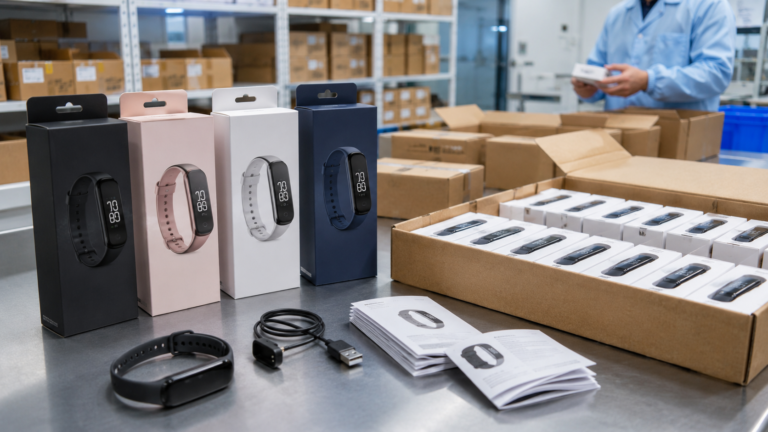
- Approved golden sample with photos and serial number.
- Final packaging artwork and kitting instructions.
- Pre-shipment inspection plan and AQL levels.
- Firmware version and update policy.
- Warranty terms, RMA process, and spare-part list.
- Delivery schedule by wave and destination.
Plan the rollout in waves by country or department. Staged deployment reduces customs surprises, eases support load, and allows a second quality check on the first production batch. Keep a portion of the budget for a second batch to cover new hires and replacements.
Comparison Table: Smart Bands vs Smart Watches vs Smart Rings
| Factor | Smart Bands | Smart Watches | Smart Rings |
|---|---|---|---|
| Typical unit cost | Lower | Higher | Mid to high |
| Screen | Small, limited | Larger, richer | None |
| Battery life | Often multi-day | Often shorter | Often multi-day |
| Fit for large populations | Strong | Moderate | Requires sizing |
| Sleep comfort | Good | Bulky for some users | Very good |
| Program messaging | Clear, visible | Premium perception | Discreet |
For most corporate wellness programs with hundreds or thousands of employees, bands offer the best balance of cost, battery life, and simplicity. Watches suit leadership or premium wellness tracks. Rings suit sleep-focused or discreet programs, though sizing logistics add complexity. If sleep quality is a core metric, see our application notes on sleep and recovery tracking.
Vendor Scoring Matrix
| Criteria | Weight | Score 1-5 | Weighted Score |
|---|---|---|---|
| EU compliance documentation | 20% | ||
| GDPR and app data handling | 15% | ||
| Pilot results and responsiveness | 15% | ||
| Manufacturing and QC evidence | 15% | ||
| MOQ, price, and landed cost | 15% | ||
| Lead time and logistics | 10% | ||
| Warranty and after-sales | 10% |
Common Mistakes and Buyer Red Flags
Common mistakes
- Choosing hardware before defining program outcomes.
- Accepting a supplier’s compliance summary without checking SKU-level certificates.
- Running a pilot without measurable acceptance criteria.
- Ignoring app hosting costs and data residency until legal review.
- Underestimating kitting, onboarding, and reverse logistics labor.
Buyer red flags
- Supplier cannot explain who manufactures the sensor module or battery.
- Certificates list a different factory or model than the quoted SKU.
- No clear RMA or spare-part process.
- App vendor cannot provide a data processing agreement.
- Price changes without explanation after MOQ is discussed.
- Reluctance to provide a golden sample or allow inspection.
Practical Buyer Checklist
- Program outcomes and acceptance criteria documented.
- RFQ package issued with data protection annex.
- Manufacturing and customization capability verified.
- Pilot completed with defect report and corrective actions.
- CE, RoHS, WEEE, UN38.3, and MSDS documents reviewed per SKU.
- GDPR roles, consent, and data residency confirmed by legal.
- Landed cost and TCO model approved by finance.
- MOQ, tooling, lead time, and warranty locked in the PO.
- Pre-shipment inspection plan and AQL levels agreed.
- Rollout waves, kitting, and support SLA defined.
FAQ
What certifications do smart bands for corporate wellness need in the EU?
Radio-equipped bands typically require CE marking under the Radio Equipment Directive, plus RoHS and WEEE compliance. Battery-powered devices usually need UN38.3 and MSDS for transport. Requirements depend on the exact configuration and target countries, so buyers should verify SKU-level certificates.
How does GDPR apply to employee health data from smart bands?
Health data is a special category under GDPR, so programs typically need a lawful basis and explicit consent, plus controls on hosting location and access. Employers should involve legal early and confirm the supplier’s data processing agreement.
What is a realistic MOQ for customized smart bands?
MOQ depends on the customization level: logo and packaging generally require smaller volumes than custom PCBs or enclosures. Buyers should ask for MOQ by SKU and by customization tier, and request a pilot allocation within the RFQ.
How long does a corporate wellness smart band rollout take?
Plan for 2-4 weeks of pilot testing, 2-4 weeks for compliance review, and production lead time that varies by customization. Buyers should request a dated schedule with sample, tooling, mass production, and freight milestones.
Are smart bands medical devices?
Most corporate wellness bands are consumer devices, not regulated medical devices. Heart rate and SpO2 features are wellness indicators and should not be presented as diagnosis. Buyers should confirm intended use and labeling with legal and regulatory advisors.
How should we handle spare parts and warranty across multiple EU countries?
Define warranty length, RMA process, and a spare-part list in the supply agreement. A regional depot or local service partner can reduce shipping time and cost compared with returning every unit to the factory.
What should be in the pre-shipment inspection plan?
Include AQL sampling, functional testing, battery and charging checks, packaging and kitting verification, and photo documentation. Align the plan with your pilot defect report so known risks are specifically checked.
Conclusion
Procuring smart bands for corporate wellness in the EU is a cross-functional project. The device is only one part of the equation; compliance, data protection, app administration, pilot testing, and reverse logistics determine whether the program survives its first year. A disciplined seven-step RFQ process — outcomes, RFQ package, vendor verification, pilot, compliance mapping, cost model, and production lock — gives procurement teams a defensible decision and a rollout plan that legal and finance can approve. Start with the requirements that are hardest to change later: data handling, certification, and form factor.
STAR KING CTA
STAR KING supplies smart bands and other wearables for OEM, ODM, and Private Label programs, with support for corporate buyers on specification, customization, and compliance documentation. To receive an RFQ-ready proposal, request a quotation and include your target headcount, countries, customization level, and required documentation.
Discuss Your Smart Wearable OEM/ODM Project
Planning a smart ring, smart watch, smart band, AI glasses, AI translator, or AI voice mouse project? Contact STAR KING to discuss product positioning, sample testing, customization scope, certification requirements, lead time, and quotation details.

Team Star King

Scan WhatsApp QR code