AI Voice Mouse for System Integrators: 7 Critical Questions Before Middle East Deployment
AI Voice Mouse for System Integrators: 7 Critical Questions Before Middle East Deployment
An AI voice mouse is a hybrid input device that combines a conventional wireless computer mouse with a microphone array, onboard voice processing, and speech-to-text or voice-command software. For system integrators, it is an evaluation-stage hardware component: you are deciding whether it can be reliably deployed across public-sector offices, corporate campuses, and smart workspaces in the Middle East. The main risks are language coverage (Modern Standard Arabic and Gulf dialects), software integration with existing endpoints, compliance documentation, and consistent supply at the volume your projects require.
Table of Contents
Table of Contents
This guide is written for integrators preparing bids in the UAE, Saudi Arabia, Qatar, and neighboring markets. It gives you a structured way to evaluate an AI voice mouse before you commit to a pilot, a purchase order, or a multi-site rollout, and it flags the questions you should send to any manufacturer before samples are shipped.
Short Answer
A deployable AI voice mouse for Middle East integration projects should support Modern Standard Arabic plus major Gulf dialects, integrate with your endpoint management and application stack, ship with clear regional compliance documentation, and come from a manufacturer that can hold a stable BOM across repeat orders. Evaluate language accuracy by live demo, not by spec sheet alone.

Table of Contents
- What Is an AI Voice Mouse and Why It Matters for Integrators
- Key Takeaways
- Key Facts for Buyers
- 7 Critical Questions Before You Deploy
- Comparing Integration-Ready vs Consumer-Grade Devices
- Common Mistakes System Integrators Make
- Practical Buyer Checklist
- FAQ
- Conclusion

What Is an AI Voice Mouse and Why It Matters for Integrators
An AI voice mouse is a peripheral that fuses a pointing device with an always-available voice input layer. Instead of treating voice as a separate dictation tool, it lets end users dictate, run commands, or trigger workflows directly from the device they already hold. For integrators, this matters because it reduces training time, keeps users in a single input context, and can be deployed without replacing existing computers—provided the software side is compatible.
In the Middle East, the business case is amplified by bilingual government services, healthcare front desks, legal and financial documentation, and multilingual customer support. A mouse that handles Arabic and English smoothly can improve accessibility and documentation throughput in exactly the environments where integrators win contracts. The relevant reference points are not marketing pages but standards: the Bluetooth SIG qualification process for wireless connectivity, and the USB Implementers Forum for wired and dongle-based connection. Each of these has documentation implications you should request from the factory.
If your present focus is voice-only hardware, a natural comparison is a dedicated AI translator device for multilingual environments; if the project also touches meeting-room AV, review the broader AI office productivity hardware solutions before you lock a single-device strategy.
Key Takeaways
- Language coverage is the single most important evaluation criterion for Middle East deployments—Modern Standard Arabic and at least one Gulf dialect should be demonstrated live.
- Software integration (driver behavior, SDK, endpoint compatibility) typically determines rollout cost more than unit price.
- MOQ, warranty, and spare-parts planning should be agreed before pilot units are ordered.
- Request compliance documentation for the specific configuration you will import; certifications are configuration-dependent.
- Ask the factory for an OEM/ODM path only if you expect to differ from catalog hardware, and confirm tooling and firmware ownership in writing.
Key Facts for Buyers
| Item | What to Verify | Why It Matters |
|---|---|---|
| Arabic language | Live demo of MSA + Gulf dialect accuracy | Reduces user frustration and support tickets |
| Integration mode | Driver package, SDK/API, OS compatibility | Determines deployment labor and scope |
| Connectivity | Bluetooth version, 2.4GHz dongle, USB-C | Impacts device imaging and endpoint policy |
| Compliance | CE/FCC/RoHS, regional import docs | Needed for customs clearance and tenders |
| MOQ | Base MOQ vs customization-tier MOQ | Controls pilot vs full-rollout cost |
| Lead time | Samples, first order, repeat order | Aligns with project delivery windows |
| Warranty & spares | RMA terms and replacement supply | Protects multi-year service contracts |
7 Critical Questions Before You Deploy
1. Does the AI voice mouse actually handle Arabic, or only English?
Ask for a live demonstration across Modern Standard Arabic and at least one Gulf dialect. Test with real sentence structures you will encounter in the client environment—names, addresses, technical terminology, and numerals. Some AI voice mouse platforms rely on cloud speech engines that can vary by region; others do local processing. The verification method is simple: bring three scripts from your end-client’s workflows and run them yourself, not through a sales demo.
2. How does the device integrate with existing endpoints?
Deployment cost usually sits in software, not hardware. Ask which operating systems are supported, whether installation requires admin rights, whether there is an enterprise deployment package, and whether the configuration can be pushed through common MDM tools. If a software development kit is available, request its documentation and licensing terms. For a broader view of where voice hardware fits into office workflows, the AI voice mouse product page outlines the baseline feature set to compare against your requirements.
3. What is the realistic accuracy under office conditions?
Accuracy depends on microphone array design, acoustic environment, and software model. Ask the manufacturer how the device performs in open-plan spaces, near HVAC noise, and with multiple speakers. Request test data if available; where data is not available, plan a controlled pilot. Buyers should verify rather than assume, because noise conditions in Middle East offices vary widely between government buildings and co-working spaces. General safety assessment principles can be cross-checked against FCC RF exposure guidance where the device includes wireless transmitters.
4. What OEM or ODM options are available, and at what MOQ?
If your bid requires branded packaging, custom firmware, or a modified enclosure, model the difference between catalog purchase and OEM development early. Typical OEM scopes include logo printing, packaging design, firmware screen strings, and application behavior. MOQ often rises with each customization layer, and tooling costs may apply for enclosure changes. The private label OEM/ODM solutions page gives a structured view of what is typically customizable versus fixed.
5. Which compliance documents apply, and for which configuration?
Certification depends on the radio configuration, battery, and target market. For GCC imports, integrate customs and standards requirements into your project plan and request documentation per shipment. Confirm whether the manufacturer holds CE, FCC, and RoHS documentation for the exact SKU you are importing, and whether UN38.3 transport documentation is available if the device ships with a lithium battery. Do not assume that a certification held for one model applies to another—buyers should verify with the manufacturer and, where required, with local authorities.
6. What are the lead times and supply risks?
Ask for sample lead time, first-order production lead time, and expected repeat-order lead time separately. Ask how the manufacturer handles component shortages in the microphone, wireless, or battery supply chain. For multi-site rollouts, a stable BOM across repeat orders matters more than a competitive first quote.
7. What after-sales and spare-parts support is offered?
Service contracts in the Middle East often run for three years or more. Ask about warranty duration, RMA process, replacement units, and whether spare parts can be stocked locally. Confirm the warranty terms in writing before you commit to a rollout, because the operational cost of a failure is usually higher than the device price.
| Evaluation Dimension | High-Risk Answer | Preferred Answer |
|---|---|---|
| Arabic support | “Works with Arabic” with no demo | Live demo with your scripts |
| Integration | Manual installation only | Documented deployment package |
| Compliance | “CE/FCC on all products” | Per-SKU documentation provided |
| MOQ | MOQ not stated until quotation | Published base and custom MOQ tiers |
| Lead time | Single lead time quoted | Sample, first order, and repeat stated |
| Warranty | Verbally stated | Written RMA and spares terms |
If you are comparing AI voice mouse options for a Middle East bid, the fastest way to reduce uncertainty is to test a sample device against your own scripts. You can request samples and confirm configuration details directly with the manufacturer before you finalize the bill of materials.
Comparing Integration-Ready vs Consumer-Grade Devices
Not every AI voice mouse is built for integration projects. Consumer-grade devices prioritize retail features and low unit cost; integration-ready devices prioritize documentation, stability, and support. The comparison below helps you qualify a candidate before you invest engineering time.
| Feature | Consumer-Grade Device | Integration-Ready Device |
|---|---|---|
| Documentation | Quick start guide | Full spec sheet, compliance file, SDK docs |
| Firmware updates | Occasional, unannounced | Scheduled, with release notes |
| Language support | Global default set | Region-specific configuration |
| MOQ flexibility | Retail quantity | Project quantity with tiered pricing |
| Customization | Limited | Logo, packaging, firmware, app |
| Warranty | Standard consumer term | Contract-specific terms |
| Spare parts | Not guaranteed | Stocking plan available |
If your project requires voice-controlled workflows beyond the desktop, compare the AI voice mouse against devices designed for adjacent tasks, such as an AI translator for healthcare settings or a pair of AI smart glasses for field operations. Matching the device to the task is part of the integration value you deliver.
Common Mistakes System Integrators Make
- Evaluating on price alone. The lowest unit price often carries hidden integration, warranty, or spare-parts costs.
- Accepting “supports Arabic” without a demo. Dialect and domain accuracy vary significantly between software stacks.
- Ignoring import documentation. Missing or mismatched compliance files can delay shipments and jeopardize tender timelines.
- Overlooking MDM and endpoint policy. Devices that require manual setup per endpoint can erode project margin.
- Not confirming MOQ tiers. Customization requests made after quotation can change pricing and lead time materially.
- Assuming one SKU’s certification covers another. Certification is configuration-dependent and should be verified per SKU.
Practical Buyer Checklist
- ☐ Run a live Arabic-language demo using three scripts from the end-client workflow.
- ☐ Confirm supported operating systems and deployment method (manual vs managed).
- ☐ Request SDK/API documentation and licensing terms if you plan custom integration.
- ☐ Verify microphone performance in the intended acoustic environment.
- ☐ Obtain per-SKU compliance documentation for the target GCC market.
- ☐ Confirm UN38.3 transport documentation if a lithium battery is included.
- ☐ Agree MOQ for base and customized configurations before quotation.
- ☐ Confirm sample, first-order, and repeat-order lead times.
- ☐ Confirm warranty, RMA, and spare-parts terms in writing.
- ☐ Confirm tooling and firmware ownership if you fund OEM development.
FAQ
What is an AI voice mouse?
It is a computer mouse that combines standard pointing functions with microphone input and speech processing, allowing users to dictate text or trigger voice commands from the same peripheral.
Can an AI voice mouse support Arabic in Middle East deployments?
Many can, but support varies by software stack. Buyers should require a live demonstration of Modern Standard Arabic and relevant Gulf dialects before committing to a pilot or deployment.
What MOQ should a system integrator expect?
MOQ depends on the configuration. Base catalog units usually carry a lower MOQ, while customized firmware, enclosure, or packaging typically raises it. The manufacturer should state both tiers in the quotation.
Which certifications matter for importing into the GCC?
Import requirements depend on the product configuration and destination market. CE, FCC, and RoHS documentation is commonly requested, and lithium-battery products may need UN38.3 transport documentation. Buyers should verify current requirements with the manufacturer and local authorities.
Can an AI voice mouse be integrated with existing enterprise software?
Integration depends on whether the manufacturer provides a software development kit or documented APIs. Request the SDK documentation and licensing terms before planning custom workflows.
How long does OEM customization take?
Timelines vary with the scope of customization. Logo and packaging changes are usually faster than firmware or enclosure changes. The manufacturer should provide a sample timeline and a production timeline separately.
What warranty terms should be negotiated?
Warranty, RMA, and spare-parts terms should be written into the purchase agreement. For multi-year service contracts, confirm replacement-unit supply and expected turnaround before rollout.
Conclusion
For system integrators working in the Middle East, an AI voice mouse is not a decorative peripheral—it is a deployment decision with language, software, compliance, and supply implications. The evaluation process described here helps you qualify a candidate quickly, reduce integration surprises, and protect the margin and reputation of your project.
STAR KING CTA
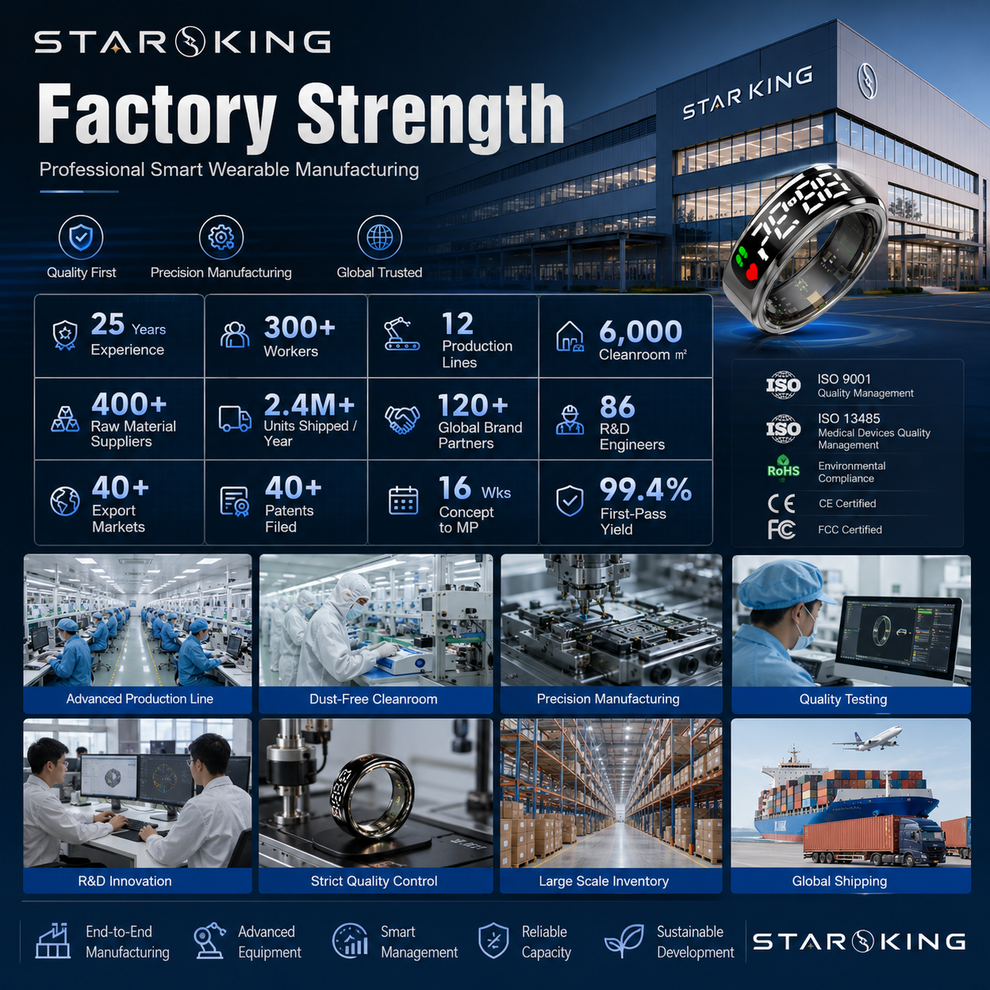
If you are preparing an AI voice mouse deployment for a Middle East project, request samples and confirm your configuration requirements with STAR KING. You can request samples for evaluation and discuss OEM or ODM options with the team before finalizing your bill of materials.
Discuss Your Smart Wearable OEM/ODM Project
Planning a smart ring, smart watch, smart band, AI glasses, AI translator, or AI voice mouse project? Contact STAR KING to discuss product positioning, sample testing, customization scope, certification requirements, lead time, and quotation details.

Team Star King

Scan WhatsApp QR code