
smart ring suppliers: 7 Critical Checks When Selecting a Smart Ring OEM for Healthcare Monitoring Solutions
smart ring suppliers buyers need a supplier evaluation process that checks product fit, OEM/ODM capability, compliance documents, quality control, pricing, lead time, and after-sales support before placing a bulk order.
Table of Contents
Table of Contents
7 Critical Checks When Selecting a Smart Ring OEM for Healthcare Monitoring Solutions
smart ring suppliers: Direct Answer
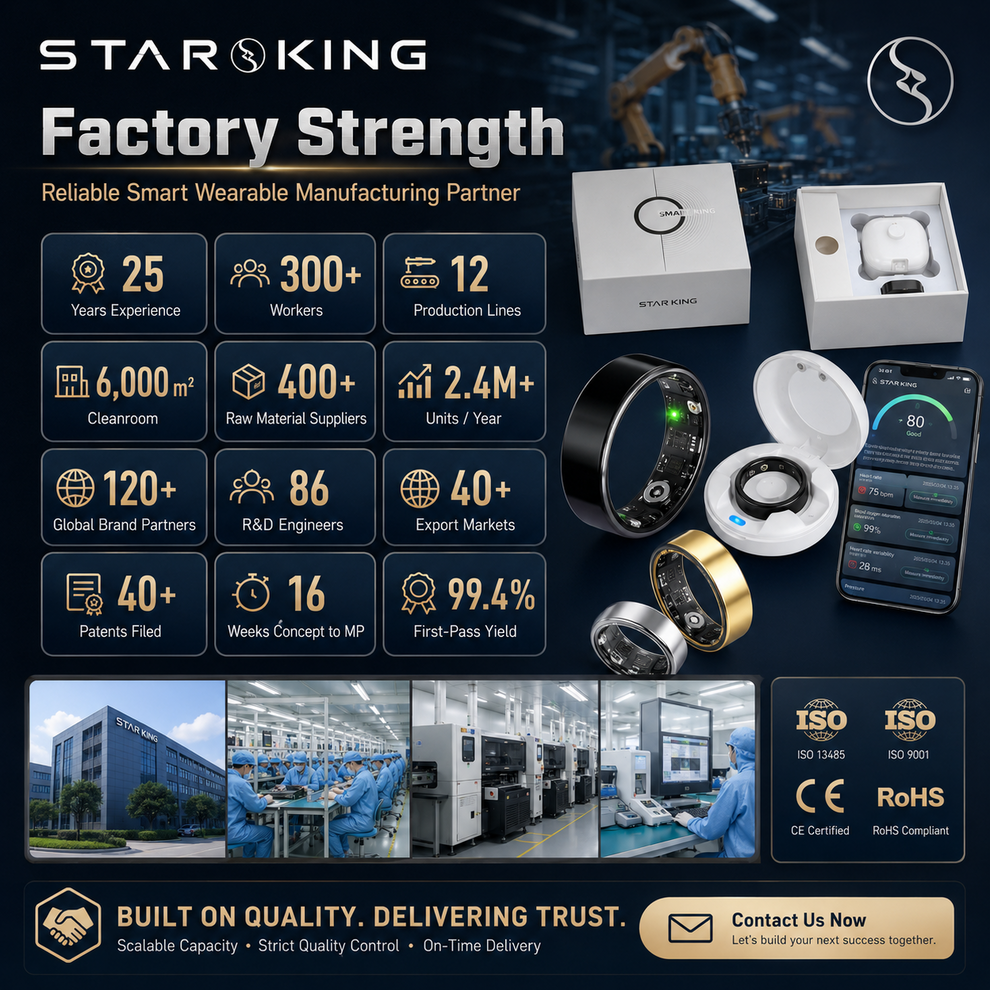
Choosing the right smart ring OEM for healthcare monitoring solutions requires evaluating seven core areas: (1) sensor accuracy and firmware validation, (2) regulatory compliance for target markets, (3) quality control infrastructure, (4) data security and app integration, (5) MOQ and scalability, (6) customization capabilities, and (7) supply chain reliability. Healthcare solution providers should prioritize OEMs with documented testing protocols, flexible customization options, and transparent certification roadmaps. STAR KING supports healthcare providers with OEM/ODM smart ring manufacturing capabilities that can be tailored to specific monitoring requirements. This guide details each check so procurement teams can make informed supplier decisions.

Table of Contents
- Why Healthcare Solution Providers Need a Specialized Smart Ring OEM
- Check 1: Sensor Accuracy and Firmware Validation
- Check 2: Regulatory Compliance and Certifications
- Check 3: Quality Control Infrastructure
- Check 4: Data Security and App Integration
- Check 5: MOQ and Scalability
- Check 6: Customization Capabilities
- Check 7: Supply Chain Reliability
- Key Facts for Buyers
- Common Mistakes and Buyer Red Flags
- Practical Buyer Checklist
- FAQ
- Conclusion
Key Takeaways
- Sensor accuracy and firmware validation are the foundation of any healthcare monitoring smart ring; without reliable data, the device has no clinical or wellness value.
- Regulatory requirements vary by target market and product claims; buyers must verify that the OEM can support the specific certifications needed, such as CE, FCC, or RoHS.
- Quality control processes, including aging tests and waterproof testing, directly impact return rates and user trust.
- Data security and seamless app integration are non-negotiable for healthcare solution providers handling sensitive health data.
- MOQ, lead time, and customization flexibility must align with your business model—whether you are piloting a new product or scaling an existing line.
- Red flags include vague answers about testing protocols, reluctance to share certification documents, and unrealistic MOQ promises.

Why Healthcare Solution Providers Need a Specialized Smart Ring OEM
Healthcare solution providers—whether offering remote patient monitoring, corporate wellness programs, or senior health monitoring—operate in a space where data accuracy, reliability, and compliance are critical. A smart ring is not just a consumer gadget; it is a data collection tool that can influence health decisions. Therefore, selecting a smart ring OEM for healthcare monitoring is fundamentally different from sourcing a fashion wearable.
Unlike general wearable manufacturers, a specialized OEM understands the nuances of health data: the need for consistent heart rate and blood oxygen monitoring, the importance of sleep tracking accuracy, and the ability to integrate with health platforms. They also recognize that different markets have different regulatory expectations for wellness vs. medical claims.
This guide walks through seven critical checks that healthcare solution providers should apply during supplier selection. Each check includes practical evaluation criteria, potential pitfalls, and questions to ask. By the end, you will have a structured framework to compare smart ring OEMs and select a partner that supports your long-term goals.
Check 1: Sensor Accuracy and Firmware Validation
The core value of a healthcare monitoring smart ring lies in its sensors. Heart rate, blood oxygen (SpO2), and sleep tracking depend on optical sensors and accelerometers. But hardware alone is insufficient; firmware algorithms process raw signals into meaningful data. When evaluating a smart ring OEM for healthcare monitoring, ask for validation data on sensor performance.
What to Ask
- What sensor components are used (e.g., photoplethysmography (PPG) sensor model)?
- How is sensor accuracy validated? Is there correlation data against reference devices?
- How often is firmware updated, and can algorithms be customized?
- Are there documented test results for different skin tones and activity levels?
Reputable OEMs will provide test reports or at least describe their validation methodology. Be cautious if an OEM cannot explain how they ensure data consistency. For healthcare applications, even small inaccuracies can erode user trust and affect program outcomes.
Check 2: Regulatory Compliance and Certifications
Regulatory requirements for smart rings depend on the product’s intended use and the target market. If the ring is positioned as a general wellness device, it may not require medical device clearance. However, if it makes medical claims (e.g., detecting arrhythmia), it may be regulated as a medical device. Buyers must verify the OEM’s ability to support the necessary certifications.
Common Certifications
- FCC (United States) for electronic devices
- CE (European Union) for health, safety, and environmental protection
- RoHS for hazardous substances
- UN38.3 for lithium battery transport
- IEC 60601 if the device is classified as medical electrical equipment
Ask the OEM to provide copies of certificates for similar products. Note that certifications are product-specific and may require testing of your final configuration. A smart ring OEM for healthcare monitoring should have experience navigating these requirements and be transparent about which certifications they hold and which require additional testing.

Check 3: Quality Control Infrastructure
Quality control (QC) is where many OEMs differentiate themselves. Healthcare solution providers cannot afford high defect rates or inconsistent performance. Evaluate the OEM’s QC processes from incoming materials to final assembly.
Key QC Areas
- Incoming material inspection: Are sensors and batteries tested before production?
- In-process testing: Is each ring tested for sensor function and battery performance?
- Reliability testing: Do they perform aging tests, drop tests, and waterproof tests?
- Pre-shipment inspection: What is the sampling plan (e.g., AQL)?
Ask for their standard operating procedures (SOPs) and sample inspection reports. A robust QC system reduces returns and protects your brand reputation.
Check 4: Data Security and App Integration
Healthcare data is sensitive. If your smart ring collects health metrics, you must ensure that data transmission and storage meet relevant privacy regulations (e.g., GDPR, HIPAA if applicable). The OEM’s app and cloud infrastructure play a critical role.
Evaluation Points
- Is data encrypted in transit and at rest?
- Does the OEM allow custom app development or integration with your existing platform?
- Can the ring sync with third-party health apps (e.g., Apple Health, Google Fit)?
- What is the process for firmware updates and security patches?
A smart ring OEM for healthcare monitoring should offer app customization or API access, enabling you to control the user experience and data flow.
Check 5: MOQ and Scalability
Minimum order quantity (MOQ) and scalability are practical considerations that can make or break a project. Startup brands and pilot programs need low MOQs, while established distributors may require high-volume production. Understand the OEM’s MOQ policy and how it changes with customization.
Typical MOQs for smart rings range from 500 to 3,000 units, but this varies by OEM and level of customization. Ask about lead time for samples, mass production, and repeat orders. A flexible OEM can grow with your business.
Check 6: Customization Capabilities
Healthcare solution providers often need custom features: specific sensor configurations, branded apps, or packaging that aligns with their program. Evaluate the OEM’s ability to customize hardware, firmware, and software.
Customization Options
- Hardware: ring size, material, color, sensor selection
- Firmware: data sampling rates, algorithm adjustments
- App: white-label app, custom dashboard, integration with your platform
- Packaging: branded boxes, user manuals, accessories
Ask for examples of past customization projects. An OEM experienced in healthcare monitoring will understand the importance of tailoring the device to specific use cases.
Check 7: Supply Chain Reliability
Supply chain disruptions can delay product launches and frustrate customers. Assess the OEM’s supply chain resilience: Do they have multiple suppliers for critical components? How do they manage logistics and inventory? What is their contingency plan for component shortages?
Also consider the total landed cost, including shipping, duties, and taxes. A smart ring OEM for healthcare monitoring should provide transparent cost breakdowns and support efficient logistics, especially for lithium battery shipments which require compliance with UN38.3 and MSDS.
Key Facts for Buyers
| Factor | Typical Range / Consideration |
|---|---|
| MOQ | 500–3,000 units depending on customization |
| Lead Time | Samples: 2–4 weeks; Mass production: 6–10 weeks |
| Certifications | CE, FCC, RoHS, UN38.3 (verify product-specific) |
| Sensor Accuracy | Request validation data against reference devices |
| Data Security | Encryption, GDPR/HIPAA readiness (if applicable) |
| QC Processes | Aging, drop, waterproof, pre-shipment inspection |
| Customization | Hardware, firmware, app, packaging |
Common Mistakes and Buyer Red Flags
Even experienced buyers can overlook critical details. Here are common mistakes and red flags to watch for when selecting a smart ring OEM for healthcare monitoring.
Common Mistakes
- Focusing solely on price and ignoring sensor quality and QC.
- Assuming all smart rings are suitable for healthcare without verifying accuracy.
- Overlooking data security and app integration requirements.
- Not clarifying MOQ, lead time, and customization costs upfront.
- Failing to request certification documents for the specific product configuration.
Red Flags
- OEM cannot provide test reports or explain sensor validation.
- Vague answers about QC processes and certification status.
- Unrealistically low MOQs or prices without clear justification.
- Reluctance to allow third-party inspections or audits.
- No clear process for firmware updates or data security.

Practical Buyer Checklist
- ☐ Request sensor accuracy validation data.
- ☐ Verify certifications for your target market (CE, FCC, RoHS, etc.).
- ☐ Review QC procedures and sample inspection reports.
- ☐ Assess data encryption and app integration options.
- ☐ Clarify MOQ, lead time, and scalability.
- ☐ Evaluate customization capabilities for hardware, firmware, and packaging.
- ☐ Check supply chain reliability and landed cost.
- ☐ Ask for references or case studies (if available).
- ☐ Confirm IP ownership and tooling arrangements.
Buyers can also review STAR KING Smart Rings OEM/ODM options to compare product positioning, customization scope, and sample planning.
FAQ
1. What certifications should a smart ring for healthcare monitoring have?
It depends on the target market and product claims. Common certifications include CE (EU), FCC (US), RoHS, and UN38.3 for battery transport. If the device makes medical claims, additional regulations may apply. Buyers should verify requirements with the OEM and relevant authorities.
2. How can I verify sensor accuracy before ordering?
Request validation reports from the OEM showing correlation with reference devices. Some OEMs may provide sample units for your own testing. Always test with your target user demographic.
3. What is a typical MOQ for customized smart rings?
MOQs vary by OEM and customization level. For standard models, MOQs can be as low as 500 units. Custom hardware or app development may increase MOQ. Discuss your volume plans early.
4. How long does it take to get samples and mass production?
Sample lead time is typically 2–4 weeks. Mass production depends on order size and customization, often 6–10 weeks after sample approval. Confirm timelines with the OEM.
5. Can the OEM integrate the smart ring with my existing healthcare platform?
Many OEMs offer app customization or API access. Discuss your integration needs during supplier evaluation. Ensure data security and compliance are addressed.
6. What are common red flags when evaluating a smart ring OEM?
Red flags include inability to provide test reports, vague QC processes, unrealistic MOQs or pricing, and reluctance to allow inspections.
7. How do I ensure lithium battery shipping compliance?
Smart rings contain lithium batteries, which require UN38.3 testing and MSDS for transport. Verify that the OEM provides these documents and follows IATA regulations.
Conclusion
Selecting a smart ring OEM for healthcare monitoring requires diligence across seven critical areas: sensor accuracy, compliance, quality control, data security, MOQ, customization, and supply chain. By applying the checks and checklist in this guide, healthcare solution providers can reduce risk and build a reliable product. Remember that the right OEM is a partner who understands your clinical or wellness goals and can support your growth.
STAR KING CTA
Ready to evaluate smart ring OEM options for your healthcare monitoring program? Contact STAR KING to discuss your requirements, request samples, or review customization capabilities. Our team can provide detailed specifications, certification documentation, and MOQ information to support your supplier selection process.
Useful Official References for Buyers
- FCC equipment authorization guidance
- European Commission CE marking information
- Bluetooth SIG specifications
Discuss Your Smart Wearable OEM/ODM Project
Planning a smart ring, smart watch, smart band, AI glasses, AI translator, or AI voice mouse project? Contact STAR KING to discuss product positioning, sample testing, customization scope, certification requirements, lead time, and quotation details.

Team Star King

Scan WhatsApp QR code