
AI smart glasses suppliers: AI Smart Glasses for UK Healthcare Providers: 7-Point OEM Buying Guide for 2026
October 4, 2026 · Team Star King

AI smart glasses suppliers buyers need a supplier evaluation process that checks product fit, OEM/ODM capability, compliance documents, quality control, pricing, lead time, and after-sales support before placing a bulk order.
Table of Contents
Table of Contents
AI Smart Glasses for UK Healthcare Providers: 7-Point OEM Buying Guide for 2026
AI smart glasses for UK healthcare providers are wearable devices that combine a camera, microphone and voice or gesture interface, so care teams can capture first-person video, transcribe consultations, and stay hands-free during patient contact. For UK buyers evaluating an OEM partner, the practical question is not whether the technology works. It is whether a specific model can be configured, tested, certified and supported for NHS-adjacent, private clinic or community care workflows. This guide sets out seven sourcing checks: use case and pilot design, OEM/ODM model choice, MOQ and unit economics, sample validation, data protection and cybersecurity, certification and post-market support.
Short Answer
To source AI smart glasses for UK healthcare providers, evaluate a supplier on four things: the ability to configure the device for your care workflow, evidence of UK-relevant compliance, sample testing that mirrors your pilot, and a production plan that matches your rollout. Because AI glasses usually ship with lithium batteries and Bluetooth or Wi-Fi radios, they typically require CE, UKCA, RoHS and UN38.3 documentation. If the device touches patient data, your UK GDPR obligations sit with you as the data controller, not with the manufacturer. Five to ten units for a pilot is a realistic starting point; confirmed production MOQs should be written into the quotation.

Key Takeaways
- AI smart glasses for UK healthcare providers are a workflow tool, not a diagnostic device; wellness or reminder features should not be described as clinical functions.
- Most healthcare buyers start with light customization on an existing ODM platform, then move to deeper firmware and app changes once the pilot proves value.
- UKCA marking is generally required for medical devices on the Great Britain market; CE alone is not always enough. Buyers should verify the exact route with their regulatory advisor.
- MOQ is usually set by tooling, screen or camera modules, battery specification and packaging, not by the final assembly line.
- Samples should be tested on your own network, with your own app permissions, before you commit to production tooling.
- Data protection, cybersecurity and battery testing are the three areas where under-prepared buyers lose the most time.

Key Facts for Buyers
| Decision area | What to confirm with the supplier | Typical UK relevance |
|---|---|---|
| Product configuration | Chipset, camera resolution, display type, audio output and battery capacity | Determines whether the glasses suit hands-free clinical or community care use |
| OEM/ODM model | Branding only, hardware/firmware tweaks, or full custom development | Affects cost, timeline and who owns the tooling |
| MOQ | Pilot quantity, mass-production quantity and packaging minimums | Small pilots are usually possible; production MOQs should be quoted in writing |
| Compliance | UKCA, CE, RoHS, UN38.3, MSDS and, where relevant, FCC for export | Certificates may be product- and market-specific; buyers should verify scope |
| Data and privacy | Where data is stored, encryption, account model, app permissions and audit logging | UK GDPR duties apply to the deploying organisation |
| Quality | Pre-shipment inspection, drop testing, aging testing and waterproof testing | Supports consistent performance across a multi-site rollout |
| Lead time | Sample lead time, tooling time and mass-production window | Typically depends on customization depth and battery sourcing |

What Are AI Smart Glasses for UK Healthcare Providers?
AI smart glasses for healthcare are head-worn devices that add voice control, real-time transcription, image capture or augmented overlays to normal vision. In a UK care setting, the most common evaluation scenarios are remote physician support, community nursing documentation, training and simulation, and assisted-living reminders. The device itself is usually a consumer-grade Android or RTOS platform. The value comes from how the firmware, companion app and back-end are configured for your organisation.
This distinction matters at procurement stage. A supplier may offer the hardware, the app and the cloud service as separate layers. UK healthcare buyers should map each layer to a contract owner and a data-protection role before signing. If the glasses are used to view or record patient information, the deploying organisation is normally the data controller, and the manufacturer is usually a processor. That split should be documented in the supply agreement.
For a wider view of where head-worn and wearable devices fit into care pathways, see our solutions page on health and fitness wearables.
Step 1: Define the Clinical and Operational Use Case
Before requesting a quotation, write a one-page use-case brief. The most useful briefs answer five questions: who wears the glasses, what task they replace or improve, where the data goes, who supports the user, and how success is measured. A remote physician support pilot in a private clinic has very different requirements from a community nursing roll-out across multiple trusts.
Use-case questions that change the specification
- Indoor or outdoor use? Display brightness, contrast and IP rating requirements change significantly.
- One-way or two-way audio? Two-way audio affects battery life, microphone array design and Bluetooth or Wi-Fi configuration.
- Live or recorded? Live streaming needs stable connectivity and may need a bonded device or hotspot policy.
- Shared or personal devices? Shared devices require a robust account and wipe model.
- What is the fallback? If the glasses fail mid-shift, the care team needs a documented alternative.
A clear use case also protects you commercially. Suppliers quote more accurately when the requirement is specific, and you avoid paying for camera or display specifications the workflow does not use.
Step 2: Choose the Right OEM/ODM Model
There are three practical routes for healthcare solution providers: white-label an existing model, request light customization, or commission a deeper OEM/ODM project. Most UK healthcare evaluations begin with light customization because it balances speed, cost and evidence gathering.
White-label or private label
The supplier supplies a standard model with your logo, packaging and app branding. This is the fastest route and the lowest commercial risk. It suits pilot programmes where the priority is proving that the workflow works before investing in custom hardware.
Light customization
You specify firmware behaviour, app screens, onboarding flow, button mapping and packaging. This is usually the best balance for healthcare providers: the underlying hardware is proven, but the user experience matches your care pathway. It also keeps tooling costs low, which matters when pilot volumes are small.
Full OEM/ODM development
Custom enclosure, optics, camera module, battery and firmware. This route offers the strongest differentiation and the longest timeline. It is normally justified when the device is central to a funded service and the expected volume supports tooling investment. Buyers should agree in writing who owns the tooling, the industrial design and any resulting intellectual property.
If you are also considering companion devices, our private label OEM/ODM solutions page outlines how branding, firmware and app customization are typically packaged across a wearable range.
Soft CTA: If you already have a use-case brief, the fastest next step is to compare a standard ODM platform against a light-customization option on the same specification sheet. Requesting samples of both configurations early usually saves weeks later in the project.
Step 3: Understand MOQs and What Drives Unit Price
MOQ in AI smart glasses is rarely a single number. Suppliers typically set separate minimums for sample orders, production runs and custom packaging. Understanding which component drives the minimum helps you negotiate.
Typical MOQ drivers
- Camera and display modules. Specialty optics or high-brightness displays may have component-level minimums.
- Battery specification. Custom battery shape or capacity can require a tooling commitment and additional safety testing.
- Enclosure and tooling. A new housing needs a mould, which is a fixed cost amortised over the production run.
- Packaging. Printed boxes, inserts and regulatory labels have their own print minimums.
- Firmware and app work. Non-recurring engineering (NRE) is usually quoted separately from unit price.
When comparing quotes, ask for the NRE, the unit price at two or three volume bands, the packaging minimum and the sample cost. A low unit price with high NRE is not necessarily cheaper overall. For a broader framework on how these cost components behave across wearable categories, see our AI smart glasses product overview.
Step 4: Plan Sample Testing and Pilot Deployment
Samples are where most healthcare evaluations succeed or fail. Test the glasses the way your team will use them, not the way a showroom demo suggests. A structured sample plan should cover hardware, firmware, app and service layers.
Suggested sample test plan
- Out-of-box setup: how long does pairing and account creation take, and can it be done by non-technical staff?
- Wi-Fi and mobile network behaviour: test on your own network, including weak-signal areas.
- Battery life under realistic load: streaming, transcription and standby.
- Audio quality in noisy environments: clinics and community settings are rarely quiet.
- Comfort over a full shift: weight distribution matters more than total weight.
- App permissions and data flow: confirm exactly what the app requests and where data is sent.
- Firmware update process: can updates be staged and rolled back?
Run the pilot with a small group before wider deployment, and record failure modes, not just success stories. That evidence is what supports a production decision and, if relevant, a future regulatory submission.

Image suggestion: Replace with a pilot image showing a clinician testing AI smart glasses on a ward or in a community care setting. See the image SEO suggestions below.
Step 5: Data Protection, Cybersecurity and UK GDPR
This is the area where healthcare buyers carry the most risk and where general consumer suppliers are often weakest. The UK GDPR and the Data Protection Act 2018 apply to personal data processed in the UK, and patient health data is a special category. Buyers should treat this as a procurement requirement, not a post-launch task.
What to ask before you shortlist a supplier
- Where is data stored or processed, and can it be kept in the UK or EEA?
- Is data encrypted in transit and at rest, and who holds the keys?
- Does the app support role-based access and audit logging?
- What is the account lifecycle when a clinician leaves or a device is reassigned?
- What is the process for a data subject access request or a deletion request?
- How are firmware vulnerabilities reported and patched, and within what timeframe?
If the glasses use a companion app, the app store listing and privacy notice should reflect the actual healthcare context, not a generic consumer description. For official guidance on UK data protection, see the Information Commissioner’s Office (ICO) UK GDPR guidance.
Practical tip: for early pilots, configure the device so that no patient-identifiable data leaves your environment. That reduces the compliance burden while you validate the workflow, and it makes the pilot easier to approve internally.
Step 6: Certification, Compliance and Battery Requirements
Consumers assume certification is automatic. In reality, each product configuration and each target market has its own requirements, and buyers should verify the scope of every certificate against the exact model they intend to buy.
Documentation to request and verify
- UKCA marking for products placed on the Great Britain market, where applicable to the product category.
- CE marking for products placed on the EU market, and where relevant to radio and electrical safety.
- RoHS for hazardous substance restrictions.
- UN38.3 test reports and MSDS for the lithium battery used in the device.
- Radio equipment documentation for Bluetooth and Wi-Fi functions, including RF exposure considerations.
- FCC documentation if the same model will also be sold in the United States.
Two cautions apply here. First, a supplier may hold certification for one configuration but not for the variant you are ordering; ask for the certificate to name the model number you will buy. Second, the regulatory status of a medical device differs from that of a general wellness or AI hardware product. A piece of AI smart glasses marketed for care coordination may not be classified as a medical device, but that classification depends on its intended purpose and on how it is marketed. Buyers should confirm the correct route with their regulatory advisor.
For official reference on medical device regulation and conformity marking, see the UK Government guidance on regulating medical devices in the UK and, where an EU route is involved, the Medical Device Coordination Group (MDCG) guidance. For battery transport requirements, the IATA Dangerous Goods Regulations framework is the standard reference used by air freight carriers.
Step 7: Production Planning, Lead Time and After-Sales Support
Lead time in this category is usually driven by customization depth, battery sourcing and certification review, not by final assembly speed. Ask the supplier to break the timeline into sample, tooling, pilot production and mass production stages.
Timeline planning questions
- What is the confirmed sample lead time after the specification is frozen?
- Is tooling required, and what is the tooling lead time?
- What is the mass-production window for the agreed quantity?
- How are shipping and lithium battery documentation handled?
- What spare parts are recommended for a multi-site rollout?
- What is the warranty period, and how are repairs handled in the UK?
After-sales support is frequently underestimated. A healthcare deployment needs a documented process for RMA, replacement units, firmware updates and spare straps or nose pads. Ask for a sample service-level agreement and confirm who handles returns in the UK versus the manufacturer.
Comparison Table: ODM, Light Customization and Full ODM
| Factor | White-label / Private label | Light customization | Full OEM/ODM |
|---|---|---|---|
| Hardware changes | None | Limited (colour, strap, button mapping) | Enclosure, optics, module selection |
| Firmware / app | Branding only | UI, onboarding, permissions, mapping | Deep changes and back-end integration |
| Tooling cost | None | Low | Significant, usually amortised |
| Typical MOQ | Lowest | Moderate | Highest |
| Timeline | Shortest | Moderate | Longest |
| Best for | Early pilots and brand trials | Healthcare workflow pilots and small rollouts | Funded services needing differentiation |
| IP and tooling ownership | Consultant-supplied | Negotiable | Must be agreed in writing |
Common Mistakes and Buyer Red Flags
Common mistakes
- Buying on price alone. A lower unit price often shifts cost into NRE, packaging or after-sales support.
- Skipping the data-protection review. Patient data questions are easier to answer before contracts than after deployment.
- Accepting a generic certificate. Certificates should name the model you are buying.
- Pilot without a fallback. If the glasses fail, staff need a documented alternative process.
- No firmware update plan. A device without a patching route ages quickly.
- Assuming CE equals UKCA. The two markets have different marking expectations and buyers should confirm the correct route.
Red flags
- Unwillingness to provide battery test reports or MSDS.
- No clear answer on where data is stored.
- MOQ and price changes between written quotations.
- No process for reporting and patching firmware issues.
- Verbal promises about “medical-grade” performance without documentation.
Practical Buyer Checklist
| Stage | Action | Evidence to collect |
|---|---|---|
| Use case | Write a one-page workflow brief | Signed internal brief |
| Supplier | Shortlist two or three OEM/ODM partners | Company information and product roadmap |
| Quotation | Request NRE, unit price bands and MOQ | Written quotation with validity period |
| Samples | Test on your own network and devices | Completed sample test report |
| Compliance | Verify certificates against the exact model | UKCA, CE, RoHS, UN38.3, MSDS |
| Data protection | Map data flows and confirm roles | Data processing agreement and DPIA notes |
| Commercials | Confirm tooling and IP ownership | Supply agreement clauses |
| Pilot | Run a controlled deployment | Pilot report with failure analysis |
| Scale | Confirm production and shipping plan | Production schedule and RMA process |
FAQ
Can AI smart glasses be classified as a medical device in the UK?
It depends on the intended purpose and on how the product is marketed and claims are made. A device positioned for general communication, training or workflow support is usually treated differently from one with a medical intended purpose. Buyers should confirm the classification with their regulatory advisor before making claims.
What MOQ should a UK healthcare provider expect for a pilot?
Suppliers often accept small pilot quantities, sometimes five to ten units, while mass-production MOQs are higher. The exact numbers depend on the supplier, the chosen configuration and packaging requirements, so they should be confirmed in a written quotation.
Does a UK buyer need both UKCA and CE?
UKCA marking applies to the Great Britain market for product categories within scope, while CE is used for the EU market. Some organisations hold both to cover both markets. The correct route depends on the product and intended purpose, so buyers should verify requirements before ordering.
What battery documentation should I request?
Ask for UN38.3 test reports and an MSDS for the lithium battery in the device, plus shipping documentation that complies with air freight rules. These are commonly required by carriers and customs.
Who is responsible for UK GDPR compliance if the glasses use a companion app?
In most healthcare deployments, the organisation deploying the device is the data controller and the manufacturer or software provider is a processor. That role split should be documented in a written agreement, with clear instructions on storage, retention and deletion.
How long does an AI smart glasses OEM project take?
White-label orders move fastest, light customization adds firmware and packaging time, and full OEM/ODM development takes the longest because of tooling and verification. Ask the supplier for a stage-by-stage timeline rather than a single total.
Can the glasses be branded for our NHS-adjacent service?
Logo, packaging and app branding are generally possible, including on light-customization projects. The scope should be defined in the quotation, and any trademarks or brand assets should be licensed clearly to the manufacturer for production use.
Conclusion
Evaluation of AI smart glasses for UK healthcare providers comes down to evidence. A supplier that can demonstrate a configurable platform, verifiable compliance documentation, a realistic MOQ, a workable sample process and a post-sale support plan is usually worth a pilot. A supplier that cannot answer data-protection or battery-safety questions is rarely worth the delay. Start with a written use case, compare at least two configurations on the same specification sheet, and test samples in the environment where the device will actually be used.
Request samples and an OEM/ODM quotation
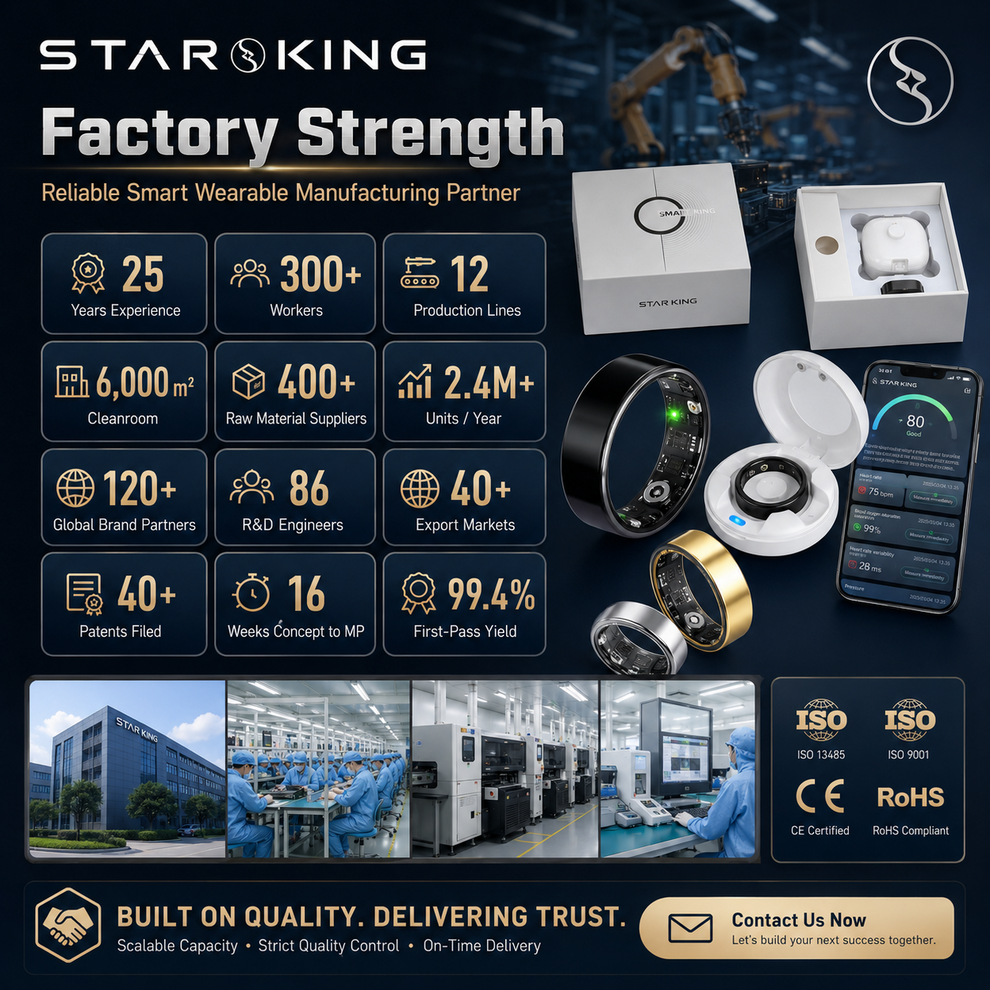
If you are evaluating AI smart glasses for a UK care workflow, the next step is to compare configurations side by side. STAR KING supplies AI smart glasses for OEM/ODM and private-label projects, including branding, firmware and packaging customization, with MOQ and lead time confirmed per project. To move forward, request product samples, share your use-case brief, and confirm the compliance documentation your deployment requires.
Editorial images


Discuss Your Smart Wearable OEM/ODM Project
Planning a smart ring, smart watch, smart band, AI glasses, AI translator, or AI voice mouse project? Contact STAR KING to discuss product positioning, sample testing, customization scope, certification requirements, lead time, and quotation details.

Team Star King

Scan WhatsApp QR code
Leave a Reply