
source AI smart glasses: How to Source AI Smart Glasses for Amazon UK: The 2026 RFQ-Ready Guide for 5 Critical Steps
October 15, 2026 · Team Star King

How to Source AI Smart Glasses for Amazon UK: The 2026 RFQ-Ready Guide for 5 Critical Steps
To source AI smart glasses for Amazon UK in 2026, Amazon sellers should confirm five things before paying a deposit: the product’s target end price and feature ceiling, UK product-safety and wireless compliance status (UKCA, CE, RoHS, and UN38.3 for the battery), the supplier’s real factory and quality controls, MOQ and lead-time that match the seller’s launch plan, and the app/Bluetooth experience the buyer can support after sale. AI smart glasses sit in a regulated, app-dependent category, so the sourcing process is closer to electronics procurement than to simple accessory buying. This guide gives Amazon sellers an RFQ-ready framework—from supplier vetting to landed cost—so the first purchase order does not become an expensive lesson in compliance or returns.
Table of Contents
Table of Contents
Table of Contents
- Short Answer: What Does It Take to Source AI Smart Glasses for Amazon UK?
- Key Takeaways
- Key Facts for Buyers
- Why AI Smart Glasses Are a 2026 Amazon UK Opportunity—and a Compliance Trap
- Step 1: Supplier Vetting and Manufacturer Verification
- Step 2: Specification Decisions and Feature Trade-Offs
- Step 3: UK Compliance for AI Smart Glasses: UKCA, CE, RoHS, UN38.3 and More
- Step 4: MOQ, Pricing and Landed Cost
- Step 5: Samples, Testing and Pre-Shipment Inspection
- OEM/ODM and Private Label Options for Amazon Sellers
- Software and App Integration: The Hidden Sourcing Cost
- Comparison Table: Sourcing Paths for AI Smart Glasses
- Request for Quotation (RFQ) Buyer Checklist
- Common Mistakes and Buyer Red Flags
- FAQ
- Conclusion

Short Answer: What Does It Take to Source AI Smart Glasses for Amazon UK?
Sourcing AI smart glasses for Amazon UK means choosing a manufacturer that can supply UKCA- and CE-ready hardware, provide test reports and battery documentation (UN38.3, MSDS), meet a realistic MOQ, and support the companion app that makes the glasses usable. The decision comes down to supplier transparency, documented compliance, and a bill of materials that fits a price point UK shoppers will actually pay. Amazon sellers should validate all three with samples and third-party checks before committing to a production run.

Key Takeaways
- AI smart glasses are a regulated, app-dependent category: compliance and software support matter as much as camera or audio specs.
- UKCA and CE are separate markings; products intended for the UK market should be reviewed against current UK rules, and buyers should verify the exact configuration and test evidence with the supplier.
- MOQs for AI smart glasses typically reflect tooling, battery and PCBA minimums, so buyers should plan launch volumes and restock cycles before signing an RFQ.
- Landed cost includes unit price, freight, duties, testing, packaging and Amazon FBA prep—budget all of them, not just the ex-works quote.
- Samples and pre-shipment inspection reduce the risk of returns and listing suspensions, which are far more expensive than a test order.

Key Facts for Buyers
| Item | Typical Range / Requirement | Why It Matters for Amazon UK |
|---|---|---|
| Target retail price | Entry AI audio glasses: £60–£120; camera/AI feature sets: £150–£300+ | Sets the BOM ceiling and feature trade-offs |
| MOQ | Often 500–1,000 units for custom builds; lower for ready models [STAR KING TO CONFIRM] | Affects cash flow and launch scale |
| Compliance documents | UKCA/CE as applicable, RoHS, UN38.3, MSDS | Amazon may request documents; UK customs and market surveillance expect them |
| Battery | Lithium-ion/polymer, UN38.3 test summary and MSDS | Required for air freight and marketplace listings |
| Tooling lead time | Typically 25–45 days for custom tooling, plus production [STAR KING TO CONFIRM] | Shapes launch timing |
| QC options | Incoming material checks, aging test, drop/waterproof test, pre-shipment inspection | Reduces returns and negative reviews |
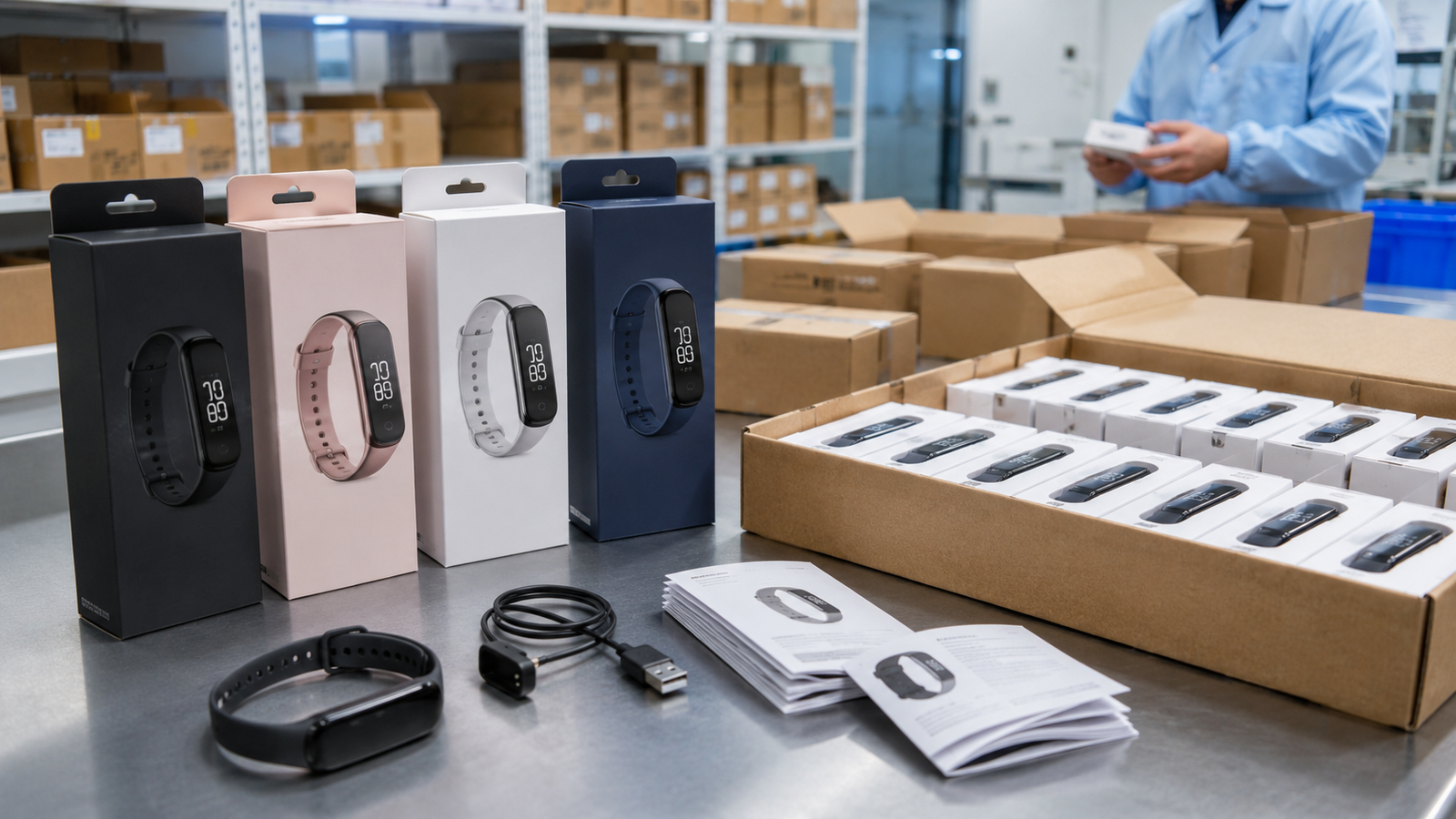
Why AI Smart Glasses Are a 2026 Amazon UK Opportunity—and a Compliance Trap
AI smart glasses combine audio, a camera or display in some models, voice assistants, and Bluetooth connectivity to a phone app. On Amazon UK, that combination attracts shoppers searching for hands-free calls, real-time translation, and lightweight wearable cameras. It also attracts regulators and marketplace quality teams, because glasses are worn on the face, contain a lithium battery, and may include radio transmitters and cameras.
For an Amazon seller, the opportunity is a differentiated listing with defensible margins. The trap is treating AI smart glasses like a generic accessory. Buyers who skip supplier verification, compliance documents, or app testing often discover the problem after inventory is in an FBA warehouse—when returns, listing takedowns, and restocking fees have already eroded the margin. If you are still defining your product line, our overview of AI smart glasses for OEM and private label programs shows the configurations buyers typically evaluate.
Step 1: Supplier Vetting and Manufacturer Verification
Not every seller of AI smart glasses is a manufacturer. Some are trading companies that add a margin and complicate communication during an RFQ. For Amazon sellers, the practical question is: can this supplier control the parts that determine quality and compliance—PCBA, battery, optics, firmware, and final assembly?
What to verify before you request a quote
- Business identity: legal company name, registration details, and factory address consistent across documents and video calls.
- Manufacturing scope: which processes are in-house (SMT, assembly, testing) and which are outsourced.
- Testing capability: whether aging, drop, waterproof and battery tests are performed in-house or by third parties.
- Export experience: history of shipping to the UK, including lithium-battery logistics.
- References: request examples of export markets, without expecting confidential customer names.
Use a live video audit or a third-party factory check if order value is significant. This step does not eliminate risk, but it filters out suppliers who cannot answer detailed RFQ questions about BOM, certifications, or lead time.
Step 2: Specification Decisions and Feature Trade-Offs
AI smart glasses vary widely. Before you request a quotation, decide which features are essential for your UK listing and which are optional. Every feature adds cost, weight, battery demand, and compliance work.
| Feature | Buyer Benefit | Sourcing Impact |
|---|---|---|
| Open-ear audio | Hands-free calls and music | Relatively lower BOM; strong everyday appeal |
| Camera | Capture and AI vision features | Adds privacy, data-handling and compliance questions |
| Real-time translation | Travel and multilingual use | Depends on app and cloud services; test accuracy carefully |
| Display (if offered) | Notifications and navigation | Higher cost, weight and power draw |
| Voice assistant integration | Hands-free control | Platform and firmware dependency |
| Battery capacity | Longer use between charges | Affects weight, UN38.3 documentation and charging accessory design |
For Amazon UK specifically, buyers should test claims such as translation accuracy, call clarity, and battery life in real conditions—not just review a spec sheet. If your roadmap also includes adjacent AI devices, our AI translator product family shows how translation hardware is commonly positioned for travel and business users.
Step 3: UK Compliance for AI Smart Glasses: UKCA, CE, RoHS, UN38.3 and More
Compliance is the area where AI smart glasses differ most from simple accessories. Because the product includes radio equipment, a battery, and possibly a camera and microphone, several regimes may apply. Requirements typically depend on the exact configuration, the intended use, and the current rules of the destination market—and buyers should verify them with the supplier and, where needed, a compliance specialist.
Documents to request during the RFQ
- UKCA and/or CE marking evidence: which marking applies to the specific model and market, with supporting test reports.
- RoHS: restriction of hazardous substances documentation for the product and packaging.
- UN38.3: battery transport test summary for lithium cells and packs.
- MSDS: material safety data sheet for the battery.
- Radio equipment documentation: for Bluetooth and any other wireless function.
- WEEE and packaging obligations: UK producer responsibilities for electronic goods and packaging, which sellers should check with their compliance advisor.
Do not assume a CE certificate from a supplier automatically covers UK market obligations, and do not assume every model in a catalog is tested for every market. Ask for the report that matches your exact model number and configuration. For a broader view of how compliance fits wearable and AI hardware programs, see our private label OEM/ODM solutions page.
Authoritative references
- UK government guidance on using the UKCA marking.
- UK guidance on placing manufactured goods on the market in Great Britain.
- EU Radio Equipment Directive 2014/53/EU for Bluetooth-enabled products.
If you sell on Amazon UK, also review Amazon’s product compliance and documentation requirements in Seller Central, since the marketplace may request evidence independently of customs.
Step 4: MOQ, Pricing and Landed Cost
MOQ for AI smart glasses is driven by the components that cannot be bought in tiny quantities: custom PCBA, battery packs, optical or acoustic modules, tooling, and packaging. Ready-to-brand models usually have lower MOQs than fully custom designs. Buyers should treat MOQ as a planning input, not a negotiation trick—the supplier’s MOQ reflects its production economics.
What drives unit price
- Processor, memory and wireless module selection.
- Camera resolution and lens quality (if applicable).
- Battery capacity and charging design.
- Frame material, hinge design and weight.
- Display or optical system (if applicable).
- Custom logo, packaging and app branding.
- Order quantity and payment terms.
Landed cost checklist for Amazon UK
- Ex-works unit price.
- Freight (air or sea) and insurance.
- UK import duties and VAT treatment.
- Compliance testing and documentation.
- Packaging, manuals and FBA prep/labels.
- Amazon referral and FBA fees.
- Returns and warranty reserve.
A supplier quote that looks cheaper at ex-works can be more expensive after freight, testing and returns are included. For sellers still comparing sourcing destinations and suppliers, our blog resources cover related sourcing and market topics.
Soft CTA: If you are preparing an RFQ and want a supplier that can discuss AI smart glasses, private label options and compliance documents in the same conversation, you can start a project discussion with STAR KING.
Step 5: Samples, Testing and Pre-Shipment Inspection
Samples are the cheapest form of risk reduction. For AI smart glasses, a sample program should go beyond unboxing. Test the app pairing, call quality in noisy environments, translation or AI feature behavior, battery runtime, fit and comfort, and charging reliability.
Sample testing checklist
- Pair the glasses with a UK-region phone and confirm app availability.
- Test Bluetooth stability at realistic distances.
- Measure actual battery life against the claimed figure.
- Check audio clarity for calls and media.
- If a camera is included, review image quality and privacy indicators.
- Inspect build quality, hinge durability and lens/frame finish.
- Confirm packaging, manual language and labeling for the UK market.
Before mass production, agree on a pre-shipment inspection scope: functional testing, aging, drop and waterproof testing where relevant, and AQL sampling. Document the acceptance criteria in the PO so both sides have the same definition of a pass.
OEM/ODM and Private Label Options for Amazon Sellers
Amazon sellers generally choose one of three paths:
- Ready model with light customization: logo printing and custom packaging on an existing AI smart glasses model. Fastest route to market.
- ODM with app and packaging branding: the manufacturer’s hardware platform adapted with your brand, packaging and app identity.
- Full OEM development: custom industrial design, tooling, firmware and app work. Highest cost and longest timeline, strongest differentiation.
Clarify ownership of tooling, molds and app source code in the contract. Buyers should confirm whether they own the mold, what happens to tooling if the relationship ends, and who maintains the app after launch. These details are easier to negotiate before the first PO than after.
Software and App Integration: The Hidden Sourcing Cost
AI smart glasses without a working app are a return waiting to happen. During the RFQ, ask about the app’s supported platforms (iOS and Android), minimum OS versions, language coverage, account requirements, firmware update process, and data handling. If real-time translation or AI features rely on cloud services, confirm who pays for those services and what happens if the provider changes terms.
For sellers expanding an AI hardware line, our AI voice mouse and AI office productivity solutions show how app-dependent devices are positioned for business users—useful context when you plan a coherent brand portfolio.
Comparison Table: Sourcing Paths for AI Smart Glasses
| Sourcing Path | Typical MOQ | Lead Time | Customization | Best For |
|---|---|---|---|---|
| Ready model, logo + packaging | Lower [STAR KING TO CONFIRM] | Shorter | Light | First Amazon UK launch |
| ODM with app branding | Medium [STAR KING TO CONFIRM] | Medium | Medium | Sellers building a brand |
| Full OEM development | Higher [STAR KING TO CONFIRM] | Longer | High | Differentiated product lines |
Buyers should ask the supplier to confirm MOQ, lead time and customization scope in writing for the specific model and configuration under consideration.
Request for Quotation (RFQ) Buyer Checklist
- Target retail price and required features defined.
- Supplier legal identity, factory address and manufacturing scope verified.
- Compliance documents requested for the exact model: UKCA/CE as applicable, RoHS, UN38.3, MSDS.
- MOQ, unit price, payment terms and lead time confirmed in writing.
- Landed cost estimated, including freight, duties, VAT, testing and FBA prep.
- Sample tested against a written checklist.
- App functionality, language support and update process tested.
- Pre-shipment inspection scope and AQL agreed.
- Tooling, mold and app ownership terms clarified.
- Warranty, spare parts and after-sales process defined.
Common Mistakes and Buyer Red Flags
Common mistakes
- Buying on unit price alone and ignoring compliance and app support.
- Assuming one certificate covers every model and every market.
- Skipping sample testing for translation, call quality or battery life.
- Underestimating FBA prep, returns and warranty reserves in the margin calculation.
- Not agreeing on AQL and inspection criteria before production.
Red flags
- Supplier cannot provide a battery UN38.3 summary or MSDS.
- Certificates show a different model number or company name than the quotation.
- App is unavailable in the target market or has no update plan.
- MOQ or lead time changes repeatedly during the RFQ process.
- No clear answer on tooling ownership or after-sales responsibility.
FAQ
What is the MOQ for AI smart glasses?
MOQ depends on whether you choose a ready model or a custom build. Ready-to-brand models often have lower MOQs, while custom tooling and PCBA work raise the minimum. Ask the supplier for the exact MOQ of the model and configuration you are quoting.
Do AI smart glasses need UKCA or CE marking for Amazon UK?
Products placed on the UK market are generally reviewed against UK rules and marking requirements, while CE relates to EU rules. The applicable regime depends on the product and current regulations, so buyers should confirm the exact requirement with the supplier and a compliance specialist before listing.
What battery documents should I request?
Request the UN38.3 test summary and the MSDS for the battery used in your exact model. These are commonly needed for air freight and may be requested during marketplace compliance reviews.
How long does production take?
Lead time depends on customization, component availability and order size. Ready models typically ship faster than custom projects that require tooling. Confirm a written schedule and build in buffer for your Amazon launch.
Can I private-label AI smart glasses with my own app?
Many manufacturers offer app branding or white-label app options, but the scope varies. Confirm whether the app is reskinned or fully custom, who maintains it, and what happens if the underlying platform changes.
How do I calculate landed cost for Amazon UK?
Add unit price, freight and insurance, UK duties and VAT, compliance testing, packaging and FBA prep, Amazon fees, and a returns/warranty reserve. Compare suppliers on landed cost, not ex-works price alone.
What should I test in a sample before ordering?
Test pairing and app stability, call and audio quality, battery runtime, comfort and fit, charging reliability, and any AI or translation features. Also check UK-market packaging, manuals and labeling.
Conclusion
Sourcing AI smart glasses for Amazon UK rewards preparation. Sellers who verify the supplier, lock down compliance documents for the exact model, plan MOQ and landed cost realistically, and test samples thoroughly are far better positioned than those who buy on price alone. The category is growing, but it is also regulated, app-dependent and return-sensitive—so the sourcing process should reflect that. Build your RFQ around the five steps in this guide, and treat compliance and after-sales support as product features, not paperwork.
STAR KING CTA
Ready to move from research to a real quote? Share your target price, required features and launch timeline, and request a quotation for AI smart glasses with the compliance documents, MOQ and lead time your Amazon UK launch needs. You can also request product samples or discuss an OEM/ODM project directly.
Request a quotation for AI smart glasses
Discuss Your Smart Wearable OEM/ODM Project
Planning a smart ring, smart watch, smart band, AI glasses, AI translator, or AI voice mouse project? Contact STAR KING to discuss product positioning, sample testing, customization scope, certification requirements, lead time, and quotation details.

Team Star King

Scan WhatsApp QR code
Leave a Reply