
smart watches supplier selection: Supplier Selection for Smart Watches: 10 Checks US Retail Chains Must Pass in 2026
October 20, 2026 · Team Star King
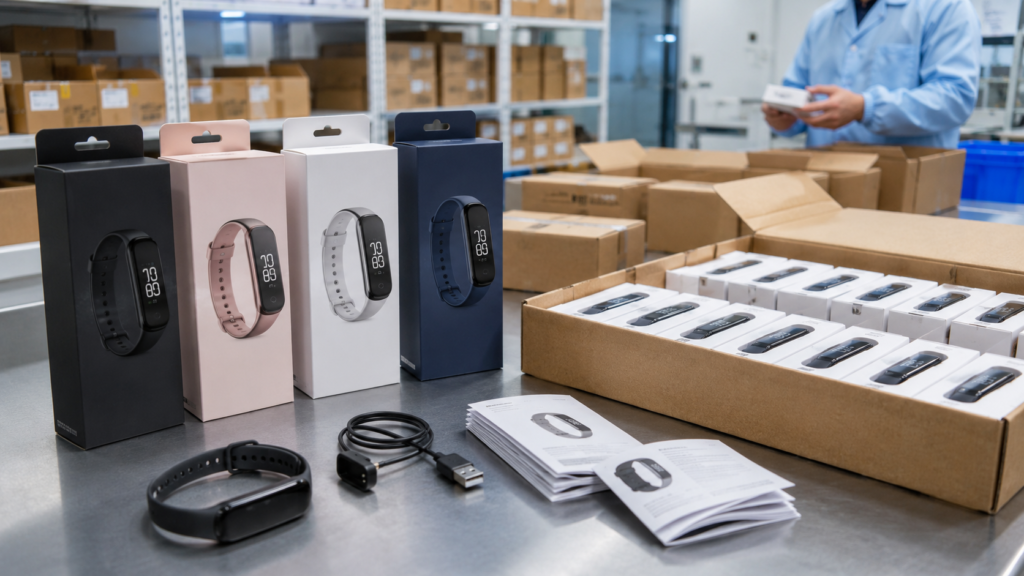
Supplier Selection for Smart Watches: 10 Checks US Retail Chains Must Pass in 2026
Smart watches supplier selection is the process of qualifying a manufacturing partner against product, compliance, quality, software and commercial criteria before a US retail chain commits to a private label program. For US retail buyers, the decision typically comes down to ten verifiable checks: FCC and UN38.3 documentation, app and firmware ownership, sampling discipline, MOQ and pricing structure, QC and inspection reports, lead time reliability, packaging and brand customization capability, warranty and spares, IP and tooling terms, and total landed cost. This guide explains each check, what evidence to request, and the red flags that should stop a program before samples ship.
Table of Contents
Table of Contents
Table of Contents
- Short Answer
- Key Takeaways
- Key Facts for Buyers
- What Smart Watches Supplier Selection Means for Retail Chains
- The 10 Supplier Selection Checks
- Comparison Table: Trading Company vs. OEM/ODM Factory
- Common Mistakes and Buyer Red Flags
- Practical Buyer Checklist
- FAQ
- Conclusion

Short Answer
US retail chains should qualify a smart watch supplier by verifying FCC equipment authorization status, UN38.3 and MSDS documents for the battery, a documented quality control process with pre-shipment inspection, clear app and firmware ownership, and transparent MOQ, tooling and lead time terms. Supplier selection for smart watches should be evidence-based: request certificates, inspection reports and sample test results rather than relying on catalog claims, and confirm every requirement against the exact product configuration and US market rules before issuing a purchase order.
Key Takeaways
- Supplier selection for smart watches is a documentation exercise as much as a product comparison exercise; request evidence before sampling.
- FCC authorization, UN38.3 and MSDS apply to specific configurations and must be matched to the model you intend to import.
- App and firmware ownership determines whether you can control the customer experience, updates and data handling after launch.
- MOQ, tooling fees and packaging costs usually drive the real landed cost more than unit price alone.
- A sample is not a validation: demand a QC plan and pre-shipment inspection before mass production.
- Retail chains need spare parts, warranty terms and firmware update commitments written into the supply agreement.

Key Facts for Buyers
| Decision Area | What to Verify | Typical Evidence | Why It Matters for US Retail |
|---|---|---|---|
| Market access | FCC equipment authorization status for the exact model and wireless configuration | FCC ID and authorization record; test report reference | Unlicensed RF devices sold in the US are subject to FCC rules |
| Battery safety | UN38.3 test summary and MSDS for the lithium battery | Test summary document, MSDS | Commonly requested for air freight and retail compliance files |
| Quality | Incoming, in-process and pre-shipment inspection | QC plan, AQL levels, inspection reports | Reduces returns and chargebacks at retail |
| Software | App source ownership, firmware update process, data handling | Customization scope, API documentation | Controls user experience and privacy posture |
| Commercial | MOQ tiers, tooling fees, payment terms | Quotation with cost breakdown | Determines landed cost and cash flow |
| Supply continuity | Lead time, capacity, spare parts | Production schedule, warranty terms | Protects shelf availability and after-sales |
What Smart Watches Supplier Selection Means for Retail Chains
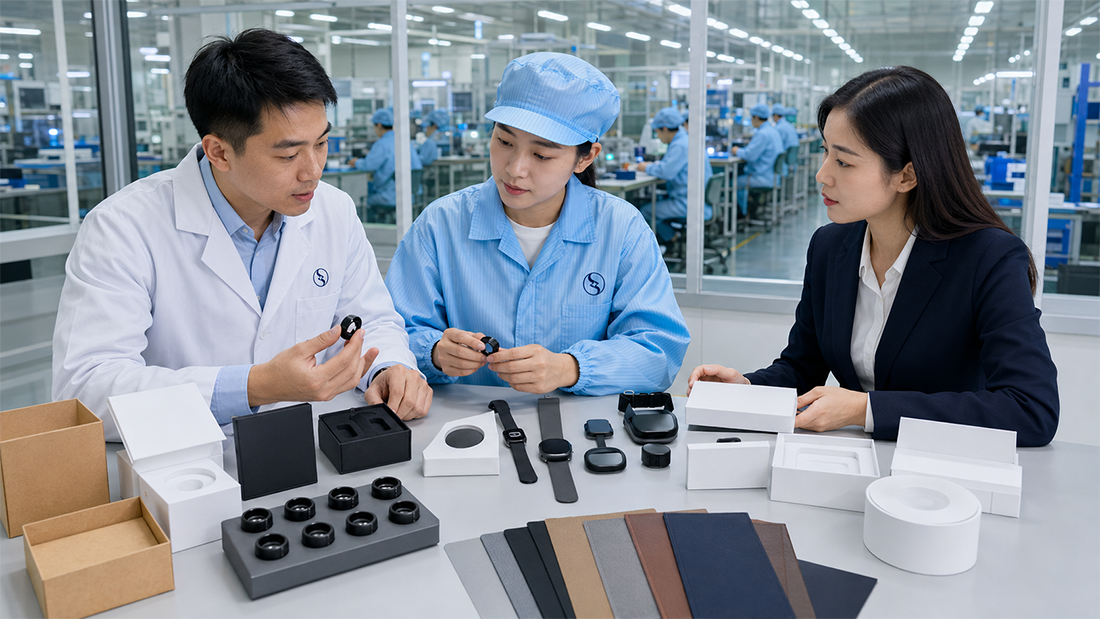
For a retail chain, smart watches supplier selection is not a single purchasing decision. It is a qualification process that spans five domains: regulatory compliance, product and software, manufacturing quality, commercial terms and after-sales support. A supplier can be strong in one area and weak in another. A factory that produces good hardware may not offer app customization; a trading company may offer flexibility but have limited control over production.
Buyers should therefore evaluate suppliers against a written scorecard rather than a presentation. The scorecard should list required evidence for each domain, the responsible person on the buying team, and a pass or fail threshold. This approach makes supplier selection comparable across candidates and creates an audit trail for internal approval.
Retail chains also carry obligations that pure e-commerce sellers do not. Shelf space commitments, planogram timing, seasonal launches and returns handling all require predictable lead times and spare-part availability. Supplier selection should weigh supply continuity and documentation quality as heavily as sample aesthetics.
The 10 Supplier Selection Checks
Check 1: Confirm FCC Authorization for the Exact Configuration
Wireless devices marketed in the US are subject to FCC equipment authorization rules. Ask the supplier for the FCC ID associated with the exact model, wireless module and configuration you plan to import. A certificate for a different model or a different module does not automatically cover your product. Confirm that the grantee name matches the manufacturer or that the supplier can explain the relationship. Buyers should verify the authorization record directly in the FCC database rather than relying on a scanned PDF.
Check 2: Review Battery Documentation: UN38.3 and MSDS
Smart watches contain lithium batteries, which are subject to transport rules. Request a UN38.3 test summary and an MSDS for the battery in the configuration you are buying. These documents are typically required by freight forwarders and are commonly requested in retail compliance files. The IATA lithium battery guidance explains why air transport rules apply. Confirm that the documents reference the same battery model and capacity as the production unit.
Check 3: Establish Who Owns the App and Firmware
The companion app is part of the product. Ask whether the supplier offers a white-label app, a customizable app, or a full custom build, and who owns the source code and data. Clarify update responsibilities: who fixes bugs, who maintains compatibility with new iOS and Android releases, and what the notice period is for breaking changes. If the supplier uses a third-party app platform, confirm the commercial terms and data-handling arrangements. For retail chains, unclear app ownership is a long-term risk because the app affects reviews, returns and customer support load.
Check 4: Request a Structured Sample and Validation Plan
A sample demonstrates what a factory can hand-assemble; a validation plan demonstrates what a factory can repeat at volume. Ask for a sample schedule with defined test items: display and touch, heart rate and blood oxygen sensor behavior under stated conditions, battery runtime, charging cycle, waterproof testing method, drop testing and aging testing. Consumer-grade health features should be described as wellness indicators, not diagnostic tools. Compare sample units across at least two production lots if possible.
Check 5: Review the Quality Control System and Inspection Standards
Request the QC plan, the AQL levels used for incoming and outgoing inspection, and a sample pre-shipment inspection report. Ask whether inspection is performed in-house or by a third party, and whether the buyer may appoint an inspection agency. Confirm how the supplier handles defects, rework and chargebacks. A supplier that cannot describe its inspection workflow in specific terms is a red flag regardless of sample quality.
Check 6: Understand MOQ, Tooling and Price Structure
Ask for a quotation that separates unit price, tooling or molding fees, sample fees, packaging costs, logo and color customization costs, and payment terms. MOQ usually depends on model, customization level and component sourcing. Request MOQ tiers so the buying team can model volume scenarios. Clarify whether tooling is one-time and whether it is amortized, refundable or owned by the buyer. A low unit price with high tooling and packaging fees can produce a higher landed cost than a higher unit price with a simpler program.
Check 7: Map Lead Time and Production Planning
Ask for lead time broken into stages: sample approval, tooling, component procurement, mass production, inspection and shipping. Confirm how Chinese New Year and other holiday periods affect the schedule. For retail chains with fixed launch dates, request a production schedule with buffer and a written statement of what happens if components are delayed. Lead time reliability is often more important than the shortest quoted lead time.
Check 8: Confirm Packaging and Brand Customization Capability
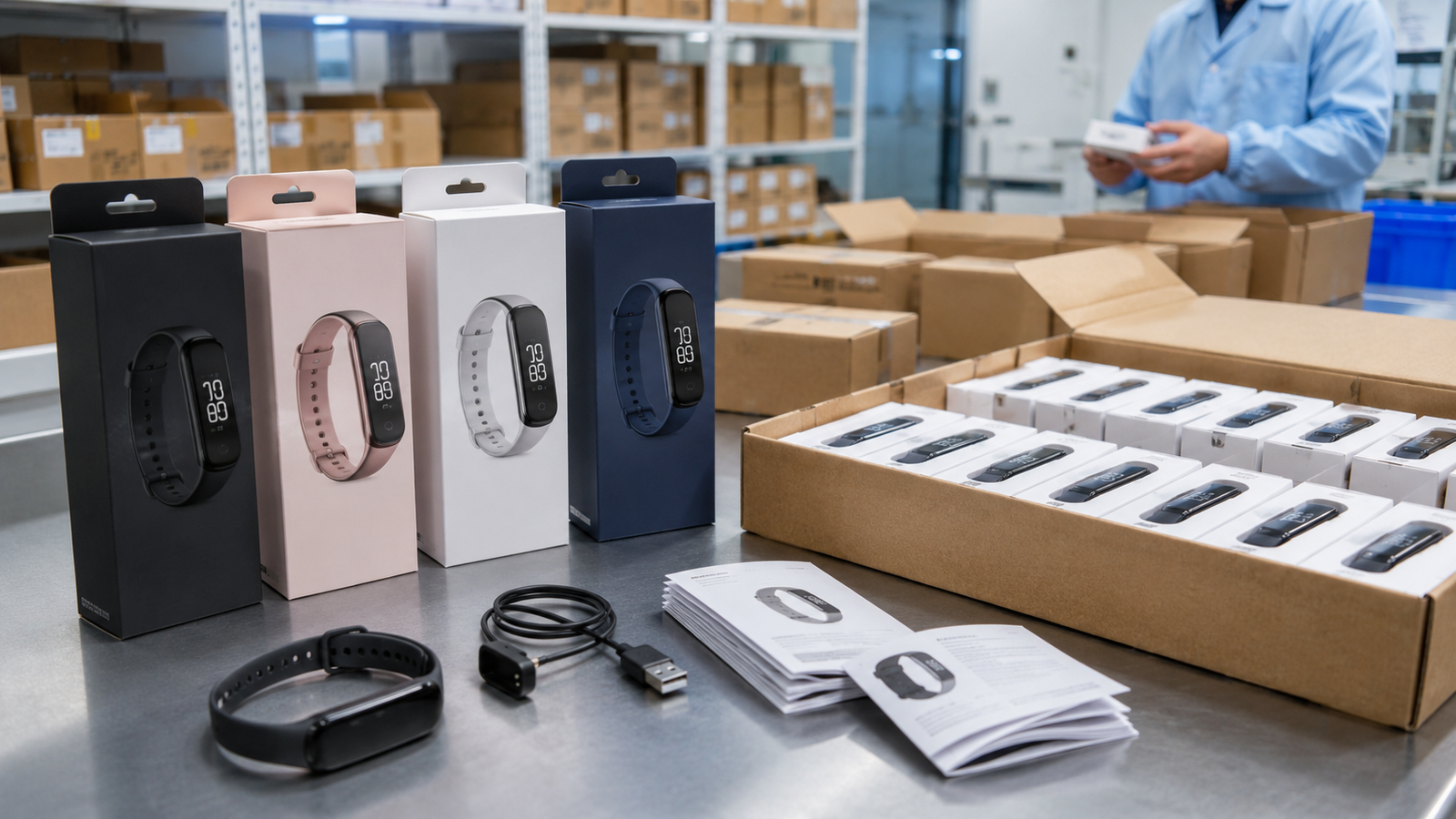
Retail packaging must meet both brand and channel requirements. Ask about logo customization, color matching, retail box structure, barcodes, manuals, language versions, warning labels and accessory configuration. Confirm whether the supplier handles packaging design support and pre-production packaging proofs. For US retail, confirm that packaging artwork includes required statements and that the supplier can support packaging changes without resetting the entire production schedule.
Check 9: Verify Warranty, Spare Parts and After-Sales Terms
Ask for the standard warranty period, the defect rate assumptions behind it, and the spare-part policy for straps, chargers and displays. Clarify the return merchandise process and who bears freight for defective units. Retail chains should also ask how firmware updates are delivered to end users and whether the supplier provides technical support content for customer service teams.
Check 10: Clarify IP, Tooling Ownership and Exclusivity
Confirm who owns industrial designs, tooling, firmware customizations and packaging artwork created for your program. Ask whether the supplier sells the same or near-identical design to other buyers, and under what terms exclusivity could be granted. Put ownership and confidentiality terms in writing before tooling begins. This check protects both brand equity and the investment in custom development.
If you are comparing wearable programs beyond watches, the same evaluation logic applies to smart ring product lines and to full private label OEM/ODM solutions.
Comparison Table: Trading Company vs. OEM/ODM Factory
| Criteria | Trading Company | OEM/ODM Factory | What Retail Chains Should Ask |
|---|---|---|---|
| Product range | Broad, multi-category | Focused on wearable hardware | Which models are produced in-house vs. sourced? |
| Customization depth | Logo and packaging | Logo, packaging, firmware, app, tooling | Can you show a completed customization project? |
| QC control | Depends on upstream factories | Documented in-house process | Who performs pre-shipment inspection? |
| Technical support | Limited, often relayed | Direct engineering contact | Can we speak with an engineer during sampling? |
| MOQ flexibility | Often lower initial MOQ | Tiered by model and customization | What are the MOQ tiers and tooling fees? |
| Lead time control | Indirect | Direct production scheduling | Can you provide a staged production schedule? |
Common Mistakes and Buyer Red Flags
Mistakes Retail Buyers Make
- Accepting a certificate without matching the model. A CE or FCC document for a different configuration does not confirm compliance for your SKU.
- Treating sample quality as production quality. Samples are often hand-selected; the QC system is what protects volume orders.
- Ignoring app maintenance costs. An app that stops receiving updates creates returns and negative reviews.
- Comparing unit price without landed cost. Tooling, packaging, freight and duty often change the ranking of suppliers.
- Skipping the spare-parts conversation. Straps and chargers are common replacement items in retail returns processing.
Red Flags in Supplier Selection
- Unwillingness to share the FCC ID or battery documentation before a deposit.
- Refusal to allow a third-party inspection.
- Vague answers about firmware ownership or update responsibility.
- Quotations without a cost breakdown or with unclear tooling terms.
- Pressuring buyers with artificial deadlines or claimed capacity shortages.
For programs that combine watches with other devices, it helps to review how smart retail and e-commerce solutions handle packaging, channel assortment and after-sales support in a single supplier relationship.
Practical Buyer Checklist
| # | Item to Confirm | Evidence Requested | Owner |
|---|---|---|---|
| 1 | FCC authorization for exact model | FCC ID and database record | Compliance |
| 2 | Battery documents | UN38.3 summary, MSDS | Compliance |
| 3 | App and firmware ownership | Written scope and update terms | Product |
| 4 | Sample validation plan | Test items and schedule | Product |
| 5 | QC and inspection | QC plan, AQL, inspection report | Quality |
| 6 | MOQ and pricing | Quotation with cost breakdown | Purchasing |
| 7 | Lead time | Staged production schedule | Supply Chain |
| 8 | Packaging customization | Artwork proof and structural sample | Brand |
| 9 | Warranty and spares | Written warranty and spare-part list | After-Sales |
| 10 | IP and tooling terms | Ownership and confidentiality clauses | Legal |
When shortlisting suppliers, request a specification comparison and a compliance document package for each candidate. STAR KING can provide current documentation status for specific smart watch models and configurations so your team can compare candidates on the same basis.
Buyers can also review STAR KING Smart Watches OEM/ODM options to compare product positioning, customization scope, and sample planning.
FAQ
How long does smart watches supplier selection usually take?
For a retail chain with a defined assortment, a structured process typically takes four to eight weeks: two to three weeks for documentation review and shortlisting, two to three weeks for sampling and validation, and one to two weeks for commercial negotiation. Programs with custom app development or tooling extend beyond this range.
Is an FCC certificate transferable between models?
No. FCC equipment authorization applies to the tested device and configuration. If the model, wireless module or RF layout changes, the authorization status must be reassessed. Buyers should verify the FCC ID against the exact SKU.
What MOQ should a retail chain expect for private label smart watches?
MOQ depends on the model, customization level and component sourcing. Logo and packaging customization usually requires lower volumes than custom firmware, app development or tooling changes. Ask for MOQ tiers rather than a single number.
Can the supplier deliver a white-label app instead of a custom app?
Many suppliers offer white-label or configurable app options that reduce cost and timeline. A custom app gives more control over branding and data but requires development budget, testing cycles and an ongoing maintenance agreement.
How should buyers verify quality control claims?
Request the QC plan, inspection standards and a recent pre-shipment inspection report. Ask whether you may appoint a third-party inspection agency and include the inspection right in the purchase order.
What documents are needed for lithium battery shipping?
UN38.3 test documentation and MSDS are commonly requested, along with the appropriate transport documentation for the chosen mode. Requirements vary by carrier and route, so buyers should confirm with the freight forwarder before booking.
Should retail chains require spare parts in the contract?
Yes. Straps, chargers and displays are common replacement items. Specify spare-part availability periods and pricing in the supply agreement to support returns processing and after-sales service.
Conclusion
Smart watches supplier selection for US retail chains comes down to verifiable evidence. The supplier that wins should be the one that can match FCC authorization to the exact model, provide battery documentation, explain app and firmware ownership, demonstrate a documented QC process and commit to lead time, warranty and spare-part terms in writing. Use the ten checks and the buyer checklist in this guide as a scorecard, and keep the comparison consistent across candidates so internal approval is based on facts rather than impressions.
Next Step
If your team is shortlisting smart watches suppliers for a US retail program, contact our sales team to request a specification comparison, sample plan and current compliance document status for the models you are evaluating. Share your target configuration, packaging requirements and launch timeline, and we will confirm which requirements apply to your program.
Discuss Your Smart Wearable OEM/ODM Project
Planning a smart ring, smart watch, smart band, AI glasses, AI translator, or AI voice mouse project? Contact STAR KING to discuss product positioning, sample testing, customization scope, certification requirements, lead time, and quotation details.

Team Star King

Scan WhatsApp QR code
Leave a Reply