
smart watches for system integrators: 7 Things System Integrators Must Check Before Sourcing Smart Watches for US Deployments in 2026
7 Things System Integrators Must Check Before Sourcing Smart Watches for US Deployments in 2026
If you are a system integrator planning to source smart watches for system integrators projects in the United States, the first evaluation question is not which model has the longest battery life or the brightest screen. It is whether the device can be integrated into your platform, documented for US compliance, shipped with a lithium-ion battery, and supported through the life of the deployment. This guide walks through seven checks that separate a smooth integration from a costly rework cycle, covering hardware interfaces, firmware and app access, FCC and battery requirements, MOQ and lead time planning, quality control, packaging, and after-sales support.
Table of Contents
Table of Contents
smart watches for system integrators: Table of Contents
- Direct Answer: What Makes a Smart Watch Suitable for Integration?
- Key Takeaways
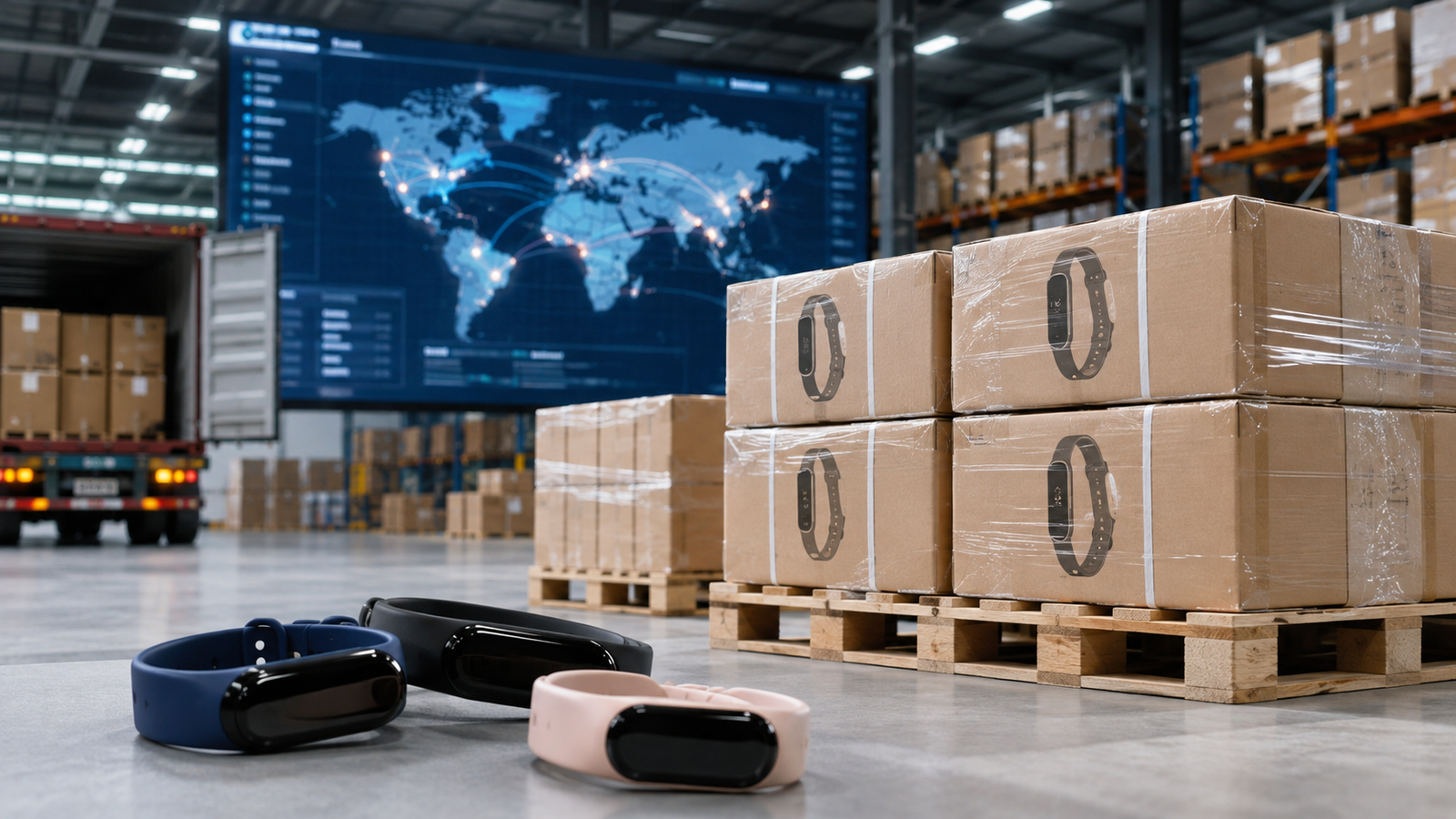
- Key Facts for Buyers
- Check 1: Hardware and Sensor Interfaces
- Check 2: Firmware, SDK, and App Integration Path
- Check 3: FCC, RoHS, and US Market Compliance
- Check 4: Battery Safety and Lithium Shipping Requirements
- Check 5: MOQ, Tooling, and Lead Time Planning
- Check 6: Quality Control and Production Testing
- Check 7: Packaging, Branding, and After-Sales Support
- Smart Watch Selection Table for Integrator Use Cases
- Common Mistakes and Buyer Red Flags
- Practical Buyer Checklist
- FAQ
- Conclusion

Direct Answer: What Makes a Smart Watch Suitable for Integration?
A smart watch is suitable for system integration projects when it offers documented hardware interfaces, an accessible SDK or API for data exchange, verifiable US compliance files (typically FCC for radio equipment, plus RoHS and battery documentation), and a manufacturing partner who can support customization, consistent quality, and predictable lead times. Buyers should verify each of these points with samples and documentation before committing to volume orders.

Key Takeaways
- For integrator projects, integration capability matters more than consumer-style features.
- Confirm whether the SDK or API is open, documented, and maintained before purchase.
- FCC, RoHS, and battery transport documentation should be verified per model and configuration.
- MOQ, tooling ownership, and lead time should be agreed in writing early.
- Quality planning—IQC, in-line checks, and pre-shipment inspection—reduces deployment risk.
- Packaging and firmware branding often require separate customization decisions.
Key Facts for Buyers
| Item | Typical Range / Notes | What to Verify |
|---|---|---|
| Display size | 1.3″–1.9″ AMOLED or TFT (varies by model) | Datasheet, brightness, touch response |
| Sensors | PPG heart rate, SpO2, accelerometer, sometimes ECG | Sensor vendor, accuracy spec, raw data access |
| Connectivity | Bluetooth 5.x, optional Wi-Fi/GPS | Bluetooth SIG listing, supported profiles |
| Battery | 200–450 mAh typical | UN38.3 report, MSDS, shipping mode |
| Compliance | FCC, RoHS, sometimes CE for other markets | Certificate holder, model number match |
| MOQ | Varies by model and customization level | Written quotation, sample terms |
| Lead time | Sample: weeks; mass production: depends on tooling and order size | Confirmed production schedule |
All figures above are illustrative. Request a current STAR KING datasheet and quotation for exact specifications. [STAR KING TO CONFIRM]
For integrators building health, fitness, or workplace programs, pairing watch hardware with complementary devices—such as smart rings—can extend data coverage without changing the software stack. STAR KING supplies several wearable form factors through one manufacturing relationship, which simplifies sourcing and quality control across a program.
Check 1: Hardware and Sensor Interfaces
Integrators rarely buy a watch because of its case color. They buy because the device can produce the data their platform needs. Start by mapping required signals to hardware capability.
Questions to ask the manufacturer
- Which sensors are on the model, and at what sampling rate?
- Is raw or processed data available to the companion app or SDK?
- Can the device run without a manufacturer cloud account?
- Are charging pins, pogo pads, or magnetic connectors standard across models?
If a project requires pairing with a mobile app your team controls, confirm early whether the watch can communicate locally (for example, BLE GATT) or only via the manufacturer’s cloud. This single decision affects architecture, privacy posture, and long-term cost.
Check 2: Firmware, SDK, and App Integration Path
Firmware and app access is often the deciding factor for integrator deployments. A consumer-grade OEM may sell the watch but keep firmware closed. An OEM/ODM partner experienced in B2B projects can discuss firmware customization, white-label companion apps, and API access options.
What “SDK access” typically means
- Documented BLE protocol – instructions for reading sensor and status data.
- Reference app source or library – code your team can adapt.
- Cloud API – for device management, firmware updates, or aggregated health data.
Verify that the API documentation is current, that a support contact exists, and what happens if the manufacturer changes firmware. Buyers should request a written statement of SDK support scope and any related fees. If the OEM offers no integration path, the watch may be fine for consumer resale but a poor fit for system integration.
Check 3: FCC, RoHS, and US Market Compliance
For US deployments, radio-equipped smart watches typically require an FCC equipment authorization, and many projects also require RoHS documentation and battery test reports. Compliance depends on the specific model, radio configuration (Bluetooth, Wi-Fi, GPS, cellular), and target market, so buyers should verify certificates for the exact configuration they intend to import rather than assume a general catalog claim.
Documents to request
- FCC equipment authorization (FCC ID) matching the model and radio configuration.
- RoHS test report or declaration for the electronics assembly.
- Battery UN38.3 test report and MSDS (see Check 4).
Reference the US FCC Equipment Authorization database to validate FCC IDs, and review the FCC equipment authorization procedures for background. If a project also touches medical claims, note that general wellness devices are not the same as FDA-cleared medical devices; buyers should verify labeling and intended-use wording with a qualified regulatory advisor. In many cases the certificate holder is the OEM or a distributor, and this affects who can legally import and label the product. Confirm this in writing with your supplier. [STAR KING TO CONFIRM model-level certificates]
Check 4: Battery Safety and Lithium Shipping Requirements
Smart watches contain lithium-ion or lithium-polymer cells. International air transport generally requires UN38.3 testing, and shipments commonly need a Material Safety Data Sheet (MSDS) and correct battery markings. Requirements vary by airline, courier, and shipping mode, and buyers should confirm current rules with their freight forwarder. For reference, see the IATA Dangerous Goods Regulations overview. Confirm with the manufacturer:
- UN38.3 report for the specific cell and pack.
- Battery shipping state (charged to a defined level, protection enabled).
- Carton labeling and documentation for the chosen transport mode.
- Whether cells are sourced from a consistent, documented supplier.
Battery safety is both a shipping question and a product reliability question. Aging tests and over-charge/discharge protection results should be part of your quality review, not a post-launch surprise.
Check 5: MOQ, Tooling, and Lead Time Planning
Early-stage integrator projects often start small — a pilot of dozens or hundreds of units before a full rollout. MOQ structures vary widely by model and customization level: logo printing, custom packaging, firmware adjustments, and new molds each carry different minimums and timelines.
Cost drivers to clarify
- Per-unit hardware cost at each MOQ tier.
- One-time costs: tooling, stencils, firmware development, packaging plates.
- Sample charges and whether they are deducted from the first mass-production order.
- Lead time for samples vs. mass production, including testing and inspection windows.
Ask who owns the tooling and molds after the project ends. Tooling ownership should be agreed in writing; some manufacturers retain molds unless the buyer explicitly purchases them, which can affect future supply options. STAR KING supports private label OEM/ODM programs and can discuss MOQ planning based on your deployment size.
Check 6: Quality Control and Production Testing
For integrator deployments, field failures cost more than unit price differences. A structured quality program typically includes incoming material inspection, in-line assembly checks, functional testing, and pre-shipment inspection. Practical questions include:
- What tests are run on every unit vs. sampled units?
- Are aging and charge/discharge tests part of the routine?
- Is waterproof testing performed, and to what rating?
- Can the buyer send a third-party inspector or attend the pre-shipment inspection?
Documented test reports and photos give your team something to review before containers ship. For programs covering workplace safety or employee wellness, quality data also supports internal approval and end-user trust. See our health and fitness wearables solutions for related use cases.
Check 7: Packaging, Branding, and After-Sales Support
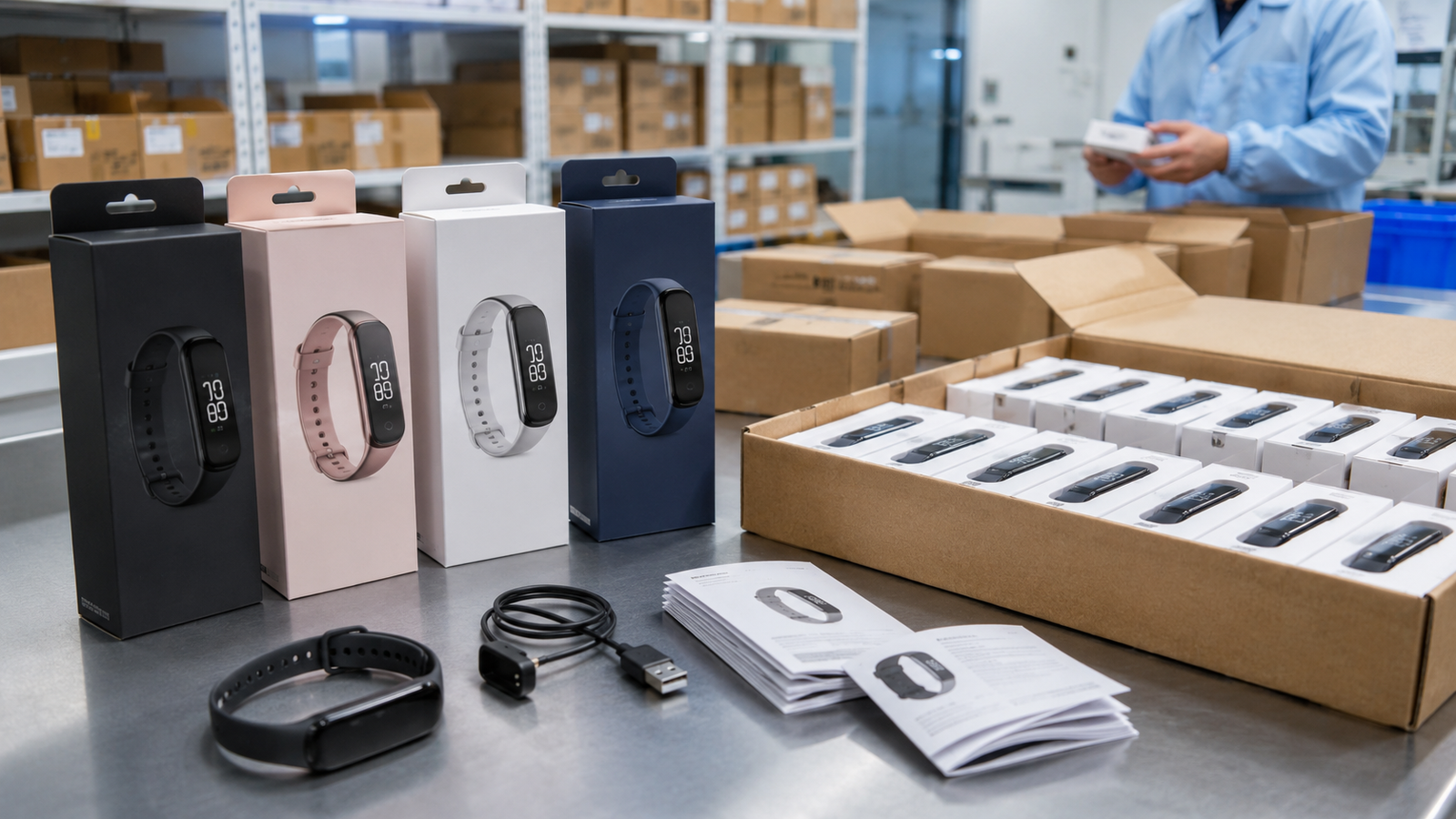
Even integrator deployments eventually need branded packaging — for end clients, for employee rollout kits, or for retail channels. Customization decisions include:
- Logo on device, strap, charger, and packaging.
- Companion app name, icon, and onboarding screens.
- User manuals and quick-start guides in the target language.
- Retail-ready vs. bulk packaging for kit assembly.
Pair packaging planning with after-sales terms. Ask about warranty length, spare parts availability (straps, chargers, screens), and the process for handling DOA or warranty units. A supplier who can support spare parts over a multi-year deployment reduces the risk of early fleet obsolescence.
Smart Watch Selection Table for Integrator Use Cases
| Integration Scenario | Key Hardware Priorities | Key Software Priorities | Customization Focus |
|---|---|---|---|
| Employee wellness program | Comfortable band, multi-day battery, reliable heart rate | Data export, privacy controls, admin dashboard | Branded packaging, onboarding content |
| Fitness and activity tracking platform | Accelerometer quality, GPS accuracy (if used) | Raw data access, SDK sync frequency | App branding, firmware tweaks |
| Senior or remote monitoring solution | Simple UI, battery life, cellular or BLE reliability | Alerts, cloud API, caregiver app | Manual, large-font interface, support materials |
| Retail or field operations pilot | Ruggedness, charging dock options | Device management, bulk provisioning | Logo, packaging, bulk cartons |
Use this table internally to rank requirements before contacting suppliers. It will speed up sample selection and quotation comparison. For complementary form factors such as bands, see our smart bands page.
Common Mistakes and Buyer Red Flags
- Treating compliance as a catalog promise. Verify certificates for the exact model and radio configuration you will import.
- Assuming SDK access is included. Ask for documentation and support terms before ordering.
- Skipping the sample evaluation. A working sample reveals fit, firmware behavior, and app stability.
- Ignoring battery paperwork. Missing UN38.3 or MSDS can delay or block shipments.
- Overlooking tooling ownership. Confirm in writing who owns molds and custom fixtures.
- Relying on verbal lead times. Request a written production schedule with milestones.
- Treating consumer health features as clinical. Wellness data is not medical diagnosis; align claims with intended use.
Practical Buyer Checklist
- Written specification sheet for each candidate model.
- Confirmed SDK/API scope, documentation, and support terms.
- FCC ID and RoHS documentation for the target configuration.
- UN38.3 report and MSDS for the battery.
- MOQ, tooling cost, and lead time confirmed in the quotation.
- Quality plan with inspection points and reporting format.
- Packaging and branding scope agreed, including language and artwork.
- Warranty, spare parts, and RMA process defined.
- Sample order placed and evaluated before mass production.
Buyers can also review STAR KING Smart Watches OEM/ODM options to compare product positioning, customization scope, and sample planning.
FAQ
Do smart watches for system integrators need FCC certification in the US?
Radio-equipped smart watches sold or imported into the United States typically require FCC equipment authorization for the specific radio configuration. Buyers should verify the FCC ID and confirm the model number matches the configuration they intend to import.
Can a manufacturer provide an SDK for custom app development?
Some OEM/ODM suppliers offer documented BLE protocols, reference app code, or cloud APIs. Availability varies by model and supplier. Request documentation and support terms in writing before committing to volume.
What is a realistic MOQ for a pilot deployment?
MOQ depends on the model and customization level. Logo and packaging changes may allow smaller runs than firmware development or new tooling. Ask for MOQ tiers and sample terms in the quotation.
How long does sampling and mass production usually take?
Sample timelines depend on whether the model is standard or customized, and mass production depends on component availability, tooling, and order size. Request a written schedule with milestones before releasing a purchase order.
Are health monitoring features on smart watches medical devices?
Generally no. Consumer wellness features such as heart rate or SpO2 tracking are not the same as FDA-cleared medical devices. Any project making medical claims should consult a regulatory professional and verify labeling requirements.
What battery documents are needed for shipping?
UN38.3 test reports and an MSDS are commonly requested for lithium battery shipments, along with correct labeling. Final requirements depend on the transport mode, courier, and destination, so confirm with your freight forwarder.
Can the watch be branded for our company or end client?
Many models support logo printing, customized packaging, and companion app branding. Scope and cost depend on the supplier and order volume; request a customization quotation to compare options.
Conclusion
Sourcing smart watches for system integrator projects is a specification, compliance, and support exercise as much as a purchasing decision. The seven checks in this guide — hardware interfaces, firmware and app access, US compliance, battery documentation, MOQ and lead time, quality control, and packaging and after-sales — give your team a structured way to compare suppliers and reduce deployment risk. Start with a written requirements list, evaluate a sample against it, and confirm every compliance and support claim in writing before scaling.
Discuss Your Smart Watch Integration Project
If you are planning a US deployment and want to compare configurations, integration options, or private-label programs, STAR KING can support the next step. Request product samples or contact our team to discuss your specification and timeline. For broader wearable options, you can also review our sourcing and product resources.
Discuss Your Smart Wearable OEM/ODM Project
Planning a smart ring, smart watch, smart band, AI glasses, AI translator, or AI voice mouse project? Contact STAR KING to discuss product positioning, sample testing, customization scope, certification requirements, lead time, and quotation details.

Team Star King

Scan WhatsApp QR code