Smart Rings for Corporate Wellness: 7-Step Procurement Guide for 2026
Smart Rings for Corporate Wellness: 7-Step Procurement Guide for 2026
Procuring smart rings for corporate wellness requires balancing health outcomes, data privacy, budget, and compliance. This guide outlines a 7-step process for corporate procurement teams: define program goals, engage OEM/ODM suppliers, validate samples, confirm MOQ and pricing, ensure compliance, plan logistics, and execute a pilot before scaling. Each step includes practical checklists and common pitfalls.
Table of Contents
Table of Contents
smart rings for corporate wellness: Table of Contents
- Step 1: Define Program Objectives and Success Metrics
- Step 2: Identify and Evaluate Smart Ring Suppliers
- Step 3: Understand OEM, ODM, and Private Label Options
- Step 4: Navigate MOQ, Pricing, and Lead Times
- Step 5: Validate Samples and Pilot Testing
- Step 6: Ensure Quality, Compliance, and Data Security
- Step 7: Plan Rollout, Support, and Scale
- Key Takeaways
- Key Facts for Buyers
- Common Mistakes and Buyer Red Flags
- Practical Buyer Checklist
- Frequently Asked Questions
- Conclusion
Key Takeaways
- Successful corporate wellness programs start with clear health goals, not device features.
- OEM/ODM partnerships enable customization but require careful evaluation of manufacturing capabilities and compliance.
- MOQ, pricing, and lead times vary widely; negotiate based on volume and customization complexity.
- Always validate sample performance and data accuracy before bulk orders; pilot testing with a small group is essential.
- Compliance with privacy regulations like GDPR and HIPAA is non-negotiable when handling employee health data.
- Plan for logistics, including lithium battery shipping, and provide ongoing employee support.

Short Answer
To procure smart rings for corporate wellness, define your program’s health objectives, select an experienced OEM/ODM supplier, validate samples, negotiate MOQ and pricing, ensure compliance with data privacy laws, and pilot the program before scaling. Focus on data accuracy, battery life, and integration with existing wellness platforms.

Key Facts for Buyers
| Factor | Typical Range/Option | Procurement Consideration |
|---|---|---|
| MOQ (standard) | 500–1,000 units | Lower for unmodified designs; higher for custom tooling. |
| Unit cost (FOB) | $30–$80 | Depends on sensors, materials, and order volume. |
| Lead time | 30–60 days | Add 2–4 weeks for customization. |
| Battery life | 3–7 days | Longer battery reduces charging friction. |
| Data accuracy | ±5–10% vs. medical-grade | Validate with sample testing. |
| Compliance | CE, FCC, RoHS, UN38.3 | Verify per product configuration and market. |
| Data security | GDPR, HIPAA (if applicable) | Ensure encryption and anonymization. |
| Warranty | 12–24 months | Clarify coverage and spare parts availability. |
Step 1: Define Program Objectives and Success Metrics
Align with Business Goals
Begin by identifying what your organization hopes to achieve: reduced sick days, improved employee engagement, or lower healthcare premiums. Involve HR, benefits, and legal teams early. Define measurable KPIs such as participation rate, average steps per day, or sleep quality improvement.
Choose the Right Health Metrics
Smart rings typically track heart rate, HRV, sleep stages, and activity. Select metrics that align with your objectives and are supported by device capabilities.
Set a Budget Range
Consider total cost of ownership: hardware, software subscriptions, support, and replacement. A pilot helps validate budget assumptions.
Step 2: Identify and Evaluate Smart Ring Suppliers
Where to Source
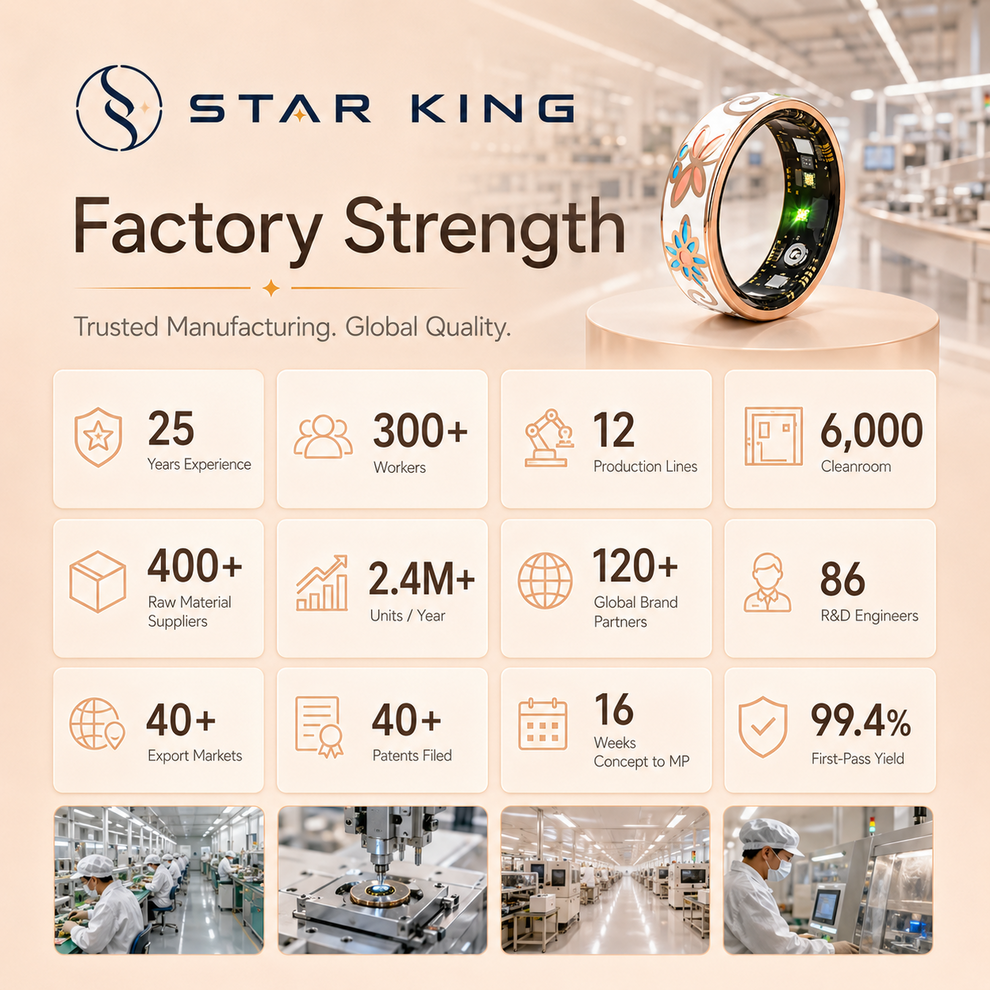
Major manufacturing hubs include China, Taiwan, and South Korea. Private label OEM/ODM specialists can provide end-to-end support.
Evaluation Criteria
- Manufacturing experience: Years in wearable production, factory audits.
- Customization capabilities: Logo, packaging, firmware, app.
- Compliance support: Ability to provide CE, FCC, RoHS, UN38.3 documentation.
- Communication: Responsiveness, English proficiency, project management.
- References: Ask for case studies (without confidential details).
Red Flags
Avoid suppliers that cannot provide test reports, are evasive about MOQs, or pressure you to skip sample validation.
Step 3: Understand OEM, ODM, and Private Label Options
Definitions
- OEM: You provide the design and specifications; the manufacturer builds to your requirements.
- ODM: The manufacturer offers a ready design that you can rebrand with minor changes.
- Private Label: You apply your brand to an existing product, often with custom packaging.
Which Model Fits Your Needs?
| Model | Customization Level | Typical MOQ | Time to Market | Best For |
|---|---|---|---|---|
| OEM | High | 1,000+ | 6–12 months | Unique product, IP ownership |
| ODM | Medium | 500–1,000 | 3–6 months | Faster launch, moderate differentiation |
| Private Label | Low | 300–500 | 1–3 months | Quick market test, brand building |
For corporate wellness, ODM or private label often balances speed and customization. However, if you need specific sensors or algorithms, OEM may be necessary.
Need help selecting the right model for your corporate wellness program? Discuss your requirements with our team.
Step 4: Navigate MOQ, Pricing, and Lead Times
MOQ Factors
MOQ depends on customization: standard colors and packaging have lower MOQs; custom tooling (e.g., unique ring size or shape) requires higher volumes.
Pricing Factors
- Order volume: tiered pricing is common.
- Sensor package: basic HR vs. SpO2 and temperature.
- Materials: titanium, ceramic, or plastic.
- Branding: logo engraving on ring, custom packaging.
- Software: app customization adds cost.
Lead Time Planning
Standard production: 30–45 days. Customization adds 2–4 weeks. Shipping time depends on method; sea freight is cheaper but slower. Consider air freight for pilots.
Negotiation Tips
Request a detailed quote with breakdown. Ask about payment terms (e.g., 30% deposit, 70% before shipment). Build a relationship for better terms on future orders.
Step 5: Validate Samples and Pilot Testing
Sample Evaluation
Order samples for key stakeholders. Test comfort, battery life, data accuracy, and app usability. Compare against your objectives. For data accuracy, you may need to cross-check with a medical-grade device (if feasible).
Pilot Program Design
- Recruit 20–50 employees across departments.
- Run for 4–8 weeks.
- Collect feedback on wearing comfort, app experience, and health insights.
- Measure engagement and preliminary health metrics.
- Evaluate data privacy compliance.
Use pilot results to refine device specifications and program logistics before scaling.
Step 6: Ensure Quality, Compliance, and Data Security
Quality Control
Request the supplier’s QC process: incoming materials, in-process checks, and final testing. Ask for sample test reports (e.g., drop test, waterproof).
Certifications
Certifications depend on product configuration and target market. Common requirements:
- CE for EU: CE marking.
- FCC for US: FCC equipment authorization.
- RoHS for hazardous substances: RoHS.
- UN38.3 for lithium batteries: IATA guidance.
Verify certificates are current and applicable. For markets like Japan or Brazil, additional certifications may apply.
Data Privacy
Employee health data is sensitive. Ensure the device and app comply with GDPR (EU), HIPAA (US healthcare), or other local laws. Data should be encrypted in transit and at rest. Anonymization or aggregation may be needed for reporting.
Step 7: Plan Rollout, Support, and Scale
Logistics
Smart rings contain lithium batteries; shipping requires proper UN38.3 testing and documentation. Work with a freight forwarder experienced in dangerous goods.
Employee Support
Provide setup guides, troubleshooting, and a helpdesk. Consider incentives for participation.
Scaling
Based on pilot success, scale to broader employee groups. Negotiate volume pricing for future orders. Maintain spare units for replacements.
Common Mistakes and Buyer Red Flags
- Ignoring data privacy: Failing to comply with GDPR or HIPAA can lead to fines and reputational damage.
- Skipping pilot: Rolling out without testing may result in low adoption and wasted budget.
- Choosing on price alone: Cheap devices often have poor accuracy and battery life, undermining program goals.
- Overlooking MOQ and lead time: Underestimating these can delay your program.
- Not verifying certifications: Assuming a supplier’s certifications cover your market can cause customs issues.
Practical Buyer Checklist
- Define objectives and KPIs.
- Evaluate at least three suppliers.
- Clarify OEM/ODM/private label options.
- Request samples and test for accuracy and comfort.
- Confirm MOQ, pricing, and lead time in writing.
- Verify compliance certificates for your target markets.
- Ensure data privacy measures are in place.
- Plan a pilot with 20–50 employees.
- Prepare logistics for lithium battery shipping.
- Establish support and replacement process.
Frequently Asked Questions
Q1: What is the typical MOQ for custom smart rings?
MOQ often starts at 500–1,000 units for ODM/private label. Custom OEM designs may require 2,000+ units. Confirm with your supplier based on customization.
Q2: How long does it take to receive smart ring samples?
Samples are usually available in 1–2 weeks if in stock. Custom samples may take 3–4 weeks.
Q3: Are smart rings accurate enough for corporate wellness?
Consumer smart rings provide trends, not medical diagnosis. They are suitable for wellness programs. Validate accuracy with pilot testing.
Q4: What certifications are required for corporate wellness smart rings?
It depends on the target market. CE (EU), FCC (US), RoHS, and UN38.3 for batteries are common. Verify with your supplier and local regulations.
Q5: How do we handle employee data privacy?
Ensure the supplier’s app complies with GDPR or HIPAA. Data should be encrypted and access restricted. Consider anonymizing data for reporting.
Q6: Can we integrate smart ring data with our existing wellness platform?
Many suppliers offer APIs or SDKs for integration. Discuss requirements early with your supplier.
Q7: What is the typical warranty for bulk orders?
Warranties vary; 12–24 months is common. Clarify coverage and spare parts availability.
Conclusion
Procuring smart rings for corporate wellness is a strategic initiative that requires careful planning. By following this 7-step guide, procurement teams can select the right supplier, validate product performance, ensure compliance, and execute a successful program. Start with a pilot, measure results, and scale based on data.
Ready to Launch Your Corporate Wellness Program?
Contact STAR KING to discuss your smart ring requirements, request samples, or get a quote for your corporate wellness initiative. Our OEM/ODM experts can help you customize a solution that meets your employees’ needs and your compliance standards.
Request a Quote or Discuss Your Project
Buyers can also review STAR KING Smart Rings OEM/ODM options to compare product positioning, customization scope, and sample planning.
Discuss Your Smart Wearable OEM/ODM Project
Planning a smart ring, smart watch, smart band, AI glasses, AI translator, or AI voice mouse project? Contact STAR KING to discuss product positioning, sample testing, customization scope, certification requirements, lead time, and quotation details.

Team Star King

Scan WhatsApp QR code