
Smart Watches for Importers: 7 Critical Checks Before You Buy for the US Market in 2026
October 24, 2026 · Team Star King

Smart Watches for Importers: 7 Critical Checks Before You Buy for the US Market in 2026
Smart watches for importers are not a simple product category to source. Before you place a purchase order for the US market, you need to verify seven areas: FCC and battery compliance, app and firmware stability, sensor accuracy claims, MOQ and landed cost, quality control and testing, packaging and branding, and after-sales support. Each check protects you from chargebacks, customs delays, and returns that erase margins. This guide explains what to ask, what to test, and what to avoid when evaluating smart watch suppliers in 2026.
Table of Contents
Table of Contents
Direct Answer: Importers buying smart watches for the US market should confirm FCC certification, UN38.3 battery reports, and app compatibility before ordering. Request pre-production samples, verify sensor claims with side-by-side testing, and calculate landed cost including duties and returns. A reliable supplier provides test reports, clear MOQ tiers, and firmware update commitments.
smart watches for importers: Table of Contents
- 1. Why Smart Watch Sourcing Fails for New Importers
- 2. Check 1: FCC and RF Compliance
- 3. Check 2: Battery Safety and UN38.3
- 4. Check 3: App and Firmware Stability
- 5. Check 4: Sensor Accuracy and Health Claims
- 6. Check 5: MOQ, Pricing, and Landed Cost
- 7. Check 6: Quality Control and Testing Protocols
- 8. Check 7: Packaging, Branding, and After-Sales
- 9. Key Facts for Buyers
- 10. Comparison Table: Supplier Evaluation Criteria
- 11. Common Mistakes and Buyer Red Flags
- 12. Practical Buyer Checklist
- 13. FAQ
- 14. Conclusion

Key Takeaways
- FCC certification is mandatory for smart watches with Bluetooth or Wi-Fi sold in the US; verify the FCC ID and test reports.
- Lithium-polymer batteries require UN38.3 test reports for air shipping; missing reports can halt customs clearance.
- App stability and firmware update commitments separate reliable suppliers from risky ones.
- Sensor accuracy claims for heart rate and SpO2 should be tested against a reference device; consumer devices are not medical devices.
- Landed cost includes product cost, freight, duties (typically 0-5% depending on classification), and return reserves.
- Pre-shipment inspection and aging tests reduce defect rates and chargebacks.
- Clear MOQ tiers and packaging customization options protect brand launch budgets.

1. Why Smart Watch Sourcing Fails for New Importers
New importers often underestimate the regulatory and technical complexity of smart watches. Unlike simple accessories, a smart watch combines a radio transmitter (Bluetooth/BLE), a lithium battery, a touch display, and firmware that must integrate with iOS and Android. Each component introduces a failure point that can lead to customs seizure, product returns, or legal exposure.
Common failure modes include: missing FCC certification, unreported battery test failures, app crashes after OS updates, inaccurate health readings that trigger complaints, and packaging that does not meet retail labeling requirements. Importers who treat smart watches like generic consumer electronics often face costly surprises at the port or in the hands of customers.
This guide is structured as seven checks. Each check corresponds to a procurement decision you must make before signing a purchase order. The checks are written for importers at the awareness stage—those exploring the category or evaluating their first supplier.
2. Check 1: FCC and RF Compliance
Any smart watch that transmits radio frequency signals (Bluetooth, Wi-Fi, cellular) must comply with Federal Communications Commission (FCC) rules for the US market. The FCC requires equipment authorization—typically certification for intentional radiators like Bluetooth devices. Without a valid FCC ID, your shipment can be refused entry, and selling non-compliant devices can lead to fines and forced recalls.
Ask your supplier for the FCC ID and verify it in the FCC’s public database. The FCC provides an FCC ID search tool where you can confirm the grantee and equipment class. Do not accept a certificate image alone; cross-check the ID.
Also confirm whether the certification covers the exact model and firmware version you plan to import. Suppliers sometimes certify one variant and ship another with different RF parameters. This is a red flag. Request a copy of the test report summary and check the frequency bands and maximum output power against the device specifications.
For devices with additional features like GPS or NFC, confirm those radios are included in the certification scope. If the supplier cannot provide a valid FCC ID, consider it a disqualifying issue for the US market.
3. Check 2: Battery Safety and UN38.3
Smart watches use lithium-polymer or lithium-ion batteries. These batteries are classified as dangerous goods for transportation, and air carriers require UN38.3 test reports. UN38.3 is a set of tests defined in the IATA Dangerous Goods Regulations that evaluate battery safety under altitude, temperature, vibration, shock, and short-circuit conditions.
Ask for the UN38.3 test report summary and the MSDS (Material Safety Data Sheet). The report should match the battery model and capacity used in your watch. If the supplier switches battery suppliers without updating reports, your shipment may be non-compliant.
Additionally, check for battery safety features: overcharge protection, thermal cutoff, and short-circuit protection. These are typically built into the battery protection circuit module (PCM). Request the PCM specification and confirm it is certified.
For US importers, also consider whether the battery falls under EPA or DOT regulations. The DOT provides guidance on lithium battery shipping. While consumer devices often ship under exceptions, the documentation must still be accurate.
4. Check 3: App and Firmware Stability
The companion app is a critical part of the smart watch experience. A poorly built app leads to negative reviews, returns, and support burden. Before committing, test the app on both iOS and Android devices, including older OS versions that your target customers may use.
Ask about firmware update policy. Does the supplier provide over-the-air (OTA) updates? How often? What is the process for reporting bugs? A supplier that cannot describe a firmware update roadmap is a risk.
Also clarify data privacy practices. The app may collect health data; ensure the supplier’s privacy policy complies with applicable US state laws (e.g., California Consumer Privacy Act). For B2B buyers, data handling is increasingly part of due diligence.
If you plan to white-label the app, confirm whether the supplier supports custom app branding and what the development cost and timeline are. This is often part of an OEM/ODM arrangement. STAR KING offers private label OEM/ODM solutions that include app customization options; confirm specifics with their team.
5. Check 4: Sensor Accuracy and Health Claims
Smart watches commonly include heart rate, blood oxygen (SpO2), and sleep tracking sensors. These are consumer-grade features, not medical devices. The FDA regulates medical devices, and consumer smart watches are generally not cleared as medical devices unless specifically authorized. Importers must avoid marketing these features as diagnostic tools.
To evaluate sensor accuracy, request sample units and compare readings against a known reference device (e.g., a pulse oximeter for SpO2 or a chest strap for heart rate) under controlled conditions. Test at rest and during mild activity. Variability is normal, but consistent large deviations indicate poor sensor quality.
Ask the supplier for any validation data they have, but treat it as indicative, not clinical proof. For US marketing, use language like “tracks heart rate” rather than “monitors heart condition.” The FDA provides guidance on medical devices; consult it if you plan health-related claims.
Also check sensor specifications: optical sensor type, LED wavelengths, and sampling rate. These details help you compare models. For a deeper look at wearable sensor technology, see our smart watches product page for specification examples.
6. Check 5: MOQ, Pricing, and Landed Cost
Minimum order quantity (MOQ) and pricing structure vary widely among suppliers. New importers often face high MOQs (e.g., 1,000 units) that strain cash flow. Ask for MOQ tiers: sample order, trial order, and mass production. Some suppliers offer lower MOQs for standard models and higher MOQs for customized versions.
Pricing should be broken down by component and customization. Request a quotation that separates product cost, packaging, and branding. Be wary of quotes that seem significantly lower than market average; they may indicate lower battery capacity, older chipsets, or skipped certification.
Landed cost calculation includes:
- Product unit price
- Freight (air or sea) and insurance
- US import duties (HS code classification; smart watches typically fall under 8517.62 or 9102.12—confirm with a customs broker)
- Merchant processing fees and chargebacks reserve
- Inland transportation and warehousing
Use a landed cost template to compare suppliers. A difference of $2 per unit can change your retail strategy. For cost analysis guidance, see our blog resources.
7. Check 6: Quality Control and Testing Protocols
Quality control (QC) is where many importers get caught. Ask about the supplier’s QC process: incoming material inspection, in-process checks, and pre-shipment inspection. A robust supplier should have documented procedures and records.
Key tests for smart watches include:
- Aging test: power on for 24-48 hours to catch early failures
- Drop test: from 1.5m onto hard surface
- Waterproof test: IP rating verification (if claimed)
- Button and touchscreen endurance
- Charging cycle test
Request a pre-shipment inspection report from a third party like SGS or Bureau Veritas, or use the supplier’s internal report. Ensure the inspection covers functionality, appearance, and packaging. For more on testing standards, refer to ISO 9001 quality management principles, which many factories follow.
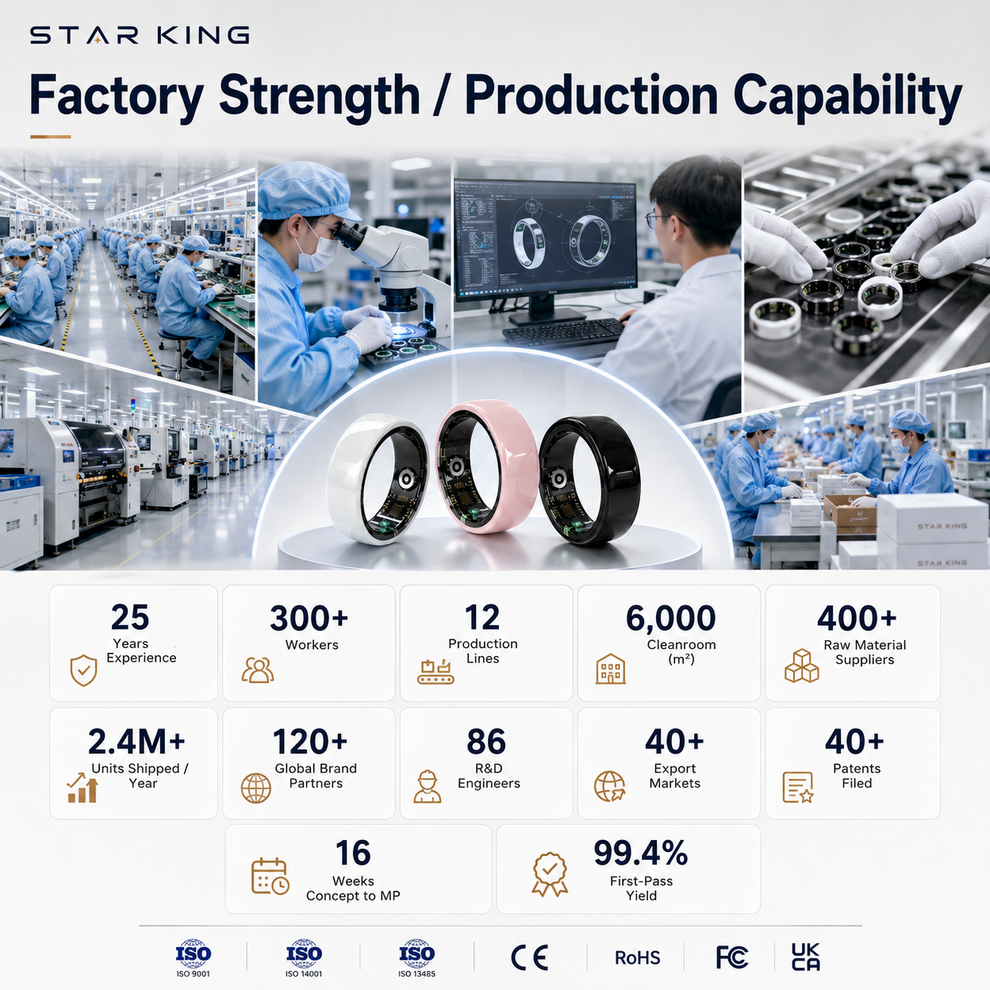
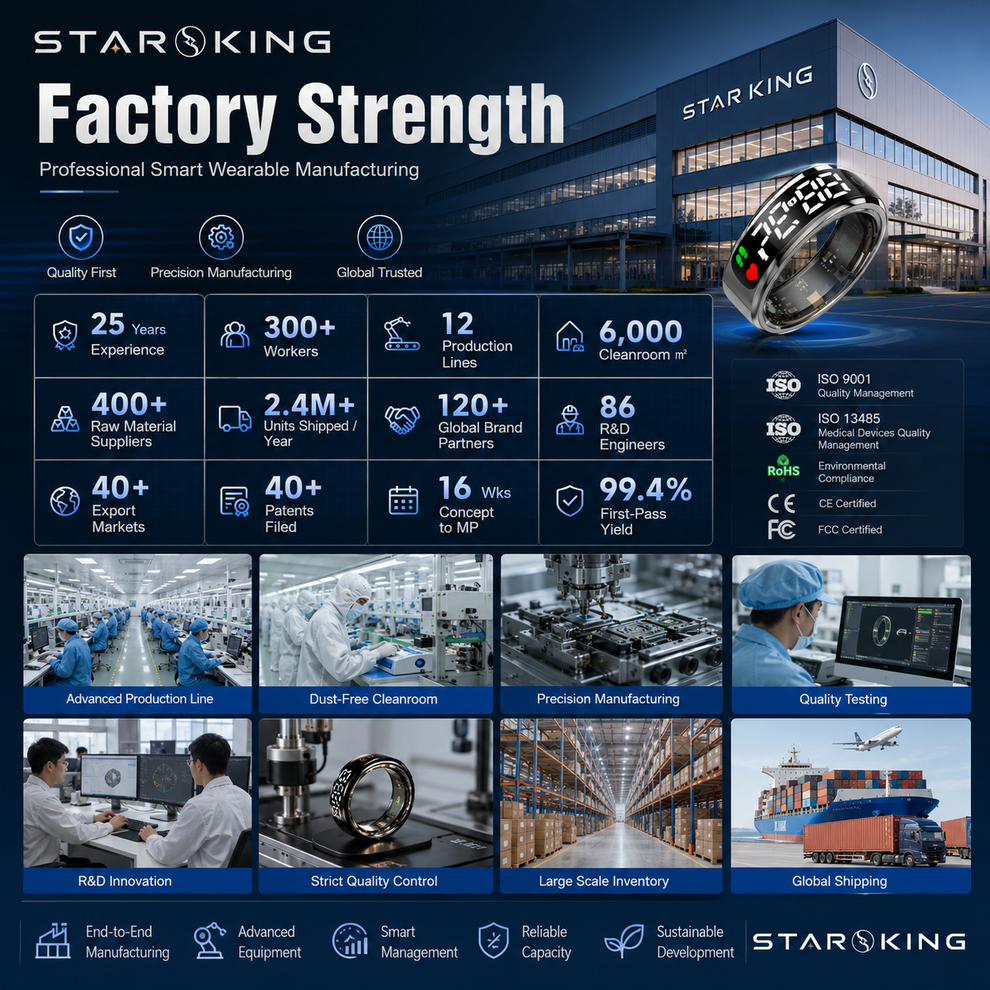
If the supplier cannot provide test reports, consider it a risk. STAR KING’s quality control process can be discussed when you request samples.
8. Check 7: Packaging, Branding, and After-Sales
Packaging is your brand’s first physical touchpoint. Confirm whether the supplier offers custom packaging (box, manual, inserts) and what the MOQ is for custom printing. Also ask about logo placement on the watch and strap.
After-sales support includes warranty terms, spare parts availability, and repair/replacement policy. For the US market, a standard warranty is 12 months. Clarify who handles returns: you or the supplier. Ask about the defect rate threshold and how replacements are shipped.
Also consider spare parts like chargers and straps. Can you order these separately? A supplier that offers spare parts reduces your after-sales friction.
Key Facts for Buyers
| Check | What to Verify | Why It Matters |
|---|---|---|
| FCC Compliance | Valid FCC ID; test report matches model | Mandatory for US sale; prevents customs seizure |
| Battery Safety | UN38.3 report; MSDS; PCM specs | Required for air shipping; safety liability |
| App Stability | Test on iOS/Android; update policy | Reduces returns and negative reviews |
| Sensor Accuracy | Compare with reference device | Prevents false health claims; consumer trust |
| MOQ & Landed Cost | MOQ tiers; full cost breakdown | Protects cash flow and margin |
| Quality Control | Pre-shipment inspection; test reports | Lowers defect rate and chargebacks |
| Packaging & After-Sales | Custom packaging MOQ; warranty terms | Brand experience and customer retention |
Comparison Table: Supplier Evaluation Criteria
Use this table to score potential suppliers on a scale of 1-5 for each criterion.
| Criterion | Weight | What to Look For | Red Flag |
|---|---|---|---|
| Certification | High | FCC ID, UN38.3, RoHS reports available | Cannot provide ID or reports |
| App & Firmware | High | Regular updates; responsive bug fixes | No update history; app crashes |
| Sensor Performance | Medium | Consistent readings vs reference | Large deviations; vague specs |
| MOQ Flexibility | Medium | Tiered MOQ; sample orders | Only high MOQ; no samples |
| QC Process | High | Documented inspection; third-party reports | No test reports; verbal assurance only |
| Communication | Medium | Responsive; clear technical answers | Slow replies; evasive answers |
| After-Sales | Medium | Warranty; spare parts; repair process | No warranty; no spare parts |
Common Mistakes and Buyer Red Flags
- Mistake 1: Accepting a certificate image without verifying the FCC ID. Always cross-check in the FCC database.
- Mistake 2: Skipping UN38.3 verification. Air carriers may reject shipments without it.
- Mistake 3: Not testing the app on multiple OS versions. App crashes after iOS updates are common.
- Mistake 4: Assuming sensor accuracy from marketing claims. Test with a reference device.
- Mistake 5: Ignoring landed cost components like duties and returns. A low unit price can hide high total cost.
- Mistake 6: Ordering without pre-shipment inspection. Defect rates above 2% can erode margins.
- Mistake 7: Overlooking packaging MOQ. Custom boxes may require 1,000+ units, delaying launch.
Red Flags: Supplier cannot provide FCC ID; refuses sample orders; no UN38.3 report; app has not been updated in over a year; no warranty terms; pressure to pay full deposit upfront.
Practical Buyer Checklist
Use this checklist before finalizing any smart watch order for the US market.
- ☐ FCC ID verified in FCC database and matches model
- ☐ UN38.3 test report and MSDS on file
- ☐ App tested on iOS and Android; update policy confirmed
- ☐ Sensor accuracy compared with reference device
- ☐ MOQ tiers and sample order terms negotiated
- ☐ Landed cost calculated including duties and returns
- ☐ Pre-shipment inspection arranged
- ☐ Packaging and logo customization MOQ confirmed
- ☐ Warranty and spare parts policy documented
- ☐ Payment terms protect against non-conformance
FAQ
1. Do smart watches need FCC certification for the US market?
Yes. Smart watches with Bluetooth, Wi-Fi, or cellular radios require FCC equipment authorization. Verify the FCC ID in the FCC database; a certificate image alone is not sufficient.
2. What is UN38.3 and why does it matter for importing smart watches?
UN38.3 is a set of safety tests for lithium batteries required for air transport. Without a valid UN38.3 report, carriers may refuse your shipment or customs may detain it.
3. What MOQ should I expect for private label smart watches?
MOQs vary by supplier and customization level. Standard models may have MOQs starting at 500-1,000 units; custom packaging and app branding often require higher volumes. Always request tiered MOQ options.
4. Are smart watch health sensors accurate enough for medical use?
No. Consumer smart watch sensors are not medical devices and are not intended for diagnosis. They provide general wellness tracking. Do not market them as medical devices unless they have FDA clearance.
5. How can I verify a supplier’s quality control process?
Request documented QC procedures, test reports (aging, drop, waterproof), and a pre-shipment inspection report. Third-party inspection from SGS or Bureau Veritas adds assurance.
6. What is the typical lead time for smart watch orders from China?
Lead times depend on order volume and customization. Sample orders may take 7-15 days; mass production typically 30-45 days after sample approval. Confirm schedules with your supplier.
7. How do I calculate landed cost for smart watches?
Add product cost, freight, insurance, US import duties (check HS code with a customs broker), and a reserve for returns and chargebacks. Use a landed cost template to compare suppliers.
Conclusion
Smart watches for importers offer a large US market opportunity, but success depends on disciplined verification. The seven checks in this guide—FCC compliance, battery safety, app stability, sensor accuracy, MOQ and landed cost, quality control, and packaging/after-sales—form a due diligence framework. Use the checklist and comparison table to evaluate suppliers objectively. Avoid red flags like missing certifications or untested apps. By investing time in sample testing and document verification, you reduce the risk of customs delays, returns, and brand damage.
As you move from awareness to evaluation, request samples and test reports from potential suppliers. STAR KING supplies smart watches and offers OEM/ODM support; their team can clarify certification status and customization options for your target market.
Ready to Evaluate Smart Watches for Your US Market Launch?
Request product samples and certification documentation to start your due diligence. Discuss your MOQ, packaging, and app requirements with our team.
Discuss Your Smart Wearable OEM/ODM Project
Planning a smart ring, smart watch, smart band, AI glasses, AI translator, or AI voice mouse project? Contact STAR KING to discuss product positioning, sample testing, customization scope, certification requirements, lead time, and quotation details.

Team Star King

Scan WhatsApp QR code
Leave a Reply