
Smart Ring Private Label in 2026: 7 Critical Checks for Global Buyers
October 23, 2026 · Team Star King
Smart Ring Private Label in 2026: 7 Critical Checks for Global Buyers
Launching a smart ring private label in 2026 requires more than finding a low-cost supplier. It demands a structured approach to supplier evaluation, product specifications, quality assurance, and regulatory compliance. This guide distills the essential checks—from OEM/ODM capability to MOQ and lead time—that private-label brands must perform to avoid costly mistakes and build a reliable supply chain. Whether you are an importer, distributor, or e-commerce seller, these seven checks will help you source smart rings with confidence and protect your brand’s reputation.
Table of Contents
Table of Contents
smart ring private label: Table of Contents
- Short Answer: What Should Private-Label Brands Check Before Sourcing Smart Rings?
- Key Takeaways
- Key Facts for Buyers
- 1. Supplier Evaluation: Verify OEM/ODM Capabilities
- 2. Product Specifications and Feature Trade-offs
- 3. MOQ and Pricing Factors
- 4. Sample Testing and Validation
- 5. Quality Control and Manufacturing Standards
- 6. Certification and Market Compliance
- 7. Supply Chain and Lead Time Planning
- Common Mistakes and Buyer Red Flags
- Practical Buyer Checklist
- FAQ
- Conclusion
Short Answer: What Should Private-Label Brands Check Before Sourcing Smart Rings?
Private-label brands should verify a supplier’s OEM/ODM capabilities, product specifications, MOQ and pricing, sample quality, quality control processes, certification status for target markets, and supply chain reliability. These checks help ensure product quality, regulatory compliance, and on-time delivery, reducing risks and total landed cost.

Key Takeaways
- Prioritize suppliers with proven OEM/ODM experience and transparent communication.
- Balance product features with cost and target market needs; avoid over-specification.
- Always request and test samples before committing to bulk orders.
- Confirm certification requirements (e.g., CE, FCC, RoHS) early and verify supplier claims.
- Plan MOQ and lead times carefully to avoid stockouts or excess inventory.

Key Facts for Buyers
| Factor | Typical Range / Consideration |
|---|---|
| MOQ | 500–1,000 units for custom private label; lower for standard models |
| Lead Time | 30–60 days after sample approval and deposit, depending on customization |
| Certification | CE, FCC, RoHS, UN38.3 typically required; verify for each market |
| Sample Cost | US$50–200 per unit, often refundable against bulk order |
| Tooling Fee | May apply for custom designs; amortized over production |
1. Supplier Evaluation: Verify OEM/ODM Capabilities
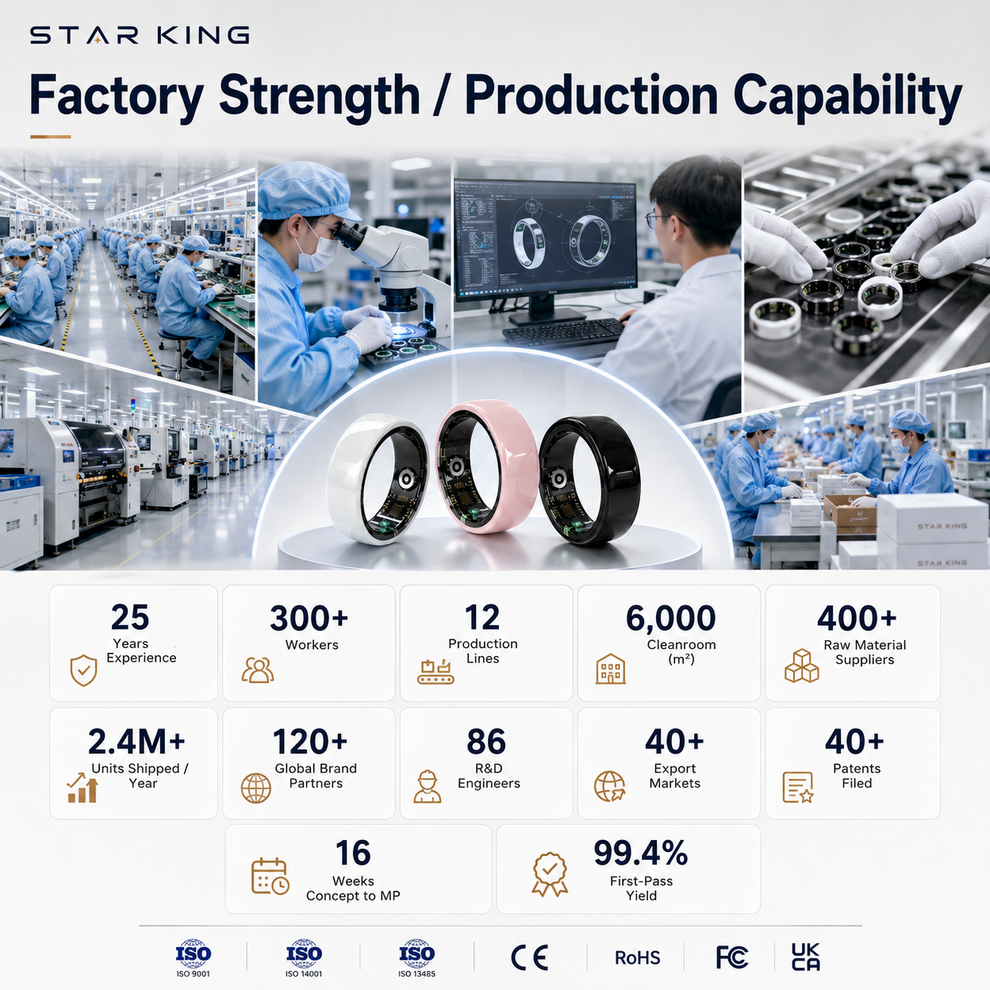
Before engaging, assess the supplier’s ability to support your private label. A reliable smart ring OEM should offer both OEM (manufacturing to your design) and ODM (adapting their existing design) services. Request their company profile, factory audit reports, and client references. Check if they have in-house R&D, firmware customization, and app development—critical for differentiation.
STAR KING, for example, provides flexible private label solutions with options for logo, packaging, and app customization. Verify that the supplier’s capabilities align with your brand’s roadmap and technical requirements.
2. Product Specifications and Feature Trade-offs
Smart rings vary widely in sensors (heart rate, SpO2, temperature), battery life, water resistance, and connectivity. Define must-have features for your target market. For instance, health-focused brands may prioritize sleep and recovery tracking, while fitness brands need accurate step and calorie monitoring. Balance features with cost and manufacturing complexity; over-specifying can inflate MOQ and price.
Key Specifications to Confirm
- Sensor types and accuracy claims
- Battery life (typical 3–7 days)
- Water resistance rating (e.g., IP68)
- Compatible app platforms (iOS/Android)
- Material and sizing options
3. MOQ and Pricing Factors
Minimum order quantity (MOQ) and pricing are often negotiable based on customization level and order volume. Standard models may have lower MOQs (e.g., 500 units), while fully custom designs require higher volumes (1,000+). Pricing is influenced by components, packaging, and certification costs. Request a detailed quotation breakdown and clarify what is included (e.g., branding, testing).
4. Sample Testing and Validation
Always order samples to evaluate build quality, sensor performance, app usability, and battery life. Test the ring in real-world conditions and compare against your specifications. A reputable supplier will provide samples within 1–2 weeks and may refund the sample cost upon bulk order. Document any issues and request improvements before mass production.
5. Quality Control and Manufacturing Standards
Inquire about the supplier’s quality management system (e.g., ISO 9001) and testing procedures. Key checks include health and fitness wearable testing for sensor accuracy, drop testing, waterproof testing, and aging tests. Ask for pre-shipment inspection reports and understand their defect rate policy. Consistent quality is essential for brand credibility.
6. Certification and Market Compliance
Certification requirements depend on your target markets. For the US, FCC and FDA (if making health claims) may apply; for Europe, CE, RoHS, and REACH. Smart rings contain lithium batteries, so UN38.3 and MSDS are often needed for shipping. Verify that the supplier can provide valid certificates and test reports. Do not assume all products are certified; confirm per configuration. Refer to official sources like the FCC and EU CE marking for guidance.
7. Supply Chain and Lead Time Planning
Understand the supplier’s production capacity, lead times, and logistics. Factors like Chinese New Year and component shortages can affect schedules. Request a production timeline and plan buffer stock. For international shipping, confirm battery shipping compliance and Incoterms. A transparent supplier will communicate proactively about delays.
Common Mistakes and Buyer Red Flags
- Choosing solely on price without verifying quality.
- Failing to confirm certification for each target market.
- Not testing samples thoroughly before bulk order.
- Overlooking MOQ implications on cash flow.
- Ignoring after-sales support and warranty terms.
Practical Buyer Checklist
- Supplier background and factory audit report verified.
- Product specifications aligned with target market.
- Samples tested and approved.
- MOQ and pricing negotiated and documented.
- Quality control process and inspection reports reviewed.
- Certification documents verified for all target markets.
- Lead times and shipping terms confirmed.
- After-sales and warranty terms agreed.
FAQ
What is the typical MOQ for private label smart rings?
MOQ often ranges from 500 to 1,000 units for custom branding, but can be lower for standard models. Negotiate based on your order volume and long-term potential.
How long does it take to get samples?
Samples are usually available within 1–2 weeks. Allow additional time for custom designs or firmware modifications.
What certifications are needed for smart rings?
Common requirements include CE (EU), FCC (US), RoHS, and UN38.3 for battery shipping. Confirm specific needs with your supplier and regulatory experts.
Can I customize the app for my brand?
Many ODM suppliers offer app customization, such as logo and color scheme. Full app development may require additional fees and time.
What is the typical lead time for bulk orders?
Production lead time is typically 30–60 days after sample approval and deposit, depending on order size and customization.
How do I ensure quality during production?
Request pre-shipment inspection and consider third-party inspection services. Maintain clear quality standards in your contract.
Conclusion
Sourcing smart rings for private label requires diligence. By following these seven critical checks, you can select a reliable partner, mitigate risks, and deliver a product that meets your brand’s standards. Remember to verify all claims and plan for compliance from the start.
Ready to discuss your smart ring private label project? Request a quotation or request product samples to start your evaluation.
Discuss Your Smart Wearable OEM/ODM Project
Planning a smart ring, smart watch, smart band, AI glasses, AI translator, or AI voice mouse project? Contact STAR KING to discuss product positioning, sample testing, customization scope, certification requirements, lead time, and quotation details.

Team Star King

Scan WhatsApp QR code
Leave a Reply