
smart watches for importers: Smart Watches for US Importers: 7 Critical Sourcing Checks Before You Commit
November 4, 2026 · Team Star King

Smart Watches for Importers: 7 Critical Sourcing Checks Before You Commit
Smart watches for importers come down to seven verifiable checks: supplier identity and factory capability, OEM/ODM scope, FCC and UN38.3 readiness, sample and firmware validation, MOQ and landed-cost math, app and data dependencies, and warranty plus spare-parts terms. US importers who confirm these before issuing a purchase order avoid the most expensive failure mode in wearable sourcing: a container of devices that cannot legally ship, cannot connect reliably, or cannot be supported after the sale.
Table of Contents
Table of Contents
This guide is written for US importers and distributors in the evaluation stage. It assumes you already know the category is crowded and that a low unit price is not the same as a low landed cost. Each section below gives you a check you can run, the reason it matters commercially, and how to verify it in practice.
smart watches for importers: Table of Contents
- Short Answer
- Key Takeaways
- Key Facts for Buyers
- Check 1: Verify the Supplier and the Actual Factory
- Check 2: Define OEM, ODM, and Private Label Scope
- Check 3: Confirm Certification and Target-Market Compliance
- Check 4: Validate Samples, Sensors, and Firmware
- Check 5: Do the MOQ and Landed-Cost Math
- Check 6: Map the App, Firmware, and Data Dependencies
- Check 7: Secure Warranty, Spare Parts, and After-Sales Terms
- OEM vs ODM vs Private Label Comparison
- Common Mistakes and Buyer Red Flags
- Practical Buyer Checklist
- FAQ
- Conclusion
Short Answer
To source smart watches for importers into the US, confirm the supplier’s identity and factory capability, agree in writing on OEM/ODM/private-label scope, and verify FCC, UN38.3, and relevant battery documentation against your exact SKU rather than a generic certificate pack. Then validate samples across firmware and app builds, calculate landed cost at your real MOQ, and lock warranty and spare-parts terms before mass production.
Key Takeaways
- Treat “smart watches for importers” as a procurement project with seven gates, not a price comparison.
- Certification applies to a specific product configuration and target market; generic certificate folders are not proof.
- MOQ drives unit price, tooling amortization, and your cash exposure; model it with freight and duties before you commit.
- App and firmware dependencies decide whether you can support the product after the sale.
- Samples must be tested as a full system: hardware, sensors, firmware, and companion app.
- Warranty, spare parts, and RMA handling should be written into the supply agreement, not agreed informally.
Key Facts for Buyers
| Decision Area | What to Confirm | Why It Matters Commercially | How to Verify |
|---|---|---|---|
| Supplier identity | Legal entity, factory address, production scope | Reduces fraud and quality risk | Video audit, business license, third-party inspection |
| OEM/ODM scope | Who owns design, tooling, and firmware changes | Affects IP and long-term flexibility | Written scope document and tooling ownership clause |
| US compliance | FCC equipment authorization, battery test summary, UN38.3 | Non-compliant stock can be unsellable | Test reports tied to model numbers, supplier declarations |
| Samples | Sensor accuracy, connect stability, battery behavior | Protects reviews and returns | Structured multi-unit sample testing |
| MOQ and cost | Price breaks, tooling fees, freight, duty | Determines real margin | Landed-cost model at your order volume |
| App dependency | App ownership, update policy, data handling | Affects support and privacy exposure | Written app support and data terms |
| After-sales | Warranty length, RMA process, spare parts | Controls returns cost | Contract clauses and spare-part price list |

Check 1: Verify the Supplier and the Actual Factory
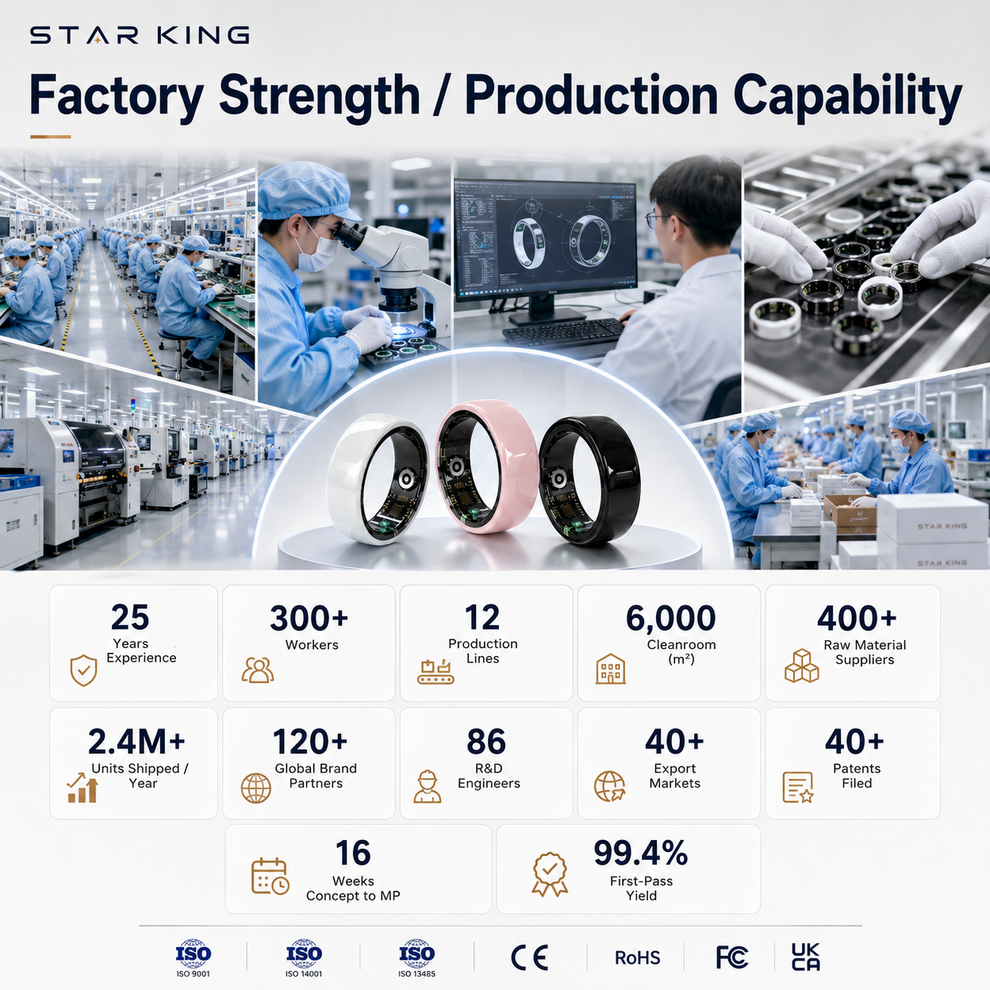
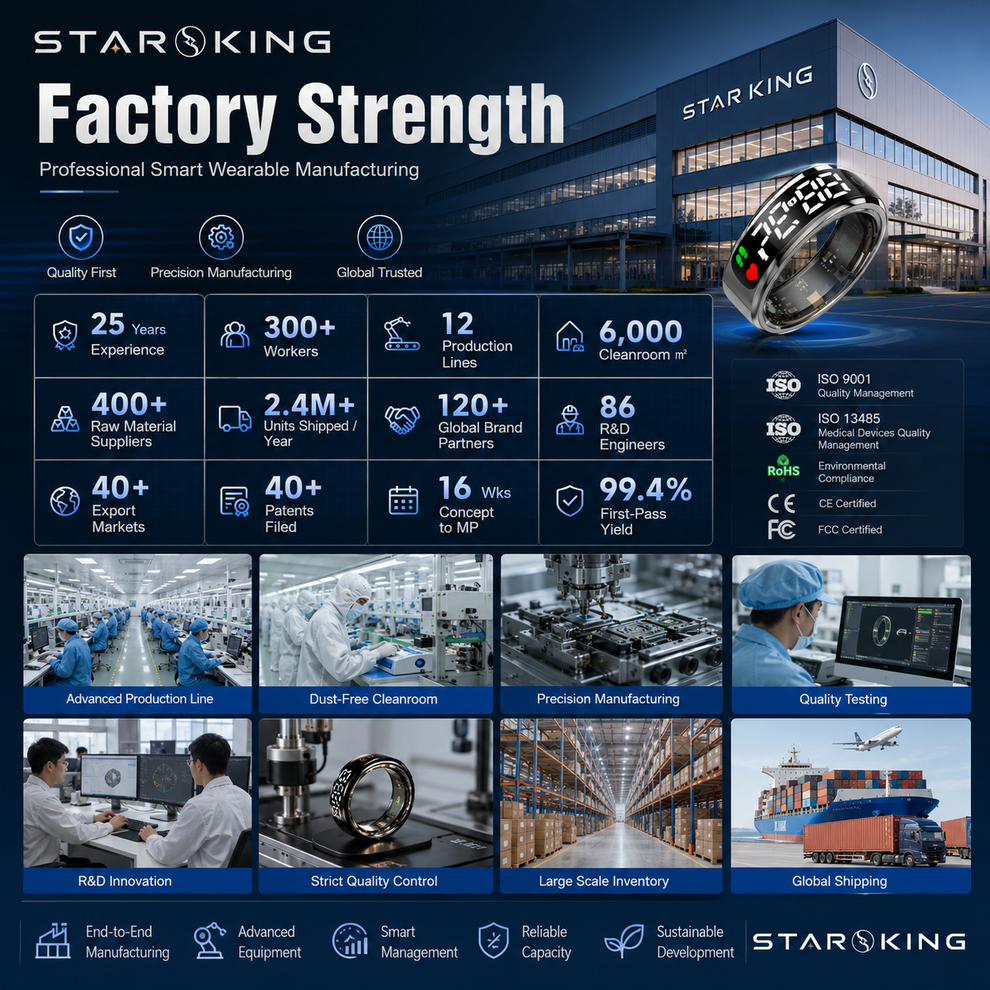
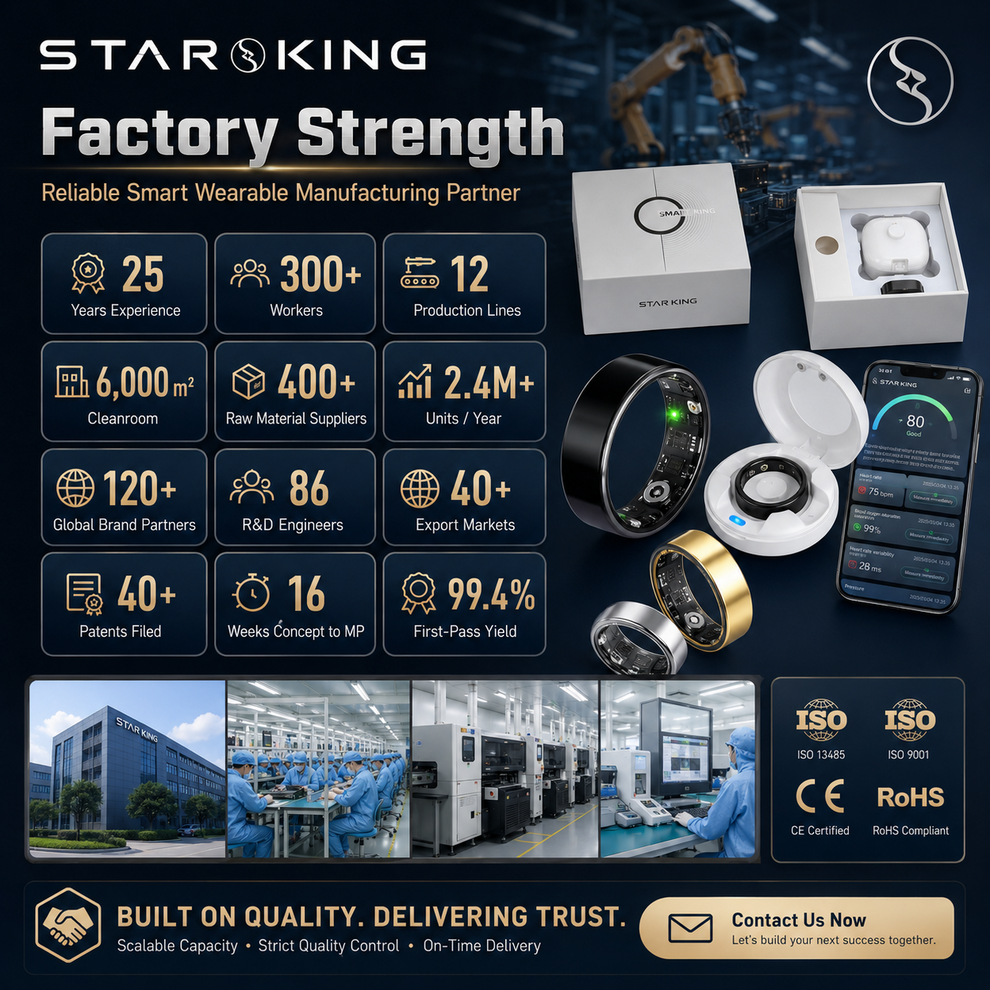
Before discussing price, confirm who you are buying from. Many trading companies present themselves as manufacturers, and many genuine factories sell through intermediaries. Neither arrangement is automatically wrong, but you need to know which one you are dealing with because it changes your ability to control quality, tooling, and lead times.
What to request
- The legal company name and registration details matching the bank account you will pay.
- The production address, not just a sales office address.
- A live or recorded video walkthrough of assembly, testing, and packing areas.
- Named contact persons for sales, engineering, and quality.
Why it matters
If the supplier does not control the production line, your ability to push a firmware change or resolve a defect batch weakens. For a first order, a third-party factory audit is a reasonable cost relative to the value of the shipment.
For a deeper look at how STAR KING approaches wearable manufacturing and private-label programs, review the private label OEM/ODM solution page and compare what is stated there against your own requirements.
Check 2: Define OEM, ODM, and Private Label Scope
The words OEM, ODM, and private label are often used interchangeably in supplier conversations, which creates cost and ownership confusion later. Define the scope in writing before you request a quotation.
A practical definition
ODM means the supplier owns an existing design and you select it, possibly with limited customization. OEM usually means the product is built to your specification, which may involve new tooling, firmware, or hardware changes. Private label typically means you brand an existing platform with your logo, packaging, and app identity.
Questions that expose scope gaps
- Who owns the tooling, and can it be transferred if we change suppliers?
- Which firmware changes are included in the quoted price, and which are chargeable?
- Can the app name, icon, and onboarding screens carry our brand?
- What is the minimum quantity for a custom enclosure versus a logo and packaging change?
Why it matters
Scope determines your differentiation and your exit cost. A private-label program with a shared app is faster to launch but less defensible. A deeper OEM program takes longer and costs more, but gives you product control.
Check 3: Confirm Certification and Target-Market Compliance
For the US market, radio-frequency devices such as Bluetooth-enabled smart watches are subject to FCC equipment authorization rules. Lithium batteries add transport and safety documentation requirements. These are not box-ticking exercises; they determine whether your stock can be sold and shipped.
Review the FCC’s guidance on equipment authorization procedures and the FAA/PHMSA rules on lithium batteries before you approve a shipment plan. For battery transport testing, the UN Manual of Tests and Criteria, including UN38.3, is the relevant reference.
What to ask for
- Test reports that reference the exact model number and hardware revision you are buying.
- Battery documentation including UN38.3 test summary and, where applicable, MSDS.
- Signed declarations covering the configuration and destination market.
- Clarity on which certifications are already held and which are project-specific.
Why it matters
Certification status typically depends on the specific product configuration, radio module, battery, and target market. A supplier may hold documentation for one model but not another. Buyers should verify rather than assume, and should require documentation as a condition of shipment.
[STAR KING TO CONFIRM: available certification documentation by smart watch model and target market]
Check 4: Validate Samples, Sensors, and Firmware
A sample is not a product until you test it as a system. Smart watches combine sensors, firmware, and a companion app, and failures often appear at the seams between them.
A structured sample test
- Order at least three to five units from the production-intent build, not hand-made golden samples.
- Test heart rate and blood oxygen readings against a known reference device under controlled conditions.
- Check Bluetooth pairing stability across iOS and Android versions your buyers actually use.
- Run a battery drain test under typical daily use and compare against the quoted life.
- Test charging behavior, waterproof claims at the stated rating, and drop resistance.
- Review app permissions, account handling, and data storage statements.
Why it matters
Sensor and app issues drive one-star reviews and returns, which erode margin faster than a slightly higher unit price. Document your test results and use them as acceptance criteria for mass production.
If you need a closer look at the category before sampling, review STAR KING’s smart watch product range to understand available form factors and feature sets.
Check 5: Do the MOQ and Landed-Cost Math
Unit price without MOQ, freight, duty, and returns allowance is not a decision input. Build a landed-cost model before you negotiate.
Cost elements to model
- Ex-works or FOB unit price at your real order quantity.
- Tooling or setup fees, amortized across the expected program life.
- Freight, insurance, and any lithium battery handling surcharges.
- Import duty and fees for the product classification you will use.
- Inspection, testing, and sample costs.
- Returns and warranty reserve as a percentage of revenue.
Why it matters
MOQ tiers often move unit price by a meaningful margin, but higher volume increases cash exposure and inventory risk. The right MOQ is the one your sell-through plan can absorb within your working-capital cycle, not the lowest price on the quotation sheet.
For a broader view of how wearables fit into health and fitness channel plans, see the health and fitness wearables solution page.
Check 6: Map the App, Firmware, and Data Dependencies
The companion app is where many importing programs fail quietly. If the app is not maintained, your devices lose value after the sale regardless of hardware quality.
What to establish in writing
- Who owns and operates the app, and who pays for updates.
- The update policy and expected support window.
- Whether the app can carry your brand identity and store listing.
- How user data is stored, and what privacy statements apply.
- What happens to existing devices if the app is discontinued.
Why it matters
Health-related data handling attracts scrutiny in the US. Buyers should review app permissions and privacy documentation and confirm that marketing claims match the app’s actual capabilities. Do not describe consumer wellness features as medical functions unless the product has the appropriate regulatory clearance, which is a separate and more demanding path.
Check 7: Secure Warranty, Spare Parts, and After-Sales Terms
After-sales terms are a sourcing decision, not a customer-service detail. Define them before mass production.
Terms to negotiate
- Warranty duration and what it covers versus what it excludes.
- RMA process, including who pays return freight and how credits are issued.
- Spare-part availability for straps, chargers, and screens.
- Defect-rate thresholds that trigger replacement or credit.
- Documentation language and packaging inserts for the US market.
Why it matters
A clear RMA framework protects both parties and reduces disputes. It also signals whether the supplier has supported importing programs before, since experienced suppliers usually have defined processes.
OEM vs ODM vs Private Label Comparison
| Model | Typical Customization | Relative Speed to Market | Relative Cost | IP and Tooling | Best For |
|---|---|---|---|---|---|
| Private label | Logo, packaging, app identity | Fastest | Lowest | Supplier-owned platform | Importers testing a new channel |
| ODM | Selection from existing designs with limited changes | Moderate | Moderate | Supplier-owned, license terms vary | Distributors building a range |
| OEM | Custom hardware, firmware, enclosure | Slowest | Highest | Negotiable, including tooling transfer | Brands seeking differentiation |
Common Mistakes and Buyer Red Flags
- Accepting a generic certificate folder. Ask for reports tied to your model number and hardware revision.
- Testing only one sample. Single-unit approval hides batch variation.
- Skipping the landed-cost model. Freight and duty can change the ranking of quotations.
- No written app support terms. Devices can become unsupportable if the app is abandoned.
- Informal warranty promises. Verbal terms are difficult to enforce across borders.
- Unclear tooling ownership. This constrains your ability to change suppliers later.
- Pressure to pay the full balance before inspection. Stage payments against inspection milestones.
Practical Buyer Checklist
- Supplier legal entity and factory address verified.
- OEM/ODM/private-label scope documented, including tooling ownership.
- FCC, UN38.3, MSDS, and any other required documentation requested against the exact model.
- Three or more production-intent samples tested across hardware, firmware, and app.
- Landed-cost model completed at the intended order quantity.
- App ownership, update policy, and data terms agreed in writing.
- Warranty, RMA, and spare-parts terms included in the supply agreement.
- Pre-shipment inspection scope and acceptance criteria defined.
If you are comparing platforms or building a private-label range, STAR KING can share product specifications and customization options so you can evaluate fits against your channel plan. Our resources blog covers related sourcing and compliance topics.
FAQ
Do smart watches need FCC certification to be sold in the US?
Bluetooth-enabled smart watches generally fall under FCC equipment authorization rules for radio-frequency devices. The specific requirement depends on the radio module and configuration, so buyers should confirm documentation against the exact model before ordering.
What is a typical MOQ for private-label smart watches?
MOQ depends on the platform, customization depth, and packaging. Logo and packaging programs usually start lower than custom enclosure or firmware projects. Request a written MOQ schedule for each customization tier.
How do lithium batteries affect shipping smart watches to the US?
Lithium batteries are subject to transport regulations and typically require UN38.3 test documentation and correct labeling. Air and sea shipments may have different requirements, so confirm the shipping plan with your forwarder.
Can we use our own app with a supplier’s smart watch?
This depends on whether the supplier provides an SDK or API and on the firmware architecture. Many ODM platforms use a shared app, while OEM programs may support custom app integration. Establish this in writing during evaluation.
How long does a private-label smart watch order take?
Lead time typically depends on customization scope, component availability, and order quantity. A logo and packaging program is usually faster than a custom enclosure or firmware project. Request a production schedule with milestone dates.
What should be included in a pre-shipment inspection?
A typical inspection covers quantity,外观 and function checks, pairing and charging tests, packaging and labeling accuracy, and sampling of battery and safety documentation. Agree acceptance criteria before production begins.
Conclusion
Smart watches for importers are a supply-chain decision as much as a product decision. The seven checks in this guide give you a repeatable way to evaluate suppliers, separate marketing claims from verifiable documentation, and protect margin through the full product lifecycle. Start with supplier verification and compliance, then validate samples and app dependencies, and only then negotiate price at your real MOQ.
STAR KING CTA
Ready to evaluate smart watches for your US channel? Request product samples or share your OEM/ODM requirements with the STAR KING team to compare specifications, customization options, and documentation needs for your target market. Request samples and discuss your sourcing plan.
Discuss Your Smart Wearable OEM/ODM Project
Planning a smart ring, smart watch, smart band, AI glasses, AI translator, or AI voice mouse project? Contact STAR KING to discuss product positioning, sample testing, customization scope, certification requirements, lead time, and quotation details.

Team Star King

Scan WhatsApp QR code
Leave a Reply