
smart watches for distributors: Smart Watches for US Distributors: 7-Point Evaluation Guide to Avoid Costly Sourcing Mistakes in 2026
October 15, 2026 · Team Star King

Smart Watches for US Distributors: 7-Point Evaluation Guide to Avoid Costly Sourcing Mistakes
Direct Answer: When evaluating smart watches for distributors in the US market, the lowest unit price rarely defines the best supplier. Buyers should score prospective OEM/ODM partners on seven weighted criteria — product fit, manufacturing capability, MOQ structure, customization depth, compliance documentation, test protocols, and post-sale support — and then validate the winner with paid samples and a pilot run before placing a container order.
Table of Contents
Table of Contents
The US smart watch shelf is crowded, but distributor margins are still healthy for teams that get sourcing right. The riskiest decisions happen before purchase orders are signed: a supplier with an attractive catalog but weak FCC paperwork, or an MOQ that locks cash into the wrong SKU, can erase a quarter of profit. This guide gives distribution buyers a structured evaluation framework for smart watches for distributors, with scorecards, compliance notes, and a sample checklist you can apply to any candidate factory.
Table of Contents
- Direct Answer
- Key Takeaways
- Key Facts for Buyers
- What “Evaluating Smart Watches for Distributors” Actually Means
- The 7-Point Supplier Scorecard
- OEM vs. ODM vs. Private Label: Which Fits Your Channel?
- US Compliance: FCC, Battery, and Labeling Basics
- MOQ, Tooling, and Landed Cost Planning
- Sample Testing and Pilot Run Protocol
- Common Mistakes and Buyer Red Flags
- Practical Buyer Checklist
- FAQ
- Conclusion
- Next Step

Key Takeaways
- Score suppliers on seven weighted criteria; product fit and compliance carry the most weight for US distribution.
- OEM, ODM, and private label are not interchangeable — each shifts cost, speed, and IP ownership.
- MOQ is negotiable in tiers; the true cost is cash tied up in slow-moving inventory.
- FCC and battery certifications must match the exact model and radio configuration you import.
- Always validate a supplier with paid samples plus a small pilot run before a container commitment.
Key Facts for Buyers
| Factor | Typical Range (Verify Per Project) | What Distributors Should Confirm |
|---|---|---|
| MOQ per color | [STAR KING TO CONFIRM] | Whether mixed-color orders count toward one MOQ |
| Sample lead time | Typically 7–20 days depending on customization | Cost of samples and whether it is credited to first order |
| Mass production lead time | Typically 25–45 days after deposit and sample approval | Production window in writing, with deposit terms |
| Tooling cost | Only relevant for custom enclosures or straps | Who owns the mold and how it is returned |
| US compliance | FCC for radio devices; battery transport docs | Certificates matching the exact model and FCC ID |
| Battery air transport | UN38.3, MSDS, and carrier documentation | Current, model-specific test summaries |
| App/firmware | Standard app or white-label option | Data hosting, update path, and brand visibility |

What “Evaluating Smart Watches for Distributors” Actually Means
For a distributor, supplier evaluation is a capital allocation decision, not a product review. You are deciding where to place working capital for 6–18 months of inventory, and how to protect margin, sell-through speed, and warranty cost. A strong evaluation covers three layers:
- The device layer: display, battery, sensors, and connection type.
- The factory layer: whether the supplier designs, assembles, and tests in-house or resells.
- The commercial layer: MOQ, price breaks, lead time, packaging, and after-sales.
Buyers who evaluate only the catalog end up with a device that photographs well but fails quietly in returns, warranty, or retail compliance. The scorecard below addresses all three layers in a sequence you can repeat for every candidate factory. If your distribution strategy spans multiple categories, it also helps to review how private-label OEM/ODM programs work across a product family, so a single supplier relationship can scale beyond watches.

The 7-Point Supplier Scorecard for Smart Watches
Score each supplier from 1 to 5 on each dimension, then apply weights. A weighted total below 3.5 signals a supplier that needs a pilot run and tighter contractual protection before you commit capital.
1. Product Fit (Weight 15%)
Match device specifications to your selling channel and price tier. A general-purpose fitness watch at $39 landed will struggle against Amazon house brands, while a display-forward watch with reliable notifications sells better in retail chains and corporate gifting. Confirm the actual chipset, display type, battery capacity, waterproof rating, and app compatibility rather than trusting a data sheet that may apply to a different SKU.
2. Manufacturing Capability and Transparency (Weight 20%)
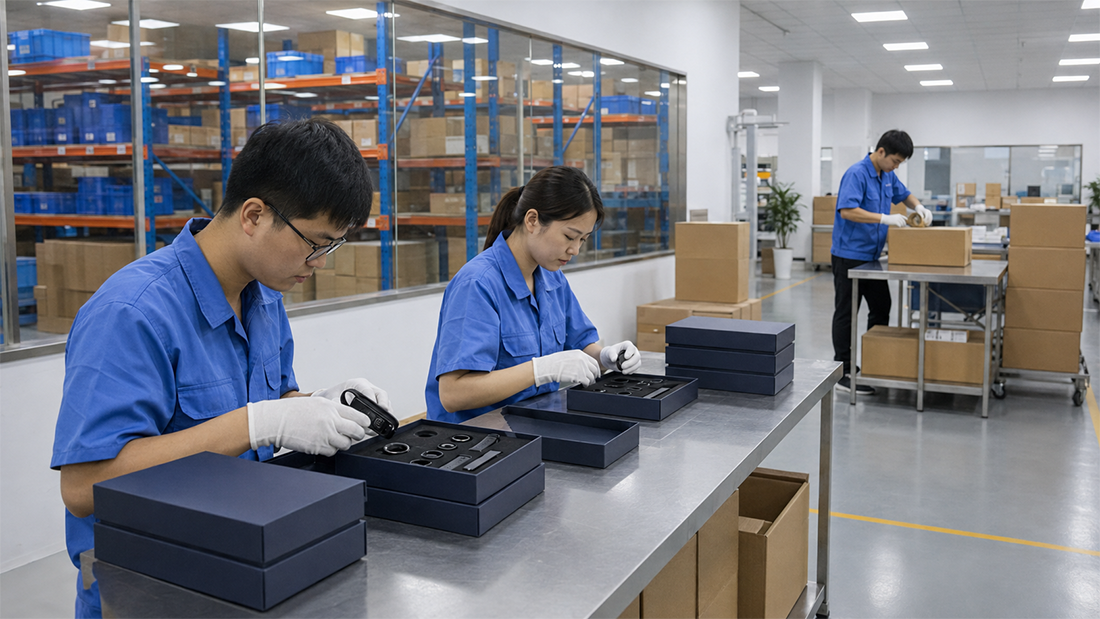
Ask whether the supplier performs SMT, assembly, aging, and final QC in their own facility, and request a live video walkthrough. For US distribution this matters because inconsistent process control shows up as a spike in dead-on-arrival rates and warranty returns. A factory that openly shares process flow, line layout, and test points is easier to audit than one that only shares finished-product photos. See how smart watch manufacturing is typically structured before you ask supplier-specific questions.
3. MOQ Structure and Flexibility (Weight 15%)
MOQ should be evaluated by cash exposure, not by number alone. A 3,000-unit MOQ split across five colors is a very different risk than 3,000 units of one color. Ask for tiered pricing, mixed-SKU rules, and whether repeat orders can run at lower quantities. Treat MOQ as a planning input, and align it with a broad sourcing guide approach that balances reorder cadence and warehouse turns.
4. Customization Depth (Weight 10%)
Customization for distributors usually means logo on the case back or strap, custom packaging, a branded app name and icon, and sometimes firmware boot logo. Establish early which elements are free, which involve tooling, and which extend lead time. Packaging customization is often the highest return-per-dollar change because it drives perceived value at retail without touching the electronics.
5. Compliance Documentation (Weight 20%)
For the US market, radio-equipped smart watches typically fall under FCC equipment authorization rules, and lithium-battery shipments are subject to transport requirements that suppliers should be able to document. Certification is model-specific, so a CE certificate for one SKU does not cover your configured variant. Compliance is the single most common reason a shipment is delayed or rejected — weight it accordingly.
6. Test Protocols and Quality Control (Weight 10%)
Ask for the QC process: incoming material checks, in-process inspection, aging or burn-in, drop and waterproof testing where claimed, and pre-shipment inspection with photographic records. A supplier that cannot describe an aging test is likely not running one. Verify the claims yourself rather than accepting a certificate of conformance at face value.
7. After-Sales, Warranty, and Spare Parts (Weight 10%)
Distribution economics depend on return and warranty rates. Ask what percentage of units the supplier budgets for defects, how warranty claims are processed, whether spare straps, chargers, and cases are stocked, and how firmware updates are delivered. A supplier with no spare-parts channel leaves you with unsellable returns.
OEM vs. ODM vs. Private Label: Which Fits Your Channel?
The three models are frequently confused. The right choice depends on your volume, speed requirement, and how much differentiation your channel needs.
| Model | What the Supplier Owns | Typical Volume Fit | Advantages | Trade-offs |
|---|---|---|---|---|
| ODM (standard catalog) | Design, tooling, firmware, app | Entry to mid volume | Fastest to market; lowest setup cost | Less differentiation; competitors may sell identical hardware |
| Private Label | Hardware platform; you own brand | Mid volume | Your logo, packaging, and app branding | Limited hardware change; MOQ still applies |
| OEM (custom) | You influence or own design | Higher volume | Differentiated product; possible IP ownership | Tooling cost, longer timeline, higher MOQ |
Most US distributors start with ODM or private label to test demand, then move selected SKUs to OEM once sell-through data justifies tooling investment. Choose the model that matches your channel first — corporate buyers often accept private label packaging, while retail chains may demand a distinctive product only OEM can provide.
Soft CTA: If you are comparing models, STAR KING can help you map your target price tier and channel to the right OEM, ODM, or private-label structure before you commit to tooling.
US Compliance: FCC, Battery, and Labeling Basics
Compliance failures are the most expensive surprises in wearable distribution because they surface at customs or at retail, after you have already paid for inventory.
Radio Equipment (FCC)
Smart watches that include Bluetooth or other radio transmitters are generally subject to FCC equipment authorization. Bluetooth-enabled devices typically use the 2.4 GHz band, and you can reference the Bluetooth SIG qualification program for how interoperability claims are documented. Always confirm the FCC ID shown on the label matches the exact model you import, and that the grantee is the actual manufacturer.
Battery and Transport Documents
Lithium batteries require transport documentation. Buyers should request a current UN38.3 test summary, an MSDS for the cell or pack, and the carrier documentation needed for air freight. These documents must match the battery used in your specific model.
Materials and Packaging
Some components and packaging materials fall under materials restrictions; requirements typically depend on the exact configuration and destination. Buyers should verify the current rules with the supplier and, where relevant, a compliance consultant before importing.
Note that certification coverage is model- and configuration-specific, and STAR KING does not claim that every product has every certification. Confirm the required scope in writing for your target SKUs.
MOQ, Tooling, and Landed Cost Planning
Unit price is only the start of landed cost. Build a simple model:
- Unit FOB price at your actual quantity tier.
- Tooling or setup cost amortized over the first order.
- Freight and insurance (air for samples, sea for bulk).
- Duties and import fees based on classification.
- Compliance and testing costs if you re-certify or add labeling.
- Warranty reserve as a percentage of units.
Two suppliers with the same FOB price can land very differently. A supplier with a higher unit price but reliable packaging and lower defect rates often wins on total cost. Model both scenarios over a 12-month period rather than per unit.
Sample Testing and Pilot Run Protocol
Samples are your lowest-cost risk reduction. Structure testing so that it produces reusable data:
- Order samples from your top two or three candidates, ideally with your logo or packaging applied so you also evaluate customization work.
- Test battery life under realistic usage, not a bench scenario.
- Test pairing and app stability across iOS and Android versions relevant to your customers.
- Run a waterproof and drop test where those claims are made.
- Photograph and log every defect with a reference number.
- Place a small pilot order and inspect it before authorizing the full run.
This process also gives you supplier responsiveness data: how fast do they answer defect reports, and do they correct issues in the pilot run? That behavior predicts post-sale support quality.
Common Mistakes and Buyer Red Flags
Mistakes Distributors Make
- Buying on unit price alone without modeling warranty and returns.
- Accepting a certificate that lists a different model or radio configuration.
- Treating MOQ as fixed instead of negotiating tiers and mixed-color rules.
- Skipping the pilot run because the sample performed well.
- Leaving spare parts and firmware update terms out of the contract.
Red Flags in Supplier Conversations
- Refusing a live video walkthrough or evading manufacturing questions.
- Unable to produce FCC ID or battery documents matching your model.
- Vague answers about defect rate, warranty policy, or spare parts.
- No written lead time or deposit terms before you are asked to pay.
- Pressure to commit to a large order before samples are validated.
Practical Buyer Checklist
- Supplier performs design, assembly, and testing in-house (or disclosed partners).
- Weighted scorecard total of 3.5 or higher.
- MOQ tiers and mixed-color rules confirmed in writing.
- Pricing reflects your actual target quantity.
- FCC documentation matches the exact model and configuration.
- Battery transport documents (UN38.3, MSDS) are current and model-specific.
- QC steps, aging test, and pre-shipment inspection terms confirmed.
- Warranty policy, defect allowance, and spare-parts availability defined.
- Packaging and logo customization costs and lead-time impact documented.
- Sample and pilot run completed with a defect log.
For buyers evaluating adjacent categories, the same framework applies to retail-focused wearable solutions and to fitness tracking applications, which often share the same compliance and support requirements.
FAQ
What is a typical MOQ for smart watches from a Chinese OEM?
MOQ varies widely by supplier and customization level. Standard ODM models may start in the low hundreds to low thousands per color, while full OEM tooling projects typically require a larger first order. Ask for tiered pricing and mixed-color rules to reduce cash exposure.
Do smart watches need FCC certification to be sold in the US?
Devices with radio transmitters generally require FCC equipment authorization, and requirements depend on the radio configuration. Buyers should confirm the FCC ID and grantee match the exact model they import.
How long does production take after I approve samples?
Mass production commonly runs 25–45 days after deposit and sample approval, depending on complexity and order size. Get the timeline in writing and plan retail or marketplace launches around it.
Can I get my logo and packaging on a standard ODM watch?
Yes. Private-label programs usually cover logo, packaging, and app naming. Some elements involve setup fees or extended lead time, so confirm the scope and cost before ordering.
Who owns the mold if I invest in custom tooling?
Mold ownership should be stated in the contract. Buyers who pay for tooling should confirm who holds the physical mold and under what conditions it is transferred or stored.
How do I verify a supplier’s quality claims?
Request the QC process description, ask for a live line walkthrough, and validate with a paid pilot run and pre-shipment inspection rather than relying on certificates alone.
What documents should accompany a lithium-battery smart watch shipment?
Typically UN38.3 test summaries, an MSDS, and carrier-specific declarations. Confirm the documents match the battery in your exact model.
Conclusion
Distributor success in the US smart watch market depends more on supplier selection than on any single specification. Use the seven-point scorecard to compare candidates objectively, confirm that your compliance documents match the exact models you import, negotiate MOQ in tiers, and validate every supplier with samples and a pilot run. This disciplined approach protects margin, reduces returns, and builds a supply relationship you can scale across product categories.
Next Step
If you are evaluating suppliers for your next wearable program, request product samples with your branding and compliance questions attached. STAR KING can walk you through configuration options, target-market requirements, and the documentation you should expect before you place a first distribution order.
Discuss Your Smart Wearable OEM/ODM Project
Planning a smart ring, smart watch, smart band, AI glasses, AI translator, or AI voice mouse project? Contact STAR KING to discuss product positioning, sample testing, customization scope, certification requirements, lead time, and quotation details.

Team Star King

Scan WhatsApp QR code
Leave a Reply