
smart rings sourcing: 7 Essential Checks Before Importing Smart Rings for Private Label in 2026
October 15, 2026 · Team Star King
7 Essential Checks Before Importing Smart Rings for Private Label in 2026
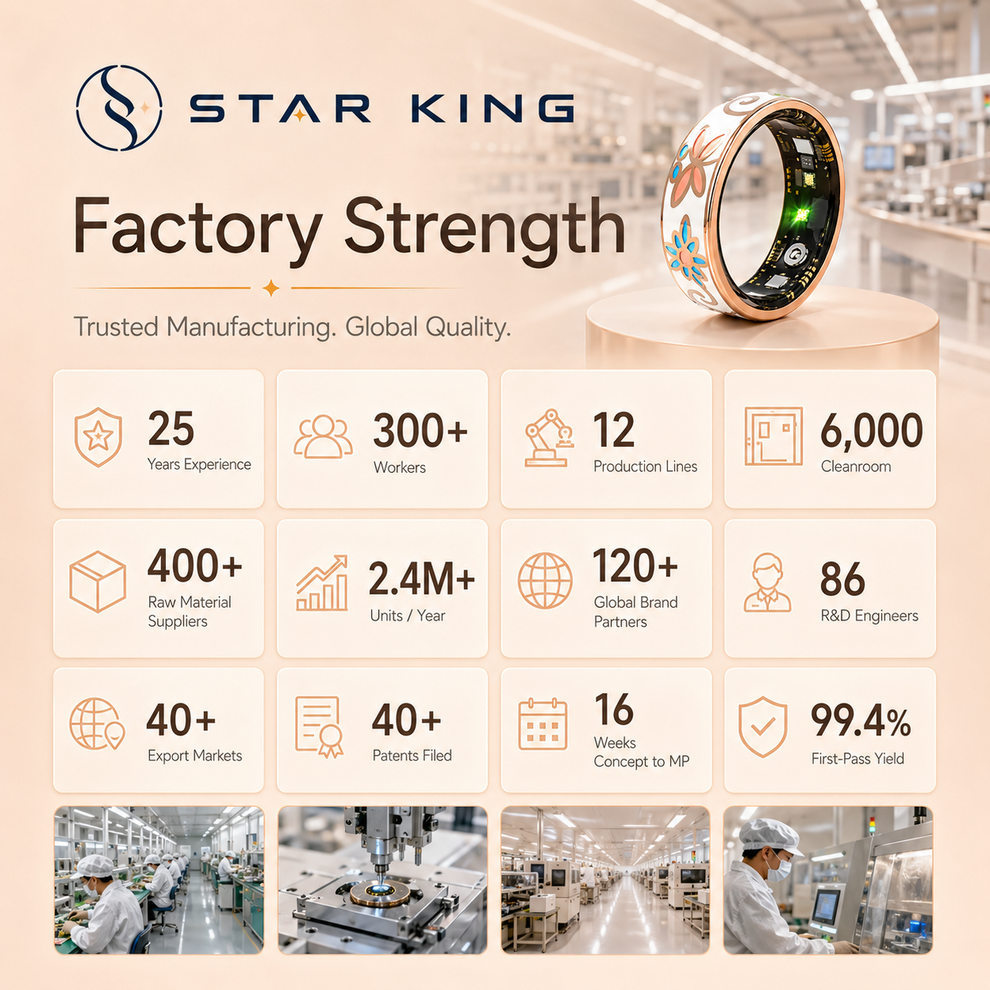
Smart rings sourcing starts with one question: can the manufacturer actually deliver consistent, compliant, and market-ready product at your volume? Before signing a purchase order, importers should evaluate seven areas—OEM/ODM capability, MOQ and tooling, sample testing, certification scope, quality control, lead time planning, and app/firmware support. This guide gives importers a practical pre-order checklist to reduce risk, avoid costly rework, and launch a private label smart ring line that meets target-market requirements.
Table of Contents
Table of Contents
Table of Contents
- What Is Smart Rings Sourcing and Why It Matters for Importers
- Key Takeaways
- Key Facts for Buyers
- Check 1: OEM/ODM and Customization Capability
- Check 2: MOQ, Tooling, and Cost Structure
- Check 3: Sample Testing and Sensor Validation
- Check 4: Certification and Target-Market Compliance
- Check 5: Quality Control and Pre-Shipment Inspection
- Check 6: Lead Time, Battery Shipping, and Logistics
- Check 7: App, Firmware, and After-Sales Support
- Comparison Table: Sourcing Priorities by Buyer Type
- Common Mistakes and Buyer Red Flags
- Practical Buyer Checklist
- FAQ
- Conclusion

What Is Smart Rings Sourcing and Why It Matters for Importers
Smart rings sourcing is the process of identifying, evaluating, and contracting a manufacturer capable of producing ring-form wearable devices that meet your specifications, branding, and target-market rules. Unlike sourcing a simple accessory, a smart ring combines a miniature battery, biometric sensors, Bluetooth connectivity, printed circuit board assemblies, and a companion app. Each of these elements introduces separate sourcing and compliance variables.
For importers, the sourcing decision determines three outcomes: whether the product can legally enter each target market, whether it will survive retail return rates, and whether the supply relationship can scale from a pilot order to repeat production. A supplier that performs well on price alone rarely performs well across all three.

Key Takeaways
- Evaluate suppliers against seven checks, not a single price quote.
- Confirm OEM, ODM, and private label scope in writing before ordering.
- Certification is product- and market-specific; verify documents match the exact configuration you buy.
- Battery shipping rules (UN38.3, MSDS) affect air freight feasibility and landed cost.
- App and firmware support determines long-term product value and return rates.
- Request samples and arrange pre-shipment inspection before releasing full payment.
Key Facts for Buyers
| Factor | Typical Range / Consideration | Buyer Action |
|---|---|---|
| MOQ | Varies by customization level [STAR KING TO CONFIRM] | Confirm MOQ per SKU and per color |
| Sampling lead time | Typically depends on customization | Request a sample timeline in writing |
| Mass production lead time | Typically depends on order volume | Plan buffer for battery shipping |
| Certification | Market- and configuration-specific | Verify certificates match your SKU |
| Battery shipping | UN38.3 and MSDS often required | Confirm documentation before booking freight |
| App support | OEM/ODM scope varies | Clarify update and bug-fix responsibility |

Check 1: OEM/ODM and Customization Capability
Before discussing price, importers should determine whether the supplier offers OEM, ODM, or both. OEM typically means the manufacturer produces to your design or specification. ODM typically means you adopt an existing design and apply your branding and selected customizations. Many wearable manufacturers offer a hybrid model.
What to Confirm
- Whether logo, packaging, app branding, and color options are available.
- Which firmware or app functions can be modified and which are fixed.
- Whether industrial design changes require new tooling.
Importers building a differentiated brand should clarify whether the supplier can support future iterations, not just a first order. A supplier that cannot describe its customization workflow in concrete steps is a warning sign. For a broader view of customization models, see Private Label OEM/ODM solutions.
Check 2: MOQ, Tooling, and Cost Structure
MOQ is rarely a single number. It is usually a matrix: minimum order per SKU, per color, per ring size, and per packaging variant. Importers should request the full MOQ matrix rather than a headline figure.
Tooling cost applies when a design requires new molds or significant structural changes. Importers should ask who owns the tooling and what happens to it if the relationship ends. Tooling ownership is an intellectual property issue and should be documented in the contract.
Cost Components to Request
- Unit price at different volume tiers.
- Tooling or setup fees, if applicable.
- Packaging and printing costs.
- Certification and testing costs, if the supplier arranges them.
- Shipping and battery documentation costs.
Landed cost, not unit price, determines margin. A lower unit price with expensive freight or certification gaps can be more costly overall. For related planning guidance, see STAR KING resources and blog.
Check 3: Sample Testing and Sensor Validation
Samples are the only reliable way to assess build quality, fit, comfort, and app performance. Importers should order samples in multiple sizes and test them under realistic conditions.
What to Test
- Charging consistency and battery life under normal use.
- Bluetooth pairing stability across common phones.
- Sensor reading consistency for heart rate and blood oxygen features.
- Water resistance claims against the stated rating.
- App onboarding and data sync.
Consumer smart ring features are typically wellness and fitness tools, not medical diagnostic devices. Buyers should avoid marketing claims that imply diagnosis or treatment unless the product and the manufacturer’s documentation support such claims in the target market.
Check 4: Certification and Target-Market Compliance
Certification requirements depend on the specific product configuration and the destination market. Importers should not assume that a general certificate covers every SKU, frequency band, or battery capacity.
Documents Importers Commonly Request
- FCC documentation for the United States.
- CE documentation for the European Union.
- RoHS compliance for restricted substances.
- UN38.3 test summary and MSDS for lithium batteries.
Buyers should verify that certificate details—model number, manufacturer, and test scope—match the product they intend to import. Official references include the FCC equipment authorization database and the European Commission CE marking guidance. For battery transport, refer to the IATA Dangerous Goods Regulations.
Check 5: Quality Control and Pre-Shipment Inspection
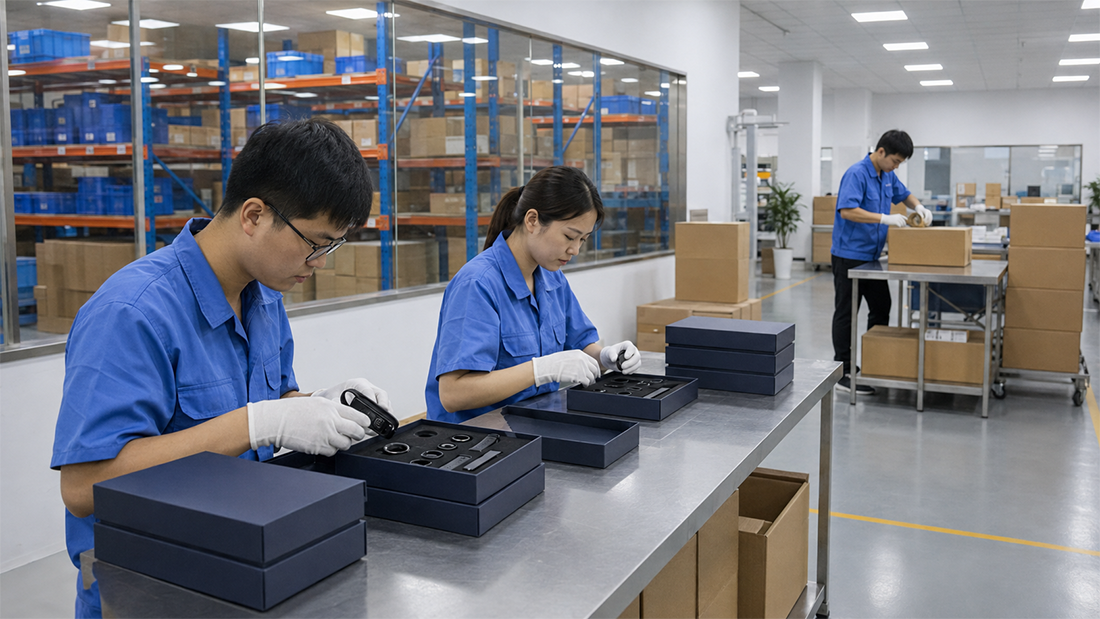
Quality control should be a documented process, not a verbal assurance. Importers should ask for the supplier’s inspection stages and acceptance criteria.
Typical QC Stages
- Incoming material inspection.
- In-process inspection during assembly.
- Functional testing of finished units.
- Pre-shipment inspection with sampling plan.
Importers can also contract a third-party inspection. This adds cost but provides independent verification. For related guidance, see health and fitness wearable solutions.
Check 6: Lead Time, Battery Shipping, and Logistics
Smart rings contain lithium batteries. This affects air freight options, packaging requirements, and documentation. Importers should confirm UN38.3 and MSDS availability before booking shipments.
Lead Time Components
- Sample development time.
- Mass production time after deposit.
- QC and pre-shipment inspection time.
- Freight and customs clearance time.
Buyers should plan buffer time, especially for first orders or peak seasons. Realistic lead times reduce the risk of missed retail windows.
Check 7: App, Firmware, and After-Sales Support
The companion app is part of the product. Importers should clarify who maintains it, how updates are delivered, and how bugs are handled after launch.
Questions to Ask
- Is the app white-label, co-branded, or fully custom?
- Are firmware updates free, and for how long?
- What is the warranty period and spare parts policy?
- Who handles returns and repairs in each market?
Clear after-sales terms protect brand reputation and reduce dispute risk. For product context, see smart rings product page.
Comparison Table: Sourcing Priorities by Buyer Type
| Buyer Type | Primary Priority | Secondary Priority | Watch-Out |
|---|---|---|---|
| Startup brand | Low MOQ, sample support | App branding | Tooling ownership |
| Amazon seller | Packaging and certification | Lead time | Compliance documents |
| Distributor | Volume pricing | Consistent QC | Repeat-order stability |
| Retail chain | Certification and warranty | Packaging compliance | Spare parts supply |
| Corporate buyer | App and data process | After-sales support | Update commitments |
Common Mistakes and Buyer Red Flags
- Buying on price alone. Skip certification and QC verification, and returns rise.
- Accepting a generic certificate. Certificates must match the exact SKU.
- Ignoring battery documentation. Missing UN38.3 or MSDS can delay shipments.
- No sample testing. Untested units often fail in real use.
- Unclear app ownership. Unclear update responsibility creates long-term cost.
- No inspection before final payment. This removes leverage if defects appear.
These issues are common across wearable categories, including bands and watches.
Practical Buyer Checklist
- Request the MOQ matrix per SKU, color, and size.
- Confirm OEM/ODM scope and tooling ownership in writing.
- Order samples and test sensors, battery, and app.
- Verify certificates against your exact configuration.
- Request QC process and inspection records.
- Confirm UN38.3 and MSDS before booking freight.
- Agree on app updates, warranty, and spare parts.
FAQ
What is the typical MOQ for a private label smart ring?
MOQ typically depends on customization level, color, and packaging. Ask for a full MOQ matrix rather than one number.
Do I need FCC or CE certification for smart rings?
It typically depends on the target market and product configuration. Buyers should verify certificates match the exact SKU being imported.
Can I use my own brand and packaging?
Many manufacturers offer private label logo and packaging options. Confirm scope, cost, and lead time in writing.
How long does production take?
Lead time depends on volume and customization. Plan buffer time for QC, freight, and battery documentation.
Are smart ring health features medical devices?
Consumer smart ring features are typically wellness and fitness tools, not diagnostic devices. Avoid medical claims unless documentation supports them.
What documents are needed to ship lithium battery products?
UN38.3 test summary and MSDS are commonly required. Requirements may vary by carrier and destination.
Should I inspect before final payment?
Yes. Pre-shipment inspection provides independent verification and reduces dispute risk.
Conclusion
Smart rings sourcing rewards preparation. Importers who confirm OEM/ODM scope, MOQ, samples, certification, QC, lead times, and app support reduce the risk of delays and returns. The seven checks in this guide provide a repeatable framework for evaluating suppliers and building a private label line that meets target-market requirements.
STAR KING CTA
If you are evaluating smart ring options for import or private label, STAR KING can help you compare specifications, confirm certification requirements, and plan an OEM/ODM project. Request product samples or a quotation to start the evaluation.
Discuss Your Smart Wearable OEM/ODM Project
Planning a smart ring, smart watch, smart band, AI glasses, AI translator, or AI voice mouse project? Contact STAR KING to discuss product positioning, sample testing, customization scope, certification requirements, lead time, and quotation details.

Team Star King

Scan WhatsApp QR code
Leave a Reply