
Smart Rings for System Integrators: 7 Critical Checks Before You Commit in 2026
November 8, 2026 · Team Star King
Smart Rings for System Integrators: 7 Critical Checks Before You Commit in 2026
If you are a system integrator considering smart rings for a client deployment, the decision goes far beyond selecting a stylish wearable. You need a device that integrates with your existing platforms, meets regional compliance, supports your volume and customization needs, and comes from a supplier you can rely on for the long term. This guide outlines seven critical checks—from SDK availability and API documentation to certification and supply chain stability—that will help you evaluate smart rings for system integrators and avoid costly integration failures.
Table of Contents
Table of Contents
smart rings for system integrators: Table of Contents
- Short Answer
- Key Takeaways
- Key Facts for Buyers
- 1. Integration Capabilities: SDK, API, and Cloud Support
- 2. Data Security and Privacy Compliance
- 3. Product Customization and White-Label Options
- 4. Certifications and Regional Compliance
- 5. Quality Assurance and Testing Protocols
- 6. Supply Chain Reliability and Lead Times
- 7. Total Cost of Ownership and Scalability
- Common Mistakes
- Practical Buyer Checklist
- FAQ
- Conclusion

Short Answer
For system integrators, the most critical factors when sourcing smart rings are integration flexibility (SDK/API availability, cloud connectivity), data security compliance, product customization (white-label, firmware), and supplier reliability (certifications, quality control, lead times). Prioritize suppliers that offer documented APIs, support custom development, and provide transparent certification and testing reports. Engage early with potential vendors to assess their technical support and long-term partnership potential.

Key Takeaways
- Integration first: Ensure the smart ring supplier provides a robust SDK, well-documented API, and cloud support for seamless integration with your platforms.
- Compliance is non-negotiable: Verify that the rings meet required certifications (e.g., CE, FCC, RoHS) for your target markets and that data privacy compliance (e.g., GDPR, HIPAA) is addressed.
- Customization matters: Look for white-label options, firmware customization, and app branding to align with your client’s brand and functional requirements.
- Quality assurance: Request detailed testing reports (e.g., battery safety, waterproofing, drop tests) and consider third-party inspections.
- Supply chain stability: Assess the supplier’s production capacity, lead times, and component sourcing to avoid delays in your project timeline.
- Total cost of ownership: Evaluate not just unit price but also integration costs, support, and scalability for future volumes.

Key Facts for Buyers
| Factor | Typical Range / Consideration |
|---|---|
| MOQ (Minimum Order Quantity) | 500–1,000 units for custom designs; lower for standard models |
| Lead Time | 30–60 days after sample approval, depending on customization |
| Certifications | CE, FCC, RoHS, UN38.3 for battery; may vary by market |
| SDK Availability | Often available; quality and support vary—request documentation |
| Customization Options | Logo, packaging, app UI, firmware features; confirm with supplier |
| Battery Life | Typically 3–7 days; confirm with usage scenarios |
| Data Security | GDPR compliance for EU; HIPAA for US healthcare if applicable |
1. Integration Capabilities: SDK, API, and Cloud Support
Smart rings for system integrators must seamlessly connect with existing IT ecosystems. Evaluate the supplier’s software development kit (SDK) and application programming interface (API) documentation. A well-documented API allows you to pull health data (e.g., heart rate, sleep stages, blood oxygen) into your own dashboards, mobile apps, or enterprise systems. Ask about cloud support: does the supplier offer a cloud platform for data aggregation, or can the ring communicate directly with your servers? Consider latency, data frequency, and whether the SDK supports both iOS and Android. Request a sandbox environment to test integration before committing.
Key questions to ask:
- Is the SDK publicly available? What languages does it support?
- What data points are accessible via API? At what frequency?
- Does the supplier offer cloud-to-cloud integration or webhooks?
- Is there a dedicated technical support team for integrators?
2. Data Security and Privacy Compliance
When deploying wearables in healthcare, corporate wellness, or senior care, data privacy is paramount. Ensure the supplier’s data handling practices comply with relevant regulations such as GDPR (EU), HIPAA (US healthcare), and other local laws. Ask where data is stored (on-device, supplier cloud, or your cloud), how it’s encrypted, and who has access. A supplier that offers on-premise or private cloud deployment may be preferable for sensitive applications. Also, clarify data ownership: you should retain ownership of end-user data. Request the supplier’s data processing agreement and security certifications (e.g., ISO 27001) if available.
3. Product Customization and White-Label Options
System integrators often need to white-label smart rings to match their client’s brand. Confirm the supplier’s capabilities in logo printing, packaging design, and app branding (custom UI, icon, and name). Beyond cosmetic changes, assess firmware customization: can you enable or disable specific sensors, adjust data sampling rates, or add custom algorithms? Some suppliers offer a companion app that can be rebranded; others provide a software development kit for you to build your own app. Clarify minimum order quantities for custom designs and the sample development process. A good supplier will provide 3D files and mockups for approval.
4. Certifications and Regional Compliance
Smart rings contain radio transmitters and lithium batteries, so they require certifications such as FCC (US), CE (EU), and RoHS (EU) for hazardous substances. For markets like Japan or Canada, additional certifications may apply. Always request copies of test reports and certificates for the exact model you plan to purchase. Be wary of suppliers who claim “CE certification” without providing documentation. For battery safety, UN38.3 test reports are essential for air transport. If your deployment involves healthcare claims, ensure the device is not marketed as a medical device unless it has the appropriate regulatory clearance (e.g., FDA). STAR KING can provide certification documentation for specific product configurations upon request. [STAR KING TO CONFIRM: specific certifications available for smart ring models]
5. Quality Assurance and Testing Protocols
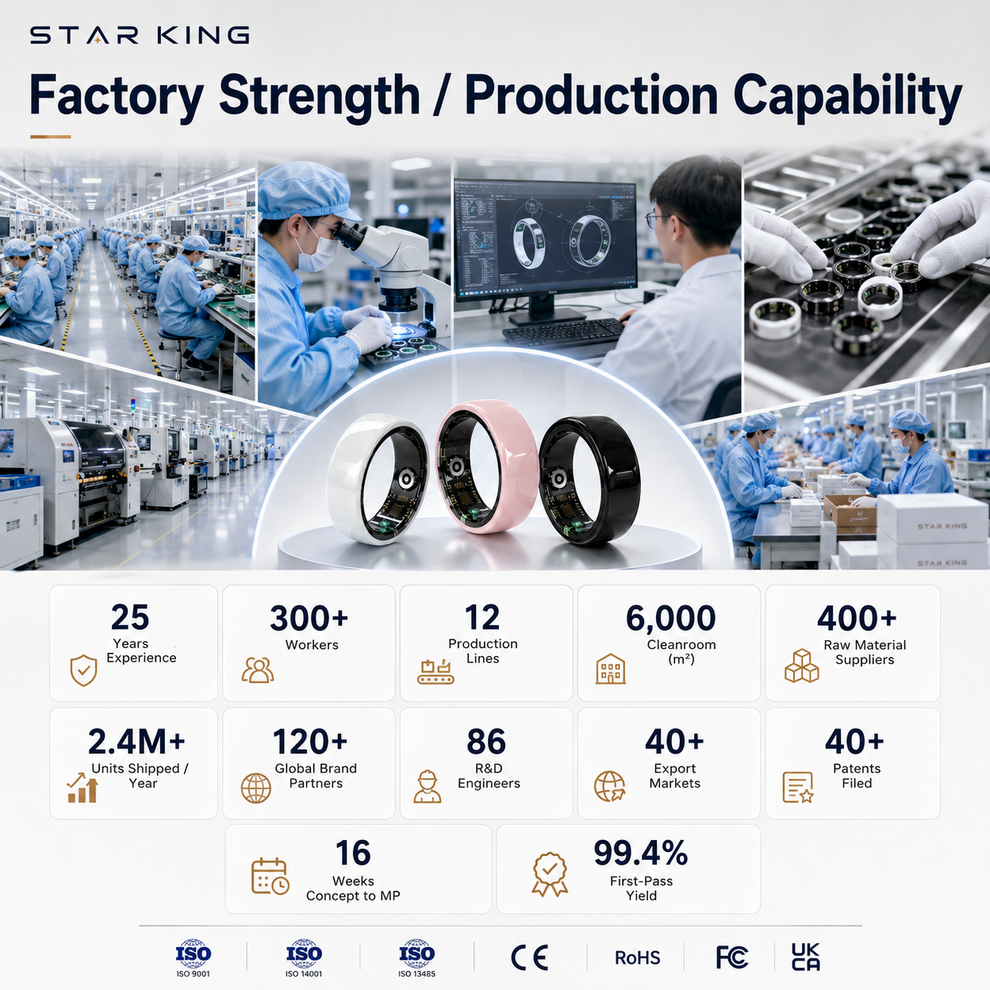
Reliability is critical for system integrators—a failed ring can disrupt an entire deployment. Inquire about the supplier’s quality management system (e.g., ISO 9001) and testing protocols. Key tests include battery aging, waterproofing (IP rating), drop testing, and sensor accuracy validation. Ask for sample test reports and consider sending a third-party inspector to the factory. A supplier that is transparent about its testing and allows audits is more likely to deliver consistent quality. Also, discuss warranty terms and spare parts availability to minimize downtime.
6. Supply Chain Reliability and Lead Times
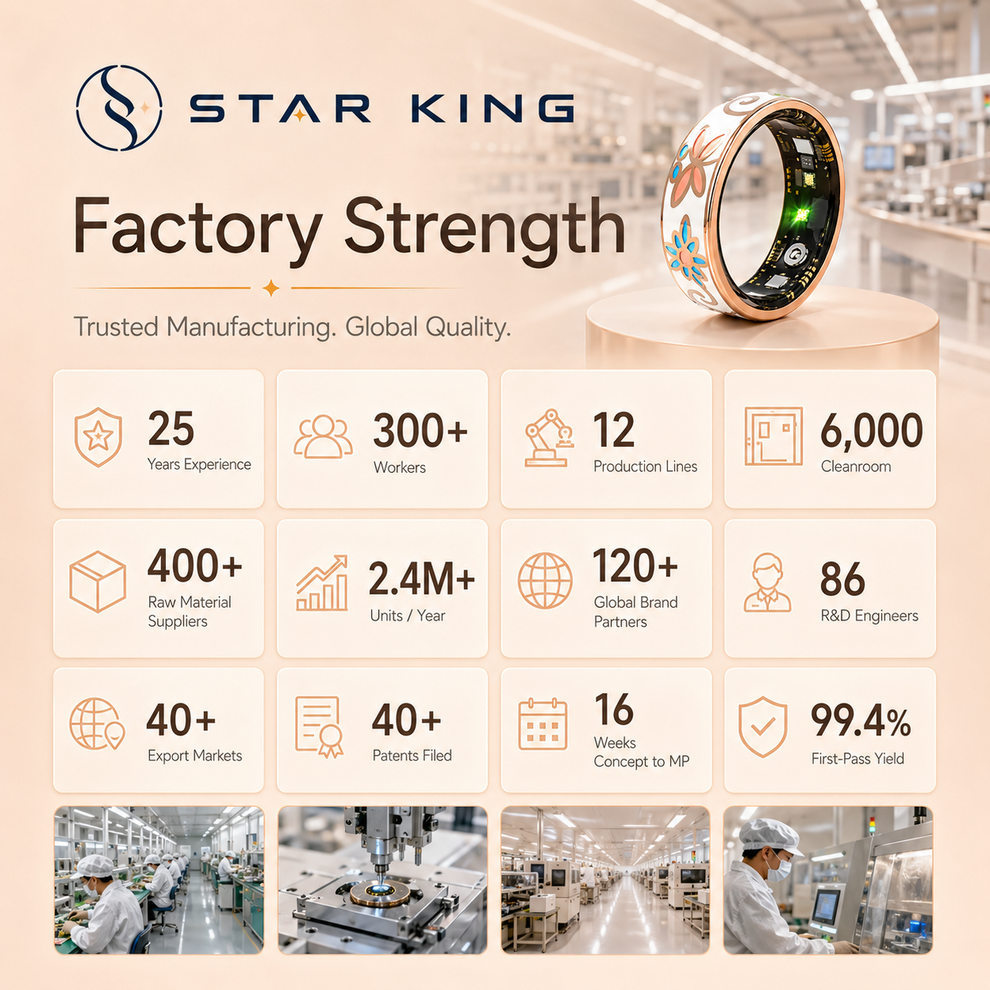
Understand the supplier’s production capacity, component sourcing strategy, and lead times. For smart rings, key components like sensors and batteries may have long lead times; a supplier with strong supplier relationships can mitigate risks. Ask for a production schedule and contingency plans. If you’re deploying in multiple regions, confirm the supplier’s ability to handle logistics and customs documentation. Request references from other system integrators or B2B clients if possible. A supplier that specializes in OEM/ODM projects will have dedicated project managers to keep you informed.
7. Total Cost of Ownership and Scalability
Beyond the unit price, consider integration costs (development time, SDK licensing), ongoing support fees, and the cost of customization. A lower-priced ring may lack robust APIs, leading to higher integration expenses. Also, evaluate scalability: can the supplier ramp up production for larger orders? Do they offer volume discounts? For system integrators, a long-term partnership with a supplier that grows with your needs is more valuable than a one-time low price. Request a detailed quotation that includes all costs, and clarify payment terms and warranty.
Common Mistakes
- Assuming all smart rings have open APIs: Many consumer-focused rings lock data behind proprietary apps. Always request SDK documentation before committing.
- Overlooking data privacy: Failing to address GDPR or HIPAA can lead to legal issues and client distrust.
- Ignoring certification validity: Certificates must match the exact model and be current. Request copies and verify with issuing bodies if needed.
- Underestimating integration effort: Budget for development time and testing; a “plug-and-play” solution is rare.
- Choosing on price alone: Cheap rings may lack quality, support, or scalability, costing more in the long run.
Practical Buyer Checklist
- ☐ Request and review SDK/API documentation; test with a sandbox environment.
- ☐ Confirm data privacy compliance (GDPR, HIPAA) and data ownership terms.
- ☐ Verify certifications (CE, FCC, RoHS, UN38.3) for the specific model and market.
- ☐ Request sample units for integration testing and user trials.
- ☐ Assess customization options (logo, packaging, app branding, firmware).
- ☐ Inquire about MOQ, lead times, and production capacity.
- ☐ Ask for quality test reports and consider third-party inspection.
- ☐ Clarify warranty, support, and spare parts availability.
- ☐ Obtain a detailed quotation including all costs (unit, tooling, customization).
- ☐ Check supplier references and visit the factory if possible.
Buyers can also review STAR KING Smart Rings OEM/ODM options to compare product positioning, customization scope, and sample planning.
FAQ
What SDKs do smart ring suppliers typically provide?
Most OEM/ODM suppliers offer an SDK for iOS and Android, often with documentation for data access (heart rate, sleep, steps). Some provide cloud APIs for data synchronization. Quality and support vary; always request a demo or sandbox access.
How do I ensure data privacy compliance with smart rings?
Choose a supplier that supports on-device data storage or private cloud deployment, and provides a data processing agreement. Confirm encryption in transit and at rest, and clarify data ownership. For healthcare applications, consult legal experts on HIPAA or GDPR requirements.
What certifications are required for smart rings in the EU and US?
In the EU, CE marking (including RED for radio equipment) and RoHS compliance are required. In the US, FCC certification for radio frequency devices and UL for battery safety may apply. UN38.3 is needed for shipping lithium batteries. Requirements depend on product features and target markets; verify with the supplier.
Can smart rings be customized with our own app?
Many suppliers offer white-label apps or SDKs that allow you to build a custom app. Some also provide firmware customization. Discuss your requirements and request a sample to test integration.
What is the typical MOQ for custom smart rings?
MOQs vary by supplier and customization level; common ranges are 500–1,000 units for custom designs. Standard models may have lower MOQs. Always confirm with the supplier.
How long does it take to receive samples and bulk orders?
Sample lead time is typically 1–2 weeks; bulk production after sample approval can take 30–60 days depending on complexity and order size. Plan your project timeline accordingly.
Conclusion
Selecting the right smart ring supplier for system integrator projects requires a structured approach. By focusing on integration capabilities, data security, customization, compliance, quality, supply chain reliability, and total cost, you can mitigate risks and ensure a successful deployment. Use the checklist above to evaluate potential partners and request documentation for verification. A well-chosen supplier becomes a strategic partner in delivering innovative wearable solutions to your clients.
STAR KING CTA
Ready to explore smart ring integration for your next project? STAR KING offers OEM/ODM services with customizable firmware, SDK support, and global compliance assistance. Request product samples to test integration with your systems, or contact our team to discuss your specific requirements and receive a detailed quotation.
Disclaimer: This article provides general guidance. Certification requirements and data privacy laws vary by product configuration and target market; buyers should verify with qualified professionals.
Useful Official References for Buyers
- FCC equipment authorization guidance
- European Commission CE marking information
- Bluetooth SIG specifications
Discuss Your Smart Wearable OEM/ODM Project
Planning a smart ring, smart watch, smart band, AI glasses, AI translator, or AI voice mouse project? Contact STAR KING to discuss product positioning, sample testing, customization scope, certification requirements, lead time, and quotation details.

Team Star King

Scan WhatsApp QR code
Leave a Reply