
smart rings for healthcare solutions: 7 Critical Checks Before You Buy Smart Rings for Healthcare Solutions in 2026
October 9, 2026 · Team Star King
7 Critical Checks Before You Buy Smart Rings for Healthcare Solutions in 2026
If you are a healthcare solution provider evaluating smart rings for healthcare solutions, you need more than sleep scores and step counts. You need validated sensors, reliable data flow into clinical or wellness platforms, clear compliance pathways, and a manufacturer who can support customization without creating regulatory or supply-chain surprises. This guide gives you seven practical checks—from defining your use case to locking down a production-ready supplier—so you can move from specification to pilot with fewer risks.
Table of Contents
Table of Contents
smart rings for healthcare solutions: Table of Contents
- Short Answer
- Key Takeaways
- Direct Answer
- Key Facts for Buyers
- 1. Define the Clinical or Wellness Use Case and Data Requirements
- 2. Verify Sensor Accuracy and Validation Evidence
- 3. Evaluate Data Integration, APIs, and Platform Compatibility
- 4. Confirm Compliance and Certification Pathways for Target Markets
- 5. Assess Battery Life, Charging, and Reliability
- 6. Plan for OEM/ODM and Private Label Customization
- 7. Validate Supply Chain, MOQ, Lead Time, and After-Sales
- Comparison Table: Smart Ring Options for Healthcare
- Common Mistakes and Buyer Red Flags
- Practical Buyer Checklist
- FAQ for Healthcare Providers Buying Smart Rings
- Conclusion
- Get a Quote

Short Answer
To buy smart rings for healthcare solutions, verify the use case, sensor validation, data integration capabilities, compliance pathway for your target markets, battery life, OEM/ODM support, and supplier reliability. Request samples, test data flow end-to-end, and confirm certification requirements before committing to production.

Key Takeaways
- Clinical or wellness goals drive every other requirement—start there.
- Sensor validation and data integration are the most common deal-breakers.
- Compliance is market- and configuration-specific; confirm, don’t assume.
- MOQ, lead time, and customization options vary widely by manufacturer.
- Pilot-testing a small batch is the fastest way to de-risk a purchase.

Direct Answer
Smart rings for healthcare solutions should be evaluated as a system: hardware, firmware, app, cloud, and support. Buyers should demand evidence of sensor performance, data export/API options, battery reliability, and compliance documentation appropriate to their region. The right supplier will support a structured pilot and scale with your program.

Key Facts for Buyers
| Factor | Typical Buyer Consideration | Action Step |
|---|---|---|
| Use Case | Remote monitoring, sleep, fitness, women’s health, corporate wellness | Document required metrics and data frequency |
| Sensor Validation | Heart rate, SpO2, temperature, motion accuracy | Request validation summaries and compare against reference devices |
| Data Integration | API, SDK, cloud, EHR/wellness platform compatibility | Test data flow in a pilot |
| Compliance | CE, FCC, RoHS, UN38.3, MSDS (as applicable) | Verify scope and markets covered |
| Battery | 3–7 days typical; depends on features | Confirm real-world usage and charging method |
| Customization | Branding, app, firmware, packaging | Request sample with custom options |
| MOQ & Lead Time | Often 500–3,000 units; 4–10 weeks | Confirm current quotes and schedule |
| Warranty & Support | 12–24 months typical; spare parts availability | Clarify terms and RMA process |
1. Define the Clinical or Wellness Use Case and Data Requirements
Start by specifying what you need the ring to measure. Is it sleep staging, heart rate variability, SpO2 trends, temperature, or activity? For healthcare solution providers, the data must often integrate into a care platform, trigger alerts, or feed into longitudinal reports. Write down required metrics, sampling frequency, and acceptable latency. This list becomes your evaluation checklist. If a supplier cannot map their specs to your use case, move on.
2. Verify Sensor Accuracy and Validation Evidence
Sensor performance is the foundation of any wearable health program. Ask for validation summaries, bench test data, or third-party evaluations where available. Note that consumer smart rings are not medical devices unless specifically cleared or approved by regulators such as the FDA. Use reputable references like the FDA medical device overview to understand regulatory boundaries. Validate claims against your own reference measurements during a pilot.
3. Evaluate Data Integration, APIs, and Platform Compatibility
Your ring must deliver data where you need it. Ask about API availability, SDK support, cloud export formats, and compatibility with platforms like Apple Health, Google Fit, or custom EHR systems. For remote health wearables, data security and privacy are critical. Request documentation on encryption and compliance with frameworks such as HIPAA if applicable. Test the full data pipeline before scaling.
4. Confirm Compliance and Certification Pathways for Target Markets
Compliance is not one-size-fits-all. A ring sold in the EU may require CE marking, while the US may require FCC for radio components. Battery shipping requires UN38.3 and MSDS. Ask the manufacturer which certifications are standard, which are optional, and whether they cover your specific configuration. Understand that certification requirements typically depend on product features and destination markets. Always verify with your own regulatory counsel.
5. Assess Battery Life, Charging, and Reliability
Healthcare programs often require consistent wear. A ring that needs daily charging may fail. Confirm typical battery life under real-world conditions, charging time, and charging method. Ask about battery cycle life and safety features. Consider how charging affects user adherence and whether a portable charger is included.
6. Plan for OEM/ODM and Private Label Customization
If you are building a branded healthcare solution, you will likely need customization: logo on the ring or charger, custom packaging, app branding, and possibly firmware adjustments. Clarify what is included at different price tiers and how customization affects MOQ and lead time. For private label smart rings, ask about tooling ownership and whether your designs remain exclusive.
7. Validate Supply Chain, MOQ, Lead Time, and After-Sales
Ask for a clear quote that includes unit price, MOQ, lead time, shipping terms, and warranty. Confirm spare parts availability and return/repair processes. For healthcare deployments, downtime can disrupt care, so after-sales support matters. Request references or case studies where possible. If the supplier is vague about production capacity or timelines, treat it as a red flag.
Comparison Table: Smart Ring Options for Healthcare
| Feature | Basic Wellness Ring | Advanced Health Ring | Custom OEM Ring |
|---|---|---|---|
| Typical Metrics | Steps, sleep, HR | HRV, SpO2, temp | Configurable |
| Data Export | App only | API/Cloud | Custom API/SDK |
| Compliance | FCC/CE (as applicable) | FCC/CE/RoHS | Market-specific |
| MOQ | 500–1,000 | 1,000–2,000 | 2,000–5,000+ |
| Customization | Limited | Packaging/logo | Full OEM/ODM |
Common Mistakes and Buyer Red Flags
- Assuming all smart rings are medical-grade—verify regulatory status.
- Ignoring data integration until after purchase—test early.
- Overlooking battery life impact on patient adherence.
- Accepting vague compliance statements without documentation.
- Not clarifying MOQ, lead time, and warranty in writing.
- Failing to request a pilot sample for real-world testing.
Practical Buyer Checklist
- Define required metrics and data frequency.
- Request sensor validation evidence.
- Confirm API, SDK, and platform compatibility.
- Verify compliance for your target markets.
- Test battery life under realistic conditions.
- Clarify customization options and associated costs.
- Review MOQ, lead time, and payment terms.
- Check warranty, spare parts, and RMA process.
- Run a small pilot before mass production.
- Ensure data privacy and security measures are in place.
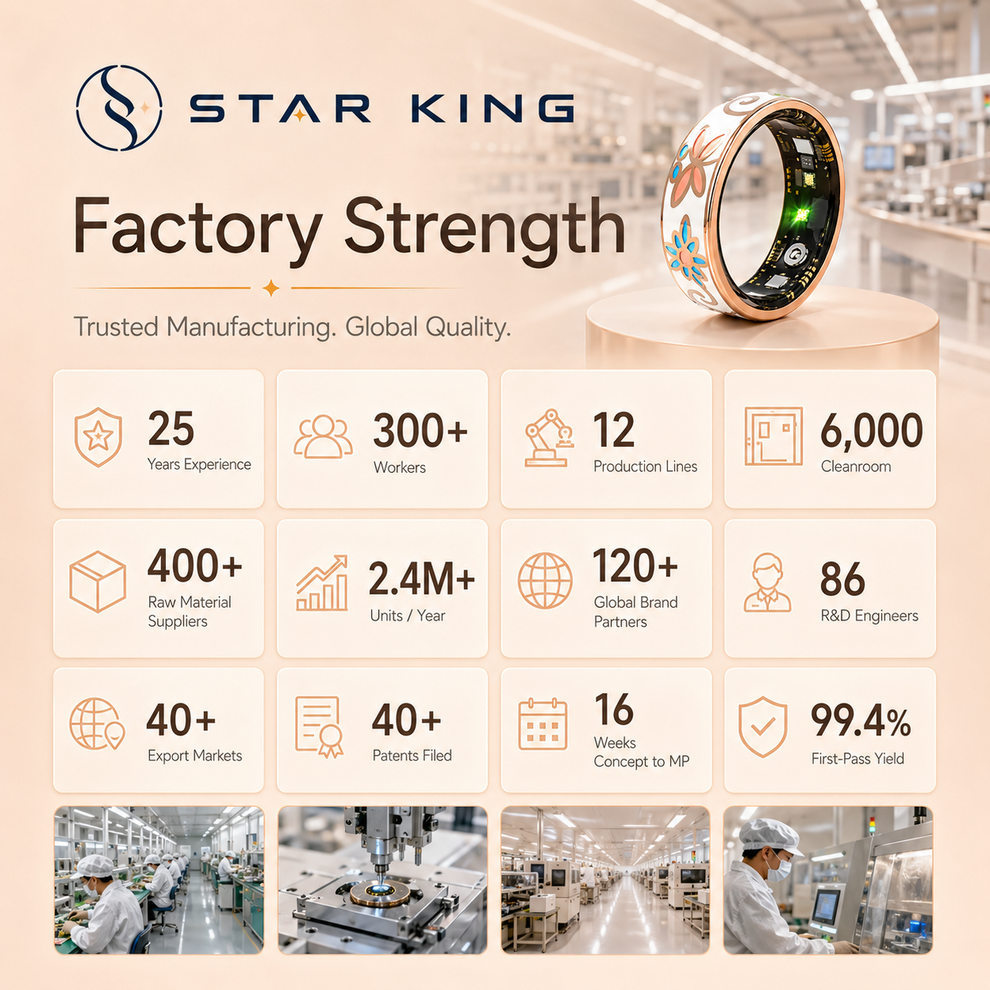
Buyers can also review STAR KING Smart Rings OEM/ODM options to compare product positioning, customization scope, and sample planning.
FAQ for Healthcare Providers Buying Smart Rings
What is the typical MOQ for smart rings for healthcare solutions?
MOQ varies by manufacturer and customization level. For standard models, MOQ often starts around 500–1,000 units. Custom OEM/ODM projects may require 2,000–5,000 units or more. Always confirm with your supplier.
How long does it take to get samples?
Sample lead time is typically 1–3 weeks for standard models, and 3–6 weeks for custom samples, depending on complexity.
Are smart rings considered medical devices?
Most consumer smart rings are not medical devices. If you intend to make medical claims or use them for diagnosis, you must comply with regulations such as FDA or EU MDR. Consult regulatory experts.
What certifications should I look for?
Common certifications include CE, FCC, RoHS, UN38.3, and MSDS for battery shipping. Requirements depend on your market and product configuration.
Can I integrate ring data into my own platform?
Many manufacturers offer APIs or SDKs for data integration. Confirm compatibility with your systems and test during a pilot.
What is the typical lead time for bulk orders?
For standard orders, lead time is often 4–8 weeks after deposit. Custom orders may take 8–12 weeks or longer.
Conclusion
Buying smart rings for healthcare solutions requires a structured approach. By focusing on use case, sensor validation, data integration, compliance, battery life, customization, and supply chain reliability, you can avoid costly mistakes and build a program that delivers value. Start with a pilot, verify everything, and partner with a manufacturer who understands your market.
Get a Quote
Ready to move forward? Request a quotation or discuss your OEM/ODM project with us. We can provide samples, customization options, and certification guidance tailored to your needs.
Discuss Your Smart Wearable OEM/ODM Project
Planning a smart ring, smart watch, smart band, AI glasses, AI translator, or AI voice mouse project? Contact STAR KING to discuss product positioning, sample testing, customization scope, certification requirements, lead time, and quotation details.

Team Star King

Scan WhatsApp QR code
Leave a Reply