
Smart Rings for Education Technology: 7 RFQ Checks Before You Buy
November 2, 2026 · Team Star King

Smart Rings for Education Technology: 7 RFQ Checks Before You Buy
Short Answer: Before you issue an RFQ for smart rings for education technology programs, confirm seven areas: target use case and data scope, sensor and battery specifications, app/SDK integration, MOQ and pricing structure, certification and market compliance, sample testing plan, and production lead time. Buyers who validate these seven points in writing reduce rework, avoid non-compliant shipments, and get comparable quotes from multiple smart ring suppliers.
Table of Contents
Table of Contents
Education technology companies increasingly evaluate smart rings for student wellness, focus and activity programs, staff well-being pilots, and research partnerships. The category is not the same as a consumer retail buy. Procurement teams must plan around device-to-app integration, data governance in school environments, bulk sample validation, and documentation that satisfies school boards, ministries of education, and import authorities. This guide is written for EdTech companies at the RFQ stage — the point where you have a use case and now need a supplier that can quote, sample, and ship to a written specification.
smart rings for education technology: Table of Contents
- What Is a Smart Ring Procurement RFQ in Education Technology?
- Key Takeaways
- Key Facts for Buyers
- Check 1: Use Case and Data Scope
- Check 2: Sensor, Battery and Form Factor Specification
- Check 3: App, Firmware and SDK Integration
- Check 4: MOQ, Tooling and Pricing Structure
- Check 5: Certification and Market Compliance
- Check 6: Sample Testing and Validation Plan
- Check 7: Lead Time, Packaging and After-Sales
- Smart Ring RFQ Comparison Table
- Common Mistakes and Buyer Red Flags
- Practical Buyer Checklist
- FAQ
- Conclusion
Key Takeaways
- Education buyers should send an RFQ with a written use case, not a generic product inquiry; suppliers quote differently when they understand deployment context.
- Smart rings for education technology usually require a defined data scope — activity, sleep, heart rate or SpO2 trends — and a clear statement that the devices are not medical diagnostic tools.
- App and SDK integration is the most common delay; confirm firmware version, data export format, and API access before samples ship.
- MOQ is typically driven by tooling, packaging and sensor module volume; request tiered pricing at 500, 1,000, 5,000 and 10,000 units.
- Certification requirements depend on the product configuration and destination market; buyers should verify CE, FCC, RoHS, UN38.3 and related documents per SKU.
- Sample validation should cover battery endurance, Bluetooth pairing stability, waterproof claims, and app sync accuracy under realistic school conditions.
- Award decisions should compare landed cost and lead time, not unit price alone.
What Is a Smart Ring Procurement RFQ in Education Technology?
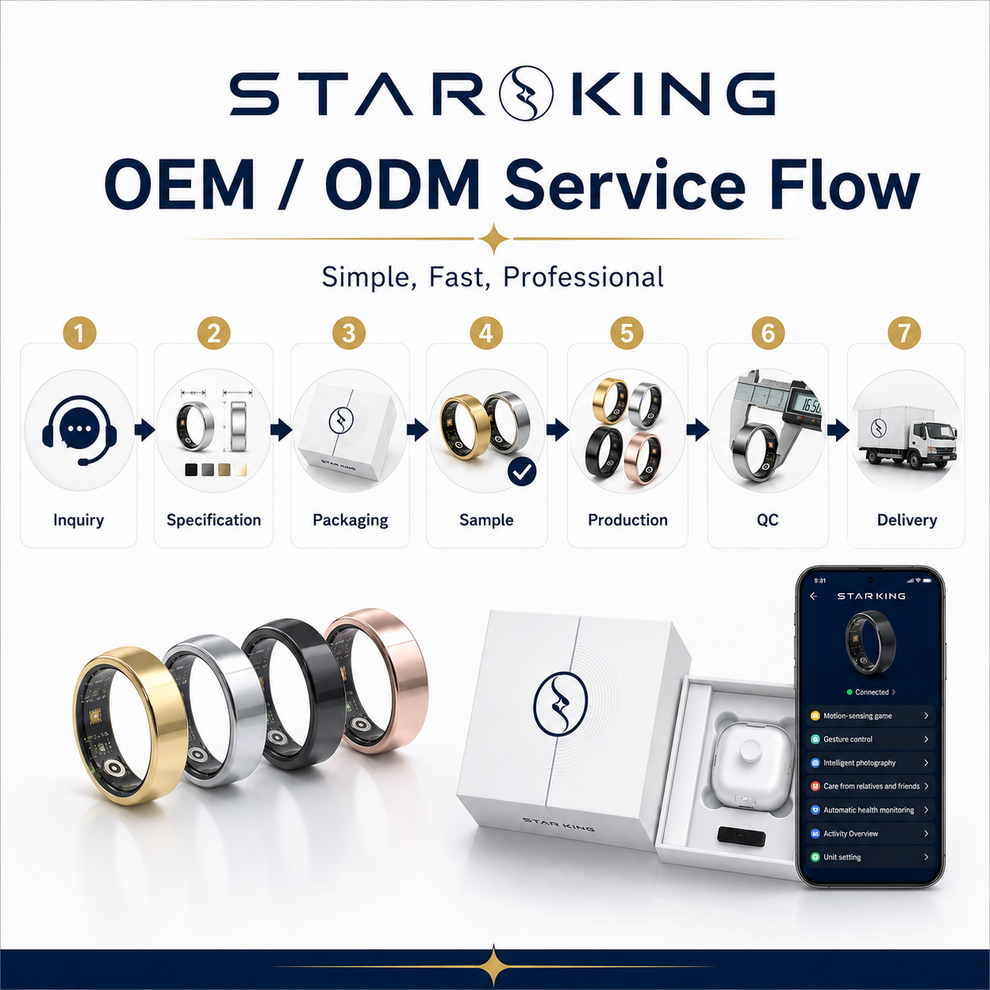
A smart ring procurement RFQ is a structured request for quotation that defines the product specification, quantity, delivery market, integration requirements and documentation needs for a wearable ring program. In education technology, the RFQ is different from a retail purchase order because the buyer is often deploying devices to students, teachers or research participants, and must document privacy handling, device management, and procurement compliance for public tenders or institutional review.
The RFQ stage follows earlier market research and typically precedes sample approval. Buyers should evaluate suppliers on how clearly they respond to specifications and questions, not only on the quoted price. A supplier that cannot state sensor model, firmware version, MOQ logic and certification scope in writing is a sourcing risk for any multi-thousand-unit program.
Product context
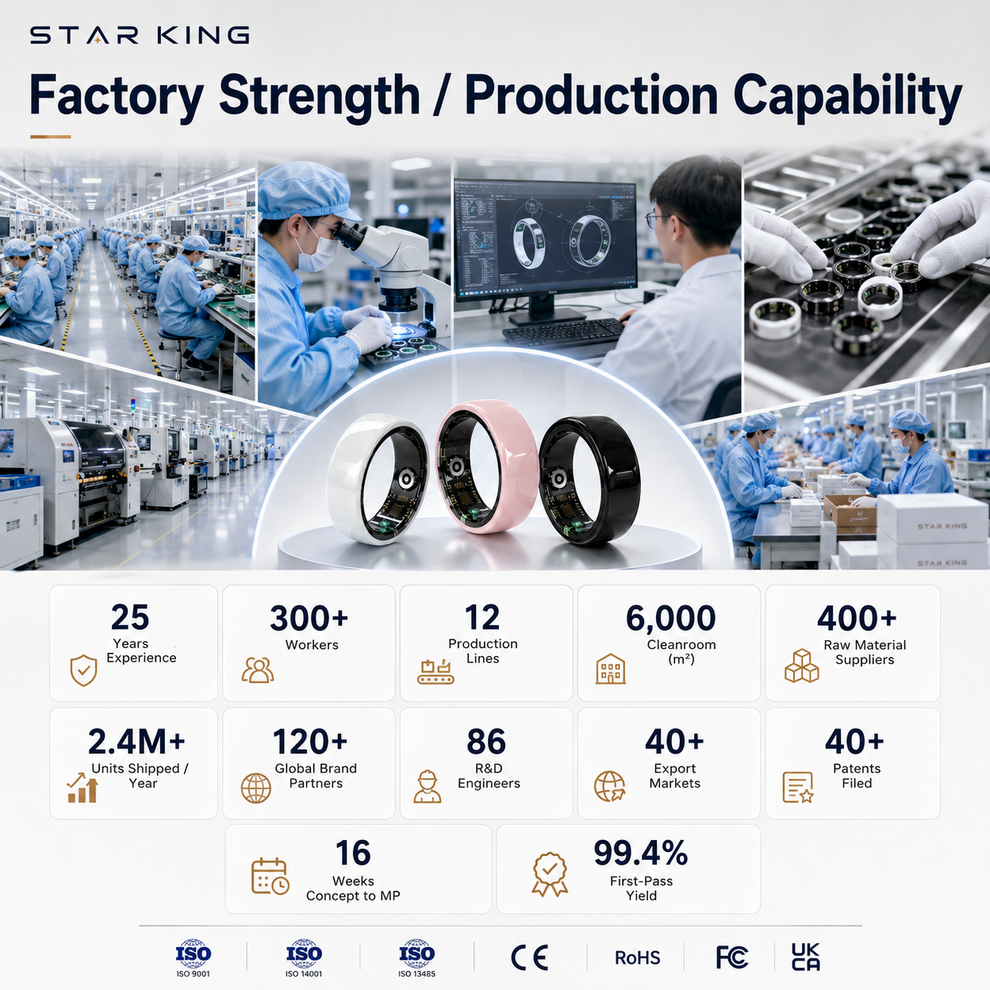
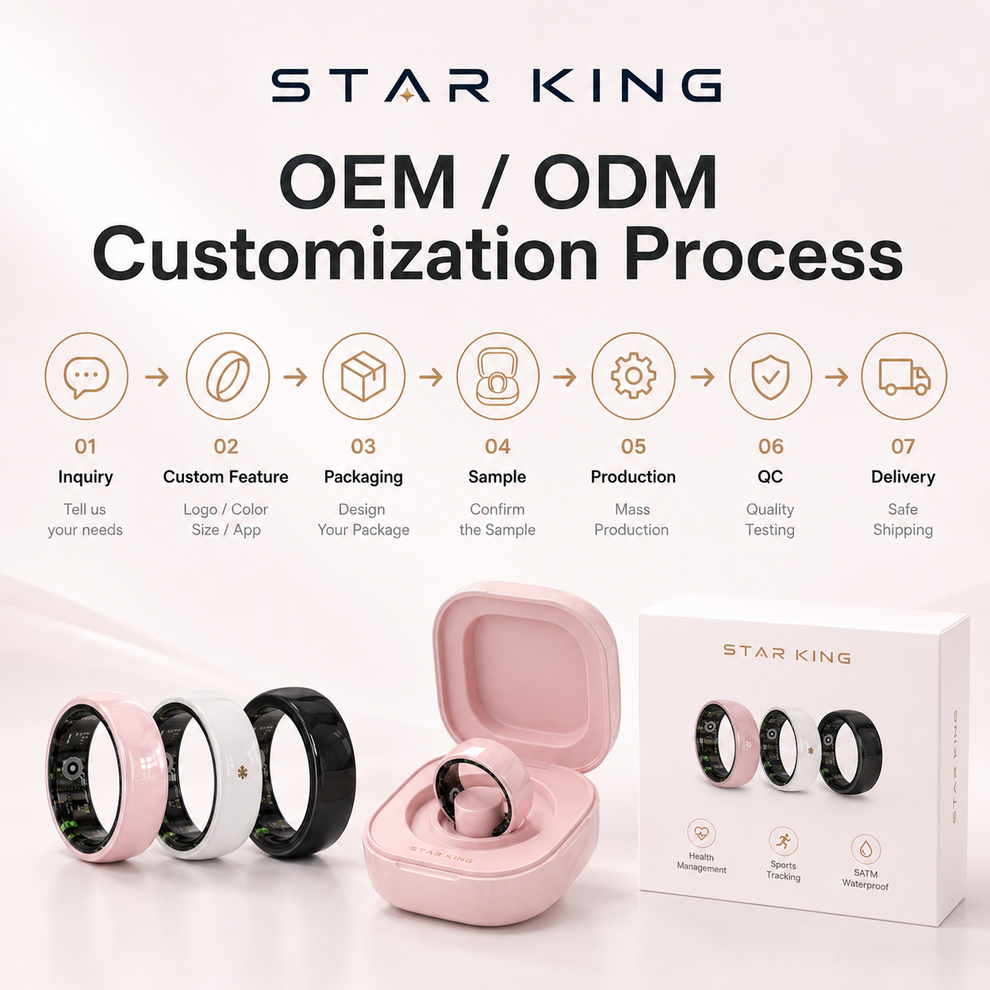
STAR KING supplies smart rings within a broader wearables and AI hardware portfolio, and offers private label and OEM/ODM engagement models. Education buyers can source standard smart ring platforms or discuss customization of branding, packaging, firmware features and companion app surfaces. Final configurations, MOQ tiers and certification coverage should be confirmed in the quotation — see [STAR KING TO CONFIRM] for model-specific details.
Key Facts for Buyers
| RFQ Factor | What Education Technology Buyers Should Confirm |
|---|---|
| Primary use case | Student wellness, focus/activity, staff well-being, or research partners; avoid medical diagnostic claims |
| Data scope | Activity, sleep, heart rate, SpO2 trend and export formats; define retention and access rules |
| App integration | Companion app options, SDK availability, API data format, account management for institutions |
| MOQ | Tiered pricing around 500, 1,000, 5,000 and 10,000 units; tooling and packaging fees clarified |
| Compliance | CE, FCC, RoHS, UN38.3, MSDS depending on SKU and destination market |
| Sampling | Golden sample approval, firmware version lock, test report and battery endurance data |
| Lead time | Sample lead time, mass production lead time, packaging add-on time, shipping mode to destination region |
| After-sales | Warranty terms, DOA policy, spare parts, firmware update responsibility |
Check 1: Define the Use Case and Data Scope
The first RFQ check is a written use case. Education technology companies typically fall into three categories: wellness and activity programs for students, staff well-being pilots, and research or learning-engagement projects. Each category changes the required sensors and the data handling expectations. A use case that only needs daily activity and sleep summaries should not be quoted with the most sensor-dense configuration, because additional sensors raise cost, power use and compliance review complexity.
Define in the RFQ whether the program is voluntary, how long participants wear the device, who can access the data, and how data will be exported. Many education buyers prefer an institutional account model where the school administrator manages enrollment and the individual retains visibility of their own data. Suppliers should confirm which of these models their companion app supports. If your use case involves any interpretation of health readings, state clearly that the devices are consumer wellness products and not medical diagnostic devices.
A practical procurement outcome is a one-page use case statement attached to the RFQ. Suppliers can then respond with a matching configuration rather than a generic catalogue pitch, and quotes become comparable. Education buyers should also check whether data analytics support is included, or whether it requires a separate business and education solution discussion.
Check 2: Sensor, Battery and Form Factor Specification
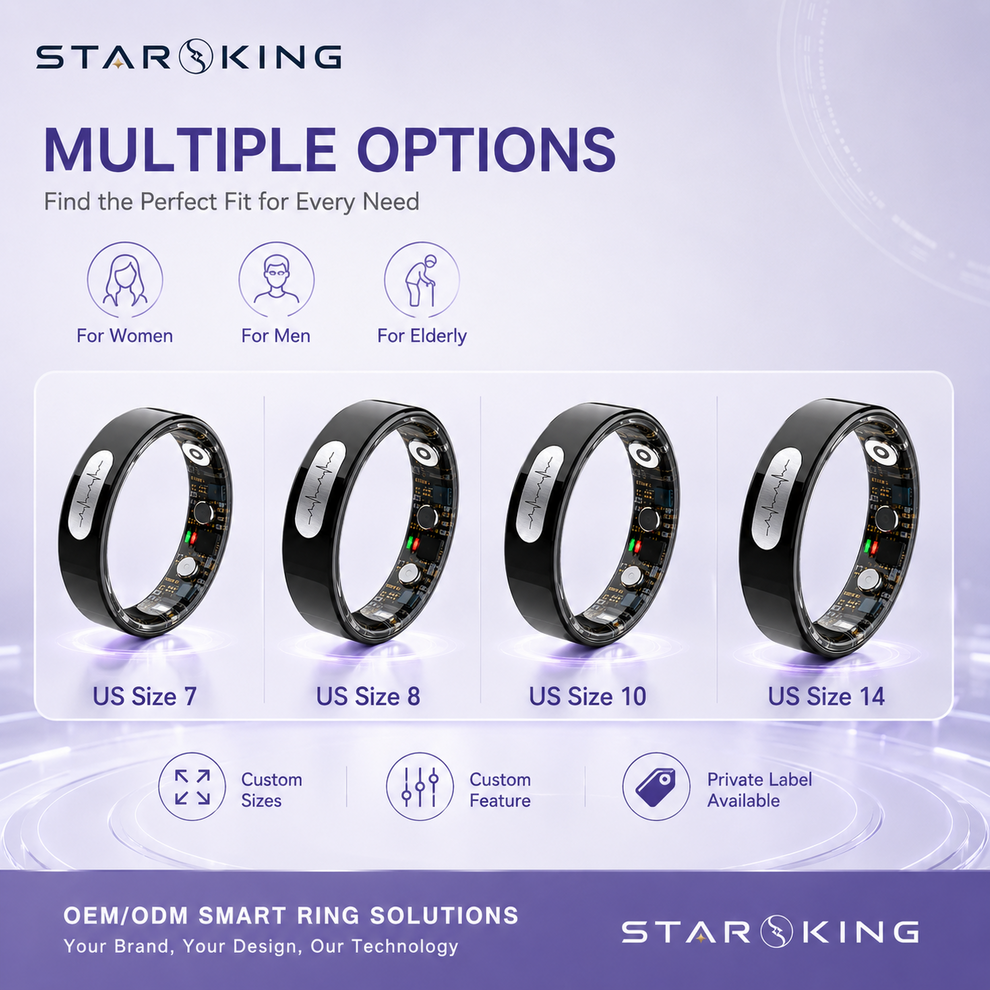
Smart ring quotation quality is driven by the hardware specification. At RFQ stage, request the sensor list, battery capacity, charging method, water resistance rating, ring size range, and materials of the shell and inner surface. For education deployments, size range matters because student populations span many ring sizes; a supplier with a narrow size set may require custom sizing kits.
Battery life should be quoted under a defined test condition, such as continuous heart rate tracking or intermittent sync. Buyers should ask for battery cycle expectations and charging case or dock options. Water resistance claims should be written as the tested rating, for example a specific IP or ATM level, and supported by test documentation on request. Materials and surface finish also affect skin comfort during long wear, which is particularly relevant for programs where students wear rings for weeks.
Specification questions to put in the RFQ
- Which sensor package is included, and is the sensor model disclosed?
- What is the rated battery life under specified conditions?
- What is the tested water resistance rating and does the supplier provide a test report?
- Which ring sizes are available, and are sizing kits offered?
- What is the surface material and allergy consideration for prolonged wear?
Buyers who cannot obtain these details in writing should treat the quote as provisional. The same specification discipline applies when comparing health and fitness wearable solutions across form factors.
Check 3: App, Firmware and SDK Integration
For education technology buyers, app integration is usually the largest technical risk and the most common source of schedule slip. The RFQ should ask whether the device uses the supplier’s standard companion app, a white-label app, or an SDK that your team integrates into your own platform. Each option has different cost, timeline and data control implications.
Request the firmware version that will ship, the update policy, and the data fields available through the app or API. Define whether the supplier supports data export in CSV, JSON or another format, and whether historical data can be retrieved for research purposes. If your institution requires account provisioning for hundreds or thousands of users, confirm how accounts are created, reset and deactivated. Confirm what happens to the data when a device is reassigned to another student.
Security and privacy questions belong in the RFQ. Ask where data is stored, whether cloud services are used, and what security measures the supplier documents. Education buyers should verify these points against their own institutional policies and applicable data-protection rules, which typically depend on the jurisdiction. If your program needs deeper customization, discuss private label OEM/ODM options for app and firmware surfaces.
Integration deliverables to request
- Sample firmware version and release notes.
- API or SDK documentation, even if only a technical summary at RFQ stage.
- Data field list and export format sample.
- Institutional account management description.
- Firmware and app update responsibility, including who fixes defects after launch.
If a supplier cannot provide a technical summary at RFQ stage, buyers should consider requesting a paid technical evaluation or a scoped sample project rather than committing to a mass order.
Check 4: MOQ, Tooling and Pricing Structure
MOQ for smart rings is not a single number. Suppliers may set minimum order quantities per model, per ring size mix, and per packaging configuration. Tooling and enclosure changes, custom colors, logo printing and retail packaging add fixed costs that are recovered through volume. The RFQ should request tiered pricing at several volumes so the buyer can model budget scenarios.
A useful RFQ structure asks for pricing at 500, 1,000, 5,000 and 10,000 units, and separately states tooling fees, sample fees, packaging setup fees, and any certification cost passed to the buyer. Buyers should also ask whether the MOQ applies per shipment or per purchase order, and whether ring size mix flexibility is included. For public-sector or school programs, purchase orders may be released in phases; confirm that the quoted price remains valid across the planned release schedule.
Soft CTA: If you have a defined education use case and volume plan, STAR KING can review your requirements and respond with a configuration and pricing structure. You can request a smart ring quotation for your program context.
Check 5: Certification and Market Compliance
Certification is a specification item, not an afterthought. Which documents are required depends on the product configuration, radio modules, battery type, and destination market. Common requests for smart rings include CE marking for EU markets, FCC equipment authorization for the United States, RoHS compliance for hazardous substance limits, UN38.3 for lithium battery transport, and an MSDS for the battery. Buyers should ask for the specific certificate scope and the model or SKU it covers, and verify that the document is current.
Radio equipment rules apply because smart rings connect over Bluetooth. The supplier should confirm the Bluetooth qualification status and the radio module used. Buyers can review official references such as the FCC rules for radio frequency devices and the EU Radio Equipment Directive to understand the framework, but should rely on the supplier’s documented test evidence for each SKU. For battery transport documentation, the IATA lithium battery guidance is a useful reference for air freight planning.
Education buyers may also face procurement rules from school districts, ministries or public tender frameworks. These are not the same as product certification. The RFQ should ask the supplier to state which certifications are available for the exact quoted configuration, and to confirm whether the buyer must arrange any local registration. Where documents are pending, request a timeline and do not assume certification until evidence is provided.
Compliance questions for the RFQ
- Which certificates apply to the quoted SKU, and can copies be provided?
- Is the battery UN38.3 report current, and is an MSDS available?
- What is the Bluetooth qualification status and radio module?
- Which destination-market requirements does the supplier handle, and which remain with the buyer?
- What is the process if a certificate needs renewal during the program?
Check 6: Sample Testing and Validation Plan
Samples are the buyer’s main risk-control tool before mass production. The RFQ should specify how many sample units are required, which sizes, and what tests the buyer will run before approving the golden sample. A written sample approval process prevents later disputes about whether the delivered goods match expectations.
A practical validation plan for education deployments covers: pairing and reconnection stability across common phone models; battery endurance over a multi-day wear test; charging reliability; app sync accuracy compared with a reference device; water resistance check consistent with the claimed rating; and comfort during prolonged wear. If the program involves younger students, include a durability and sizing check because handling differs from adult consumer use.
The golden sample should be sealed and referenced in the purchase agreement, with firmware version recorded. Suppliers should state what changes are permitted after approval and how change notification works. Buyers should also request the supplier’s pre-shipment inspection process and any routine quality checks. For related quality guidance, see the STAR KING resources blog.
Check 7: Lead Time, Packaging and After-Sales
Lead time for education programs is often tied to an academic calendar. Missing a semester start can delay a pilot by months, so the RFQ should ask for a production schedule broken down by sample approval, component lead time, mass production, packaging and shipping. Packaging customization, including languages and institutional branding, adds time and should be quoted separately.
Shipping lithium-battery devices internationally requires compliant transport documentation and packaging. Confirm the shipping mode — air, sea or courier — and the Incoterms for the quote, so that landed cost is comparable across suppliers. After-sales terms should be in the quote: warranty duration, dead-on-arrival handling, spare parts availability, and who pays return freight for defective units. For multi-year programs, ask about product lifecycle and component continuity.
Lead time and logistics items
- Sample lead time and mass production lead time in working days.
- Packaging lead time for custom branding and manuals.
- Incoterms and freight mode for lithium-battery shipments.
- Warranty terms and DOA policy.
- Spare parts and replacement unit process.
Smart Ring RFQ Comparison Table
| Decision Area | Weak RFQ Response | Strong RFQ Response | Why It Matters for EdTech |
|---|---|---|---|
| Use case | Generic catalogue PDF | Configuration mapped to wellness or research use | Prevents over-specification and cost creep |
| Specification | Marketing claims only | Sensor, battery and water resistance details with conditions | Supports comparable quotes and test planning |
| App integration | “App included” | Firmware version, API data fields, account model | Reduces schedule risk before semester start |
| Pricing | Single unit price | Tiered pricing plus tooling and packaging fees | Enables budget approval and landed cost model |
| Compliance | “CE and FCC available” | Certificate scope per SKU and document timeline | Avoids customs and tender rejection |
| Sampling | Samples without approval process | Golden sample, test plan and change notification | Protects quality expectations |
| Lead time | Single vague estimate | Schedule by phase, with packaging and shipping | Protects academic calendar commitments |
Common Mistakes and Buyer Red Flags
Common mistakes
- Sending a one-line inquiry. Without a use case, suppliers quote generic configurations that may not fit education deployments.
- Comparing unit price only. Tooling, packaging, certification, freight and warranty costs change the real landed cost.
- Leaving app integration to the end. Data fields and account management should be confirmed before mass production is scheduled.
- Assuming certification covers every SKU. Certificate scope often depends on the configuration and radio module.
- Skipping a written sample approval. Without a sealed golden sample and firmware record, quality disputes become difficult to resolve.
- Planning against a single lead time. Production, packaging and shipping should be scheduled as separate phases.
Buyer red flags
- The supplier will not disclose sensor model or firmware version at RFQ stage.
- Certification documents are described but not provided for the quoted SKU.
- MOQ and tooling fees are unclear or change after the quote is issued.
- No defined process for firmware updates or defect handling.
- Health readings are presented as diagnostic or clinical results.
- Lead times are promised without reference to component or packaging dependencies.
Practical Buyer Checklist
- Written one-page use case and data scope attached to the RFQ.
- Sensor, battery, water resistance and size range specification requested.
- App, SDK or API data fields and account model confirmed.
- Tiered pricing requested at multiple volumes, with tooling and packaging fees itemized.
- Certification scope confirmed per SKU for the destination market.
- Sample quantity, sizes and validation plan agreed in advance.
- Golden sample approval process and firmware version recorded.
- Lead time broken down by sample, production, packaging and shipping.
- Incoterms and lithium-battery shipping documentation confirmed.
- Warranty, DOA policy and spare parts terms included in the quote.
FAQ
What should an education technology company include in a smart ring RFQ?
Include the use case, participant count, deployment timeline, destination market, required data fields, app integration expectations, sample quantity and any institutional procurement requirements. A written use case is the single most useful item because it lets suppliers quote a matching configuration instead of a generic product.
What MOQ should Education buyers expect for bulk smart rings?
MOQ varies by supplier, model and packaging. Request tiered pricing at several volumes and ask whether MOQ applies per model, per ring size mix or per purchase order. Custom tooling, colors and packaging usually raise the effective minimum. STAR KING MOQ tiers are [STAR KING TO CONFIRM].
Are smart rings medical devices for student health programs?
Consumer smart rings are generally wellness devices, not medical diagnostic tools. Education programs should describe features as activity, sleep and trend monitoring, and avoid diagnostic claims. If a program requires clinical-grade measurement, buyers should verify regulatory classification with qualified advisors before procurement.
Which certifications do smart rings need for schools?
Requirements depend on the product configuration and destination market. Common requests include CE, FCC, RoHS, UN38.3 and MSDS. School procurement rules may add documentation requirements that are separate from product certification. Buyers should request certificate scope per SKU and verify current validity before ordering.
How long does smart ring sampling and production take?
Timelines depend on configuration, packaging and component availability. Ask for a schedule by phase: sample preparation, sample approval, mass production, packaging and shipping. Academic calendar deadlines should be shared with the supplier so lead time risk can be assessed early. STAR KING lead times are [STAR KING TO CONFIRM].
Can smart ring apps integrate with an existing education platform?
Integration depends on whether the supplier offers an SDK or API and what data fields are exposed. Ask for documentation, export formats and account management details at RFQ stage. Some buyers start with the supplier’s standard app and plan a later integration phase; others require API access before pilot launch.
How should buyers compare smart ring quotes from different suppliers?
Normalize quotes to the same specification, volume, packaging and Incoterms. Compare landed cost, certification scope, app integration deliverables, sample approval process and after-sales terms. The lowest unit price is rarely the lowest program cost when integration and compliance work are included.
Conclusion
Smart rings for education technology programs are procurement projects with technical, compliance and calendar risk. The seven RFQ checks in this guide — use case, hardware specification, app integration, MOQ and pricing, compliance, sample validation, and lead time — give buyers a structured way to compare suppliers and control risk before committing to volume. Buyers who put these points in writing receive clearer quotes and reduce the chance of rework during a pilot or rollout.
STAR KING works with international B2B buyers on wearable sourcing and private label programs. Share your use case, target market and volume plan, and the team can respond with configuration options, documentation status and a quotation aligned to your RFQ.
STAR KING CTA
Ready to compare smart ring specifications or discuss a custom program for your education deployment? Request a quotation and include your use case, volume tiers and destination market so the response matches your RFQ.
Discuss Your Smart Wearable OEM/ODM Project
Planning a smart ring, smart watch, smart band, AI glasses, AI translator, or AI voice mouse project? Contact STAR KING to discuss product positioning, sample testing, customization scope, certification requirements, lead time, and quotation details.

Team Star King

Scan WhatsApp QR code
Leave a Reply