
Smart Rings for Amazon Sellers: The 10-Point RFQ Checklist Before You Request Quotes
November 11, 2026 · Team Star King
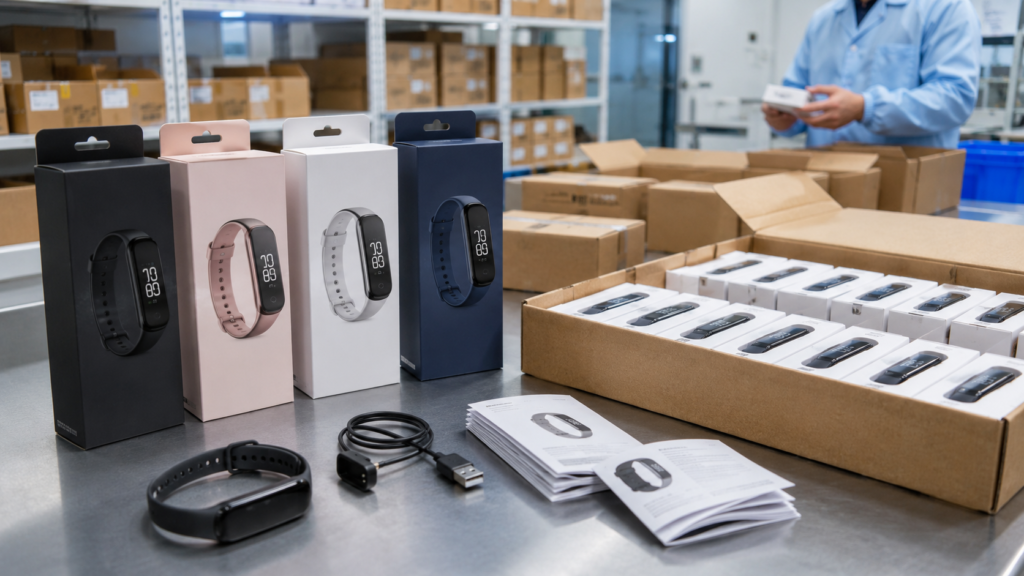
Smart Rings for Amazon Sellers: The 10-Point RFQ Checklist Before You Request Quotes
If you are sourcing smart rings for Amazon sellers, the fastest way to get a usable quote is to send suppliers a structured RFQ that specifies ring sizes, sensor requirements, app ownership, certification targets, packaging, MOQ, and Incoterms. A vague “send me your catalog” message usually returns vague pricing and untested assumptions. This guide gives you a 10-point checklist to compare OEM suppliers, avoid red flags, and prepare a quote request that Amazon-focused factories can answer accurately.
Table of Contents
Table of Contents
smart rings for Amazon sellers: Short Answer
Smart rings for Amazon sellers should be evaluated as a full supply-chain package, not just a device. Before requesting quotes, confirm the supplier’s MOQ, available ring sizes, sensor and battery specifications, app and firmware customization options, certification status, packaging capability, lead times, and after-sales support. Send all requirements in one RFQ so suppliers quote the same scope.

Table of Contents
- Why Smart Ring RFQs Fail on Amazon
- Key Takeaways
- Key Facts for Buyers
- 1. Define the Product and Use Case
- 2. Confirm Ring Sizes and Fit Strategy
- 3. Specify Sensors and Health Features
- 4. Decide App, Firmware, and Data Ownership
- 5. Plan Certification and Amazon Compliance
- 6. Agree on MOQ, Pricing Tiers, and Tooling
- 7. Validate Samples and Test Reports
- 8. Lock Packaging, Branding, and FBA Prep
- 9. Confirm Lead Times, Shipping, and Battery Rules
- 10. Review Warranty, Spare Parts, and Returns
- Smart Ring Supplier Comparison Table
- Common Mistakes and Buyer Red Flags
- Practical Buyer Checklist
- FAQ
- Conclusion
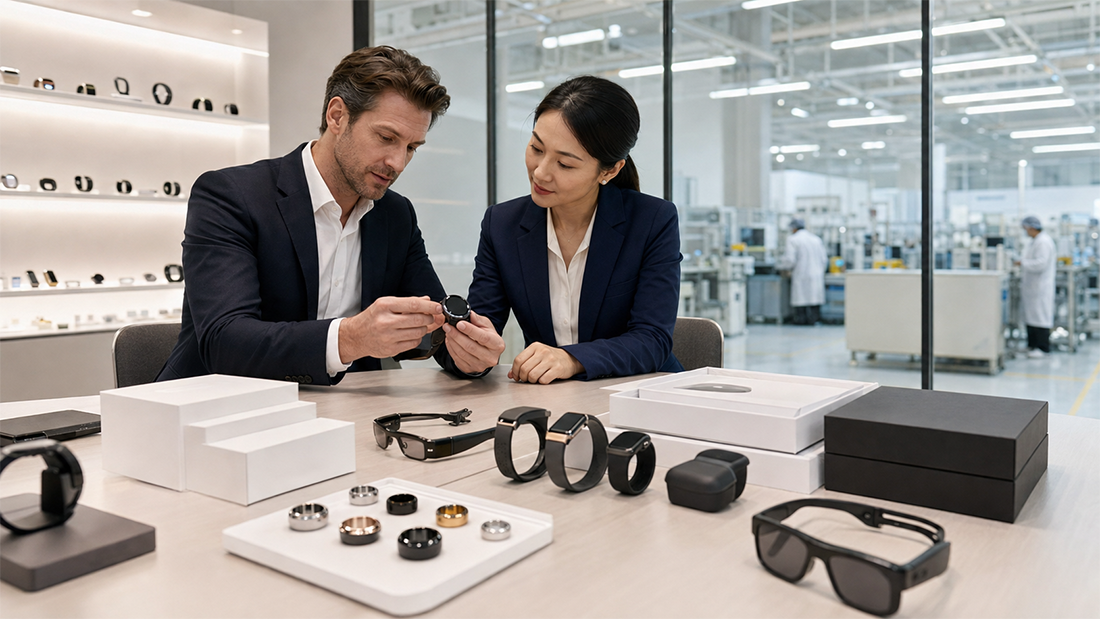
Key Takeaways
- An RFQ for smart rings for Amazon sellers must include size ranges, sensor specs, app requirements, certification targets, and packaging details in one document.
- MOQ and unit price are linked to ring sizes, sensor modules, packaging, and customization depth; ask for a size-level breakdown.
- App and firmware ownership terms affect long-term Amazon listing stability and should be agreed before tooling starts.
- Certification depends on the exact product configuration and destination market; request per-SKU evidence rather than general claims.
- Lithium battery shipping rules and FBA prep requirements should be confirmed before you approve mass production.
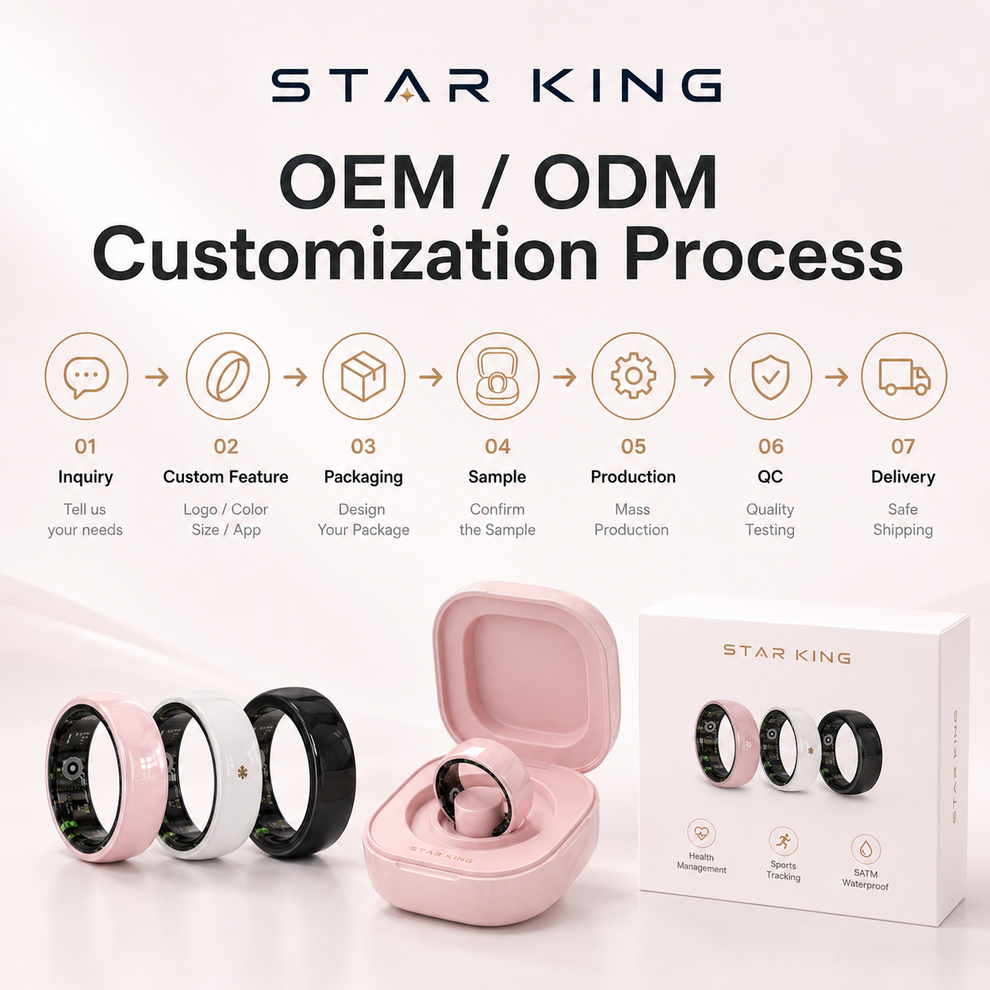
Key Facts for Buyers
| RFQ Element | What to Specify | Why It Matters on Amazon |
|---|---|---|
| Product configuration | Ring sizes, colors, sensor set, battery target, display or no display | Prevents quote mismatch and listing returns |
| App and firmware | White-label app, custom logo, data ownership, update responsibility | Affects brand control and customer support |
| Certification | Target markets, required reports, per-SKU evidence | Amazon may request compliance documentation |
| MOQ | Total units and size-level breakdown | Impacts cash flow and inventory risk |
| Packaging | Retail box, inserts, barcodes, FBA labels | Reduces receiving errors and listing issues |
| Lead time | Sample, production, testing, and shipping schedule | Keeps launch and restock dates realistic |
| Battery shipping | UN38.3, MSDS, carrier acceptance | Required for air and ocean freight |
| Warranty | Coverage period, spare parts, replacement policy | Protects reviews and margins |
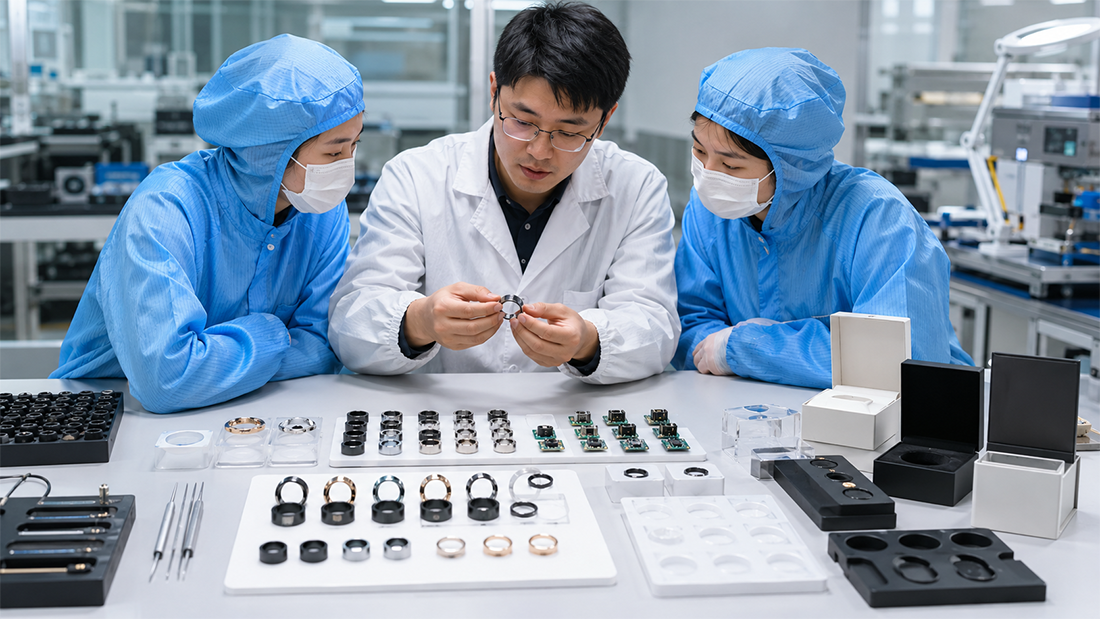
Why Smart Ring RFQs Fail on Amazon
Smart rings are compact hardware with several interdependent parts: sensor module, battery, charging case or dock, firmware, mobile app, and size-specific shell tooling. Amazon sellers often send a short RFQ that asks only for price and MOQ. Suppliers then quote different assumptions: one includes a basic app, another quotes a custom app separately; one quotes only standard sizes, another includes tooling. The result is a set of quotes that cannot be compared.
A better approach is to treat the RFQ as a procurement specification. It should state what you are selling, where you will sell it, which claims you plan to make, and what you need the supplier to own. This is especially important for smart rings for Amazon sellers because listing compliance, customer returns, and review quality depend on details that are easy to overlook at the quotation stage.
1. Define the Product and Use Case
Start with the commercial use case. A sleep-focused ring, a fitness-oriented ring, and a corporate wellness ring may share hardware but require different app dashboards, packaging messages, and listing claims. Write a one-page product brief that states the target customer, price band, main features, and the claims you intend to make.
For Amazon, avoid medical claims unless you have the regulatory basis to support them. Consumer smart rings typically provide wellness and lifestyle data, not diagnosis. The wording on your listing, packaging, and app should match the supplier’s validated feature set.
Questions to answer before the RFQ
- Will the ring be sold as a standalone brand or as a private-label add-on?
- Which features are core: sleep tracking, heart rate, blood oxygen, activity, or notifications?
- Do you need a charging case, a dock, or both?
- Which markets will you sell into first?
If you are still comparing wearable form factors, review the broader smart ring product range alongside your smart watch or band plans so your RFQ does not duplicate overlapping SKUs.
2. Confirm Ring Sizes and Fit Strategy
Ring sizing is a common source of returns. Unlike a watch band, a ring must fit a specific finger. Ask the supplier which sizes are available, whether size-specific tooling is required, and whether sizing kits can be supplied for pre-launch measurement or customer support.
For Amazon sellers, size availability affects inventory planning. A listing that offers six sizes requires stock across all six, or careful variant management. Ask for a size-level MOQ breakdown so you can estimate the cost of offering a full size range versus a limited launch set.
What to ask
- Standard size range and any gaps: [STAR KING TO CONFIRM]
- Minimum quantity per size: [STAR KING TO CONFIRM]
- Availability of sizing kits or printable size guides
- Shell material options and color finishes
Image suggestion: Close-up of smart ring sizes on a measurement gauge. ALT: “Smart rings for Amazon sellers shown in multiple sizes on a sizing gauge.”
3. Specify Sensors and Health Features
Sensor specifications determine what you can promote and what customers will expect. Ask the supplier to list the sensor set, sampling behavior, battery impact, and supported metrics. Avoid accepting a general feature list without understanding how each metric is generated.
For a quote-ready RFQ, separate must-have features from optional features. This lets suppliers price a base configuration and optional add-ons, which is more useful than a single all-in price.
Feature trade-offs to discuss
- Continuous heart rate versus interval sampling
- Blood oxygen monitoring frequency and battery cost
- Sleep staging depth versus data storage requirements
- Charging case capacity versus product size
Suppliers should explain how firmware updates may change battery life or data accuracy. A responsible supplier will describe tested configurations rather than promising unlimited performance.
4. Decide App, Firmware, and Data Ownership
The app is part of the product experience. Amazon customers expect onboarding, firmware updates, and clear data handling. Before you request a quote, decide whether you need a white-label version of the supplier’s existing app, a custom-branded app, or a deeper integration with your own platform.
Ask who owns the app code, who maintains it, how updates are released, and what happens if you change suppliers. These terms affect your ability to keep a stable listing over time. For sellers building a long-term brand, app and firmware ownership deserve the same attention as hardware tooling ownership.
App questions for the RFQ
- Is the app white-label, custom, or supplier-branded?
- Can the app logo, name, and color scheme be customized?
- Where is user data stored and who controls it?
- How are firmware updates delivered and tested?
If your roadmap includes multiple wearable types, review private label OEM/ODM options so app and firmware decisions are consistent across products.
5. Plan Certification and Amazon Compliance
Certification requirements depend on the product configuration, radio modules, battery, and destination market. Do not accept a blanket statement that “all products are certified.” For each SKU you plan to sell, ask for the relevant reports and confirm they match the exact model, battery, and radio configuration.
Amazon may request compliance documentation for electrical products and products with batteries. Sellers should verify the latest requirements in Amazon Seller Central and with their compliance advisor. Common documents discussed in wearable sourcing include CE, FCC, RoHS, UN38.3, and MSDS; the applicable set depends on where you sell and how you ship.
Certification checklist
- Target markets and required standards for each
- Per-SKU certificate and test report availability
- Radio module approval status
- Battery test documentation and carrier acceptance
- Labeling and language requirements
For official reference, see the FCC radio frequency device certification page and the RoHS compliance overview. Buyers should verify current regulations independently because requirements may change.
6. Agree on MOQ, Pricing Tiers, and Tooling
MOQ for smart rings is usually influenced by ring sizes, shell colors, packaging, and customization. A supplier may accept a lower total MOQ if you limit the size range or choose existing tooling. Ask for a pricing table that shows unit cost at different quantities and a separate line for tooling, samples, and packaging setup.
Clarify whether tooling is shared or dedicated, who owns it, and what happens to the tooling if the relationship ends. For Amazon sellers, tooling ownership can protect your product design and reduce risk if you later qualify a second supplier.
Commercial items to confirm
- MOQ by size and color: [STAR KING TO CONFIRM]
- Sample cost and whether it is credited against the bulk order
- Tooling cost and ownership terms
- Payment terms and currency
- Price validity period
7. Validate Samples and Test Reports
Sample approval should be a structured process, not a single look-and-feel check. Test the app onboarding, charging behavior, sensor readings, battery life in your expected use case, and packaging durability. Record the sample firmware version and hardware revision so the mass production unit can be compared against the approved sample.
Ask for test reports that support the features you plan to promote. Battery safety, drop testing, waterproof testing, and aging testing may be relevant depending on the product. The exact test plan should match the product’s claimed rating and target market.
Sample validation checklist
- App pairing and account setup
- Charging case and dock performance
- Sensor consistency across sizes
- Battery life under normal use
- Packaging and accessory completeness
8. Lock Packaging, Branding, and FBA Prep
Packaging is part of your Amazon listing. Specify retail box dimensions, printed materials, warranty card, barcodes, and FBA labels. If you plan to sell in multiple markets, confirm language versions and any market-specific labeling.
Ask the supplier to confirm whether they can support FBA prep or whether you need a third-party prep center. This affects landed cost and launch timing. For private-label sellers, packaging customization is often the fastest way to differentiate an otherwise similar ring.
Packaging RFQ details
- Box type and print method
- Logo placement and brand colors
- User manual languages
- Barcode and FNSKU label support
- Master carton configuration
Image suggestion: Private-label smart ring retail box with accessories and manual. ALT: “Private label smart rings for Amazon sellers shown with retail packaging and accessories.”
9. Confirm Lead Times, Shipping, and Battery Rules
Smart rings contain lithium batteries, so shipping requires the correct documentation and carrier acceptance. Ask for UN38.3 and MSDS documentation and confirm which carriers and routes have been used for similar products. Air, express, and ocean freight may have different requirements.
Lead time should be broken into sample lead time, production lead time after sample approval and deposit, testing time, and shipping time. Build a buffer for Amazon inbound receiving and any compliance review. For sellers planning Q4 or Prime Day launches, work backward from the listing live date.
Logistics checklist
- Sample lead time: [STAR KING TO CONFIRM]
- Mass production lead time: [STAR KING TO CONFIRM]
- Battery documentation availability
- Incoterms and freight responsibility
- FBA inbound appointment support
10. Review Warranty, Spare Parts, and Returns
Amazon returns and reviews are sensitive to defects and support quality. Ask how the supplier handles defective units, whether spare parts such as chargers and sizing kits are available, and what warranty period is standard. Clarify who pays return shipping for defective units and how replacements are processed.
For branded sellers, a clear after-sales process protects listing health. Include warranty terms and support responsibilities in the RFQ so they are quoted, not negotiated after the order.
Smart Ring Supplier Comparison Table
Use this table to compare responses from different suppliers on the same criteria. Score each supplier consistently before shortlisting.
| Criteria | What a Strong Answer Looks Like | Red Flag |
|---|---|---|
| Product specification | Clear sensor list, battery target, size range | Generic feature list only |
| App and firmware | Documented white-label or custom options | No clarity on ownership or updates |
| Certification | Per-SKU reports and market mapping | “All certified” without evidence |
| MOQ | Size-level MOQ and pricing tiers | One price with no breakdown |
| Samples | Structured sample approval process | Only catalog photos |
| Packaging | Retail box and FBA prep options | No barcode or label support |
| Lead time | Milestone-based schedule | Single vague date |
| After-sales | Warranty and spare parts policy | No replacement process |
Common Mistakes and Buyer Red Flags
Common mistakes
- Requesting a price before defining the product configuration and target market.
- Comparing quotes that include different app, packaging, or certification scope.
- Assuming all ring sizes have the same MOQ and unit cost.
- Ignoring battery shipping documentation until the order is ready.
- Failing to record the approved sample firmware and hardware revision.
Buyer red flags
- The supplier will not provide per-SKU certification evidence.
- MOQ changes significantly after you ask for a written quote.
- App ownership and data handling are unclear.
- Lead times are promised without a production schedule.
- Warranty and spare parts are not addressed in writing.
If you are preparing an RFQ for smart rings and want to compare configuration options, our team can help you structure the request before you send it to multiple suppliers. Discuss your smart ring RFQ with STAR KING.
Practical Buyer Checklist
- Product brief with target markets and claims
- Required ring sizes and size-level quantities
- Sensor and feature list, with must-haves separated from options
- App, firmware, and data ownership requirements
- Certification and test report requirements by market
- MOQ, pricing tiers, tooling, and payment terms
- Sample approval criteria and records
- Packaging, branding, barcode, and FBA prep requirements
- Battery shipping documentation and Incoterms
- Warranty, spare parts, and returns process
For additional context on wearable quality checks, see the STAR KING resources blog and review the sleep and recovery application page if your first SKU will focus on sleep tracking.
Image suggestion: Quality inspection of smart rings on a testing bench. ALT: “Quality control inspection of smart rings for Amazon sellers before shipment.”
FAQ
What is a realistic MOQ for smart rings for Amazon sellers?
MOQ depends on ring sizes, colors, packaging, and customization. A limited size range with standard tooling usually requires a lower MOQ than a full size range with custom packaging. Ask for a size-level breakdown and confirm whether sample costs are credited: [STAR KING TO CONFIRM].
Which certifications should I request before listing smart rings on Amazon?
The applicable certifications depend on the product configuration and destination market. Sellers commonly discuss CE, FCC, RoHS, UN38.3, and MSDS, but the required set should be confirmed with the supplier and your compliance advisor. Request reports that match the exact SKU you plan to sell.
Can I get a private-label app for a smart ring?
Many suppliers offer white-label or customized app options, but scope varies. Ask whether the app logo, name, and color scheme can be changed, who maintains updates, and where user data is stored. Confirm these terms in writing before tooling begins.
How long does sample and production take?
Sample and production lead times vary by configuration and order size. Ask for a milestone schedule covering sample approval, mass production, testing, and shipping. Battery documentation and Amazon inbound receiving should be included in your timeline: [STAR KING TO CONFIRM].
Can the supplier ship smart rings directly to Amazon FBA?
Some suppliers support FBA prep, including barcode labels and carton marking, while others require a third-party prep center. Confirm FBA capabilities and any related costs in the quote so landed cost is accurate.
Who owns the tooling and product design?
Tooling and design ownership should be agreed in the RFQ or contract. Ask whether tooling is dedicated to your product, who holds ownership, and what happens if you change suppliers. Clear terms reduce risk when you scale.
What should I check in a smart ring sample?
Check app pairing, charging, sensor consistency across sizes, battery life in normal use, packaging, and accessory completeness. Record the sample firmware version and hardware revision, then compare mass production units against the approved sample.
Conclusion
Smart rings for Amazon sellers succeed or fail on details that are decided before the first quote arrives. A structured RFQ covering sizes, sensors, app ownership, certification, MOQ, packaging, lead times, battery shipping, and warranty lets you compare suppliers on the same basis. It also reduces the risk of returns, listing issues, and margin surprises after launch. Use the checklist in this guide to prepare your next RFQ and keep every supplier response comparable.
STAR KING CTA
Ready to move from checklist to quote? Send STAR KING your smart ring requirements, including target sizes, markets, app needs, and packaging direction, and request a quotation tailored to your Amazon launch plan. Request a smart ring quotation or ask to review sample and customization options.
Discuss Your Smart Wearable OEM/ODM Project
Planning a smart ring, smart watch, smart band, AI glasses, AI translator, or AI voice mouse project? Contact STAR KING to discuss product positioning, sample testing, customization scope, certification requirements, lead time, and quotation details.

Team Star King

Scan WhatsApp QR code
Leave a Reply