
Smart Ring Suppliers for Distributors: 7-Step Due Diligence Before You Commit
October 17, 2026 · Team Star King
Smart Ring Suppliers for Distributors: 7-Step Due Diligence Before You Commit
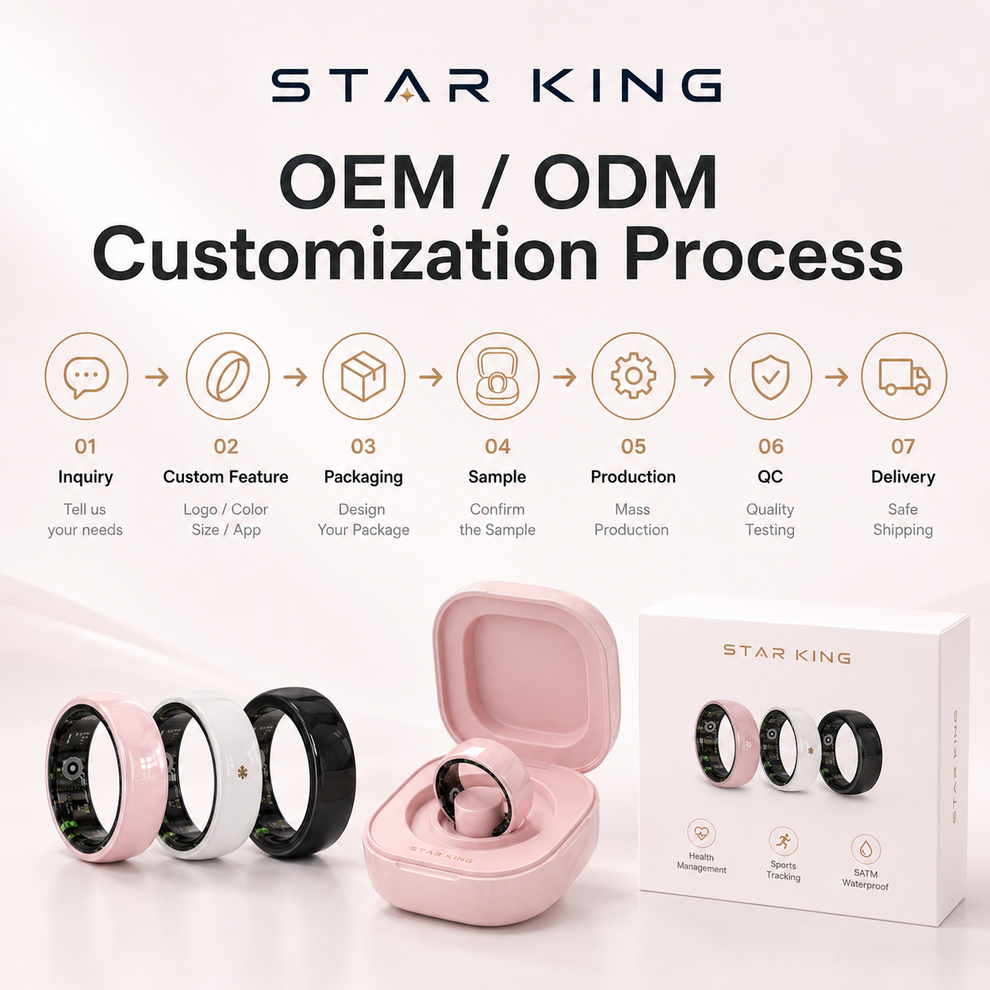
Choosing among smart ring suppliers is a supply-chain decision, not a product-feature decision. A distributor should verify five things before signing: B2B pricing tiers and margin, MOQ and lead-time commitments in writing, firmware and app ownership rights, battery-safety documentation for freight, and territory or channel protection. STAR KING supports distributor programs with OEM/ODM smart rings and Private Label Wearables, but this guide is written to help you evaluate any supplier on equal terms.
Table of Contents
Table of Contents
Table of Contents
- Short Answer: How Distributors Should Vet Smart Ring Suppliers
- What Makes Smart Ring Suppliers Different From Generic Wearable Vendors
- Key Takeaways
- Key Facts for Buyers
- The 7-Step Due Diligence Framework
- B2B Pricing, Margin, and Landed Cost Model
- MOQ, Lead Time, and Sample Development Terms
- Certification and Battery Compliance Checklist
- Software, App, and Data Ownership
- Decision Matrix: Comparing Smart Ring Suppliers
- Common Mistakes and Buyer Red Flags
- Practical Buyer Checklist
- FAQ
- Conclusion
Short Answer: How Distributors Should Vet Smart Ring Suppliers
Run a structured evaluation across seven dimensions: manufacturing capability, B2B pricing and margin, MOQ and lead-time flexibility, certification and battery compliance, firmware and app ownership, quality-control systems, and after-sales support. Ask for documents rather than verbal assurances, and validate each claim with a paid sample and a pre-shipment inspection clause. Distributors who complete this process before committing to a supplier usually avoid the two biggest risks — frozen inventory and untraceable battery shipments.
What Makes Smart Ring Suppliers Different From Generic Wearable Vendors
Smart rings are a compact, battery-powered, sensor-dense category. Unlike a phone case or a cable, a smart ring combines a lithium-polymer cell, a photoplethysmography (PPG) sensor array, a Bluetooth radio, charging circuitry, and a mobile app — all inside a sealed, water-resistant shell. That means the supplier you choose is not just a molding shop; it must manage firmware, app updates, battery documentation, and structural waterproofing simultaneously.
For distributors, the practical consequence is that evaluation must extend beyond unit price. A supplier that offers the lowest FOB quote but has no UN38.3 test summary or no firmware-update process will generate returns, freight delays, and warranty disputes in your market. Buyers should evaluate smart ring suppliers on total delivered cost and after-sales burden, not on unit price alone.
Key Takeaways
- Verify MOQ, lead time, and pricing tiers in writing — verbal commitments are not enforceable.
- Request UN38.3 test summaries and MSDS for every battery SKU you plan to import; airlines and freight forwarders may require them.
- Confirm who owns firmware, app code, and tooling when you fund custom development.
- Ask for pre-shipment inspection (PSI) and aging-test data, especially for rechargeable rings.
- Negotiate territory or channel protection if you are investing in marketing.
- Start with a paid sample batch before committing to mass production.
Key Facts for Buyers
| Evaluation Area | What to Request | Why It Matters to Distributors |
|---|---|---|
| Manufacturing capability | Factory profile, line count, in-house vs. outsourced processes | Determines scalability and consistency across reorders |
| B2B pricing | Tiered price list by quantity, FOB or EXW terms | Directly affects margin and channel competitiveness |
| MOQ | MOQ per SKU, per color, per size | Affects cash tied up in slow-moving sizes |
| Lead time | Standard and peak-season lead times in writing | Protects retail launch and replenishment windows |
| Certification | CE, FCC, RoHS, UN38.3, MSDS status per model | Required for customs clearance and retail listings |
| Software ownership | App white-label rights, firmware update terms | Prevents dependence on a supplier-controlled app |
| Quality control | PSI process, defect rate targets, aging and drop tests | Reduces returns and warranty claims |
| After-sales | Warranty period, spare parts, RMA process | Determines long-term service cost |
The 7-Step Due Diligence Framework
Step 1 — Verify the Manufacturer, Not Just the Trading Company
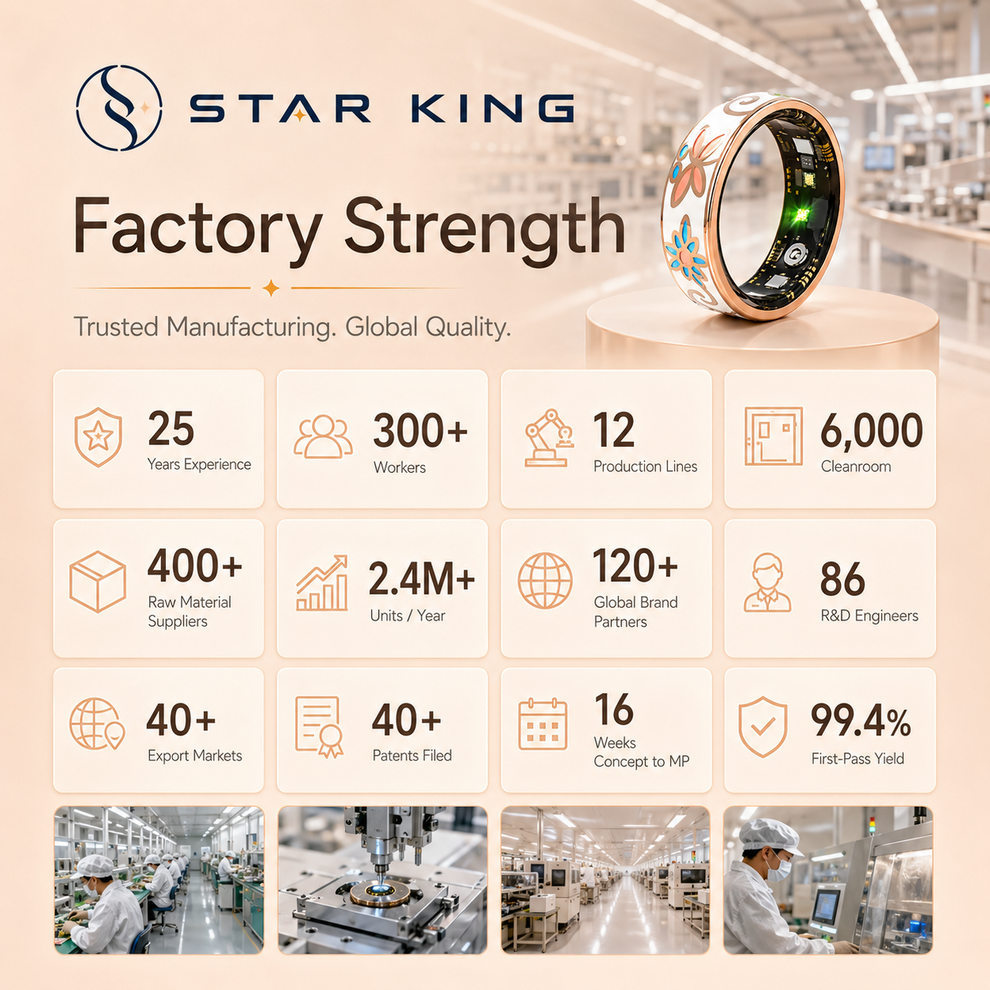
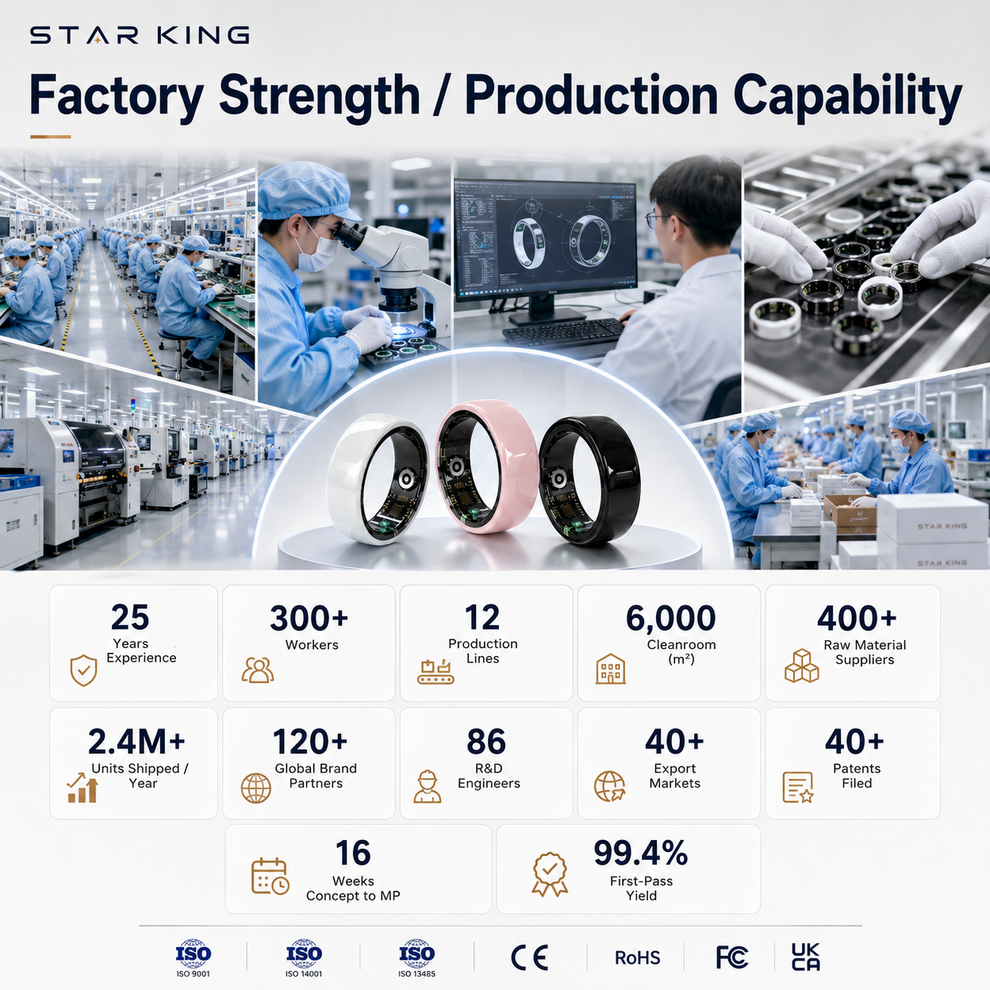
Many suppliers present themselves as factories but are trading intermediaries. Ask for the business license, a factory video walkthrough, and the name of the production entity. If a supplier cannot show where the rings are assembled and tested, treat pricing as indicative only. For distributor programs, direct manufacturer relationships usually reduce both cost and communication latency.
Step 2 — Map the Full SKU and Size Range
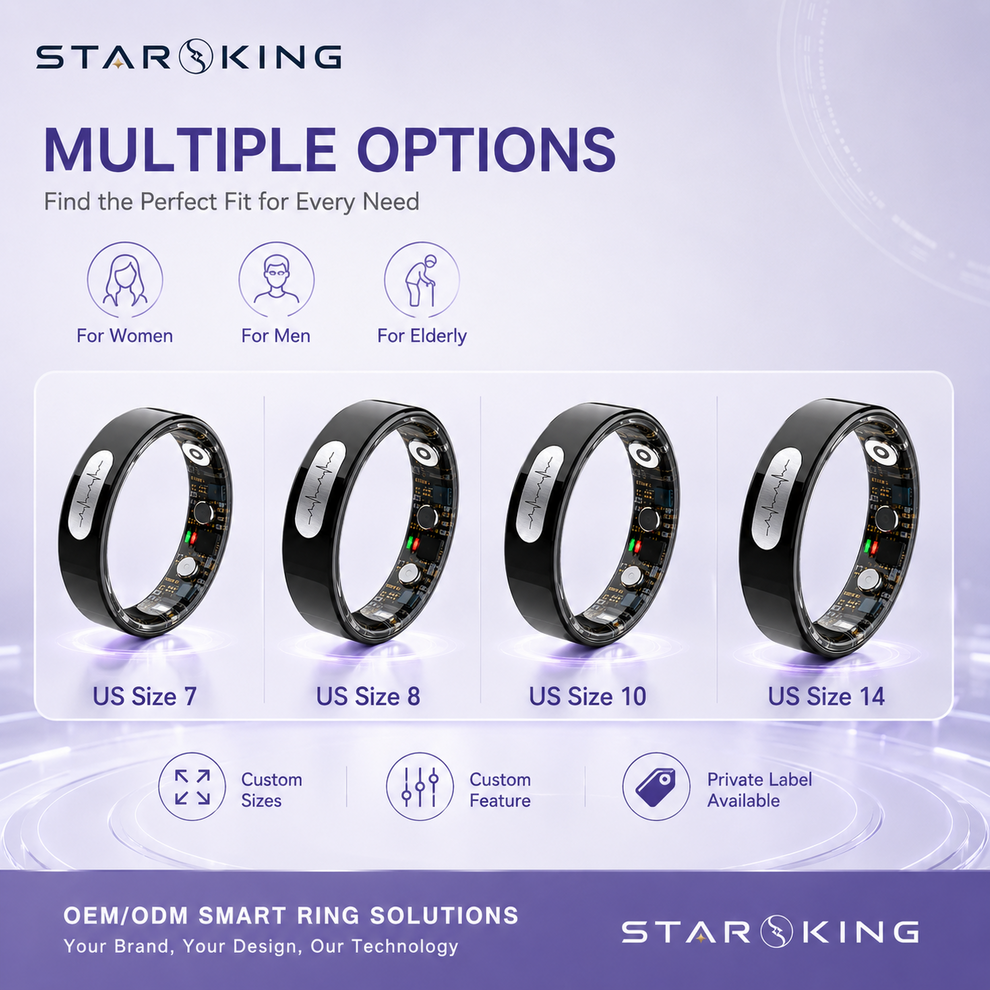
Smart rings typically come in multiple sizes and finishes. Ask for a size matrix and confirm which sizes are in stock versus made-to-order. Distributors frequently underestimate the working capital tied up in slow-moving sizes; a supplier that supports mixed-size cartons can reduce dead stock.
Step 3 — Confirm B2B Pricing Tiers and Margin
Request a tiered price list with clear breakpoints. Clarify whether pricing is FOB, EXW, or CIF, and which party covers freight, insurance, and duties. A landed-cost model (see below) shows your true margin before you commit.
Step 4 — Lock Down MOQ and Lead Time in Writing
MOQ is rarely a single number: it may differ by SKU, color, and packaging. Ask for MOQ per variant and confirm whether the supplier supports small trial orders. Lead time should be stated for standard production, first orders, and peak season, with a buffer clause.
Step 5 — Audit Certification and Battery Documentation
Certification requirements depend on the product configuration and the destination market. Buyers should verify CE, FCC, RoHS, UN38.3, and MSDS status per model rather than assume coverage. Lithium batteries are regulated for transport, and carriers may require UN38.3 test summaries. See the U.S. FCC equipment authorization page and the IATA Dangerous Goods Regulations for baseline references; your freight forwarder can confirm what applies to your lane.
Step 6 — Clarify Software, App, and Data Ownership
Ask who owns the mobile app, the firmware, and the cloud backend. If you plan to build a distributor brand, confirm whether the app can be white-labeled, whether data is stored on your account, and how firmware updates are delivered. Without this, a private-label program can stall at launch.
Step 7 — Validate Quality Control and After-Sales
Request the PSI process, defect-rate targets, and warranty terms. Confirm spare-part availability and the RMA workflow. A supplier that cannot describe its aging or drop test process is a supplier you should not scale with.
If you want to compare these requirements against a live distributor program specification, request a distributor pricing and MOQ sheet before you build your launch plan.
B2B Pricing, Margin, and Landed Cost Model
Unit price alone does not determine margin. Distributors should model landed cost, which includes product cost, freight, insurance, duties, and any certification or labeling cost. The table below is a planning template — fill in your own figures.
| Cost Line | Typical Basis | Notes for Distributors |
|---|---|---|
| Product cost | FOB or EXW per unit | Confirm by size and finish |
| Freight | Air or sea | Lithium batteries may affect carrier options |
| Insurance | % of cargo value | Often required for higher-value shipments |
| Duties and taxes | Per destination market | Verify HS code with a customs broker |
| Certification/labeling | One-time or per batch | Depends on market and product configuration |
| Warranty reserve | % of revenue | Set based on defect data, not guesswork |
MOQ, Lead Time, and Sample Development Terms
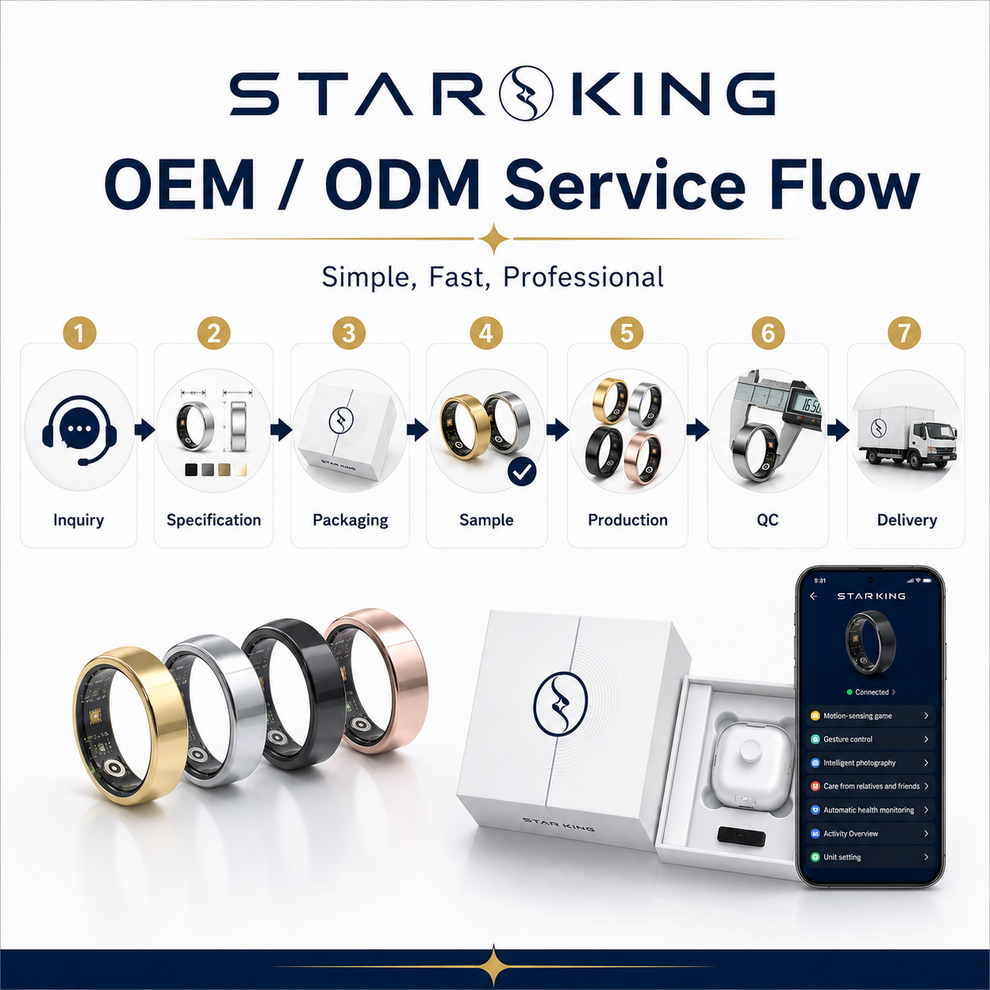
Distributors should separate MOQ into three parts: MOQ for stock models, MOQ for private-label packaging, and MOQ for custom firmware or app work. Stock-model MOQ is usually lowest; custom tooling or app development typically raises the minimum and extends lead time. Ask each supplier to quote all three so you can stage your rollout.
Sample development deserves its own line item and timeline. A paid sample batch lets you test pairing, app stability, charge cycles, and fit before mass production. Budget for it and request written confirmation that sample costs are deductible from the first mass-production order if the supplier offers that option.
Certification and Battery Compliance Checklist
Certification requirements vary by product configuration and destination. Use this checklist as a request list, not as a guarantee that any supplier holds these documents:
- CE marking documentation for EU markets (where applicable)
- FCC equipment authorization for U.S. markets
- RoHS compliance statement
- UN38.3 test summary for the lithium battery
- MSDS for the battery and finished goods
- Country-of-origin labeling
- Recyclability and WEEE obligations for EU sellers
Buyers should verify each document against the exact model they intend to import. Requirements typically depend on the target market and may change; confirm with your customs broker and a certified testing lab before shipment.
Software, App, and Data Ownership
For distributor brands, the app is part of the product. Confirm whether the supplier provides a white-label app, whether your logo and colors are configurable, and how firmware updates reach end users. Ask where health and activity data is stored and who can access it. If data privacy rules apply in your market, verify compliance obligations with qualified counsel — this guide is not legal advice.
Decision Matrix: Comparing Smart Ring Suppliers
Score each candidate from 1 (weak) to 5 (strong) and total the columns. This keeps the comparison objective when quotes look similar.
| Criterion | Supplier A | Supplier B | Supplier C |
|---|---|---|---|
| Direct manufacturer verification | |||
| B2B pricing tiers | |||
| MOQ flexibility | |||
| Lead-time clarity | |||
| Certification/battery docs | |||
| App/firmware ownership | |||
| Quality-control process | |||
| After-sales and spare parts | |||
| Territory protection |
Common Mistakes and Buyer Red Flags
- No written MOQ or lead time. Verbal promises cannot be enforced when a retail launch slips.
- Certification claimed but not documented. Ask for the actual test summary or certificate, matching the exact model.
- No UN38.3 or MSDS. Battery shipments may be refused or delayed without them.
- Unclear app ownership. If the supplier controls the app, your brand is rented, not owned.
- No PSI option. Pre-shipment inspection is a low-cost risk reduction; a supplier that resists it is a caution sign.
- Pricing without terms. FOB, EXW, and CIF quotes are not comparable until freight and duties are added.
- No spare parts or RMA policy. Returns will land on your books, not the supplier’s.
Practical Buyer Checklist
- Business license and factory verification completed
- Size and SKU matrix confirmed
- Tiered B2B price list received
- MOQ per SKU, color, and packaging confirmed in writing
- Lead times for standard, first, and peak-season orders confirmed
- Certification and battery documents requested per model
- PSI and defect-rate terms agreed
- Warranty and RMA process documented
- App/firmware ownership and update path clarified
- Paid sample batch ordered and tested
- Landed-cost model completed
For buyers building a full wearable line, the same discipline applies to smart watches and smart bands; the sourcing framework is similar even when the form factor changes.
Buyers can also review STAR KING Smart Rings OEM/ODM options to compare product positioning, customization scope, and sample planning.
FAQ
What MOQ should a distributor expect for smart rings?
MOQ varies widely by supplier, model, and customization level. Stock models with standard packaging usually carry the lowest MOQ; private-label packaging or custom firmware raises it. Ask for a written MOQ by SKU and by variant before comparing quotes.
Do smart rings need UN38.3 and MSDS for shipping?
Because smart rings contain lithium batteries, carriers and freight forwarders may require UN38.3 test summaries and MSDS documents. Requirements depend on the carrier and destination; confirm with your forwarder before booking freight.
Can a distributor get exclusive territory rights?
Some suppliers offer territory or channel protection, especially for buyers committing to volume or marketing investment. It is negotiable and should be written into the agreement, including performance thresholds and renewal terms.
Who owns the app when I private-label a smart ring?
It depends on the agreement. Some suppliers provide white-label apps with your branding; others retain ownership. Clarify app ownership, data storage, and firmware update responsibilities in the contract before launch.
How long does a first smart ring order take?
First orders typically take longer than repeat orders because of sampling, tooling, and packaging setup. Ask each supplier for separate lead times for samples, first mass production, and repeat orders, and add a buffer for peak-season capacity.
How do I compare quotes that use different Incoterms?
Convert every quote to landed cost by adding freight, insurance, duties, and certification or labeling costs. Only then does the comparison reflect your actual margin.
What quality-control documents should I request?
Request the pre-shipment inspection process, defect-rate targets, and test records such as aging and drop tests where available. Confirm whether a third-party inspection is permitted.
Conclusion
Selecting smart ring suppliers is a structured procurement task. Distributors who verify manufacturer status, pricing tiers, MOQ, lead time, certification, software ownership, and quality control before committing are better positioned to protect margin and avoid returns. Use the 7-step framework and the decision matrix in this article as a repeatable process, and document every commitment in writing.
Ready to compare a distributor program against your requirements? Contact STAR KING sales to request product samples, confirm MOQ and certification requirements, or discuss an OEM/ODM project for smart rings.
Discuss Your Smart Wearable OEM/ODM Project
Planning a smart ring, smart watch, smart band, AI glasses, AI translator, or AI voice mouse project? Contact STAR KING to discuss product positioning, sample testing, customization scope, certification requirements, lead time, and quotation details.

Team Star King

Scan WhatsApp QR code
Leave a Reply