
smart ring RFQ guide: 10-Step Smart Ring RFQ Guide for Corporate Procurement Teams
10-Step Smart Ring RFQ Guide for Corporate Procurement Teams
Corporate buyers often ask us: “How do we issue a smart ring RFQ that gets accurate, comparable, and compliant quotes from manufacturers?” The direct answer is that a well-structured RFQ should include product specifications, target markets, compliance requirements, MOQ and lead time expectations, and a supplier qualification checklist. This guide explains the ten steps procurement teams need to take to streamline their smart ring sourcing process and select a manufacturer that can support OEM/ODM or private label programs.
Table of Contents
Table of Contents
Short Answer: A smart ring RFQ should require suppliers to provide detailed specs, test reports, certification status, MOQ and pricing tiers, sample lead times, production lead times, and proof of quality management systems. Buyers must also list their target markets and desired branding to get accurate compliance and customization answers.
| Key Fact | Buyer Implication | Verification Step |
|---|---|---|
| Smart rings are regulated as consumer electronics, not medical devices | CE/FCC/RoHS are typically required; medical claims require additional evaluation | Request certification copies or test lab reports |
| Lithium batteries require UN38.3 and transport documentation | Must ensure supply chain can provide MSDS and proper shipping certification | Ask for UN38.3 test summary and transport packing certificate |
| MOQ can range from 500 to 5000 units depending on customization | Higher MOQ may be needed for logo, packaging, or firmware changes | Discuss MOQ with each shortlisted manufacturer |
| Lead times vary from 2 to 10 weeks after sample approval | Planning is critical for corporate rollouts | Request production lead time in RFQ and confirm production slots |
| IP and tooling ownership must be negotiated before mass production | Protects custom designs and software investments | State IP ownership requirements in RFQ and confirm in contract |
Key Takeaways:
- Define your requirements clearly to reduce misunderstandings.
- Always verify supplier credibility and manufacturing capabilities independently.
- Certification and compliance must be confirmed against your target markets.
- Use sample testing to validate performance claims.
- Plan for predictable lead times and production capacity.
- Negotiate IP and tooling rights upfront.
smart ring RFQ guide: Introduction: Why Corporate Procurement Teams Need a Structured Smart Ring RFQ
Smart rings are growing in popularity for corporate wellness programs, employee health monitoring, and secure access applications. For procurement professionals, the sourcing process differs from buying standard electronics. You must evaluate manufacturer capabilities, OEM/ODM options, certification requirements, and long-term supply reliability. Without a structured smart ring RFQ (request for quotation), you risk receiving incomplete quotes, hidden costs, or products that fail to meet specifications. This guide walks you through a practical ten-step process that leading global buyers use to source smart rings from China and other manufacturing hubs. It is designed for corporate procurement teams, importers, and private-label brands that plan to issue RFQs and compare manufacturers effectively.

Table of Contents
- Step 1: Define Your Smart Ring Specifications and Use Case
- Step 2: Verify Total Cost of Ownership (TCO)
- Step 3: Calculate MOQ and Production Lead Time
- Step 4: Ensure Quality Control and Certifications
- Step 5: Assess Supplier Capabilities and Culture Fit
- Step 6: Customization and OEM/ODM Services
- Step 7: Protect Intellectual Property and Tooling
- Step 8: Shipping Logistics and Lithium Battery Compliance
- Step 9: RFQ Evaluation and Sample Testing
- Step 10: Long-term Partnership and Post-sale Support
Key Facts for Buyers (Quick Reference Table)
| Aspect | Typical Question | Why It Matters |
|---|---|---|
| Functionality | Which sensors and features are required? | Dictates battery life, size, and hardware cost. |
| App & Software | Is your own app required, or white-label? | Affects development time and data integration. |
| Design | What about size, weight, casing material? | Impacts comfort and luxury positioning. |
| Certification | Which markets will you sell into? | CE/FCC/RoHS, etc., vary by region. |
| Battery | Battery life expectations? | Affects charging cycle and battery size. |
| MOQ | What quantities are planned? | Higher MOQ usually lowers per-unit price. |

Step 1: Define Your Smart Ring Specifications and Use Case
Before sending an RFQ, your team must determine the exact purpose of the smart ring. Is it for corporate wellness, contactless payment, secure access, or health alerts? Define the sensing capabilities needed: heart rate, sleep tracking, step count, SpO2, or body temperature. Consider whether the ring should operate without a phone (memory storage). Decide on battery life (typically 2–7 days), charging mode, and water resistance requirements (IP67 or higher). A precise spec sheet allows manufacturers to offer accurate quotes and prevents costly revisions later. Clearly describe the target user population (e.g., employees, patients or senior users) because that affects design and compliance.
Step 2: Verify Total Cost of Ownership (TCO)
Smart ring RFQ evaluations must go beyond unit price. Consider shipping costs, customs duties, payment fees, tooling investment, certification costs, and ongoing app/software licensing. Ask suppliers for a landed cost breakdown, including typical per-unit freight cost and insurance. For corporate buyers, also account for warranty returns, replacement units, and potential software update fees. A low per-unit price may not save money if hidden costs arise later. TCO analysis helps you compare suppliers on a transparent basis.

Step 3: Calculate MOQ and Production Lead Time
Indicate your expected order quantities for the first 12 months. Suppliers usually have a minimum order quantity (MOQ) for OEM/ODM projects. MOQs depend on total value, customization level, and component availability. Ask for incremental pricing tiers: e.g., 500, 1000, 2000, and 5000 units. Clarify lead times for sample, pilot run, and mass production. Typical sample lead times range from 5 to 15 days, and production often requires 2 to 6 weeks after deposit and approval. Manufacturers with flexible capacity are better for phased launches. Confirm that raw materials and components are in stock to avoid delays.
Step 4: Ensure Quality Control and Certifications
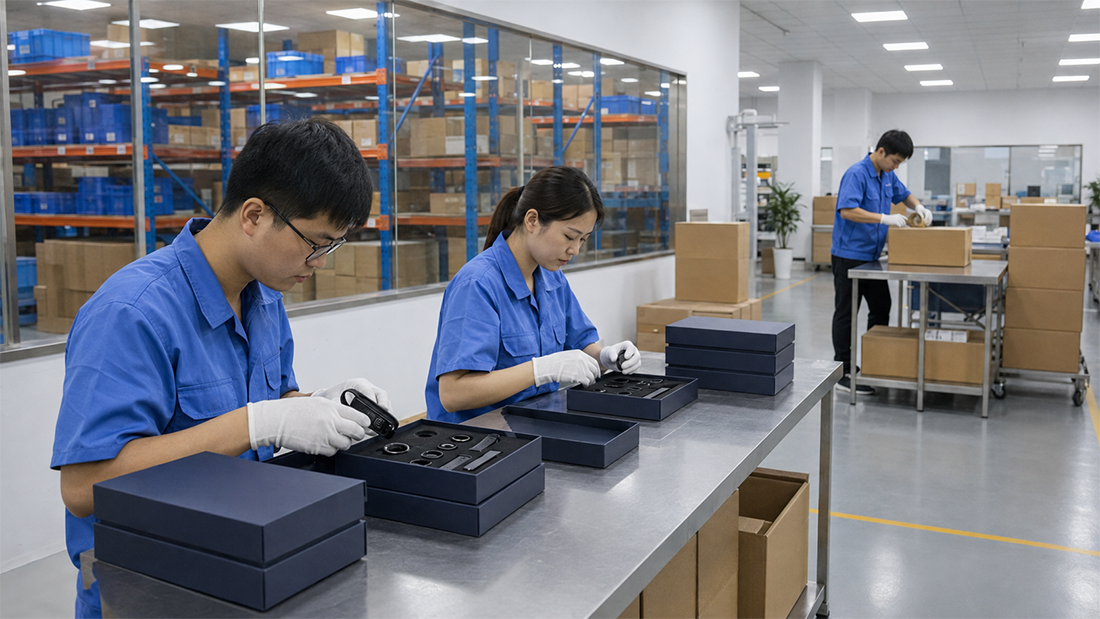
For corporate deployments, product reliability is critical. In your RFQ, require manufacturers to explain their quality management system (e.g., ISO 9001, ISO 13485 if applicable) and offer third-party testing reports. For global distribution, ask about certifications like CE, FCC, RoHS, and (if applicable) telecommunication requirements. Battery safety is especially important: ensure UN38.3 and MSDS documentation are available. Insist on pre-shipment inspection and request batch test records. Note that the required certifications depend on your target markets; verify with your legal or compliance team. Many manufacturers can help obtain certifications, but costs and timelines vary.
Step 5: Assess Supplier Capabilities and Culture Fit
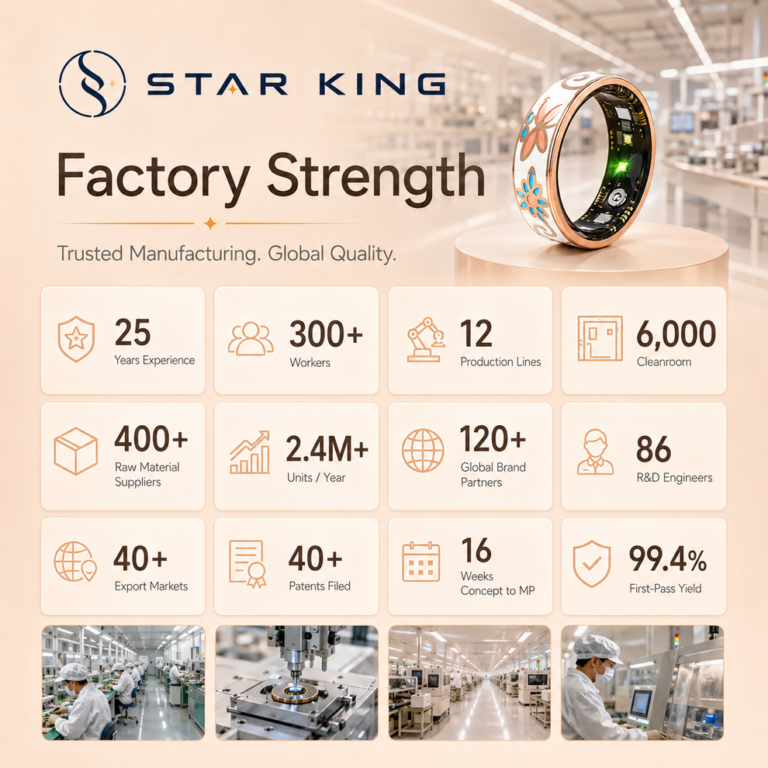
Send a comprehensive questionnaire with your RFQ to shortlist suppliers. Look for those experienced with wearable development and manufacturing for global markets. Ask about production floor, testing equipment, R&D engineers, and years of smart ring experience. Evaluate their client base and case studies (if they agree to share). Use video meetings and factory audits (on-site or virtual) to verify claims. Cultural fit is equally important: communication speed, English proficiency, and proactive problem-solving reduces project stress. Avoid suppliers that are vague about technical details or hesitate to share documentation.
Step 6: Customization and OEM/ODM Services
If you are building your own brand, decide which customization level you need. Basic OEM includes logo printing and customized packaging. ODM may include industrial design changes, unique casing colors, and firmware features. Advanced projects may require smartphone app customization, integration with your existing system, or API access. In the RFQ, explicitly state your expectations for Industrial Design (ID), hardware, firmware, and app. Clearly differentiate between what you provide and what you expect the manufacturer to handle. If you need a completely proprietary design, ask about hardware/firmware development time and identify design ownership early. Check if they can support sensor calibration and specific health data algorithms for a particular use case.
Step 7: Protect Intellectual Property and Tooling
Before sharing proprietary designs, require a non-disclosure agreement (NDA). In the RFQ, ask whether tooling and molds are included in the project cost and who owns them after mass production. For fully customized parts, moulds, and firmware, ownership should be yours after production ends. Ensure the manufacturer agrees not to sell your unique designs to third parties. Include IP indemnity clauses in your supply agreement. Verify that they can provide documentation of compliance with international IP laws.
Step 8: Shipping Logistics and Lithium Battery Compliance
Smart rings contain small lithium-ion batteries, subject to international transport regulations (UN38.3, MSDS). Ask suppliers to provide shipping certificates and packaging guidelines. Consider whether to ship by air, sea, or combination; batteries may have restrictions by freight forwarders. For corporate rollouts, you might need multiple delivery points. Discuss Incoterms, transit times, and insurance. Request samples delivered to various destinations to test logistics. Also, ask if they can warehouse in your target region if necessary.
Step 9: RFQ Evaluation and Sample Testing
Create a scoring matrix to evaluate quotes. Include compliance with specs, price, lead times, MOQ flexibility, certification readiness, quality, and communication. Never award the order solely on price. Ask for 2–3 samples from top candidates for rigorous internal testing. Evaluate ring size fit, battery life, sensor accuracy, water resistance, and companion app reliability. Test the ring under typical office or field conditions. Weigh the time and costs of sample testing against long-term reliability risks. Use samples to verify non-disclosed claims.
Step 10: Long-term Partnership and Post-sale Support
Before finalizing, clarify support for warranty, replacement parts, and firmware updates post-launch. Ask about failure rates and after-sales service terms. Understand lead time for spare parts and repair turnaround. Corporate buyers need a partner that will maintain quality over multiple orders. Establish clear communication channels and dedicate a project manager. Negotiate continuous improvement and periodic cost reviews to adapt to market changes. Plan for regular audits and maintain honest communication about production schedules.
Common Mistakes in Smart Ring RFQs (Buyer Red Flags)
- Not defining minimum battery life or tolerance limits. Battery life claims vary widely in real use.
- Ignoring warranty and return policy – corporate buyers need clear replacement agreements.
- Focusing solely on cheapest quote and sacrificing quality or reliable certification.
- Assuming all manufacturers have valid certifications – always ask for copies.
- Skipping sample testing due to time pressure. This leads to costly field failures.
- Not checking mold and IP ownership – may be locked into a single supplier without ownership.
- Omitting shipping requirements for battery-powered devices, causing delays or compliance fines.
Practical Buyer Checklist
- Have you defined the usage scenario and required features (heart rate, sleep, GPS (if any), battery life)?
- Have you listed target markets and verified certification requirements?
- Have you calculated total cost of ownership including freight, taxes, and any tooling?
- Have you communicated expected order volumes and production schedule?
- Have you requested sample testing and a pre-production pilot?
- Have you negotiated IP and tooling ownership clauses?
- Have you planned battery transport compliance?
Frequently Asked Questions
What are the essential components of a smart ring RFQ?
Essential components include technical specifications (size, weight, sensors, and battery), order quantities, target markets, certification needs, customization level (logo, packaging, or firmware), sample requirements, and requested delivery timeframe. You should also ask for quality certifications and reference customers.
What typical MOQs do smart ring manufacturers set?
MOQs often range from 500 to 1000 units for OEM/ODM projects, but some factories accept smaller quantities if you pay higher unit cost. Verify if there are variations for different customization levels.
What certifications are required for importing smart rings to the EU or US?
In the EU, products typically require CE and RoHS compliance. In the US, FCC authorization may be needed for electronic devices emitting radio frequency, and FDA rules may apply if medical claims are made. Always confirm with a compliance expert for your specific product features.
How long does it take to develop a custom smart ring?
A simple logo change might take 2–3 weeks; an ODM redesign of hardware or firmware can take several months, including iterative sampling. Ask for a detailed project timeline in your RFQ.
How can we verify a manufacturer’s certifications are real?
Request certified test reports from labs and, if possible, verify directly with the certification body or check the company’s online registration. Third-party inspections can also confirm compliance.
What payment terms are common in smart ring sourcing?
Typical payment terms are 30–50% deposit with balance before shipment, but larger projects may involve letters of credit. Negotiate terms that protect both parties, especially for milestone-based development.
How do we handle firmware updates for corporate deployments?
Ensure your manufacturer provides over-the-air update infrastructure or lets you host your own. Clear in your RFQ who controls firmware updates and cybersecurity.
Conclusion
A well-executed smart ring RFQ is the foundation of successful procurement. By following these ten steps, corporate procurement teams can reduce sourcing risks, get transparent quotes, and secure a supplier capable of meeting quality, compliance, and delivery goals. Remember that the lowest price rarely leads to the lowest total cost in the long run. Use the checklist and apply the guidance when shortlisting and negotiating with potential manufacturers.
STAR KING CTA: If you are ready to initiate a smart ring RFQ or discuss your OEM/ODM project, request a detailed quotation or speak with our engineering team to review your specifications today. Get a quote and let us help you find the right solution for your business.
Buyers can also review STAR KING Smart Rings OEM/ODM options to compare product positioning, customization scope, and sample planning.
Useful Official References for Buyers
- FCC equipment authorization guidance
- European Commission CE marking information
- Bluetooth SIG specifications
Discuss Your Smart Wearable OEM/ODM Project
Planning a smart ring, smart watch, smart band, AI glasses, AI translator, or AI voice mouse project? Contact STAR KING to discuss product positioning, sample testing, customization scope, certification requirements, lead time, and quotation details.

Team Star King

Scan WhatsApp QR code