
smart ring OEM suppliers: How to Evaluate Smart Ring OEM Suppliers: 7 Checks for Distributors Before You Send an RFQ
October 27, 2026 · Team Star King
How to Evaluate Smart Ring OEM Suppliers: 7 Checks for Distributors Before You Send an RFQ
Evaluating smart ring OEM suppliers means checking far more than a product photo and a price list. A distributor should verify manufacturing capability, ownership of the companion app, MOQ bands, realistic lead times, certification status for the target market, and after-sales support before issuing an RFQ. This guide gives distributors seven practical checks, a comparison table, red flags, and a buyer checklist to turn an early RFQ into a workable long-term supply relationship.
Table of Contents
Table of Contents
smart ring OEM suppliers: Table of Contents
- Short Answer
- Key Takeaways
- Key Facts for Buyers
- What a Smart Ring OEM Supplier Should Deliver
- Check 1: Product Architecture and Sensor Options
- Check 2: App and Firmware Ownership
- Check 3: MOQ, Tooling, and Cost Structure
- Check 4: Sample Validation and Testing
- Check 5: Certification and Market Compliance
- Check 6: Lead Time and Production Planning
- Check 7: Warranty, Spare Parts, and After-Sales
- Supplier Comparison Table
- What to Include in Your Smart Ring RFQ
- Common Mistakes and Buyer Red Flags
- Practical Buyer Checklist
- FAQ
- Conclusion
Short Answer
Distributors should qualify smart ring OEM suppliers through seven checks: product architecture, app and firmware ownership, MOQ and cost structure, sample validation, certification for the target market, lead time planning, and after-sales coverage. A supplier that answers all seven with documented evidence is a safer RFQ partner than one offering the lowest unit price. Confirm details in writing before committing to tooling or mass production.
Key Takeaways
- Smart rings combine hardware, sensor firmware, and a mobile app; distributors must verify all three layers before an RFQ.
- MOQ is often tied to ring size sets, color options, packaging, and tooling, not just to total unit volume.
- The companion app is frequently the weakest link in private label programs; confirm who controls it and who maintains it.
- Certification requirements typically depend on the product configuration, radio module, and destination market.
- Lead times should be quoted as a range with milestones, including sample approval, mass production, testing, and shipping.
- A formal RFQ package shortens quotation cycles and reduces the risk of spec drift.
Key Facts for Buyers
| Decision Area | What to Verify | Why It Matters to Distributors |
|---|---|---|
| Product architecture | Sensor set, battery, ring sizing, waterproof rating | Defines sellable SKUs and competitive positioning |
| App and firmware | App owner, white-label options, data handling, updates | Poor app support creates returns and support tickets |
| MOQ and tooling | MOQ per model, size set, color, packaging; tooling cost | Determines working capital and inventory risk |
| Samples | Sample timeline, test criteria, sign-off process | Validates functional and cosmetic quality before bulk |
| Compliance | CE, FCC, RoHS, UN38.3, MSDS documentation | Required for customs clearance and retailer onboarding |
| Lead time | Quoted range, production capacity, shipping mode | Supports launch dates and distributor replenishment |
| After-sales | Warranty terms, spare parts, RMA process | Protects margin and channel reputation |
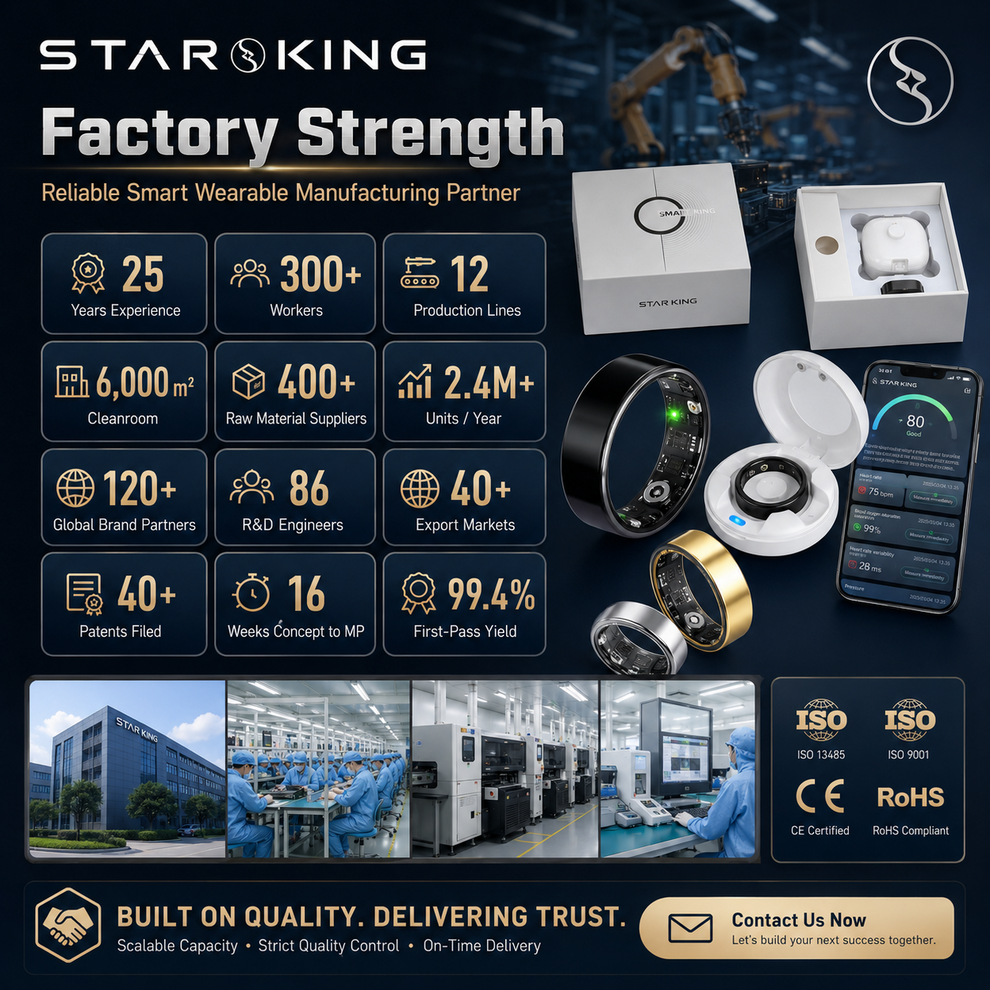
What a Smart Ring OEM Supplier Should Deliver
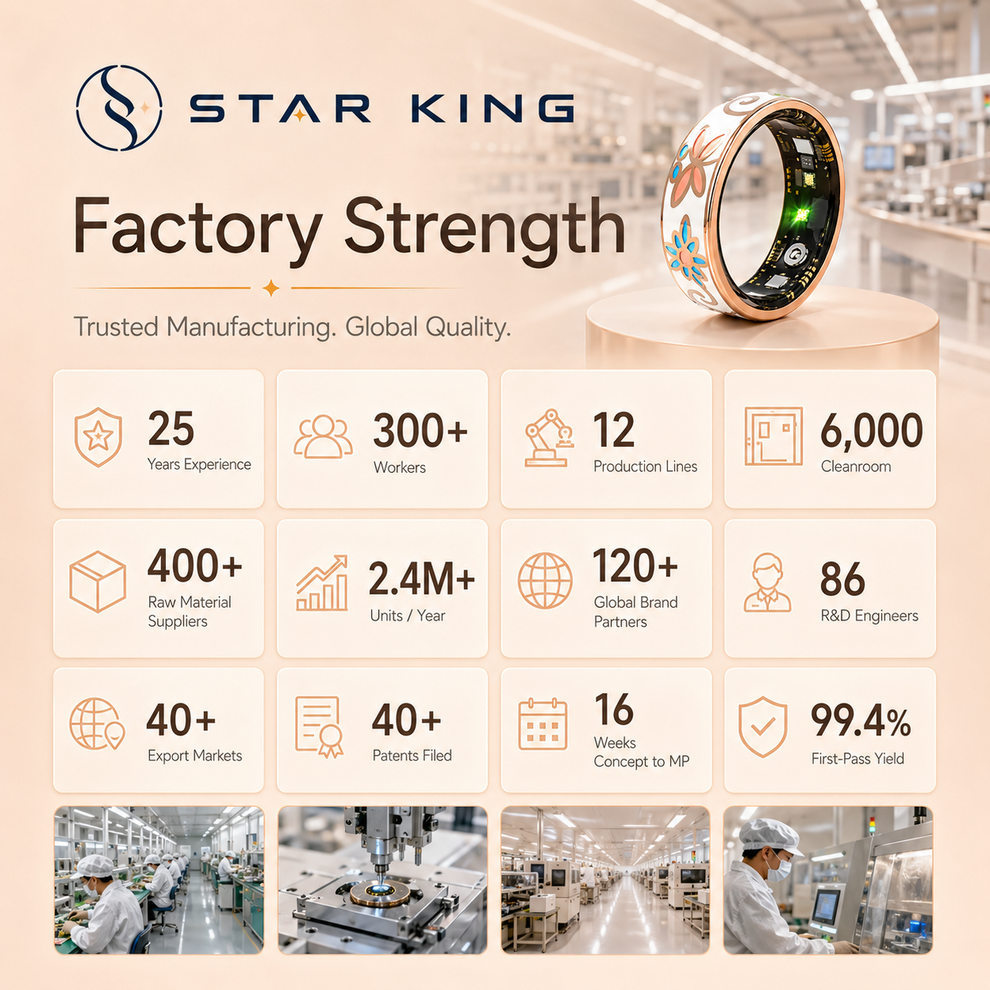
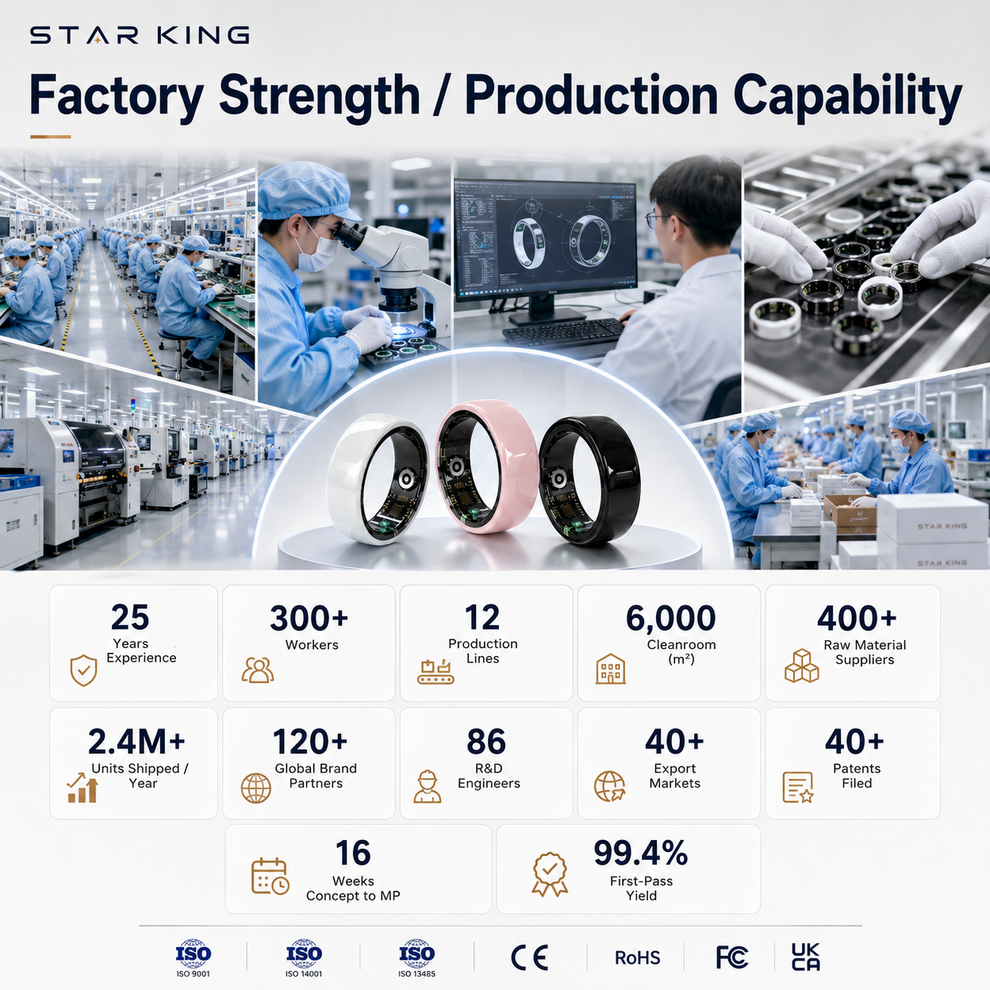
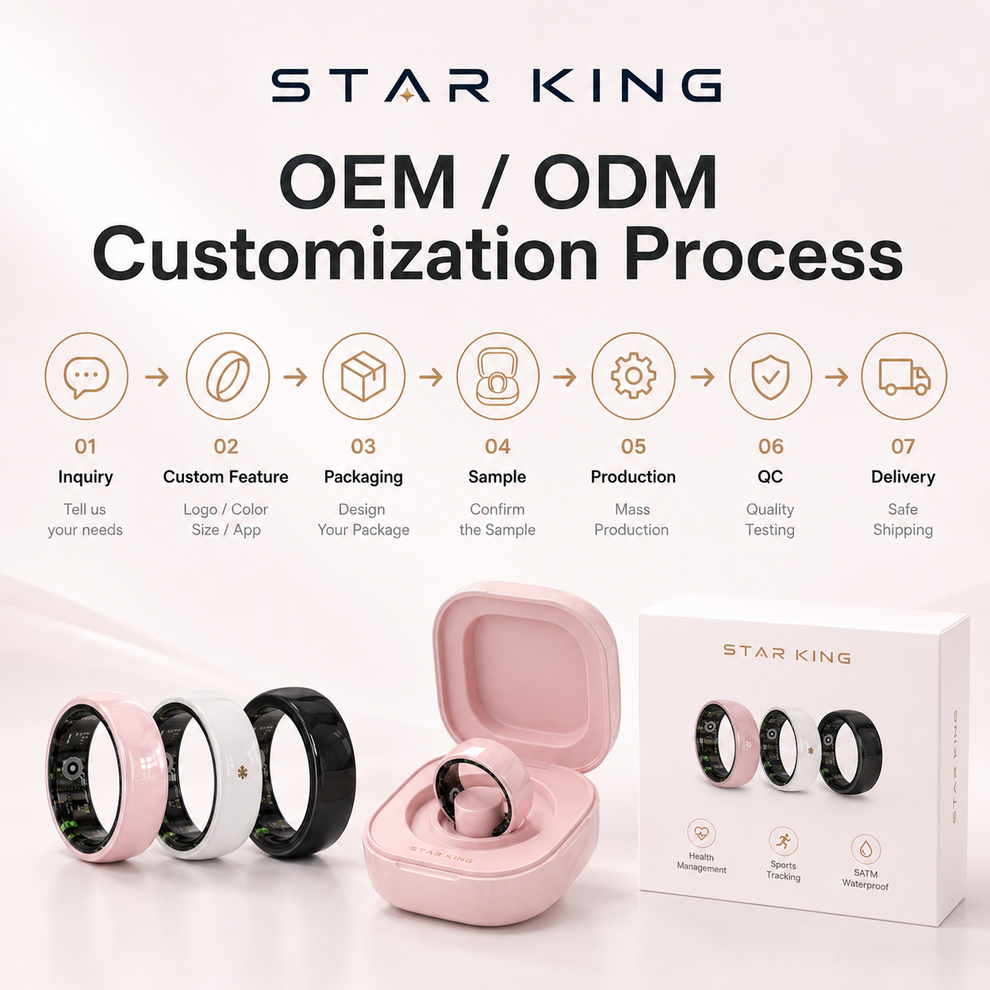
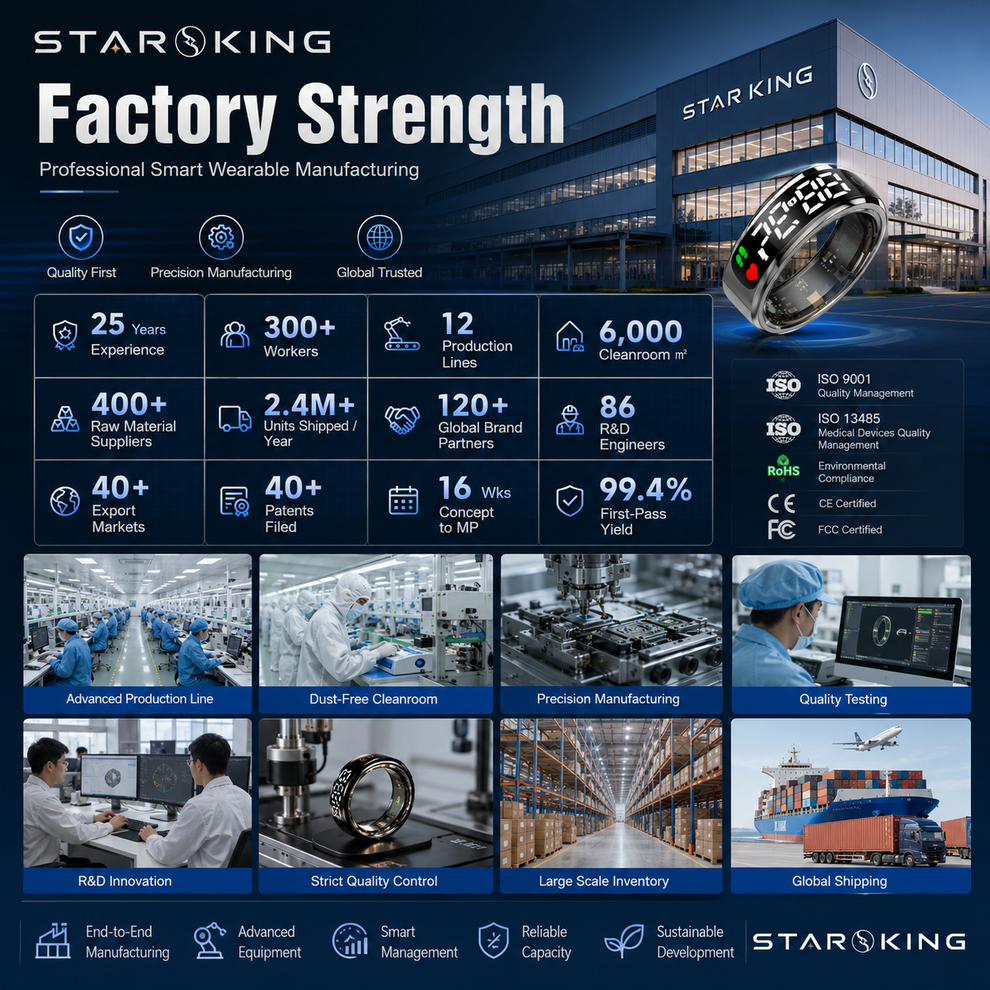
A smart ring OEM supplier is a manufacturer that provides a ring-form wearable platform and supports a buyer’s customization and branding requirements, from enclosure finish and packaging to app branding and firmware settings. For distributors, the relevant question is not simply whether a supplier can make a ring, but whether it can deliver a repeatable, supportable product line across multiple SKUs and markets.
Most smart rings in the market combine an optical sensor module, accelerometer, battery, charging case, and a companion mobile app. Buyers should treat the product as a three-layer system: hardware, firmware, and app. A weakness in any layer becomes a support burden for the distributor, particularly when end users expect sleep tracking, activity data, and heart rate monitoring to work reliably.
The established product pages on smart rings give buyers a reference point for typical specifications and customization options, while the private label OEM/ODM solution explains how branding and packaging are handled in an OEM program.
Check 1: Product Architecture and Sensor Options
Begin by mapping the SKU plan against the supplier’s platform. A distributor selling into multiple channels often needs a tiered lineup: an entry model, a mid-tier model with additional sensors, and a premium model with a larger battery or more advanced app features.
Questions to put in writing
- Which sensor set is included, and what does the firmware do with the raw data?
- What ring sizes are available, and does each size carry the same battery capacity?
- What is the waterproof rating, and has it been tested consistently across sizes?
- What is the battery life under typical use, and how is it measured?
Distributors should ask for the specification sheet per SKU, not a single generic sheet. Ring size affects battery volume, and battery life claims that are not tied to a test condition are difficult to defend to retail partners.
Check 2: App and Firmware Ownership
The companion app is where many private-label wearable programs fail. If the supplier does not own or control the app, the distributor may be unable to request fixes, feature changes, or branding updates. Buyers should clarify whether the app is a supplier-owned platform, a third-party SDK integration, or a fully custom build.
Ask who publishes the app to the app stores, who handles store compliance updates, and how user data is stored and processed. Data handling practices matter for distributors selling into markets with privacy expectations, and they should be documented rather than described verbally. The sleep and recovery application is a useful reference for how app features are positioned to end users.
For more background on how app and firmware customization affect sourcing timelines, see the STAR KING resources blog.
Check 3: MOQ, Tooling, and Cost Structure
MOQ for smart rings is rarely a single number. It is usually a matrix combining model, ring size set, color, and packaging. A distributor ordering five sizes in two colors may be quoted a higher effective MOQ than a distributor ordering a single size set. Tooling and customization costs should be separated from unit price so the total investment is visible.
Cost items to request separately
- Unit price by quantity band
- Tooling or mold cost, if applicable, and ownership terms
- Logo and packaging customization cost
- Sample cost and whether it is credited against the first order
- Certification or documentation cost, if a new market is added
- Estimated freight and battery shipping surcharges
Buyers should confirm how MOQ is counted and whether mixed-size and mixed-color orders are allowed. Where tooling is involved, distributors should clarify ownership in writing; see the smart retail and e-commerce solution for context on multi-SKU retail planning. [STAR KING TO CONFIRM] specific MOQ bands and tooling thresholds.
Check 4: Sample Validation and Testing
Sampling is the distributor’s main opportunity to test manufacturing consistency before committing capital. Request samples that match the intended production configuration, including packaging and branded app screens where relevant. Define acceptance criteria before the samples arrive so decisions are based on evidence rather than impressions.
Practical sample tests
- Wear the ring for several days and check data stability across sleep, activity, and heart rate
- Charge and discharge cycles to verify battery claims
- Water exposure consistent with the stated rating
- Pairing and app stability across Android and iOS devices
- Cosmetic inspection of finish, fit, and sizing
Request the supplier’s own test records, such as aging, drop, and waterproof testing, and compare them with your sample results. These records are typically part of a quality control file and should be available for review.
Check 5: Certification and Market Compliance
Certification is configuration-specific. A supplier may hold documentation for one ring model and radio module but not for a new variant. Distributors should request certificates and test reports by exact model and market, and verify the issuing laboratory and report dates.
Common requirements include CE marking for the EU, FCC equipment authorization for the United States, RoHS for restricted substances, UN38.3 for lithium battery transport, and MSDS documentation for battery shipments. Bluetooth functionality may also require qualification through the Bluetooth SIG. For market-specific rules, distributors should check the official FCC and European Commission resources rather than relying on supplier summaries.
Where documentation is incomplete, the buyer should ask whether the supplier will support testing for the target market and at what cost. Certification status should be stated as verified for the exact configuration, not assumed for the entire product range.
Check 6: Lead Time and Production Planning
A quoted lead time should include more than assembly. Distributors need a timeline that covers sample approval, material readiness, mass production, quality inspection, and shipping preparation. Lithium battery shipments may require additional documentation and carrier acceptance time, which can extend the total schedule.
Timeline questions for the RFQ
- What is the standard production lead time after deposit and sample approval?
- What is the lead time for a customized logo or packaging run?
- Are there seasonal capacity constraints that should be planned around?
- Which shipping mode is assumed, and how does battery handling affect it?
Ask the supplier to quote lead time as a range with milestone dates. A single number without assumptions is difficult to plan against, particularly for distributors managing retail replenishment.
Check 7: Warranty, Spare Parts, and After-Sales
After-sales terms protect distributor margin. A clear warranty policy should state the covered period, what failures are included, and how returns are processed. Distributors should also clarify whether spare rings, charging cables, and packaging components can be ordered separately for replacement and refurbishment programs.
Ask how firmware updates are delivered and whether the supplier provides technical documentation for retail partners. A defined RMA process and named technical contact reduce the risk of unresolved support cases in the channel.
Supplier Comparison Table
| Evaluation Area | Weak Signal | Strong Signal |
|---|---|---|
| Product architecture | Single generic spec sheet | SKU-level specs with test conditions |
| App ownership | Unclear app owner; no update path | Documented app platform and maintenance plan |
| MOQ | One blended MOQ figure | MOQ by model, size, color, and packaging |
| Samples | Samples not matching production config | Production-equivalent samples with test records |
| Compliance | Certificates without model reference | Reports tied to exact model and market |
| Lead time | Single number, no milestones | Range with milestones and assumptions |
| After-sales | Verbal warranty only | Written warranty, RMA process, spare parts |
What to Include in Your Smart Ring RFQ
A structured RFQ shortens quotation cycles and makes supplier responses comparable. Distributors should include target SKUs, estimated annual volume, size and color split, branding requirements, target markets, required certifications, packaging needs, and requested delivery windows.
When comparing quotations, normalize the unit price to include tooling, packaging, documentation, and freight. A lower unit price with unclear certification or app support can cost more over the product lifecycle. The quote request form is the practical next step once the RFQ package is ready.
Common Mistakes and Buyer Red Flags
- Buying on price alone: A low quote that excludes certification or app maintenance shifts cost to the distributor later.
- Ignoring ring size complexity: Battery and fit vary by size; a single-size sample does not validate the full set.
- Assuming certification covers all models: Reports are tied to specific configurations and radio modules.
- Accepting verbal warranty terms: Warranty and RMA details should be documented in the quotation or contract.
- Skipping the app test: App stability and store compliance are common sources of returns.
- No tooling ownership clause: Where custom tooling is paid for, ownership and transfer terms should be explicit.
Practical Buyer Checklist
- SKU-level specification sheets received and reviewed
- App ownership, update, and data handling documented
- MOQ confirmed by model, size, color, and packaging
- Tooling cost and ownership terms in writing
- Production-equivalent samples tested against acceptance criteria
- Certification reports checked by model and target market
- UN38.3 and MSDS documentation available for battery shipping
- Lead time quoted as a range with milestones
- Warranty, RMA process, and spare parts availability confirmed
- Quotation normalized for tooling, packaging, documentation, and freight
FAQ
What is a realistic MOQ for private label smart rings?
MOQ is typically set per model and may be affected by ring size sets, color, and packaging. Distributors should ask for the MOQ matrix rather than a single figure, since mixed-size orders can change the effective minimum.
Do smart rings require UN38.3 testing?
Smart rings contain lithium batteries, so UN38.3 documentation is commonly required for air transport, and MSDS documentation may be requested by carriers. Buyers should confirm documentation for the exact battery configuration being shipped.
Can a distributor white-label the companion app?
White-label app options depend on the supplier’s platform. Some suppliers offer branded app shells, while others require a custom build. Distributors should confirm branding scope, update responsibility, and store publishing arrangements in writing.
How long does a smart ring OEM program usually take?
Timelines typically depend on customization scope, sample approval, production scheduling, and shipping mode. A realistic plan should include sample rounds, mass production, inspection, and battery documentation before dispatch.
Are CE and FCC certificates valid for every smart ring model?
Certification is generally tied to a specific model, radio module, and configuration. Distributors should request reports that reference the exact model being purchased and verify them with the issuing laboratory where possible.
What warranty terms should distributors request?
Distributors should request a written warranty period, defined failure coverage, an RMA process, and availability of spare parts. Terms should be included in the quotation or supply agreement rather than agreed verbally.
Conclusion
Smart ring OEM suppliers should be evaluated as full product partners, not price lists. Distributors that verify product architecture, app ownership, MOQ structure, sample quality, certification, lead time, and after-sales terms before issuing an RFQ reduce launch risk and protect channel margin. The seven checks in this guide provide a repeatable qualification process that can be applied to every supplier shortlisted for a smart ring program.
Next Step: Request a Smart Ring OEM Quotation
Ready to compare options? Share your target SKUs, estimated volume, size and color split, branding requirements, and destination markets with STAR KING and request a quotation. The team can confirm available configurations, MOQ bands, lead time ranges, documentation status, and sample arrangements for smart ring OEM and private label programs.
Discuss Your Smart Wearable OEM/ODM Project
Planning a smart ring, smart watch, smart band, AI glasses, AI translator, or AI voice mouse project? Contact STAR KING to discuss product positioning, sample testing, customization scope, certification requirements, lead time, and quotation details.

Team Star King

Scan WhatsApp QR code
Leave a Reply