
Smart Ring Manufacturing for Startup Brands: 2026 Sourcing Guide to OEM, MOQ and Launch
October 13, 2026 · Team Star King

Smart Ring Manufacturing for Startup Brands: 2026 Sourcing Guide to OEM, MOQ and Launch
Smart ring manufacturing is the process of turning a ring form-factor wearable design into a shippable, certified product through a factory that handles tooling, electronics assembly, firmware, app integration, testing and packaging. For startup brands in 2026, the fastest route is usually an ODM platform with cosmetic and packaging customization, moving to deeper OEM work once sell-through is proven. This guide focuses on the purchase-stage decisions: which model to choose, how MOQ works, what to test, how to handle compliance, and how to plan lead times and landed cost.
Table of Contents
Table of Contents
Direct Answer
Startup brands should treat smart ring manufacturing as a staged investment rather than a single order. First order a sample or evaluation unit and verify the app, sensor accuracy claims, battery performance and charging behavior. Then confirm MOQ, tooling ownership, firmware access, certification scope and lead time before placing a purchase order. Choosing an ODM platform first reduces upfront cost and risk; deeper OEM customization increases differentiation but also cost, tooling and timeline.
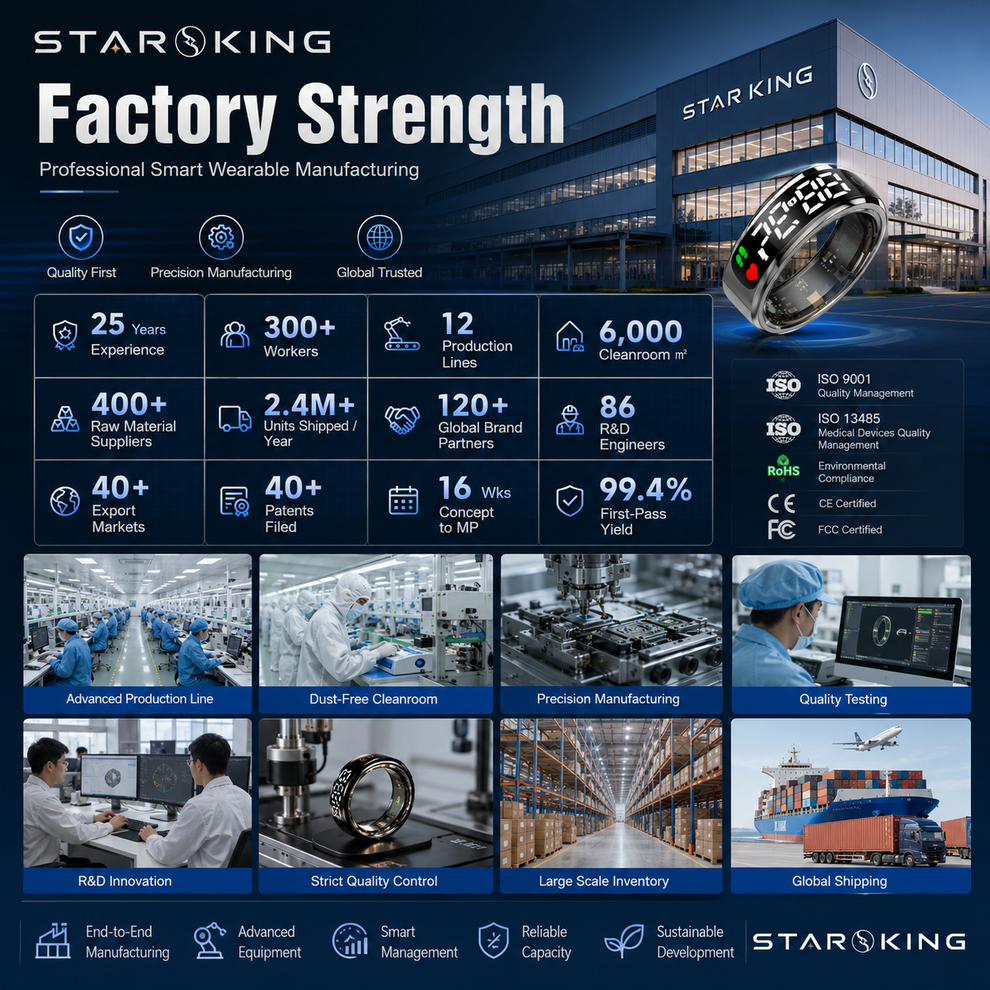
Table of Contents
- Why startup brands are entering the smart ring category in 2026
- What is smart ring manufacturing? A buyer-side definition
- OEM vs ODM vs private label: which model fits your launch stage
- How MOQ works and what actually drives smart ring MOQ
- What drives cost: tooling, electronics, sensors, app and packaging
- Sample testing and verification before you commit
- Certification and target-market compliance
- Lead time planning and production schedule
- Battery safety, UN38.3 and international shipping
- App, firmware, API, mold ownership and IP
- Key Facts for Buyers
- Comparison and decision table
- Common mistakes and buyer red flags
- Practical buyer checklist
- FAQ
- Conclusion
Why startup brands are entering the smart ring category in 2026
Smart rings have moved from novelty to a real product category, driven by interest in sleep tracking, recovery and discreet always-on wearables. For a startup brand, the appeal is clear: a ring is small, ship-friendly, and can carry a premium price point without the screen and mechanical complexity of a watch. The challenge is that a ring is also a precision wearable with a battery, a sensor stack, a charging system and a companion app, so sourcing decisions have long-term consequences.
Most startup brands do not begin with a fully custom ring. They begin with a proven platform and a differentiated brand layer: colorways, finishes, packaging, app experience and messaging. This is where OEM/ODM manufacturing becomes a practical question rather than a theoretical one. The decisions you make in the first purchase order determine your cost structure, your compliance path, and how fast you can reorder.
What is smart ring manufacturing? A buyer-side definition
Smart ring manufacturing is the coordinated production of a ring-shaped wearable that combines a miniaturized PCB, optical and motion sensors, a rechargeable battery, a charging interface, an enclosure, and firmware that connects to a mobile app. From a buyer’s perspective, manufacturing is not just assembly: it includes tooling, component sourcing, quality control, testing, packaging and compliance documentation.
Buyers should evaluate manufacturing partners on five dimensions: product platform maturity, customization depth, quality processes, compliance support, and communication discipline. A factory that can explain its testing steps, its MOQ logic and its certification approach is usually easier to work with than one that only sends a catalog.
OEM vs ODM vs private label: which model fits your launch stage
ODM: fastest route to first order
In an ODM model, the factory owns the design and you select from an existing platform. Customization is usually limited to finish, color, logo, packaging and app branding. This is the lowest-risk entry for a startup brand because tooling cost and development time are minimal.
Private label: brand on a proven product
Private label is essentially ODM with your brand identity applied. It is suitable when your differentiation comes from brand, positioning, content and channel rather than hardware. If your plan is to test the market on Amazon or a DTC store, this is often the correct first step.
OEM: deeper customization, higher commitment
OEM involves modifying or developing the hardware, enclosure, firmware or app to your specification. Expect tooling, engineering time, higher MOQ and longer lead time. OEM makes sense after you have validated demand and know which features customers actually value.

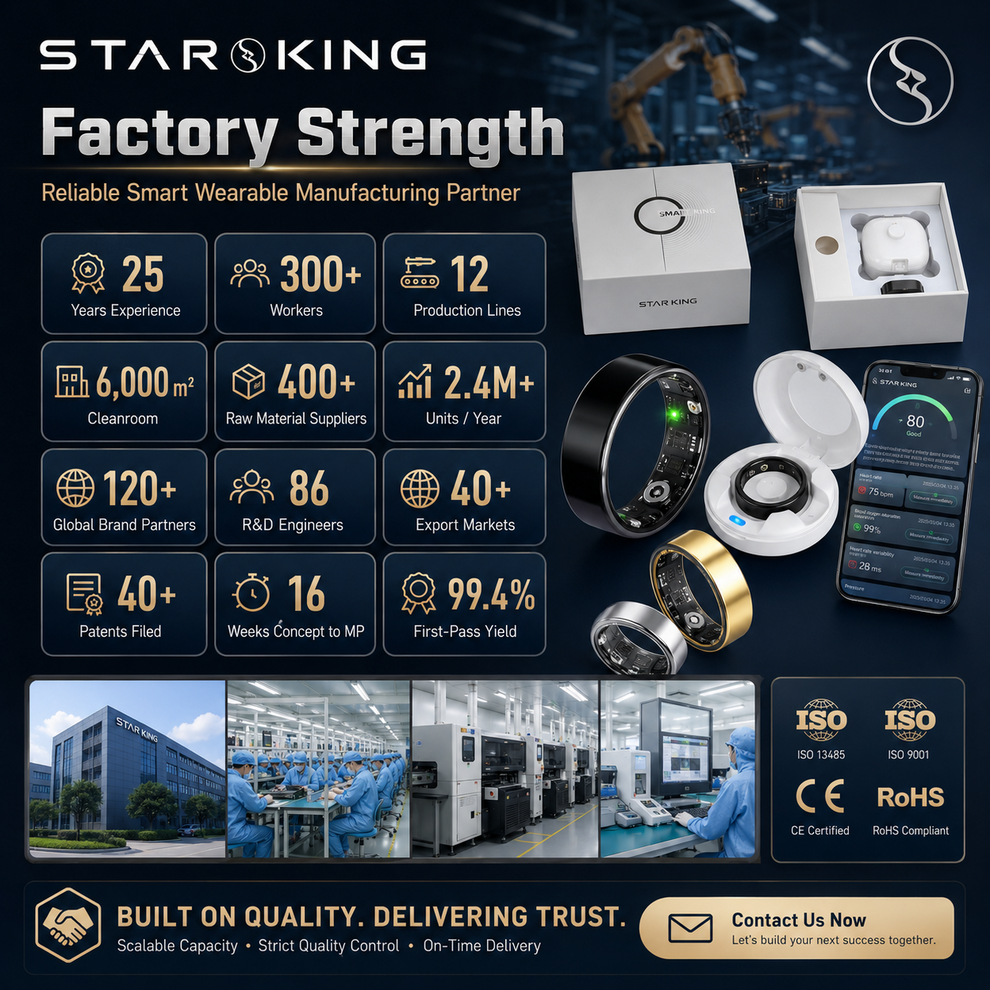
Suggested image: smart ring manufacturing line showing assembly and inspection.
How MOQ works and what actually drives smart ring MOQ
MOQ is not an arbitrary number. It reflects tooling amortization, component order quantities, packaging runs, testing batch size and production scheduling. A ring uses small precision parts, so component suppliers often have their own minimums that feed into the factory’s MOQ.
For startup brands, the practical question is whether to accept a higher MOQ at a lower unit price, or a lower MOQ at a higher unit price. Many factories offer a sample or pilot batch, then a standard production MOQ. Typical structures include a small trial quantity, a mid-tier first production run, and a scaled reorder. Exact numbers depend on the platform and customization level: [STAR KING TO CONFIRM].
What drives cost: tooling, electronics, sensors, app and packaging
Unit cost is the sum of several layers. Buyers who understand these layers negotiate better and forecast landed cost more accurately.
- Tooling: new enclosure molds, charging dock tooling and fixture costs. Usually a one-time investment. Cost depends on design complexity: [STAR KING TO CONFIRM].
- Electronics and sensors: PCB, optical sensors, motion sensors and battery. Sensor choice affects both cost and performance claims.
- Firmware and app: app customization, branding and any integration work.
- Packaging: retail box, inserts, manuals and language variants.
- Testing and compliance: in-house QC plus third-party certification if required for your market.
Landed cost also includes freight, duties, battery handling surcharges and any certification fees. A low ex-works price can become an expensive landed cost if batteries and packaging are not planned properly.
Sample testing and verification before you commit
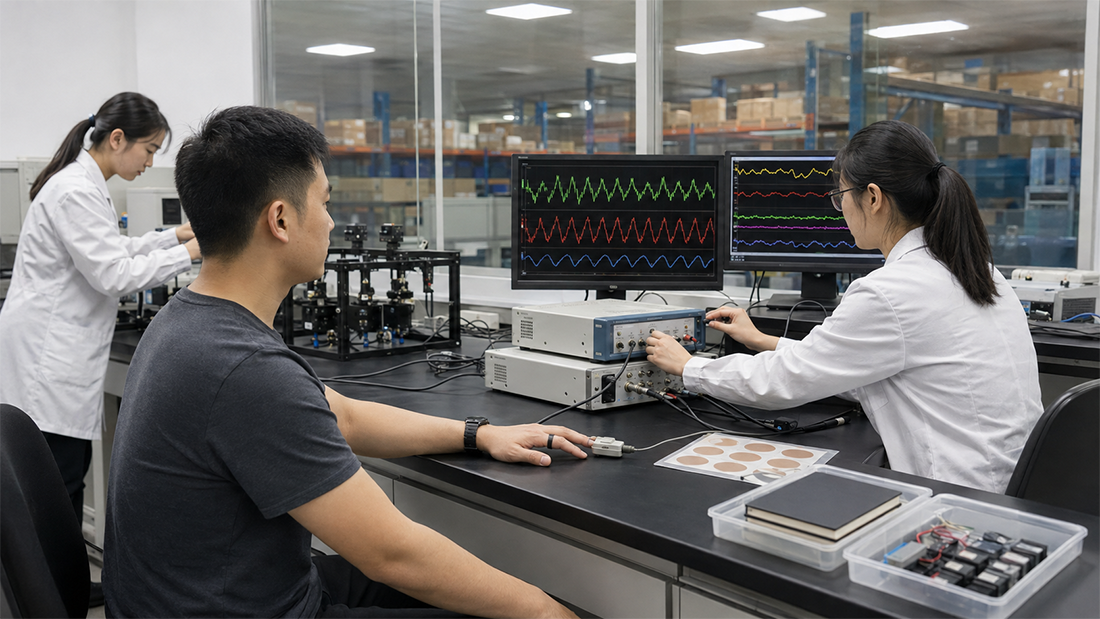
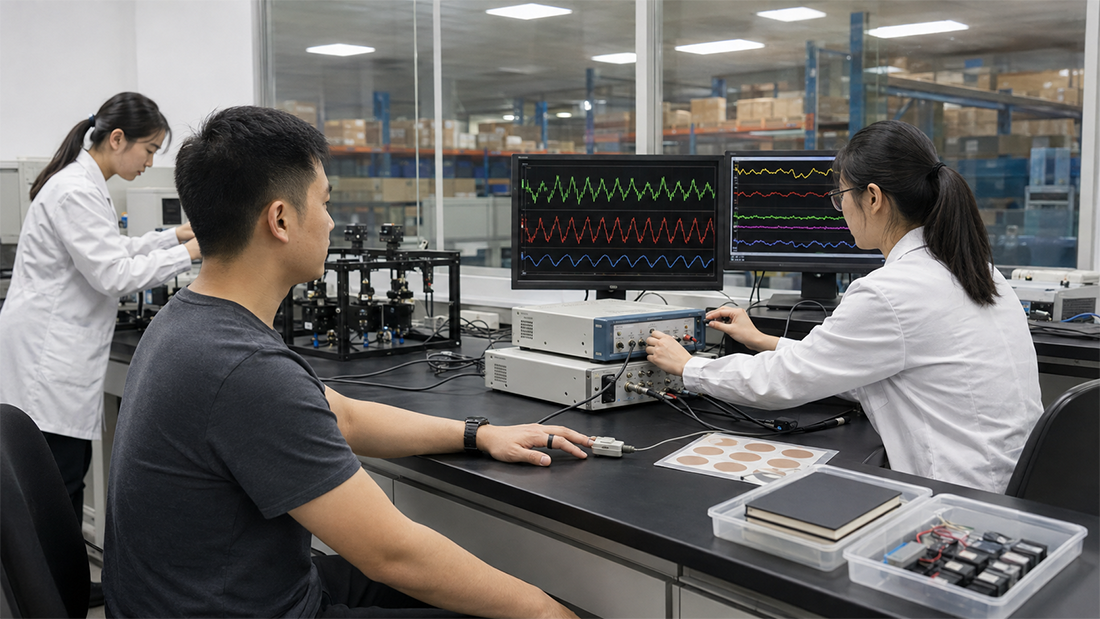
Samples are where you separate marketing claims from product reality. Request units with production firmware and the shipping app build, not an engineering prototype. Test the ring across the scenarios your customers will actually use: overnight sleep tracking, daytime activity, charging cycles and app pairing stability.
Because ring fit affects sensor contact, test multiple sizes. Poor fit can mimic poor sensor performance, and buyers should distinguish between a fit problem and a hardware problem before rejecting a supplier.

Suggested image: sample rings in different sizes being tested and compared.
Certification and target-market compliance
Compliance requirements typically depend on the product configuration, the radio modules used and the destination market. A smart ring with Bluetooth usually requires radio-type approvals, and a battery-powered device usually requires battery transport documentation. Buyers should verify the exact scope with the factory and, where needed, an accredited lab.
Common requirements may include CE marking for the EU, FCC authorization for the United States, RoHS for hazardous substance limits, and UN38.3 plus MSDS for lithium battery transport. None of these should be assumed; each depends on the specific product and market.
Lead time planning and production schedule
Lead time has several stages: sample production, sample approval, component procurement, mass production, testing, packaging and shipping. For a first order, buyers should budget time for iteration after sample review. Rushing sample approval usually creates rework later.
Plan backward from your launch or channel commitment. If you are launching on a marketplace with a fixed date, add buffer for certification and freight. Exact sample and production lead times depend on the platform and order size: [STAR KING TO CONFIRM].
Battery safety, UN38.3 and international shipping
Smart rings contain lithium batteries, so transport rules apply. Air carriers and freight forwarders typically require UN38.3 test summaries and an MSDS. Packaging must meet applicable battery shipping requirements, and some destinations have additional rules.
Buyers should confirm battery documentation before booking freight and should verify whether the forwarder accepts the specific battery type and configuration. Battery safety is also a product quality issue: charging behavior, over-discharge protection and thermal performance should be part of your sample evaluation.
App, firmware, API, mold ownership and IP
Software is often the hidden variable in smart ring projects. Ask who owns the app, whether it is white-label or a shared platform, how firmware updates are delivered, and whether any data can be exported. If your business model depends on a branded app experience, confirm branding and update rights in writing.
For tooling and molds, clarify ownership and transfer terms before paying. If you fund a mold, you should understand whether you own it, whether it can be moved, and what conditions apply. Intellectual property terms should be documented, not assumed.
Key Facts for Buyers
| Decision Area | Typical Reality | Buyer Action |
|---|---|---|
| First order model | ODM or private label is common for startups | Validate demand before funding custom tooling |
| MOQ | Depends on platform, customization and components | Ask for pilot and standard production tiers: [STAR KING TO CONFIRM] |
| Tooling | One-time cost for custom enclosures | Confirm ownership and transfer terms in writing |
| Samples | Production firmware and app build matter | Test fit, battery, pairing and data accuracy claims |
| Compliance | Depends on configuration and target market | Verify CE, FCC, RoHS, UN38.3 and MSDS scope |
| Lead time | Includes sample, procurement, production and freight | Plan backward from launch with buffer |
| Landed cost | Includes freight, duties and battery handling | Model total cost, not just unit price |
Soft CTA: Where Startup Brands Usually Need Help
If you are comparing smart ring platforms and want to understand what can be customized at your stage, it helps to review real private label and OEM/ODM options before locking a specification. A short specification conversation often reveals which features are platform-standard and which require tooling.
Comparison and decision table
| Factor | ODM | Private Label | OEM |
|---|---|---|---|
| Who owns the design | Factory | Factory | Shared or buyer-specified |
| Customization depth | Low to medium | Low | Medium to high |
| Upfront investment | Low | Low | Higher |
| MOQ pressure | Lower | Lower | Higher |
| Time to first order | Fastest | Fast | Slowest |
| Best for | Market entry and testing | Brand-first sellers | Validated, scaling brands |
Common mistakes and buyer red flags
- Approving samples without the shipping app build. Engineering builds can behave differently from mass-production firmware.
- Assuming certification is included. Always confirm which certificates exist for the exact configuration and market.
- Ignoring battery documentation. Missing UN38.3 or MSDS can delay or block shipment.
- Choosing on unit price only. Landed cost and reorder reliability matter more than a small unit savings.
- No written tooling or IP terms. Verbal agreements create disputes when you scale.
- Single-size sampling. Fit affects sensor readings; test multiple sizes.
- No reorder plan. Confirm how fast a repeat order can be produced.
Practical buyer checklist
- Define whether you are launching ODM, private label or OEM.
- Request a sample with production firmware and the shipping app.
- Test fit across sizes, battery life and charging behavior.
- Confirm MOQ tiers for pilot and production orders.
- Get tooling cost, ownership and transfer terms in writing.
- Verify app branding, update rights and data access.
- Confirm certification scope for each target market.
- Obtain UN38.3 and MSDS for battery shipping.
- Model landed cost including freight, duties and battery handling.
- Agree on lead time, inspection steps and packaging approval.

Suggested image: packaging, branding and QC checklist for a smart ring production run.
Buyers can also review STAR KING Smart Rings OEM/ODM options to compare product positioning, customization scope, and sample planning.
FAQ
What is a realistic MOQ for a startup brand’s first smart ring order?
It depends on the platform and customization level. Many factories offer a pilot quantity and a higher production MOQ. Ask for both tiers and confirm the exact figure before budgeting: [STAR KING TO CONFIRM].
Can I get a custom mold for a smart ring as a startup?
Usually yes, but custom molds raise cost, MOQ and timeline. Many startups launch on an existing enclosure with custom finish and packaging, then invest in tooling after demand is proven.
Are CE and FCC certification included automatically?
No. Certification depends on the product configuration, radio modules and target market. Buyers should verify which approvals apply and whether the factory can supply documentation, potentially through an accredited lab.
What documents do I need to ship smart rings internationally?
Because rings contain lithium batteries, UN38.3 test summaries and an MSDS are typically required. Packaging and carrier rules vary, so confirm with your forwarder and the factory.
Can I customize the app?
Often branding, onboarding and some interface elements can be customized, while the core platform is shared. Confirm branding rights, update process and data access in writing before ordering.
How long does the first production run take?
Lead time includes sample approval, component procurement, production, testing and freight. Exact timelines depend on the order and customization: [STAR KING TO CONFIRM].
Who owns the mold if I pay for it?
Ownership and transfer terms should be documented. Buyers who fund tooling should confirm whether the mold can be transferred or reused before paying.
Conclusion
For startup brands, smart ring manufacturing is a sequence of decisions rather than a single purchase. Start with a proven platform and validate it through samples, then confirm MOQ, tooling terms, app rights, certification scope and lead time. Model landed cost, not just unit price, and plan for battery documentation early. Brands that treat the first order as a learning step usually scale faster and with fewer surprises.
STAR KING CTA
Ready to move from research to a real specification? Request a quotation and discuss your OEM/ODM smart ring project with STAR KING, including MOQ, sample, tooling and compliance questions for your target market.
Useful Official References for Buyers
- FCC equipment authorization guidance
- European Commission CE marking information
- Bluetooth SIG specifications
Discuss Your Smart Wearable OEM/ODM Project
Planning a smart ring, smart watch, smart band, AI glasses, AI translator, or AI voice mouse project? Contact STAR KING to discuss product positioning, sample testing, customization scope, certification requirements, lead time, and quotation details.

Team Star King

Scan WhatsApp QR code
Leave a Reply