
Smart Bands for EU E-commerce Sellers: The 7-Point Import Checklist
November 6, 2026 · Team Star King

Smart Bands for EU E-commerce Sellers: The 7-Point Import Checklist
Smart bands for EU e-commerce sellers are not a simple volume purchase. They are a controlled import decision that combines product configuration, CE marking, RED and RoHS compliance, EU battery rules, MOQ planning, lead time, packaging, and after-sales support. The fastest way to reduce risk is to run a seven-point import checklist before you approve a supplier, pay a deposit, or book a shipment to an EU fulfillment center.
Table of Contents
Table of Contents
smart bands for EU e-commerce: Short Answer
Buy smart bands for EU e-commerce by checking seven areas in order: product specification, EU compliance documents, battery and transport rules, MOQ and landed cost, sample validation, packaging and branding, and after-sales planning. A supplier that can support most of these steps with written documentation is usually a better long-term partner than one that only offers a low unit price.
Key Takeaways
- Smart bands sold in the EU typically require CE-related documentation, and radio-enabled models may require RED compliance. Buyers should verify the exact configuration with the supplier.
- Battery-powered wearables may require UN38.3 test summaries, MSDS, and specific shipping documentation for lithium batteries.
- MOQ, tooling, packaging, certification, and firmware customization are common cost drivers that affect your landed cost more than the FOB unit price.
- Sample testing should cover firmware stability, app pairing, heart rate and SpO2 trends, charging behavior, and waterproof claims where applicable.
- E-commerce sellers should plan packaging, barcodes, marketplace labeling, and returns handling before mass production.

Table of Contents
- Why EU E-commerce Sellers Need a Structured Smart Band Import Checklist
- Step 1: Define the Smart Band Specification Before You Compare Prices
- Step 2: Verify EU Compliance Documents, Not Just Certificate Images
- Step 3: Confirm Battery, Transport, and Environmental Requirements
- Step 4: Calculate MOQ, Landed Cost, and Cash Flow Impact
- Step 5: Run Sample Validation and App Testing
- Step 6: Plan Packaging, Branding, and Marketplace Requirements
- Step 7: Prepare After-Sales, Warranty, and Spare Parts
- Key Facts for Buyers
- Comparison Table: Low-Price Supplier vs Compliance-Ready Supplier
- Common Mistakes and Buyer Red Flags
- Practical Buyer Checklist
- FAQ
- Conclusion

Why EU E-commerce Sellers Need a Structured Smart Band Import Checklist
Selling smart bands on European marketplaces is different from selling accessories. The product contains a radio module, a lithium battery, sensors, firmware, and a mobile app. Each element creates a separate decision point for the importer. A single missing document can hold a shipment at customs or cause a marketplace listing to be suspended.
A structured checklist helps e-commerce sellers compare suppliers on the criteria that matter after the sale: compliance, app stability, returns rate, and restocking speed. It also makes internal approval easier because purchasing, marketing, and finance teams can review the same set of facts.
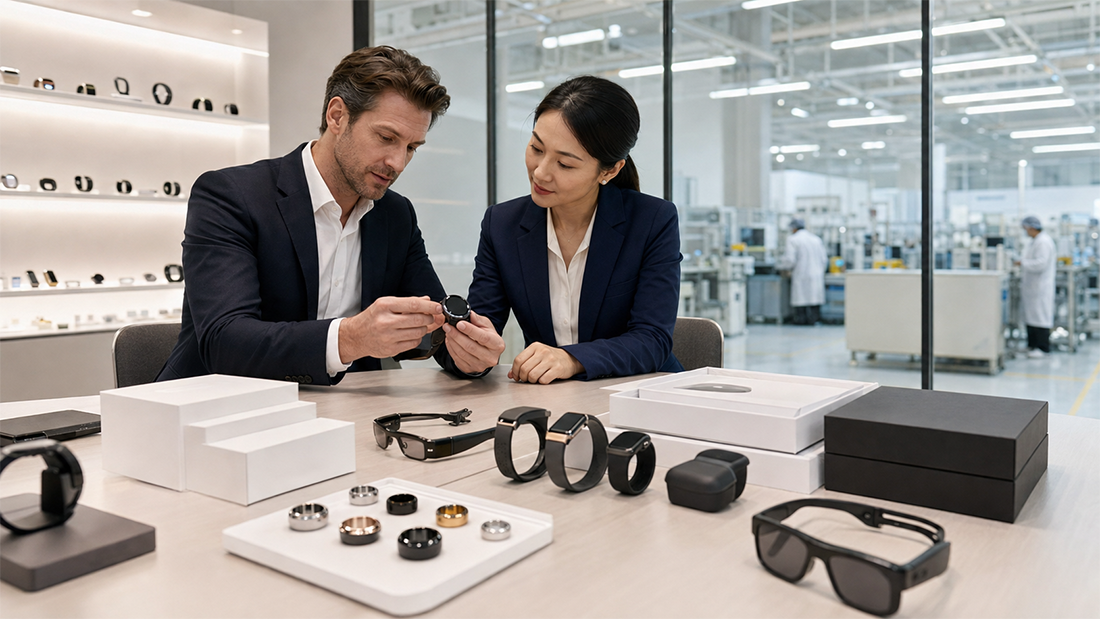
STAR KING supplies smart bands and related wearables for private-label and OEM/ODM projects. This checklist reflects the questions international buyers typically ask during supplier evaluation. It is written for purchase-stage decisions, not for general product education.
Step 1: Define the Smart Band Specification Before You Compare Prices
Price comparison only works when the specification is fixed. Smart bands for EU e-commerce can vary widely in display type, sensor package, battery capacity, water resistance rating, Bluetooth version, and app features. Two quotations with a 30% price gap often reflect different configurations rather than different supplier efficiency.
Core specification items to lock down
- Display: TFT or AMOLED, size, resolution, and touch control.
- Sensors: heart rate, SpO2, accelerometer, and any additional sensor required for your positioning.
- Battery: capacity in mAh, typical usage days, charging method, and standby behavior.
- Connectivity: Bluetooth version and supported operating systems.
- Water resistance: the exact rating you plan to claim and whether the supplier can support it with test reports.
- App: whether you use the supplier’s standard app, a white-label app, or a custom app.
- Language support: EU language coverage for the app and device UI.
For sellers building a health-oriented range, the smart bands product page is a practical starting point because it shows the hardware categories that can be adapted for private-label projects. Specification decisions should be made before MOQ negotiation, because changing the sensor package or display later usually affects tooling, firmware, and certification scope.
Image suggestion: A specification comparison board showing three smart band configurations. Alt text: smart bands for EU e-commerce specification comparison.
Step 2: Verify EU Compliance Documents, Not Just Certificate Images
EU market access for smart bands typically depends on the product configuration and the claims you make. Radio-enabled devices usually fall under the Radio Equipment Directive (RED), while electrical safety and electromagnetic compatibility requirements may also apply. RoHS restrictions on hazardous substances are commonly relevant for consumer electronics. Buyers should verify the exact scope with the supplier and, where needed, with a qualified compliance consultant.
A certificate image is not the same as a valid declaration. Ask for the declaration of conformity, the test report number, the standards referenced, the model names covered, and the date of issue. Confirm that the model name on the document matches the model you are buying. If the supplier cannot provide a clear document trail, treat that as a commercial risk rather than a paperwork delay.
Documents to request before deposit
- EU declaration of conformity for the exact model and radio configuration.
- Test reports covering RED, EMC, and safety where applicable.
- RoHS test report or material declaration.
- REACH statement or SVHC declaration if your compliance policy requires it.
- WEEE and packaging registration guidance for your seller country.
The European Commission provides official reference material on the Radio Equipment Directive and on RoHS. These pages are useful when you need to confirm which obligations apply to your product category. They do not replace supplier documentation, but they help you ask better questions.
Do not assume every smart band model from a supplier is certified for every EU market. Certification scope can vary by model, radio module, battery, and even accessory. Buyers should verify the specific SKU they intend to import.
Image suggestion: Compliance document folder with declaration of conformity and test report. Alt text: smart bands for EU e-commerce compliance documents.
Step 3: Confirm Battery, Transport, and Environmental Requirements
Smart bands contain lithium batteries. Shipping these products internationally usually requires transport documentation such as a UN38.3 test summary and a safety data sheet (MSDS). Air freight, sea freight, and express couriers may apply different rules, so the supplier and your logistics provider should confirm the correct documents before booking.
The EU battery framework is also evolving. Sellers should check current requirements for battery labeling, documentation, and producer responsibility in the countries where they sell. Compliance obligations often depend on the seller’s registration status and the fulfillment model, so buyers should verify with their compliance advisor or a specialist service.
Battery-related questions for the supplier
- Can you provide a UN38.3 test summary for the exact battery used in this model?
- Is the MSDS current and consistent with the battery specification?
- What battery labeling appears on the product and packaging?
- Have you shipped this model to EU destinations before, and which documents were used?
If you sell through Amazon or another marketplace, check the platform’s battery documentation requirements separately. Marketplace rules can be stricter than general customs requirements, and listings may be blocked until the correct documents are uploaded.
Step 4: Calculate MOQ, Landed Cost, and Cash Flow Impact
MOQ is not only a production quantity. It affects tooling amortization, packaging minimums, certification cost per unit, and cash flow. A supplier may offer a low MOQ for a standard model but require a higher MOQ for custom colors, logo printing, or custom packaging.
Build a landed cost model before you negotiate. Include the FOB price, freight, insurance, duties, VAT treatment, marketplace fees, packaging, certification amortization, and expected return rate. For many e-commerce sellers, the difference between two suppliers is smaller in unit price than in return rate and restocking speed.
Cost drivers to model
- Unit price at the confirmed specification.
- Tooling or mold cost, if a custom housing is required.
- Packaging setup and printing cost.
- Certification and testing cost per model.
- Freight mode and battery shipping surcharges.
- Payment terms and deposit percentage.
If you are planning a private-label range, the private label OEM/ODM solution page outlines the customization areas that usually affect MOQ. Reviewing those areas early helps you avoid a quotation that later changes when packaging or firmware requirements are added.
Step 5: Run Sample Validation and App Testing
Samples should be tested as if they were already in your warehouse. That means pairing the band with the app, checking firmware version, measuring battery behavior over several days, testing notifications, and reviewing data accuracy trends. Consumer wearable health features are not medical diagnostics, so marketing claims should stay within general wellness language unless the product has the appropriate regulatory status.
Sample validation checklist
- Pairing success rate across Android and iOS devices.
- Firmware update process and recovery if an update fails.
- Heart rate and SpO2 trend consistency during controlled activity.
- Sleep tracking behavior and app data display.
- Charging time, battery drain, and standby performance.
- Water resistance claim verification where applicable.
- App language coverage for your target EU markets.
Document every issue with photos, app screenshots, and firmware version numbers. A supplier that responds with engineering feedback rather than generic reassurance is usually better prepared for mass production.
Image suggestion: Tester wearing a smart band while reviewing app data. Alt text: smart bands for EU e-commerce sample testing.
Step 6: Plan Packaging, Branding, and Marketplace Requirements
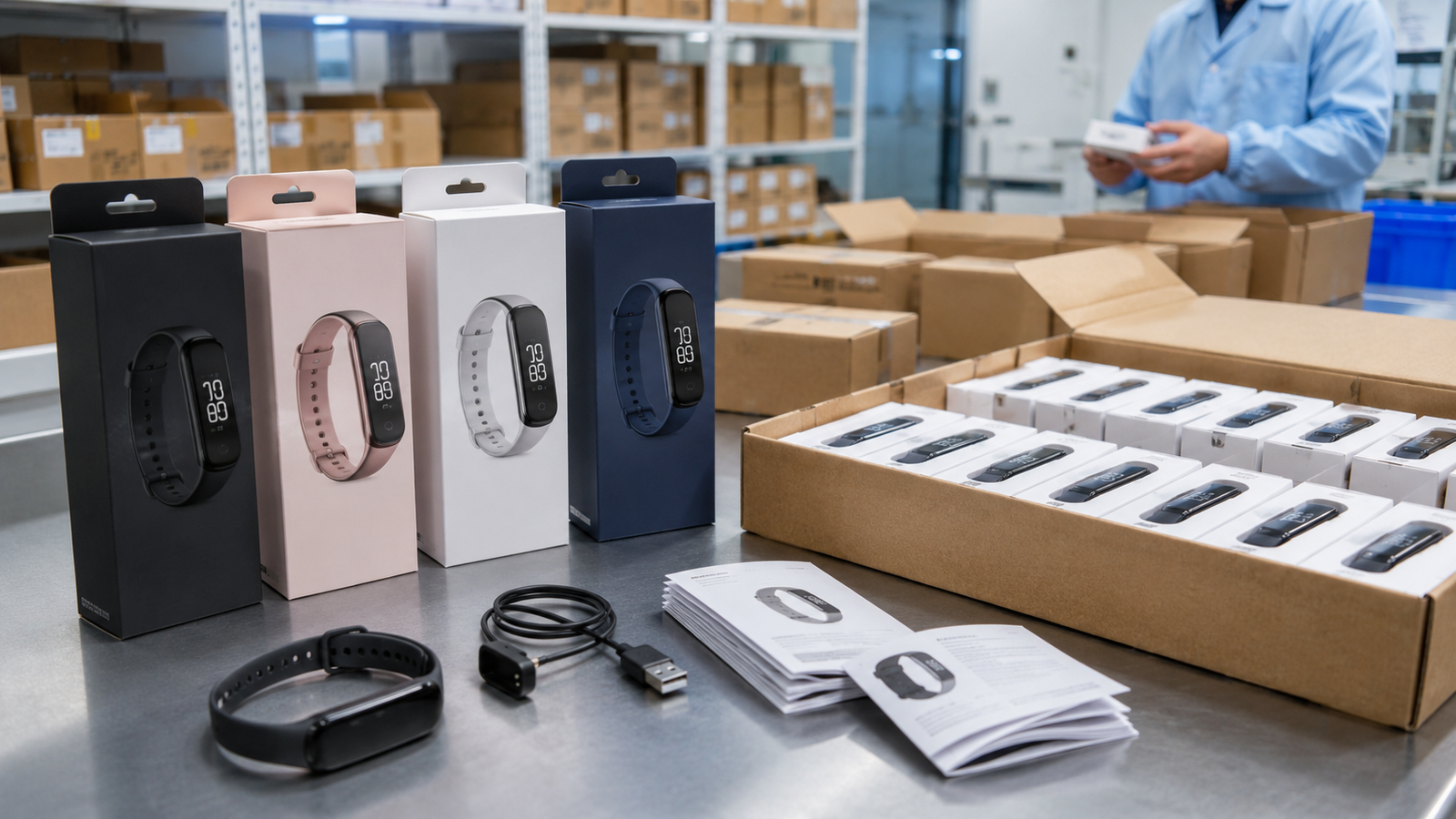
Packaging is a compliance and logistics topic, not only a design topic. EU sellers often need language-specific manuals, importer information, barcodes, and marketplace labels. Amazon FBA and other fulfillment models may require specific label placement and shipment preparation.
Decide early whether you need standard packaging, custom printed boxes, or a full private-label program. Custom packaging usually increases MOQ and lead time. It also creates a new approval step before mass production.
Packaging items to confirm
- Artwork file format and print proof approval process.
- Manual language set for your target countries.
- Importer name and address placement, if required.
- Barcode type and label position.
- Accessory list, including charging cable and quick start guide.
Ask the supplier to send a physical packaging proof before bulk printing. Digital proofs often miss color differences, material texture, and label placement issues that matter in retail and marketplace listings.
Step 7: Prepare After-Sales, Warranty, and Spare Parts
Returns are part of e-commerce economics. Before you order, agree on warranty terms, defect rate thresholds, replacement policy, and spare parts availability. Ask how the supplier handles firmware-related issues after shipment and whether they provide technical documentation for your support team.
If you sell in multiple EU countries, your support process should match local consumer expectations and applicable return rules. A supplier that can provide troubleshooting guides, firmware release notes, and replacement components reduces the operational burden on your team.
After-sales questions to ask
- What is the warranty period and what does it cover?
- How are defective units verified and replaced?
- Are spare bands, chargers, and packaging available for resale or replacement?
- Who provides technical support for app or firmware issues?
- How are firmware updates communicated and documented?
Key Facts for Buyers
| Decision Area | What to Verify | Why It Matters for EU E-commerce |
|---|---|---|
| Product specification | Display, sensors, battery, app features, language support | Prevents price comparison errors and reduces return risk |
| EU compliance | CE-related documents, RED and RoHS scope, declaration of conformity | Supports customs clearance and marketplace listing approval |
| Battery and transport | UN38.3 summary, MSDS, shipping documents | Reduces shipment delays and courier rejection risk |
| MOQ and cost | Tooling, packaging, certification, freight, payment terms | Shapes landed cost and cash flow |
| Sample validation | Pairing, firmware, battery, sensor trends, waterproof claims | Reveals quality before mass production |
| Packaging | Artwork, manuals, barcodes, importer labels | Meets marketplace and retail requirements |
| After-sales | Warranty, replacements, spare parts, firmware support | Controls return cost and customer satisfaction |
Comparison Table: Low-Price Supplier vs Compliance-Ready Supplier
| Evaluation Point | Low-Price Supplier Pattern | Compliance-Ready Supplier Pattern |
|---|---|---|
| Quotation detail | Single price with unclear specification | Line-item quotation with specification and cost drivers |
| Compliance documents | Certificate image only | Declaration, test report, model matching, and date verification |
| Battery documents | Provided on request after deposit | Provided during evaluation |
| Sample process | Generic sample, slow feedback | Defined sample plan with engineering feedback |
| Packaging | Standard box only | Artwork proof, manual languages, label planning |
| After-sales | Unclear warranty terms | Written warranty, replacement policy, spare parts plan |
Common Mistakes and Buyer Red Flags
Common mistakes
- Comparing prices before locking the specification.
- Accepting a certificate image without checking the model and date.
- Forgetting that marketplace battery rules may be stricter than customs rules.
- Ordering custom packaging without a physical proof.
- Skipping app testing on the phones your customers actually use.
- Underestimating return handling and spare parts needs.
Buyer red flags
- The supplier cannot explain which directive applies to the exact model.
- Documents show a different model name or an expired test date.
- The supplier refuses to provide a UN38.3 summary before deposit.
- Firmware or app support is described only verbally, with no documentation.
- Packaging MOQ changes after the order is confirmed.
- Warranty terms are not written into the quotation or contract.
Practical Buyer Checklist
- Specification sheet signed off internally.
- EU compliance document set reviewed for the exact model.
- RED and RoHS scope confirmed with the supplier.
- Battery transport documents requested and checked.
- Landed cost model completed, including certification and freight.
- Sample tested on Android and iOS with firmware version recorded.
- Packaging proof approved physically.
- Warranty, replacement, and spare parts terms agreed in writing.
- Marketplace-specific labeling and documentation requirements checked.
- First shipment plan and restocking lead time confirmed.
For sellers comparing wearable categories alongside smart bands, the smart watches range and the STAR KING blog provide additional context on product positioning and sourcing decisions.
FAQ
Do smart bands for EU e-commerce always require CE marking?
Most radio-enabled smart bands sold in the EU fall within CE-related requirements, but the exact obligations depend on the product configuration, radio module, and intended use. Buyers should verify the specific model and ask for a declaration of conformity that matches it.
What is a realistic MOQ for private label smart bands?
MOQ typically depends on whether you choose a standard model, custom colors, logo printing, custom packaging, or a custom housing. Standard models usually have lower MOQs than full tooling projects. Ask for a written MOQ breakdown by customization level.
How long does production and delivery to the EU usually take?
Lead time usually depends on sample approval, packaging proofing, component availability, and freight mode. Battery shipping rules can add handling time. Buyers should plan a buffer before marketplace peak seasons and confirm the schedule in writing.
Can the supplier provide UN38.3 and MSDS documents?
A qualified smart band supplier should be able to provide battery transport documentation for the model being shipped. If documents are only available after deposit, that should be treated as a planning risk.
Can I use my own app with a private label smart band?
App options usually include the supplier’s standard app, a white-label version, or a custom app integration. The right choice depends on your budget, timeline, and data requirements. Confirm firmware and app support responsibilities before mass production.
What should I test in a smart band sample?
Test pairing, firmware stability, battery behavior, sensor trends, notification delivery, language support, and water resistance claims where applicable. Record issues with screenshots and firmware versions so the supplier can respond with engineering feedback.
Conclusion
Smart bands for EU e-commerce can be a strong product category when the import process is managed as a sequence of verifiable decisions. Start with the specification, then verify compliance documents, battery transport requirements, MOQ and landed cost, sample performance, packaging, and after-sales terms. Sellers who follow this sequence reduce the risk of customs delays, listing suspensions, and high return rates.
STAR KING supports smart band and wearable projects for private-label and OEM/ODM buyers. The next step is to confirm your specification, target EU markets, and customization needs so the quotation reflects the actual project rather than a generic price list.
STAR KING CTA
Ready to compare smart band options for your EU store? Request a quotation with your target specification, quantity, packaging requirements, and destination market. If you are still evaluating configurations, ask for product samples and a compliance document checklist before you commit to a production order.
Discuss Your Smart Wearable OEM/ODM Project
Planning a smart ring, smart watch, smart band, AI glasses, AI translator, or AI voice mouse project? Contact STAR KING to discuss product positioning, sample testing, customization scope, certification requirements, lead time, and quotation details.

Team Star King

Scan WhatsApp QR code
Leave a Reply