
AI smart glasses supplier: How to Evaluate AI Smart Glasses Suppliers in 2026: 7 Checks UK Distributors Must Run
How to Evaluate AI Smart Glasses Suppliers in 2026: 7 Checks UK Distributors Must Run Before Signing
To select an AI smart glasses supplier for the UK, distributors should verify seven things before signing: demonstration-stock availability, model-by-model MOQ, fixed sample-testing steps, the specific radio, battery and UKCA/CE documentation tied to the exact configuration they will import, app and data terms with UK GDPR obligations, realistic sample-to-delivery lead times, and the OEM, tooling and spare-parts terms. This guide explains each check, what good answers look like, and the risks that most often reach a UK distributor after payment. It is written for importers, retail chains and e-commerce sellers comparing Chinese manufacturers as an AI smart glasses supplier, and the same framework applies whether you buy finished units or develop a private-label line.
Table of Contents
Table of Contents
Table of Contents
- Short Answer
- Key Takeaways
- Key Facts for Buyers
- What UK Distributors Actually Need From an AI Smart Glasses Supplier
- Check 1: Model Matrix and Demonstration Stock
- Check 2: MOQ, Price Breaks and Total Landed Cost
- Check 3: Sample Testing Protocol
- Check 4: Compliance Files for the Exact SKU You Import
- Check 5: App, Firmware and UK GDPR Data Handling
- Check 6: Lead Time and Production Governance
- Check 7: Commercial, Tooling and After-Sales Terms
- Supplier Comparison and Decision Table
- Common Mistakes and Buyer Red Flags
- Practical Buyer Checklist
- FAQ
- Conclusion

Short Answer
The best AI smart glasses supplier for a UK distributor is the one that answers configuration, certification, MOQ and lead-time questions per model, not in general terms. Before a purchase order, request the model matrix, a quote with pack and accessory detail, the test report for the exact SKU and battery pack you will import, a written app and data-handling summary, and a spare-parts and warranty commitment. Suppliers that provide these without being pushed are usually the ones with stable firmware and predictable production.

Key Takeaways
- Evaluate an incoming AI smart glasses supplier model by model, because displays, optics, cameras and battery packs change certification scope, unit price and MOQ.
- UK import compliance for AI glasses typically involves UKCA, UK-specific radio requirements, battery transport documentation and WEEE and packaging obligations; the exact file set should be agreed in writing.
- Sample testing should judge translation and audio quality in real noise, battery endurance, thermal behavior and app stability, not just industrial design.
- Treat the app as part of the product: update cadence, data location and UK GDPR roles affect your returns rate and reputation.
- Ask for a loader or repair procedure in writing, because small-batch suppliers rarely offer a stocked UK repair network.
- Distributors who plan after-sales and spare parts during selection spend less time on dispute resolution after delivery.
Key Facts for Buyers
| Decision Factor | What to Ask the Supplier | Why It Matters to UK Distributors |
|---|---|---|
| Sourcing model | OEM, ODM or white-label catalogue? Who owns the industrial design and tooling? | Determines exclusivity, redesign cost and how fast you can launch a private label. |
| MOQ by model | MOQ for the selected display and frame, and per colour or brand | Controls cash tied up in stock and the size of your first order. |
| Sample policy | Sample fee, turnaround and whether it is credited against the first order | Lets you validate the exact configuration before committing. |
| Compliance files | UKCA/CE, radio, RoHS, battery test summary and MSDS for the exact SKU | Affects customs clearance and your ability to place the product in the UK. |
| App and data | Update frequency, permission list, data location and deletion process | Reduces support tickets, returns and UK GDPR exposure. |
| Lead time | Sample, tooling, first article and mass-production timing | Determines whether you can hold a launch date or seasonal window. |
| After-sales | Warranty length, spare parts, firmware rollback and repair instructions | Protects distributor margin when retail customers return products. |
What UK Distributors Actually Need From an AI Smart Glasses Supplier
The phrase “AI smart glasses supplier” describes a wide range of companies. Some design and mould frames and integrate optics; others assemble modules into an existing housing; others simply rebrand a catalogue product. Each model changes what you can customise and what you must verify.
Under a white-label arrangement, you buy a proven model, apply your logo and packaging, and rely on the supplier’s app and firmware. Under an ODM programme, the supplier adapts an existing platform, which may involve a different frame, camera module or battery, so compliance documentation usually needs to be reissued for the new configuration. Under a full OEM project, you control the specification and tooling, which gives exclusivity but adds development time and cost before the first sellable unit.
For UK distributors specifically, three pressures shape supplier selection: retail customers expect working units and simple returns; consumer law and data protection rules apply to connected devices; and buyers increasingly ask how app data is stored and deleted. That means a supplier’s certification files, firmware support and app documentation matter as much as unit price.
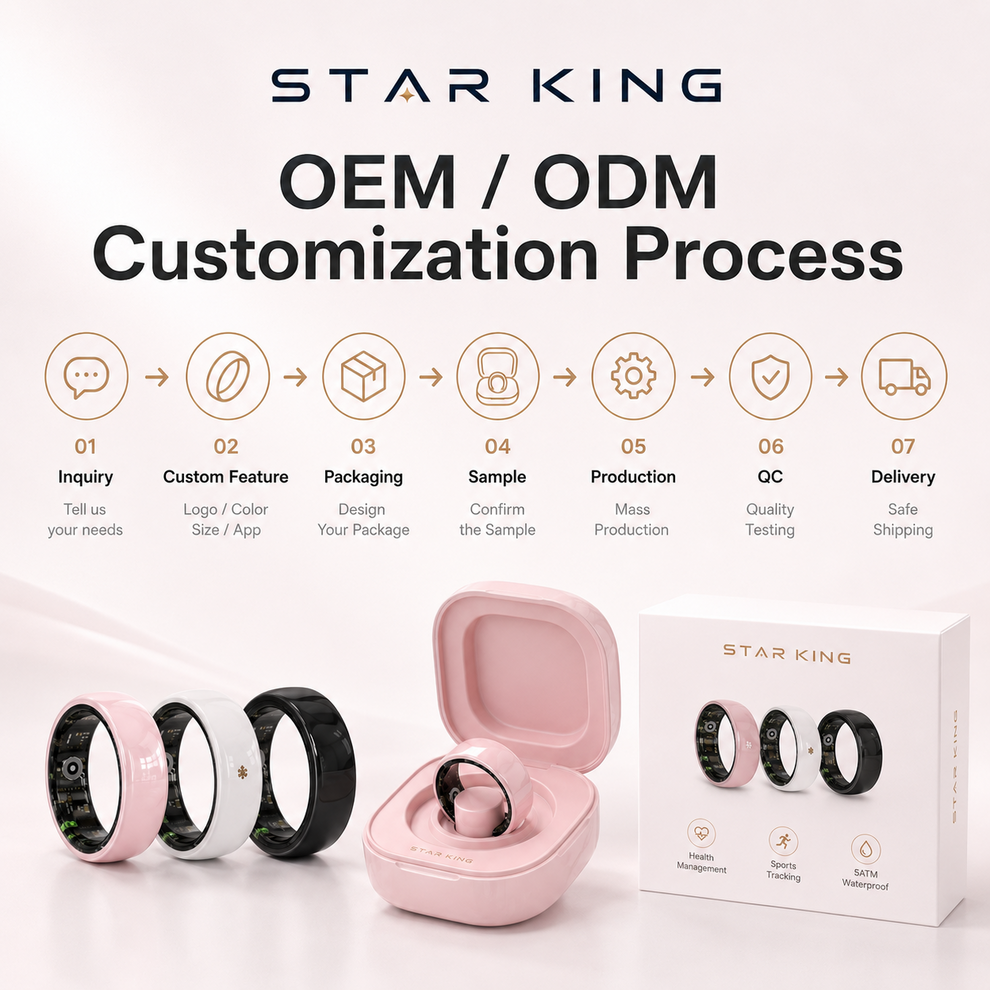
STAR KING supports distributors through private label and OEM/ODM programmes that can be scoped to a first order rather than only to large minimum runs. Distributors can start with an existing AI smart glasses platform and add branding before deciding on deeper customisation.
Check 1: Model Matrix and Demonstration Stock
Map the SKUs before you talk about price
Ask for a model matrix that lists, for each model: frame and lens type, display method, camera specification, audio path, battery capacity, app compatibility, unit price, MOQ and certification status. AI eyewear varies most in the display and audio design, and those two choices drive cost, weight and comfort.
Typical configurations fall into three groups: audio and voice-only frames, capture-and-translate models with a camera and microphone, and display models with an in-lens or projected image. A model matrix prevents a common mistake: comparing quotes for different technical products. Distributors should match each model to a channel, because specification needs differ across independent retail, travel retail, business-to-business gifting and education supply.
Demonstration stock and try-before-buy
UK retail buyers and corporate prospects expect to test fit. Ask whether demo units are available separately from sample orders, whether a demo unit can be reflashed with current firmware, and how quickly replacement demo stock ships. A supplier that only offers sealed retail packaging can slow your sales cycle significantly.
Check 2: MOQ, Price Breaks and Total Landed Cost
MOQ for AI smart glasses is usually set per model and per colour, not per order. Displays, optical modules and custom frames carry tooling or minimum batch charges, so a low-MOQ offer on a catalogue model may rise sharply once you add a new frame colour or a custom lens.
Build a landed-cost, not a unit-price, model
Unit cost is only part of your margin. A practical landed-cost sheet should include the following lines:
- Unit price at your target quantity, with band prices at higher volumes.
- Branding and packaging cost, separating logo printing from custom gift-box tooling.
- Carton dimensions, gross weight and carton count per pallet.
- Battery documentation and any special transport surcharges.
- Freight mode and estimated transit time, including UK port or airport handling.
- Duty treatment and import VAT, which depend on product classification and the shipment terms you agree; buyers should verify the current position with their customs broker or tax adviser.
- Warranty reserve and expected return allowance.
Two suppliers quoting the same unit price can produce very different margins once these lines are included.
If you need to test a specific configuration, requesting samples and a quotation with the exact model, quantity and branding scope makes it easier to compare suppliers on the same basis.
Check 3: Sample Testing Protocol
Samples should be tested against written criteria, otherwise impressions dominate and the decision is hard to defend internally. Run three checks that matter most to UK buyers: does the product do the core job in real conditions, does it survive a normal day of use on one charge, and does it behave safely under thermal stress?
Translation and audio in real noise
Real-time translation should be judged in realistic environments: a busy shop floor, a car with the window open, a meeting room with air conditioning. Record examples, note how quickly turns are spoken, and decide what error rate your channel can tolerate. Keep your acceptance criteria written down, because a second sample from another supplier should be judged the same way.
Battery endurance, thermals and app stability
Measure battery endurance in continuous use, not standby. Track how warm the temple becomes during charging and during long translation sessions, since users notice device temperature quickly. Install the app on both a current iPhone and a current Android model, check for permission requests that feel excessive, and watch for disconnects, repeated logins or failed firmware updates.
Sample agreement and IP
Where a supplier develops a custom frame or design, goods should be ordered under a written development or manufacturing agreement that states mould ownership, tooling transfer rights and confidentiality. Summarise your requirements in writing, allow the supplier to confirm feasibility and cost, then have the final document reviewed by a qualified legal adviser as needed. Do not rely on a verbal understanding of who owns the mould.
Check 4: Compliance Files for the Exact SKU You Import
Compliance is a supplier-selection test because it reveals whether a factory controls its own product data or forwards general files. UK and EU rules apply to connected devices, radio equipment, batteries and packaging, and obligations are configuration-specific. Once you narrow your AI smart glasses suppliers to a shortlist, request a document pack for your exact SKU and colour.
What a UK document pack typically includes
- UKCA-related documentation for the product category, or a clear statement of status and timing.
- CE documentation where the EU market is also relevant.
- Radio equipment documentation for the Bluetooth and Wi-Fi modules, referencing the standards actually applied.
- RoHS statements for materials.
- Battery transport documents, such as a UN 38.3 test summary and an MSDS, for the specific battery pack.
- Safety and conformity wording that matches the model sold, not a family certificate covering unrelated products.
The UK government publishes guidance on using the UKCA marking, and the EU maintains CE marking rules on the Your Europe portal. Local official sources such as the EU CE marking portal should be treated as the primary reference. Whether a given product requires a specific marking or test depends on its design and intended use, so buyers should verify requirements with a compliance adviser or their authority before committing to a shipment.
Two further points are often overlooked. First, radio and electrical compliance attaches to the exact hardware variant, so a change of camera module or battery can restart part of the process. Second, a Bluetooth module supplier listing does not automatically cover your finished accessory; the finished product still needs to meet the relevant requirements. A supplier that explains this distinction clearly is usually managing its documentation properly.
Check 5: App, Firmware and UK GDPR Data Handling
The app and firmware are not accessories. They determine returns, reviews and support load. Ask for a firmware update cadence, a review of the permission list and a written explanation of how data moves between the glasses, the phone app and any supplier or third-party cloud service.
Devices aimed at the UK routinely raise data protection questions. The ICO, the UK’s data protection regulator, publishes guidance for organisations including business advice on the rules. Distributors do not run the firmware, but they sell the connected product, so they should know whether a privacy notice is supplied, whether data deletion requests can be handled and who answers a customer complaint about recorded content.
Confirm whether translation and transcription are processed offline or through cloud services, where the servers sit, and whether live translation records or audio snippets are stored. For accessibility or educational deployments, ask what data ends up on a shared device and what can be deleted locally. If a channel such as healthcare, children’s tutoring or workplace monitoring faces tighter expectations, those require legal review rather than a supplier assurance.
Check 6: Lead Time and Production Governance
Reliable lead times come from stable components and honest batch scheduling. Ask for a milestone schedule rather than a single number, and test whether the answer changes when you add a colour or a new packaging design.
Milestones to request in writing
- Sample lead time for a single unit, plus cost and shipping method.
- Pre-production sample timing when customisation is involved.
- Mass-production lead time for your quantity, with any seasonal buffer noted.
- Booking-to-shipment window and the documents provided before dispatch.
A supplier that shortens its stated lead time only after you push is managing the relationship rather than the schedule, and that pattern often continues after the deposit is paid.
Quality control structure
Ask about the incoming-inspection process for displays and batteries, end-of-line production testing, and pre-shipment inspection. Distributors carrying larger orders may appoint a third-party inspection before final packing, which gives an independent record of what was in the cartons. Confirm whether aging and functional tests run on the full batch or on samples, and ask for the report format rather than a summary.
Check 7: Commercial, Tooling and After-Sales Terms
The commercial section of a supply agreement decides your margin over the full product life, not just launch. Read it with the same care as a retail supply contract.
Terms worth negotiating explicitly
- Warranty period and what is excluded, such as accidental damage or water ingress.
- Spare-parts availability, especially temple arms, hinges and lenses.
- Firmware rollback and a repair or reset procedure for products returned by customers.
- Brand exclusivity by territory or channel, or a clear statement that none exists.
- Tooling ownership and mould transfer terms if the relationship ends.
- Defect-rate thresholds and how replacements are credited.
This is where many distributors discover the true cost of a low unit price. A supplier that cannot support a return from a UK customer through spare parts or a defined repair path often transfers that cost to you.
Supplier Comparison and Decision Table
Use the table below when scoring shortlisted suppliers on a common basis.
| Selection Check | High-Confidence Answer | Warning Sign |
|---|---|---|
| Model matrix | Detailed per model, with display, camera and battery data | Marketing images only, no technical breakdown |
| MOQ | Per-model MOQ and colour minimums in writing | “Very low MOQ” with no quantities stated |
| Samples | Paid samples, clear timing, credited against first order | Free samples with no written specification |
| Compliance | Report pack for the exact SKU and battery | Generic certificate image, blurred test scope |
| App and data | Named app, update cadence, documented data flow | No clarity on cloud processing or deletion |
| Lead time | Milestone schedule with buffer | One number that moves when you ask twice |
| After-sales | Spare parts, warranty terms and repair steps | No parts availability, warranty in verbal form |
Score each supplier on measurable answers. A supplier with fewer models but complete documentation often beats a broader catalogue with gaps.
Common Mistakes and Buyer Red Flags
1. Comparing unlike models. Display, camera and battery choices change almost every commercial term. Match the specification before comparing price.
2. Accepting a family certificate. A document covering a different model or battery pack creates a customs and retail risk. Ask for the exact SKU and pack.
3. Ignoring the app. A weak app produces returns and negative reviews that a distributor cannot fix, only absorb.
4. Overlooking data protection. If you cannot explain data handling to a retailer or business buyer, that conversation will stall.
5. Treating sample quality as production quality. The handwritten unit you test should be produced under the same procedures as the mass run. Ask what changes at scale.
6. Skipping the tooling clause. When a relationship ends, ambiguous ownership of moulds and designs becomes an expensive problem.
7. Assuming transport is routine. Lithium batteries normally require UN 38.3 documentation and may be classified under dangerous-goods rules depending on capacity and packaging. Verify requirements with your freight forwarder before the first order.
8. Accepting a lead time without a buffer. Component delays are common in optics and displays. A schedule with no buffer rarely survives first contact with production.
Practical Buyer Checklist
- Model matrix received, with display, camera, battery and app compatibility per model.
- Quotation states unit price, band prices, payment terms and export terms.
- MOQ confirmed per model, colour and branding package.
- Sample order placed with a written test sheet attached.
- Test sheet scored: translation quality, audio, battery endurance, thermals, app stability.
- Compliance pack requested for the exact SKU, colour and battery pack.
- Firmware update policy and app permission list reviewed.
- Data flow described in writing, including cloud location and deletion process.
- Lead-time milestones agreed, with buffer for display and battery supply.
- Inspection method agreed, including any third-party pre-shipment check.
- Warranty, spare parts and defect terms stated in the contract.
- Tooling and design ownership clarified, with transfer terms.
- Battery transport documentation confirmed with the forwarder.
- UK import and tax treatment confirmed with a customs or tax adviser.
FAQ
What MOQ should a UK distributor expect for AI smart glasses?
MOQ is set per model and colour and rises when custom frames, lenses or packaging tooling are involved. Ask for MOQ at two or three quantity bands so you can model cash and stock risk before choosing a launch quantity.
Which certifications apply to AI smart glasses in the UK?
Electrical and radio products sold in the UK typically require UKCA-related documentation and may also need CE files for the EU market. Batteries and packaging carry separate obligations. The correct file set depends on the exact product and configuration, so buyers should confirm requirements before ordering.
How long does AI smart glasses development take?
White-label orders can often ship faster because the platform already exists. When supplier tooling is required for a custom shape, a development and trial stage usually applies, then mass production. Ask for a milestone schedule rather than one number.
Who owns the app and the firmware?
In most white-label and ODM arrangements, the supplier owns the platform and the buyer receives usage and branding rights. Full ownership or source access is rare and should be defined in writing if required, especially in regulated or enterprise deployments.
Can AI smart glasses be shipped by air?
Lithium battery products are commonly shipped by air when documentation, state of charge and packaging meet airline and forwarder requirements. Capacity, packaging and carrier rules affect the answer, so confirm with your forwarder using the actual battery pack specification.
What should I test in a smart glasses sample before scaling?
Prioritise the core function in real noise, continuous battery endurance, charging temperature, app installation on both iOS and Android, and stability over an extended session. Score each item on a fixed sheet so samples from different suppliers can be compared fairly.
How do I protect tooling and design ownership?
State ownership, transfer and confidentiality terms in a written development or manufacturing agreement signed before tooling starts, and have the document reviewed by a qualified legal adviser. A verbal understanding is not sufficient if the relationship later ends.
Conclusion
Selecting an AI smart glasses supplier is a documentation exercise as much as a price negotiation. UK distributors should confirm the model matrix, MOQ per configuration, sample performance against a written standard, compliance files for the exact SKU, the app and data-handling position, a milestone lead time and clear after-sales and tooling terms. Suppliers that answer these points precisely tend to deliver predictable production; those that deflect them usually create avoidable costs after launch.
Next Step
STAR KING works with UK and international distributors on AI smart glasses and can support white-label branding, custom packaging and OEM/ODM development for the AI hardware category. If you are evaluating suppliers for a UK launch, request product samples, a quotation for your target quantity and the certification files for your intended configuration so you can compare options on the same basis.
Request product samples and a quotation from STAR KING
Discuss Your Smart Wearable OEM/ODM Project
Planning a smart ring, smart watch, smart band, AI glasses, AI translator, or AI voice mouse project? Contact STAR KING to discuss product positioning, sample testing, customization scope, certification requirements, lead time, and quotation details.

Team Star King

Scan WhatsApp QR code