Smart Bands for EU Importers: 7-Point OEM Evaluation Guide (2026)
Smart Bands for EU Importers: 7-Point OEM Evaluation Guide (2026)
Smart bands for EU importers should be evaluated on seven points: CE conformity (RED, EMC, RoHS, REACH), battery compliance for shipping (UN38.3, MSDS, IEC 62133), MOQ and tooling, firmware and app ownership, sample testing, packaging and labeling, and after-sales terms. In the EU, the importer — not the factory — is often the legally responsible economic operator. This guide gives importers a practical checklist to qualify an OEM partner before placing a first bulk order.
Table of Contents
Table of Contents
Choosing a smart band supplier on price alone is one of the fastest ways to lose margin in the EU market. This evaluation guide is written for importers, distributors and private-label brands preparing a first or second smart band program in Germany, France, the Netherlands, Poland, Spain, Italy or the Nordics. It focuses on what importers must verify before a purchase order, not on consumer features.
smart bands for EU importers: Table of Contents
- Short Answer
- Key Takeaways
- Key Facts for Buyers
- Why EU Importers Need a Different Evaluation Checklist
- The 7-Point OEM Evaluation Checklist for Smart Bands
- Comparison Table: Entry, Mid and Advanced Smart Band Programs
- Practical Buyer Checklist
- Common Mistakes and Buyer Red Flags
- FAQ
- Conclusion
Short Answer
For EU importers, the safest way to source smart bands is to choose an OEM partner that can provide, before mass production: (1) a CE RED technical file and EU Declaration of Conformity, (2) RoHS and REACH statements, (3) UN38.3 test summaries and MSDS for the battery, and (4) a written agreement on firmware, app and data ownership. MOQ typically depends on the level of customization — logo-only programs usually start lower than full ODM programs with new tooling. Buyers should verify every claim with documents, not verbal assurances.

Key Takeaways
- The EU importer is frequently the legally responsible economic operator for CE-marked smart bands, even when the factory is in Asia.
- Smart bands require CE (RED 2014/53/EU, EMC 2014/30/EU), RoHS 2011/65/EU, REACH and battery compliance — each on a per-SKU basis.
- UN38.3 and MSDS documentation is commonly required by air carriers and EU customs, and must match the shipped battery exactly.
- MOQ and lead time depend heavily on three variables: tooling new vs. existing, firmware customization depth, and packaging format.
- Sample testing should include functional tests, charging cycle behavior, app pairing, and aquatic/aging tests when relevant.
- Firmware and app ownership should be defined in writing to avoid lock-in and to support future product generations.
- A structured evaluation avoids the most common EU importer mistakes: underspecified compliance, unclear labeling responsibilities and undocumented battery content.

Key Facts for Buyers
| Item | Typical EU Importer Consideration | How to Verify |
|---|---|---|
| CE marking route | RED 2014/53/EU for Bluetooth; EMC 2014/30/EU; LVD may not apply to low-voltage wearable bands | Request EU Declaration of Conformity and RED technical file |
| RoHS / REACH | Material restrictions and SVHC declarations for the finished product and packaging | Request RoHS test reports and REACH SVHC statements |
| Battery compliance | UN38.3 test summary, MSDS, IEC 62133 for cell and pack (may be required depending on carrier and EU country) | Match test documents to the actual battery model and capacity |
| Importer role | Often the “economic operator” placing product on the EU market | Confirm importer name, address and contact details on the label |
| MOQ | Typically lower for logo-only programs, higher for full ODM with new tooling | Request a written MOQ matrix by customization level |
| Lead time | Depends on sample rounds, tooling, battery supply and packaging | Request a signed production schedule with milestones |
| Data protection | GDPR applies when EU user data is processed via app or cloud | Confirm where data is stored and who is the data controller |
Why EU Importers Need a Different Evaluation Checklist
An Amazon seller in the United States often focuses on returns, ratings and account health. An EU importer faces a different set of obligations. Under EU market surveillance rules, the importer placing a product on the market must ensure the product conforms to applicable directives, keep documentation available, and provide traceability. This is why the evaluation checklist for smart bands for EU importers looks more like a compliance and partnership audit than a product review.
The Importer as Economic Operator
In practice, this means the importer’s company name and address are on the label or on the EU Declaration of Conformity. If a market surveillance authority requests a technical file, the importer is often the first contact. Buyers should therefore ask a smart band OEM partner three questions early: which documents will you provide, how long will you retain them, and who updates them if firmware or components change. A supplier that cannot answer these questions is a sourcing risk, regardless of unit price.
It is common for importers to need a Responsible Person service or an authorized representative in the EU. Whether this is required depends on the product category, the directives applied and the interpretation of national authorities. Buyers should verify requirements with a qualified EU compliance consultant or legal advisor before placing large orders.
Battery, Wireless and Wearable-Specific Rules
Smart bands contain lithium-ion or lithium-polymer batteries and Bluetooth radios. That combination triggers battery transport rules and radio equipment rules. A smart band with a heart-rate optical sensor, for example, is not automatically a medical device, but if the brand markets it with medical claims, the regulatory picture can change. Buyers should avoid medical claims unless the product is properly classified and registered.
The 7-Point OEM Evaluation Checklist for Smart Bands
1. CE Conformity and Technical File
What to ask: Which directives apply to this specific SKU? Request the EU Declaration of Conformity, the RED technical file structure, EMC reports, and any RF test summaries. Confirm that the frequency bands and power levels match EU allowances.
Why it matters: A generic CE certificate for a different model is not sufficient. Documents must reference the exact model and the actual radio module.
How to verify: Cross-check the model number, the radio chipset and the test date. Ask whether the test lab is recognized. See the European Commission CE marking page for the general framework.
2. RoHS, REACH and Materials Declarations
What to ask: RoHS 2011/65/EU reports for the finished band and its strap, plus REACH SVHC declarations. If the strap touches skin, ask about nickel release and skin-contact materials.
Why it matters: EU customs and market surveillance increasingly request these documents, and retail chains often require them as part of onboarding.
How to verify: Request the report number, the testing laboratory, and the sample description. Ask how the supplier controls supplier changes that could affect materials.
3. Battery Documentation (UN38.3, MSDS, IEC 62133)
What to ask: UN38.3 test summary, MSDS, and — where applicable — IEC 62133 reports for the cell and the pack. Confirm whether the battery is built into the band or shipped separately, since this changes packing and carrier documentation.
Why it matters: Air carriers and freight forwarders typically require UN38.3 and MSDS before accepting lithium-battery shipments. These documents must match the exact battery shipped.
How to verify: Compare the battery model, capacity and manufacturer on the MSDS with the battery in the sample. For context, see the IATA lithium battery guidance.
4. MOQ, Tooling and Customization Depth
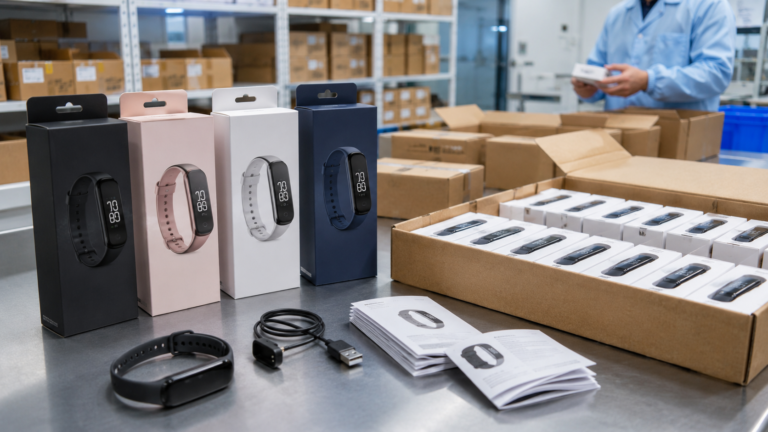
What to ask: A written MOQ matrix distinguishing: logo-only on existing hardware; custom strap color; custom packaging; new enclosure tooling; and full ODM with custom firmware. Ask whether tooling is owned by you or the factory.
Why it matters: MOQ usually scales with customization depth. Tooling ownership affects your ability to switch suppliers later.
How to verify: Request a tooling agreement that specifies ownership, transfer conditions and amortization. Illustrative MOQ ranges in this guide are examples only and should be confirmed with the supplier: [STAR KING TO CONFIRM].
Soft CTA: If you are comparing OEM partners for a first EU smart band program, you can review STAR KING’s private label and OEM/ODM solution to see how customization levels map to MOQ and lead time.
5. Firmware, App and Data Ownership
What to ask: Is the app white-label or fully custom? Who hosts the cloud backend? Who owns the firmware source or update rights? What is the update roadmap? Can the band work with a third-party app?
Why it matters: App lock-in is one of the most expensive problems in wearable sourcing. If the factory controls the app and the data model, switching suppliers later can mean restarting your product roadmap.
How to verify: Ask for a written statement on firmware and app ownership, update frequency, and what happens to EU user data at end of contract. Under GDPR, the data controller and processor roles should be defined.
6. Sample Testing and Verification
What to ask: At least one functional sample round before production. Test pairing behavior, charge cycles, screen brightness, sensor consistency, app syncing and strap comfort. If the band claims water resistance, ask how it is tested.
Why it matters: Datasheets rarely reflect real-world battery life, Bluetooth stability or sensor accuracy. Sample testing reveals these gaps before you commit to a purchase order.
How to verify: Create a simple scoring sheet covering battery life under a defined scenario, pairing success rate, firmware stability, and app rating. Document sample serial numbers.
7. Packaging, Labeling and After-Sales
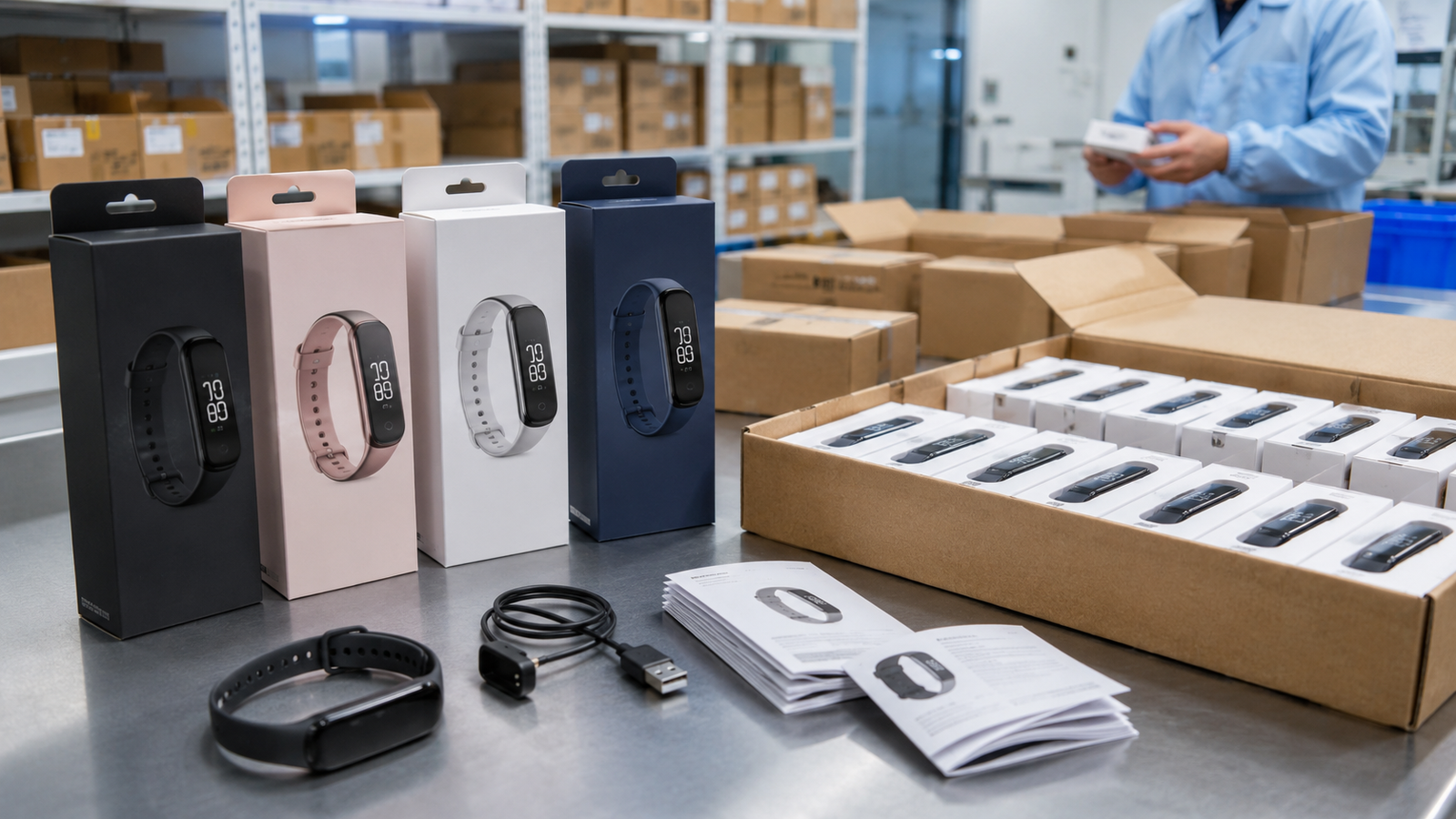
What to ask: Retail packaging artwork files, multi-language inserts for EU markets, importer label fields (name, address, contact), warranty terms, spare parts availability, and return handling.
Why it matters: EU labeling is not cosmetic. The importer name and address are part of the compliance obligation. After-sales terms determine your true landed cost.
How to verify: Request a packaging proof with all mandatory label fields. Confirm the warranty scope in writing and how spare bands or straps are handled.
Comparison Table: Entry, Mid and Advanced Smart Band Programs
| Program Type | Typical Customization | Compliance Workload | MOQ Sensitivity | Best For |
|---|---|---|---|---|
| Entry (logo-only) | Logo on existing hardware, standard packaging | Lower — existing CE reports may be reused if the model is unchanged | Lower MOQ than full ODM [STAR KING TO CONFIRM] | Amazon sellers, test orders, brand trials |
| Mid (semi-custom) | Custom strap color, packaging artwork, firmware color/branding | Moderate — packaging and label updates, updated DoC | Moderate — depends on packaging printer minimums | Distributors, retail chains, private label brands |
| Advanced (full ODM) | New enclosure, firmware features, custom app | High — new RED technical file, EMC/RF re-test, possible app data review | Higher — tooling and testing drive commitment | Startup brands, corporate wellness, system integrators |
Buyers should match the program type to their sales channel. A retail chain onboarding several hundred stores often needs the mid or advanced program because packaging and label requirements exceed a logo-only setup. An e-commerce seller testing demand may prefer the entry program first.
Practical Buyer Checklist
- Requested and reviewed the EU Declaration of Conformity for the exact model.
- Compared UN38.3 and MSDS documents against the actual battery in the sample.
- Confirmed RoHS and REACH SVHC statements for the band and strap.
- Confirmed importer name and address fields on the package label.
- Received a written MOQ matrix by customization level.
- Confirmed tooling ownership and transfer conditions in writing.
- Reviewed firmware and app ownership terms, including update rights.
- Ran at least one sample test round with a documented scoring sheet.
- Received a production schedule with milestones and buffer.
- Confirmed warranty scope and spare parts availability.
- Confirmed where EU user data is processed and who is the controller.
- Evaluated landed cost including freight, battery handling and duties.
Common Mistakes and Buyer Red Flags
Common Mistakes
- Accepting a generic CE certificate: A certificate for a different model does not cover your SKU. Model numbers on the certificate must match the SKU you import.
- Assuming battery documents are interchangeable: UN38.3 and MSDS documents must match the actual battery model and capacity.
- Overlooking the importer label: In many EU member states, the label must show the importer’s name and address. Sellers sometimes discover this at the port.
- Underestimating app lock-in: If the app is controlled entirely by the factory, roadmap changes and supplier switches become expensive.
- Planning for the wrong program type: A logo-only program rarely satisfies retail chain packaging and compliance requirements without modification.
- Skipping sample testing under realistic conditions: Datasheet battery life and real-world battery life are different numbers.
Buyer Red Flags
- Supplier refuses to share test documents before a deposit.
- Test reports show a different manufacturer name or model than the quote.
- No clear answer on who owns the tooling or the firmware.
- Verbal warranty promises but no written terms.
- No documented process for handling component changes that affect compliance.
- Reluctance to identify the EU Responsible Person or authorized representative.
Buyers can also review STAR KING Smart Bands OEM/ODM options to compare product positioning, customization scope, and sample planning.
FAQ
What is the typical MOQ for smart bands for EU importers?
MOQ depends on customization depth, existing tooling and packaging format. Logo-only programs on existing hardware usually have lower MOQ than projects with new enclosures or custom firmware. Buyers should request a written MOQ matrix rather than rely on a single number, and confirm actual values with the supplier.
Does a smart band need CE marking to be sold in the EU?
Generally yes, if the band contains a Bluetooth radio and is placed on the EU market. The applicable directives typically include RED 2014/53/EU for the radio, EMC 2014/30/EU, and RoHS 2011/65/EU for material restrictions. The exact combination depends on product configuration and how it is marketed. Buyers should verify the specific requirements with a compliance consultant.
Who is the EU Responsible Person for an imported smart band?
When an importer places a product on the EU market, the importer often assumes the role of the responsible economic operator, but rules differ by directive and member state. Some importers appoint an authorized representative or a Responsible Person service. The correct setup depends on the product and the market; buyers should confirm with a qualified EU advisor.
What battery documents are needed to ship smart bands to the EU?
Air carriers and forwarders commonly require a UN38.3 test summary and an MSDS for the lithium battery inside the band. IEC 62133 reports for the cell and pack may also be requested depending on carrier and destination country. Documents must match the exact battery model and capacity. See IATA guidance for carrier-level requirements.
Can I private-label a smart band without changing the hardware?
Yes. Many importers start with a logo-only program using existing hardware, then move to semi-custom or full ODM after demand is validated. The compliance workload is usually lower if the model itself is unchanged, but packaging and label updates may still be needed.
How long does a smart band OEM project take from sample to mass production?
Lead time typically depends on sample rounds, tooling status, battery supply, and packaging. Logo-only programs generally move faster than full ODM programs with new tooling and custom firmware. Buyers should request a production schedule with defined milestones and buffer before signing.
Should I choose a smart band OEM based on price or compliance?
Both matter, but compliance gaps can be more expensive than a modest unit-price difference. Returns, customs holds, marketplace suspensions and relabeling costs can erase margin quickly. Buyers should treat compliance documents as a sourcing requirement and price as a negotiation variable within a qualified supplier pool.
Conclusion
Evaluating smart bands for EU importers is a compliance, customization and partnership decision — not a single price comparison. The seven-point checklist in this guide — CE conformity, RoHS/REACH, battery documentation, MOQ and tooling, firmware and app ownership, sample testing, and packaging/after-sales — gives importers a repeatable framework for qualifying a smart band OEM partner. Apply the checklist to at least two or three candidate suppliers, score their responses, and choose the partner whose documentation and product roadmap match your channel. For related applications, see our overview of fitness tracking applications, and for broader wearable context, review the smart watches line as a comparison point. More evaluation guides are available on our resources blog.
STAR KING CTA
If you are evaluating smart bands for an EU import or private label program, the next step is a structured sample and specification review. You can request product samples and share your target market, target channel and customization level so that specification, compliance document and MOQ questions can be answered in one pass.
Request smart band samples and customization options
Discuss Your Smart Wearable OEM/ODM Project
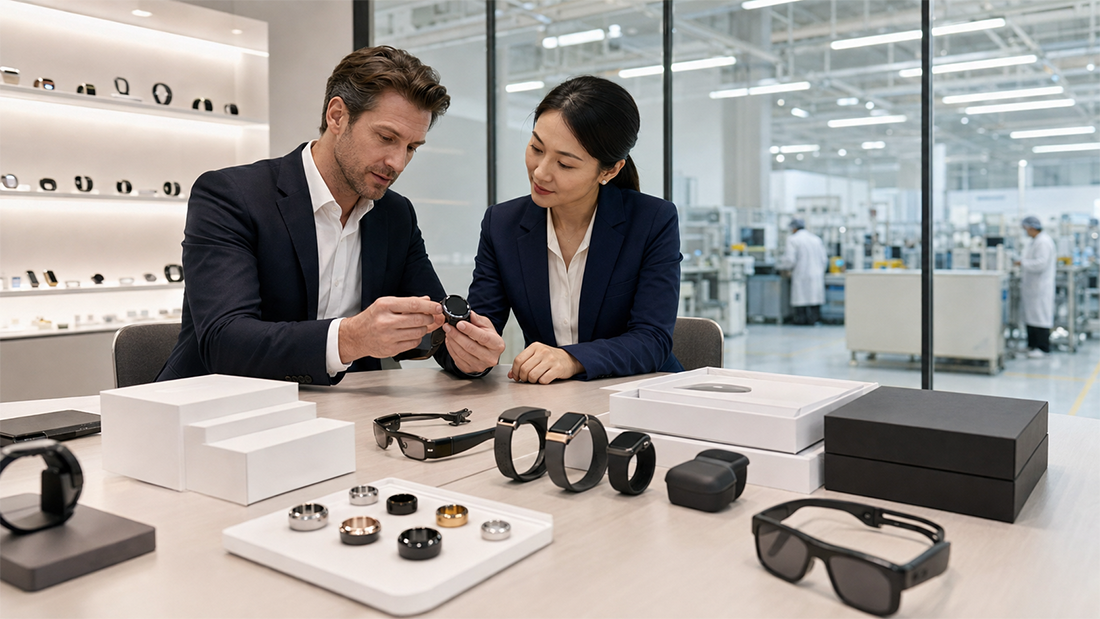
Planning a smart ring, smart watch, smart band, AI glasses, AI translator, or AI voice mouse project? Contact STAR KING to discuss product positioning, sample testing, customization scope, certification requirements, lead time, and quotation details.

Team Star King

Scan WhatsApp QR code