
AI smart glasses for education: AI Smart Glasses for UK EdTech: The 2026 Buyer’s Guide to OEM, Compliance, and Classroom Deployment
October 27, 2026 · Team Star King
AI Smart Glasses for UK Education: The 2026 Buyer’s Guide to OEM, Compliance, and Classroom Deployment
AI smart glasses for education are wearable devices that combine a camera, microphone, display or audio output, and on-device or cloud AI to support classroom capture, translation, accessibility, and hands-on learning. For UK edtech companies, sourcing them means choosing an OEM partner that can evidence UKCA/CE readiness, GDPR-aware data handling, classroom-grade durability, and a pilot path before mass production. This guide explains the seven sourcing steps UK education technology buyers should follow in 2026.
Table of Contents
Table of Contents
AI smart glasses for education: Short Answer
UK edtech buyers should source AI smart glasses for education through a structured OEM process: define the classroom use case, shortlist suppliers with verifiable compliance documentation, validate samples in a controlled school pilot, and only then scale. MOQ, UKCA/CE evidence, GDPR data-flow documentation, and firmware/API flexibility are the four factors most likely to decide whether a rollout succeeds.
Table of Contents
- Key Takeaways
- Key Facts for Buyers
- Step 1: Define the Classroom Use Case Before You Contact Suppliers
- Step 2: Evaluate AI Smart Glasses Suppliers, Not Consumer Listings
- Step 3: Choose the Right Engagement Model (OEM, ODM, or Private Label)
- Step 4: Understand MOQ and What Drives Unit Price
- Step 5: Plan Certification and UK Market Compliance
- Step 6: Run a Structured School Pilot with Sample Units
- Step 7: Plan Firmware, App, and Deployment Support
- OEM vs ODM vs Private Label: Comparison Table
- Common Mistakes and Buyer Red Flags
- Practical Buyer Checklist
- FAQ
- Conclusion
- Next Step with STAR KING
Key Takeaways
- AI smart glasses for education are still an emerging category in UK classrooms; buyers should validate before scaling.
- UKCA and CE marking, GDPR-compliant data flows, and battery transport documentation are the three compliance pillars to verify early.
- MOQ varies by model and customization depth; logo and packaging changes are usually easier to start with than firmware changes.
- A controlled pilot in 2–5 schools is the most reliable way to de-risk a larger order.
- OEM/ODM partners should be evaluated on documentation, not sales claims.
Key Facts for Buyers
| Factor | What UK Education Buyers Should Confirm |
|---|---|
| Product category | AI smart glasses with camera, audio, and optional display |
| Typical engagement models | OEM, ODM, private label |
| Compliance to clarify | UKCA, CE, RoHS, UN38.3, MSDS; scope depends on model and intended market |
| Data protection | GDPR/UK GDPR; data flow documentation; on-device vs cloud processing |
| MOQ | Depends on model and customization; often lower for logo/packaging than for firmware |
| Trial approach | 2–5 school pilot with sample units before mass production |
| Lead time drivers | Tooling, firmware changes, certification testing, and shipping method |

Step 1: Define the Classroom Use Case Before You Contact Suppliers
AI smart glasses for education can mean different things to different stakeholders. Before approaching an OEM, write down the specific educational problem the device should solve. Common UK use cases include:
- Language learning: real-time translation or captions for multilingual classrooms.
- Accessibility: audio or visual support for students with hearing or visual impairments.
- Hands-on STEM: first-person recording of lab or fieldwork without occupying hands.
- Teacher observation: structured lesson capture with clear consent and data-retention rules.
Each use case changes the specifications you need. Translation features may prioritize microphone quality and cloud language support; accessibility use may prioritize battery life and display readability; STEM recording may prioritize camera resolution and storage. Defining this first prevents a common sourcing error: buying a general-purpose device and later discovering it does not match classroom workflows.
Step 2: Evaluate AI Smart Glasses Suppliers, Not Consumer Listings
Consumer marketplaces list many AI smart glasses, but an education buyer needs a supplier that can support procurement, compliance, and after-sales. A useful first filter is documentation quality.
Documentation to request in the first supplier conversation
- Product specification sheet with model numbers and hardware versions.
- Available certification evidence—scope and status for UKCA, CE, RoHS, UN38.3, and MSDS.
- Battery details, including capacity, charging method, and transport documentation.
- Firmware update policy and whether a documented API or SDK exists.
- Warranty terms and spare-parts availability.
- Factory quality process description, including pre-shipment inspection.
You can evaluate whether a supplier is a manufacturer or a trading intermediary by asking about tooling ownership, firmware change capability, and production-line testing. For further context on how factory capability is typically verified, buyers may review the ISO 9001 quality management standard as a reference framework for what a mature quality process should look like.
STAR KING supports buyers who want to compare AI smart glasses configurations and OEM options for education deployments.
Step 3: Choose the Right Engagement Model (OEM, ODM, or Private Label)
The three models differ mainly in how much product definition you control and how much development cost you carry.
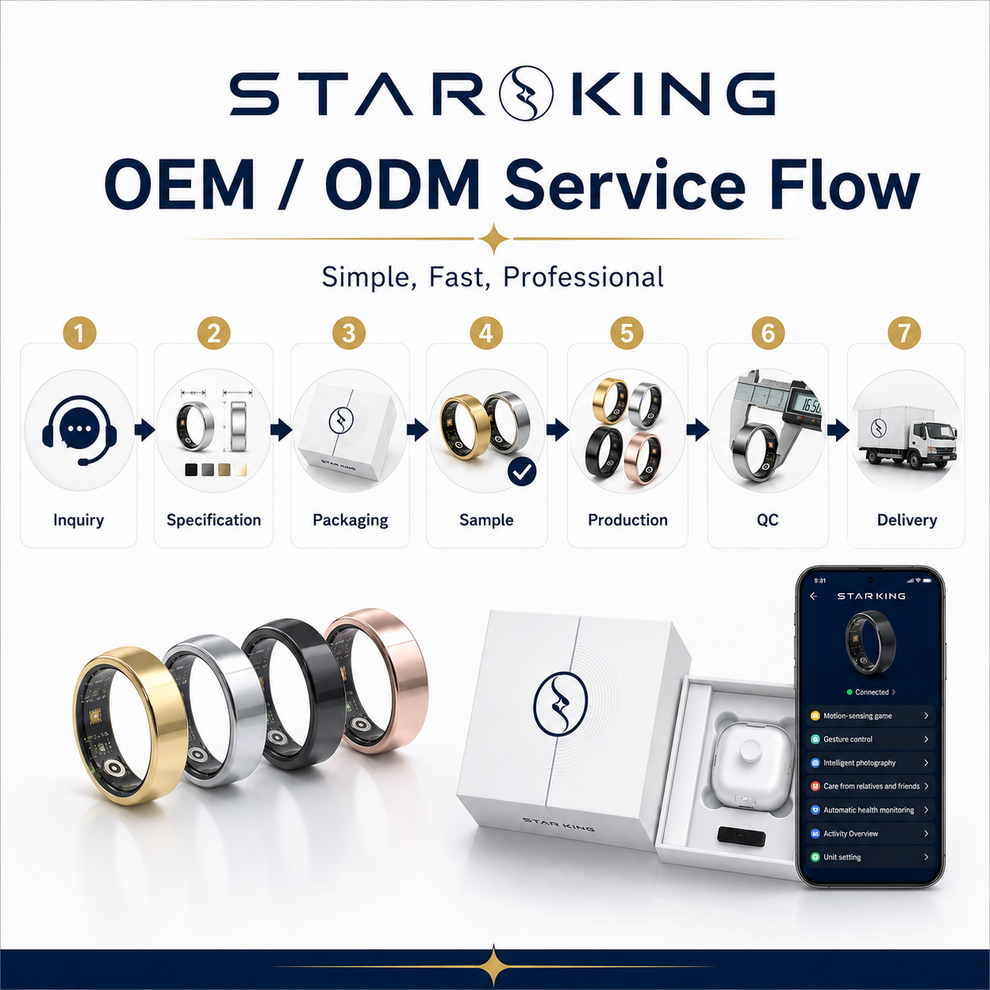
- Private label: You select an existing model and customize logo, packaging, and sometimes app branding. This is usually the fastest and lowest-cost route, but differentiation is limited.
- ODM: You select an existing platform and request modest changes—colorways, packaging, language packs, or app skin. This balances speed and customization.
- OEM: You define the product more fully, including enclosure, firmware behavior, app, and packaging. This carries higher tooling and validation effort but supports stronger differentiation.
For UK education technology companies, ODM and private label are often the pragmatic first step, with OEM following once classroom demand is validated. Buyers who want a deeper overview of these pathways can review STAR KING’s private label OEM/ODM solutions.
Step 4: Understand MOQ and What Drives Unit Price
MOQ is not a fixed number across the category. It typically depends on model, customization scope, and component availability. The table below summarizes typical drivers.
| Customization Area | Typical Impact on MOQ | Typical Impact on Unit Cost |
|---|---|---|
| Logo printing | Lower | Low |
| Packaging design | Lower–medium | Low–medium |
| App skin / brand colors | Medium | Medium |
| Firmware feature changes | Higher | Higher |
| Enclosure or hardware changes | Highest | Highest |
Buyers should also model landed cost, not just unit price. For UK imports, this includes freight, insurance, import VAT, customs duty where applicable, and any testing or relabeling. A supplier quote that appears lower may not remain lower after these costs are included. Education buyers should confirm [STAR KING TO CONFIRM: MOQ by model] and request a landed-cost worksheet before committing to volume.
Step 5: Plan Certification and UK Market Compliance
UK market requirements for AI smart glasses depend on the specific product configuration, radio modules, and intended use. Buyers should verify the following with their supplier and, where needed, a compliance consultant:
- UKCA / CE: Radio equipment placed on the UK market typically requires UKCA marking; CE may still be relevant for parallel EU distribution. The exact scope depends on the product.
- RoHS: Restricted substances requirements apply to electrical and electronic equipment.
- Battery transport: Lithium batteries often require UN38.3 test summaries and MSDS for shipping.
- Data protection: UK GDPR obligations apply if the device or companion app processes personal data, particularly camera and audio data.
Official references buyers can review include the UK Government UKCA marking guidance and the ICO UK GDPR guidance. Buyers should request certificate scope and issuing body information rather than accepting “certified” as a claim. Not every model carries every certification, and requirements may differ between the UK and other export markets.
Step 6: Run a Structured School Pilot with Sample Units
AI smart glasses for education should be proven in a controlled pilot before volume orders. A useful pilot structure includes:
- Sample units: request units matching the intended production configuration.
- Pilot sites: recruit 2–5 schools or colleges representing different age groups and classroom types.
- Test dimensions: battery life under realistic lesson use, comfort over a school day, translation or accessibility accuracy, connectivity, and teacher/student feedback.
- Data review: confirm what data the device and app collect, where it is processed, and how it is retained or deleted.
- Decision gate: define pass/fail criteria before the pilot starts, and document results.
This pilot is also the point where buyers should test the supplier’s responsiveness. A supplier that supports a small pilot well is more likely to support a larger rollout. Buyers can request sample terms through STAR KING’s sample request page; [STAR KING TO CONFIRM: sample lead time and pilot support terms].
Step 7: Plan Firmware, App, and Deployment Support
Deployment in schools often depends on software as much as hardware. Buyers should clarify:
- Whether firmware updates are delivered over the air and how often.
- Whether the companion app supports managed deployment or device management.
- Whether a documented API or SDK is available for integrating school platforms.
- What language packs and translation capabilities are supported.
- What warranty, repair, and spare-parts terms apply to education buyers.
These questions shape total cost of ownership. A device with limited firmware support may cost more over a multi-year school deployment than a higher-priced device with a documented update path. Buyers who want an overview of software and app customization can review the business and education solutions from STAR KING.
OEM vs ODM vs Private Label: Comparison Table
| Model | Your Control | Typical MOQ | Development Effort | Best For |
|---|---|---|---|---|
| Private Label | Branding, packaging | Lowest | Low | Fast market entry and initial pilot |
| ODM | Platform plus modest changes | Medium | Medium | Differentiation without full hardware development |
| OEM | Product and software definition | Highest | High | Long-term differentiated product lines |
Common Mistakes and Buyer Red Flags
Common mistakes
- Choosing a supplier based on unit price before checking landed cost and warranty.
- Treating a certification logo as evidence without reviewing certificate scope.
- Starting with a very large order instead of a pilot.
- Ignoring data protection documentation until after the pilot.
Buyer red flags
- Supplier is vague about which model is being quoted.
- No sample units available before a volume commitment.
- No documentation of battery transport requirements.
- Claims that all models are “certified” without stating which certification and for which market.
- Reluctance to provide a written warranty and after-sales process.
Practical Buyer Checklist
- ☐ Written classroom use case and pilot success criteria defined
- ☐ Supplier provides model-specific specification sheets
- ☐ Certification scope and status reviewed for UK market
- ☐ UK GDPR data flow reviewed with internal data protection lead
- ☐ MOQ and landed-cost worksheet received
- ☐ Sample units tested in at least two schools
- ☐ Firmware update policy and API availability confirmed
- ☐ Warranty and spare-parts terms documented
- ☐ Import VAT, duty, and shipping costs modeled
- ☐ Production timeline with buffer agreed in writing
FAQ
What should UK education buyers check before ordering AI smart glasses?
Confirm model-specific certification scope, UK GDPR data flows, battery transport documentation, warranty terms, and pilot results before placing a volume order.
Are AI smart glasses for education subject to UKCA marking?
Radio equipment placed on the UK market typically requires UKCA marking, but the exact scope depends on the product configuration and intended use. Buyers should verify with the supplier and, where needed, a compliance consultant.
What MOQ should a first-time buyer expect?
MOQ varies by model and customization depth. Logo and packaging changes usually require a lower MOQ than firmware or hardware changes. Education buyers should request MOQ in writing for the specific configuration.
How long does a pilot-style sample order usually take?
Sample lead times depend on model availability and any customization. Buyers should confirm lead time in writing before committing to a pilot schedule; [STAR KING TO CONFIRM: sample lead time].
Can private label branding be applied to AI smart glasses?
Yes, private label typically covers logo, packaging, and sometimes app branding. The scope depends on the supplier and model.
What should buyers ask about data protection?
Ask what data the device and app collect, whether processing occurs on-device or in the cloud, where data is stored, and how retention and deletion are handled under UK GDPR.
How do education buyers plan for warranty and repairs?
Request written warranty terms, spare-parts availability, and a repair or replacement process that matches the deployment length for schools.
Conclusion
AI smart glasses for education are a promising but still-developing category for UK edtech companies. The buyers who succeed will be those who define a clear classroom use case, verify compliance documentation, run a controlled pilot, and choose an OEM partner that supports firmware and after-sales needs. Starting with private label or ODM and moving to OEM once demand is validated is a common and pragmatic path. For more procurement context, see the STAR KING resources blog.
Next Step with STAR KING
If you are preparing a pilot or planning an OEM/ODM project for AI smart glasses in education, request product samples and share your classroom use case. STAR KING can help you compare configurations and confirm customization scope for your target market.
Discuss Your Smart Wearable OEM/ODM Project
Planning a smart ring, smart watch, smart band, AI glasses, AI translator, or AI voice mouse project? Contact STAR KING to discuss product positioning, sample testing, customization scope, certification requirements, lead time, and quotation details.

Team Star King

Scan WhatsApp QR code
Leave a Reply