
smart watches sourcing: 9 Critical Checks for Distributors Sourcing Smart Watches for the US Market in 2026
November 16, 2026 · Team Star King
9 Critical Checks for Distributors Sourcing Smart Watches for the US Market in 2026
Smart watches sourcing for US distribution comes down to nine verifiable checks: FCC authorization, battery certification for air freight, a written quality plan, MOQ and landed-cost math, firmware and app support, packaging and private-label terms, warranty and spare-parts policy, tooling and IP ownership, and realistic lead-time planning. Distributors who confirm these before issuing a purchase order reduce customs holds, returns and margin surprises. This guide explains each check, what evidence to request, and the red flags that should pause a deal.
Table of Contents
Table of Contents
smart watches sourcing: Table of Contents
- Short Answer
- Key Takeaways
- Key Facts for Buyers
- Check 1: FCC and US Compliance
- Check 2: Battery and Air Freight Rules
- Check 3: Quality Control and Test Reports
- Check 4: MOQ, Pricing and Landed Cost
- Check 5: Firmware, App and Data Support
- Check 6: Packaging and Private-Label Customization
- Check 7: Warranty and Spare Parts
- Check 8: Tooling, IP and Exclusivity
- Check 9: Lead Time and Production Planning
- Comparison Table: Supplier Profiles
- Common Mistakes and Buyer Red Flags
- Practical Buyer Checklist
- FAQ
- Conclusion

Short Answer
US distributors buying smart watches should require FCC equipment authorization, UN38.3 and MSDS battery documentation, a documented QC process, and clear OEM/private-label terms in writing. Confirm MOQ, landed cost including duties and tariffs, app support lifecycle, and warranty coverage before placing a purchase order. Most problems trace back to unverified supplier claims, not product design.
Key Takeaways
- FCC authorization is not optional for US distribution; request the FCC ID and verify it in the public database.
- Lithium battery shipping requires UN38.3 test summaries and MSDS; air freight rules differ from ocean freight.
- Landed cost is the only reliable pricing number; ask for FOB, freight, duty and tariff assumptions.
- MOQ should be tied to a written prototype and pilot-batch plan, not a verbal promise.
- Warranty terms and spare-parts availability must be agreed before the first mass-production run.
Key Facts for Buyers
| Item | Typical Expectation | What to Verify |
|---|---|---|
| FCC authorization | Required for US sale | FCC ID and grantee record |
| Battery documents | UN38.3 summary and MSDS | Latest test date and model match |
| MOQ | Varies by model and customization | Written quotation with SKU-level MOQ |
| Sample lead time | Usually 1-3 weeks for stock models | Confirmed schedule with deposit date |
| Mass production | Usually 4-8 weeks after sample approval | Production plan and QC gates |
| Warranty | Typically 12 months, varies by supplier | Written policy and RMA process |
| App support | Ongoing firmware and app updates | Support roadmap and data terms |
Check 1: FCC and US Compliance
Smart watches contain Bluetooth and often Wi-Fi radios, which places them under FCC equipment authorization rules for the US market. The FCC’s equipment authorization framework explains the paths for certification and the supplier’s obligations. Distributors should not accept “FCC ready” as a substitute for a grantee record. Request the FCC ID, confirm the grantee name matches the manufacturer, and look up the record in the FCC database before committing volume.
What to request
- FCC ID and grantee contact information.
- Test report summary covering the radio modules in the exact SKU.
- Written statement that the SKU you are buying is covered by the authorization.
Certification requirements depend on the final product configuration and the markets you serve. A model sold in the US may not carry the same markings as one sold in the EU. Buyers should verify requirements with a compliance consultant or the relevant authority.
Check 2: Battery and Air Freight Rules
Smart watches ship with lithium-ion or lithium-polymer cells. Air transport of lithium batteries is governed by the ICAO Technical Instructions and IATA Dangerous Goods Regulations, with additional US requirements from the FAA hazardous materials rules. Distributors should request a UN38.3 test summary and a current MSDS for the exact battery model, then confirm with the freight forwarder whether the shipment qualifies for air cargo.
Documents to collect
- UN38.3 test summary covering the battery used in the SKU.
- MSDS with a date that matches the current cell supplier.
- Battery safety test report and pack configuration details.
Do not assume a supplier’s battery documents apply across all models. A substitution during production can invalidate shipping documentation and create a customs or carrier dispute.
Check 3: Quality Control and Test Reports
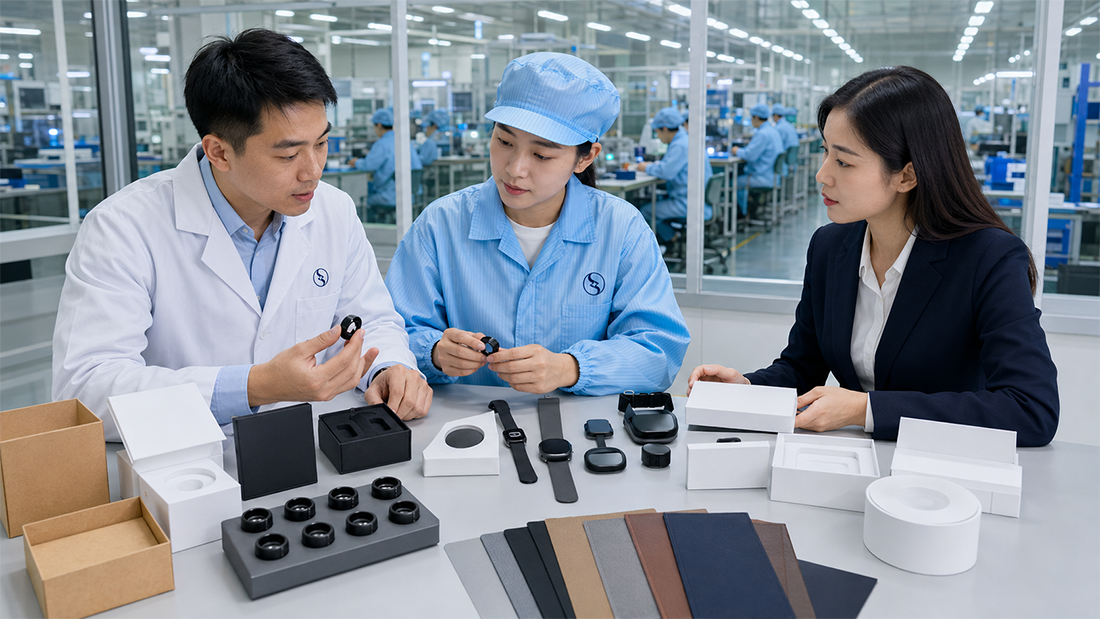
Quality control for smart watches covers incoming component checks, in-process assembly checks, functional testing, aging, drop testing and waterproof testing where the product claims a rating. Ask for the supplier’s QC process flow and the acceptance criteria for each gate. A written plan with named checkpoints is more useful than a certificate alone.
Evidence to request
- QC flow chart with incoming, in-process and final inspection steps.
- Pre-shipment inspection scope and who performs it.
- Test reports for drop, waterproof and aging, with the exact SKU and test conditions.
Third-party inspection before shipment is common for distributor orders and can be arranged through inspection firms. Confirm who pays, what AQL level applies, and how defects are resolved.
If your catalog also includes other wearable formats, the same QC logic applies; see our smart watches product line for reference specifications.
Check 4: MOQ, Pricing and Landed Cost
MOQ for smart watches typically depends on the model, the level of customization and whether the tooling is shared or dedicated. Distributors should ask for SKU-level MOQ in writing, then build a landed-cost model that includes FOB price, freight, insurance, duty and any applicable tariffs. The Harmonized Tariff Schedule is the reference for US duty classification; classification depends on product features and should be confirmed with a customs broker.
Landed-cost inputs
- FOB price at the agreed MOQ.
- Freight and insurance estimates for air and ocean.
- Duty rate and any trade-program measures.
- Inspection, labeling and warehousing costs.
Distributors often compare suppliers on unit price alone. A lower unit price with weaker documentation can cost more after customs delays, returns and chargebacks.
Check 5: Firmware, App and Data Support
Smart watches depend on companion apps and firmware updates. Before ordering, ask who maintains the app, how often firmware is updated, and what happens if the app is discontinued. For private-label buyers, app customization may be available but terms vary. Data handling should be documented, especially if the watch collects health-related metrics.
Questions to ask
- Which app is used, and is it shared with other brands?
- What is the firmware update cadence?
- Are health metrics presented as wellness data rather than medical claims?
- What data is stored, and where?
Consumer health features such as heart rate or blood oxygen tracking are wellness features and should not be marketed as diagnostic tools. Buyers should confirm marketing language matches the product’s actual claims.
Check 6: Packaging and Private-Label Customization
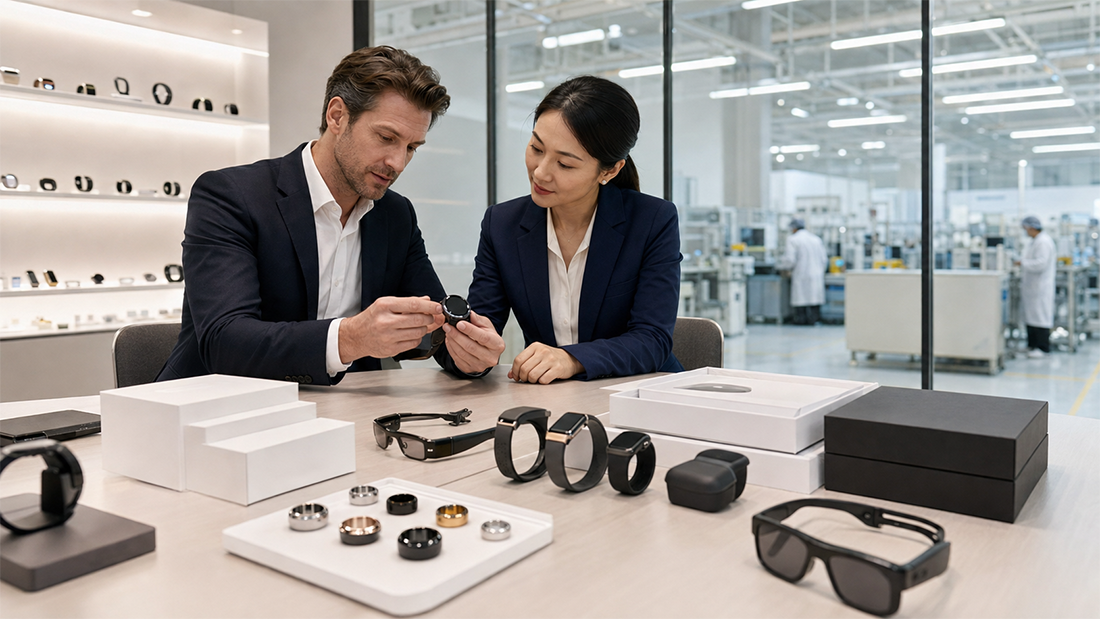
Private-label programs vary by supplier. Logo customization, packaging design, manual localization and retail-ready packaging are common requests for US distributors. Ask what is included at the base MOQ and what triggers additional tooling or setup fees. Packaging customization affects lead time and should be scheduled before production.
Customization items to confirm
- Logo printing method and placement.
- Retail box design and artwork approval process.
- User manual language and FCC statement placement.
- Serial number and barcode labeling.
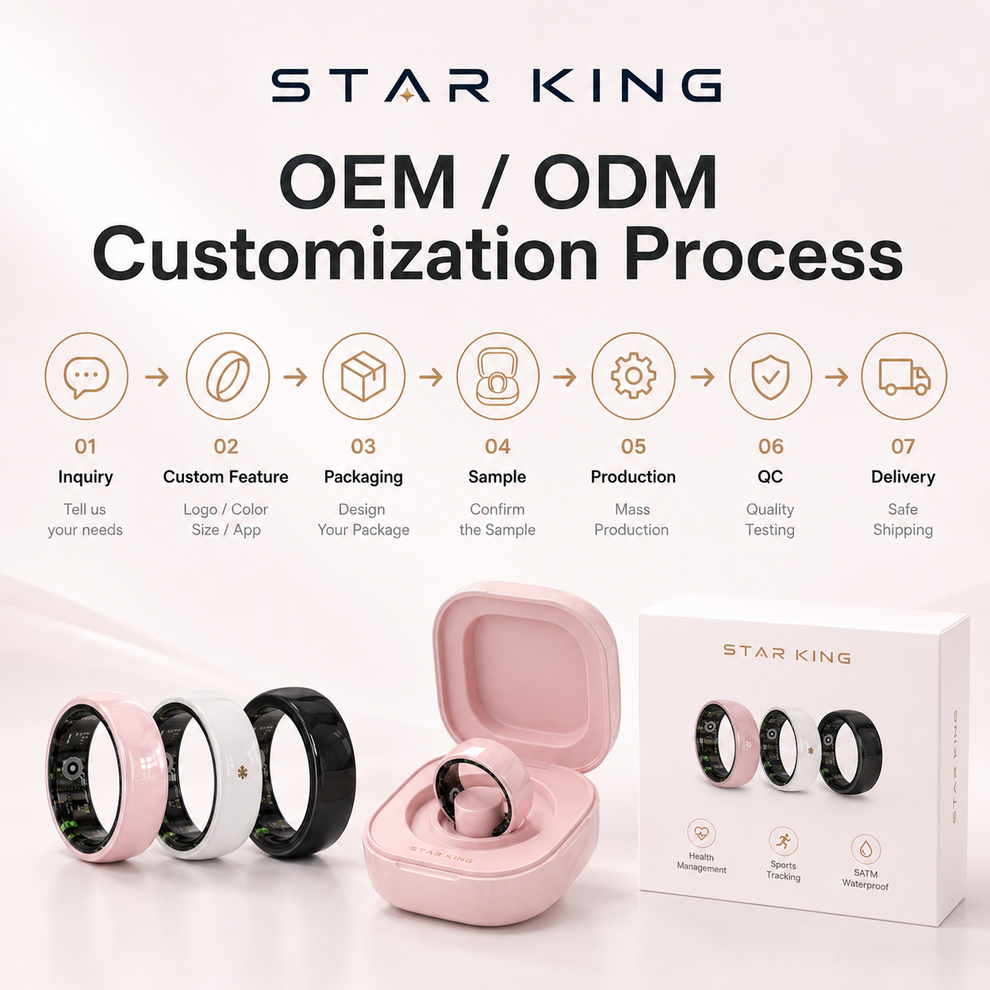
For buyers building a broader wearable assortment, our private label OEM/ODM solutions page outlines the customization workflow.
Check 7: Warranty and Spare Parts
Warranty policy and spare-parts availability affect return costs and customer satisfaction. Ask for the written warranty period, what is covered, and how RMA is handled. Distributors should also confirm whether replacement straps, chargers and screens are available after the initial order.
Warranty checklist
- Warranty length and coverage terms.
- RMA process and who pays return freight.
- Spare-parts availability window.
- Defect rate threshold for replacement or credit.
Check 8: Tooling, IP and Exclusivity
If you invest in tooling or custom design, confirm ownership in writing. Tooling ownership, mold storage and transfer terms should be documented. For private-label designs, ask whether the supplier sells the same design to other buyers and under what terms. Exclusivity is rarely free and usually tied to volume commitments.
Documents to request
- Tooling ownership clause and mold maintenance terms.
- Design ownership and IP indemnity language.
- Exclusivity terms, if offered, with volume conditions.
Check 9: Lead Time and Production Planning
Lead time depends on sample approval, component availability, customization and shipping method. Ask for a production schedule with milestones, then plan retail commitments around realistic dates. Air freight is faster but constrained by battery shipping rules; ocean freight is slower but usually more economical for larger volumes.
Planning questions
- What is the sample lead time for stock and custom models?
- What is the mass-production lead time after deposit and artwork approval?
- How are delays communicated, and what remedies apply?
Distributors introducing a new wearable line can review the health and fitness wearables solution for application context when positioning products to retail buyers.
Comparison Table: Supplier Profiles
| Profile | Strengths | Risks | Best Fit |
|---|---|---|---|
| Trading company | Wide catalog, flexible MOQ | Limited control over production and documentation | Small trial orders |
| OEM/ODM manufacturer | Customization, engineering support | Higher MOQ, longer setup | Private-label programs |
| Brand-owned factory | Consistent quality systems | Less flexible on design changes | Volume distribution |
Common Mistakes and Buyer Red Flags
- Accepting a screenshot of an FCC certificate without verifying the FCC ID.
- Ordering without a written QC plan or pre-shipment inspection scope.
- Comparing FOB prices without building a landed-cost model.
- Assuming battery documents cover every model in the catalog.
- Relying on verbal promises about app support or spare parts.
- Signing tooling agreements without ownership language.
- Marketing wellness metrics as medical diagnoses.
Practical Buyer Checklist
| Area | Document or Action | Status |
|---|---|---|
| FCC | Verify FCC ID in public database | ☐ |
| Battery | Obtain UN38.3 summary and MSDS | ☐ |
| QC | Review QC flow and inspection scope | ☐ |
| Pricing | Build landed-cost model | ☐ |
| App | Confirm support lifecycle | ☐ |
| Packaging | Approve artwork and manual | ☐ |
| Warranty | Review written policy | ☐ |
| Tooling | Confirm ownership terms | ☐ |
| Lead time | Agree milestone schedule | ☐ |
FAQ
Do smart watches need FCC certification for US distribution?
Smart watches with Bluetooth or Wi-Fi radios typically require FCC equipment authorization before US sale. Distributors should verify the FCC ID in the public database and confirm the authorized model matches the SKU they are buying.
What is a realistic MOQ for private-label smart watches?
MOQ varies by model, customization and tooling. Stock models may have lower MOQ than fully customized designs. Ask for SKU-level MOQ in writing and tie the first order to a prototype and pilot-batch plan.
Can smart watches ship by air from China to the US?
Lithium battery products can ship by air when documentation and packaging meet carrier and regulatory requirements. Provide UN38.3 and MSDS documents to your forwarder and confirm acceptance before booking.
How do distributors calculate landed cost for smart watches?
Add FOB price, freight, insurance, duty and any applicable tariffs, then include inspection, labeling and warehousing costs. Confirm HTS classification with a customs broker because classification depends on product features.
What warranty terms are common for wholesale smart watches?
Warranty periods vary by supplier, often around 12 months. Confirm what is covered, the RMA process, who pays return freight and the defect threshold for credit or replacement.
Who owns the tooling for a custom smart watch design?
Tooling ownership should be documented before production. If you fund the tooling, request a written clause covering ownership, maintenance and transfer terms.
Conclusion
Smart watches sourcing for US distribution is a documentation and verification exercise as much as a pricing exercise. Distributors who confirm FCC authorization, battery documents, QC plans, landed cost, app support, customization terms, warranty, tooling ownership and lead times before ordering reduce customs holds, returns and margin surprises. The nine checks in this guide can be run in sequence before any purchase order is issued.
Primary CTA: Request a quotation for smart watches and discuss your distribution requirements, including FCC documentation, MOQ and customization options, with the STAR KING team.
Request a Smart Watch Quotation
Discuss Your Smart Wearable OEM/ODM Project
Planning a smart ring, smart watch, smart band, AI glasses, AI translator, or AI voice mouse project? Contact STAR KING to discuss product positioning, sample testing, customization scope, certification requirements, lead time, and quotation details.

Team Star King

Scan WhatsApp QR code
Leave a Reply