
smart bands RFQ: Smart Bands for EU E-Commerce: 10 RFQ Checks Before You Commit in 2026
October 26, 2026 · Team Star King

Smart Bands for EU E-Commerce: 10 RFQ Checks Before You Commit in 2026
A smart bands RFQ should confirm the exact SKU specification, app and firmware ownership, CE/RoHS/REACH and battery documentation, MOQ tiers, sample testing plan, and landed cost before you commit to a purchase order. For EU e-commerce sellers, the RFQ is the last low-cost checkpoint before tooling, packaging, and certification costs become difficult to reverse. This guide gives you 10 practical checks, a decision table, and a buyer checklist you can send to any smart band supplier.
Table of Contents
Table of Contents
smart bands RFQ: Short Answer
A strong smart bands RFQ answers five questions in writing: what hardware and firmware you are buying, which EU compliance documents apply to that exact configuration, how samples will be tested, what the MOQ and lead time look like by tier, and who owns the app, tooling, and brand assets. If a supplier cannot answer these in the quotation stage, treat it as a procurement risk rather than a price opportunity.

Table of Contents
- Why the RFQ stage decides EU e-commerce margins
- Key Takeaways
- Key Facts for Buyers
- 1. Lock the SKU specification before comparing prices
- 2. Confirm the app, firmware, and data model
- 3. Request EU compliance documents for the exact configuration
- 4. Verify battery safety and transport documentation
- 5. Agree on a sample testing and validation plan
- 6. Map MOQ tiers against your sell-through forecast
- 7. Calculate landed cost, not unit price
- 8. Plan lead time, replenishment, and safety stock
- 9. Confirm packaging, branding, and IP ownership
- 10. Review warranty, spare parts, and after-sales terms
- Comparison table: RFQ maturity by supplier type
- Common Mistakes and Buyer Red Flags
- Practical Buyer Checklist
- FAQ
- Conclusion

Key Takeaways
- The RFQ is a specification and risk document, not only a price request.
- EU compliance depends on the exact SKU configuration, including radio, battery, and app data flows.
- App and firmware ownership affects long-term brand value and switching costs.
- Landed cost, MOQ tiers, and lead time planning usually matter more than quoted unit price.
- A written sample test plan protects both the buyer and the supplier before mass production.
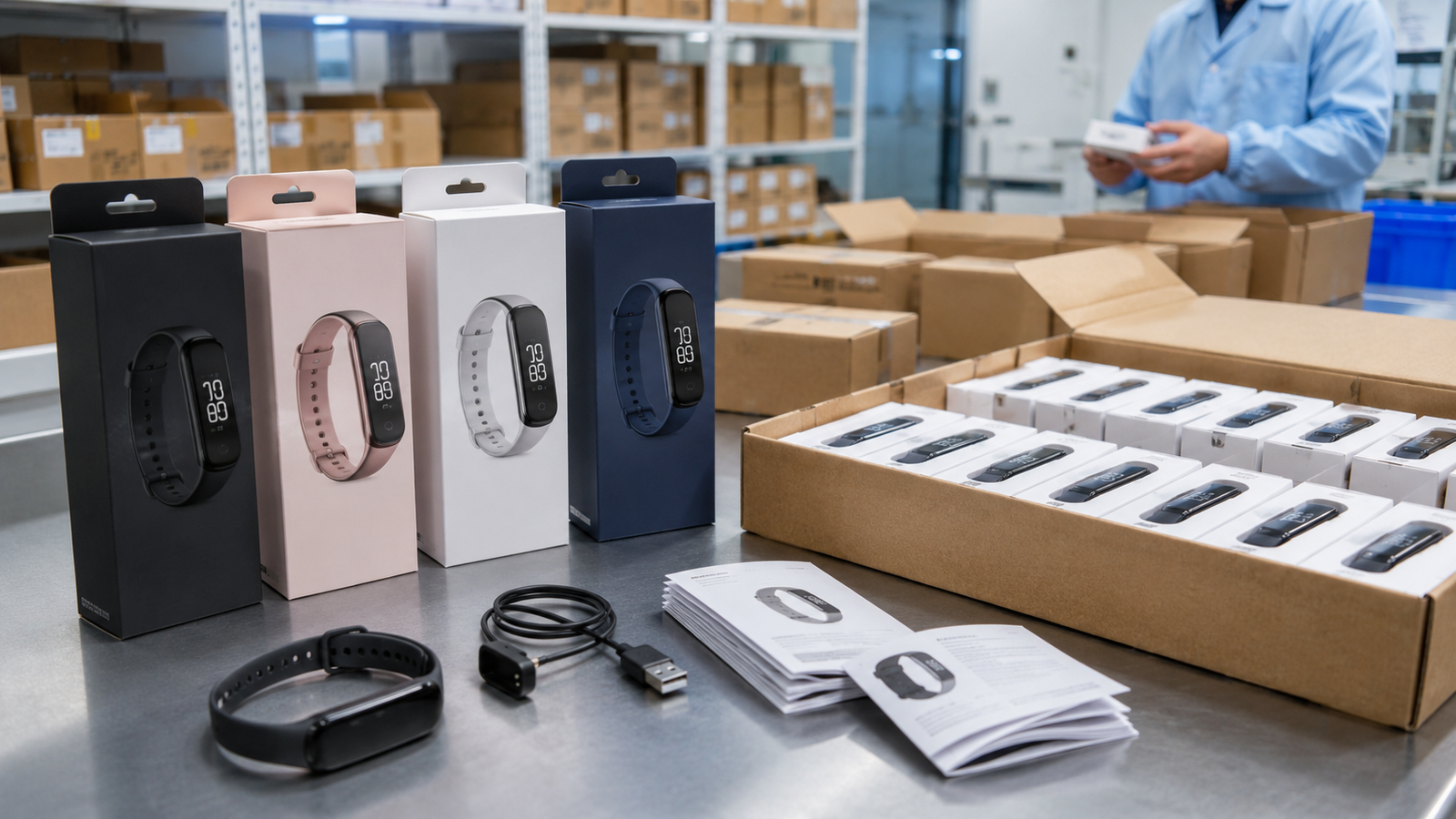
Key Facts for Buyers
| RFQ Item | What to Request | Why It Matters for EU E-Commerce |
|---|---|---|
| SKU specification | Model number, sensor list, display, battery, water resistance rating | Prevents comparing different products on price alone |
| Compliance documents | CE, RoHS, REACH, WEEE, battery documentation | Marketplace and customs checks may require these |
| Battery transport | UN38.3 test summary, MSDS, packing instructions | Affects air freight and courier acceptance |
| App and firmware | App ownership, update policy, data hosting, SDK/API options | Affects GDPR planning and brand control |
| Sample plan | Golden sample, test checklist, approval sign-off | Reduces mass-production mismatch risk |
| MOQ | MOQ per color, per packaging, per customization | Impacts cash flow and warehouse planning |
| Lead time | Sample lead time, production lead time, peak-season capacity | Supports launch dates and replenishment |
| Landed cost | FOB price, freight, duty, VAT, packaging, certification cost | Determines real gross margin |
| Warranty | Warranty period, DOA policy, spare parts | Protects marketplace ratings and returns budget |

Why the RFQ stage decides EU e-commerce margins
Most e-commerce sellers treat the RFQ as a price-collection exercise. In practice, it is the stage where product, compliance, and supply assumptions are fixed. Once a supplier starts tooling, packaging, and certification work for your brand, changing the sensor set or battery capacity becomes expensive. A written RFQ protects your margin because it forces both sides to confirm the same product and the same responsibilities before money moves.
EU e-commerce adds a second layer: compliance and data obligations. Radio equipment, batteries, packaging, and the app behind the wearable can each create obligations that vary by product configuration and by country. Buyers should verify applicable requirements with the supplier and, where needed, with a compliance lab or legal advisor. The RFQ should collect evidence, not assurances.
If you are evaluating smart bands alongside other wearables, the same sourcing logic applies to smart watches and smart rings. Comparing the RFQ quality across product categories often reveals which supplier is genuinely organized for OEM work.
1. Lock the SKU specification before comparing prices
Two quotations for a “smart band” can describe very different products. Before price comparison, ask each supplier to quote a named SKU with a fixed specification sheet. The sheet should list display type and size, sensor set, battery capacity, charging method, water resistance rating, supported Bluetooth version, app name, and language support.
What belongs in the specification sheet
- Model number and hardware revision
- Display type, size, and resolution
- Sensor list: heart rate, blood oxygen, accelerometer, and any others
- Battery capacity, charging method, and stated battery life test conditions
- Water resistance rating and test method
- Bluetooth version and companion app requirements
- Supported languages and firmware version
Ask the supplier to state whether health readings are wellness features or medical functions. For EU e-commerce, avoid marketing language that implies diagnosis unless the product and claims have been reviewed for the applicable regulatory framework. Buyers should verify claims with the supplier and local advisors.
2. Confirm the app, firmware, and data model
The companion app is part of the product. In the RFQ, ask who owns the app, whether it is a white-label app shared across customers, and how firmware updates are delivered. If you plan a private-label brand, ask whether the app can carry your brand name, icon, and onboarding screens, and whether user data is hosted in a region compatible with your GDPR planning.
Questions to put in writing
- Is the app developed and maintained by the supplier or a third party?
- Can the app name, icon, and store listing be customized for our brand?
- Where is user data stored, and what data processing terms are available?
- Is there an SDK or API for future integration with our systems?
- What is the firmware update policy and end-of-support plan?
For sellers building a long-term brand, app ownership is a strategic issue. A shared app can reduce launch cost, but it may limit differentiation. A custom app increases development cost and timeline but gives more control. The right choice depends on your channel strategy and budget. If you are also considering AI office hardware, the same ownership questions appear in AI voice mouse projects.
To discuss app, firmware, and branding options in more detail, you can review the private label OEM/ODM solutions page before finalizing your RFQ.
3. Request EU compliance documents for the exact configuration
EU market requirements depend on the product configuration and the seller’s role in the supply chain. For radio-enabled wearables, CE marking is typically relevant, and RoHS and REACH may also apply. Batteries, packaging, and electronic waste can introduce additional obligations. The RFQ should ask for documents that match the exact SKU, not generic certificates for a different model.
Documents to request
- EU Declaration of Conformity for the exact model, if available
- Test reports supporting CE, RoHS, and REACH claims
- WEEE registration information where applicable
- Packaging and battery labeling information
- Safety data sheet and battery transport documents
Buyers should verify that the model number on the certificate matches the quotation and the packaging. Sellers remain responsible for the claims they make on marketplaces. Official references such as the European Commission CE marking page and the Bluetooth SIG declaration process can help you frame compliance questions, but they do not replace local legal advice.
Certification cost and timeline depend on the product, the test lab, and whether modifications are needed. A supplier that offers a ready certificate for a stock model may reduce time to market, but you should confirm that the certificate covers your exact configuration, packaging, and brand arrangement.
4. Verify battery safety and transport documentation
Smart bands contain lithium batteries, so transport documentation matters. Ask for the UN38.3 test summary, MSDS, and packing instructions for the battery used in the quoted SKU. These documents are commonly requested by air carriers and couriers, and they should be available before you book freight.
Battery questions for the RFQ
- What battery cell and capacity are used in the quoted SKU?
- Are UN38.3 and MSDS documents available for that battery?
- What is the recommended state of charge for transport?
- What packaging and labeling are used for battery-containing products?
- How is battery aging tested before shipment?
Battery safety also affects product quality. Ask how the supplier tests charging, over-discharge, and aging. Testing protocols should be documented, and the RFQ should state which tests are performed on every batch versus during design validation. Buyers can review general battery guidance from authorities such as the FAA lithium battery guidance for transport context, while confirming shipment-specific requirements with their freight forwarder.
5. Agree on a sample testing and validation plan
Samples are not only for evaluating look and feel. They are the reference for mass production. In the RFQ, propose a sample plan that includes a golden sample, a written test checklist, and a sign-off process. The checklist should cover pairing, app setup, sensor accuracy under defined conditions, battery life, charging, water resistance, and packaging integrity.
Sample plan steps
- Request pre-production samples from the quoted SKU.
- Test pairing, app onboarding, and firmware update.
- Run a defined battery life test and record conditions.
- Check water resistance according to the stated rating.
- Review packaging, labels, and manuals for your market.
- Approve a golden sample and keep it as the production reference.
- Agree on how deviations will be handled.
If you need to compare form factors, you can also review smart bands product options and discuss sample availability with the supplier. A sample plan should be part of the RFQ response, not a separate favor after quotation.
6. Map MOQ tiers against your sell-through forecast
MOQ is rarely a single number. It can differ by color, packaging, logo customization, and app branding. The RFQ should ask for a MOQ matrix so you can see the cost impact of each customization. A low headline MOQ may exclude custom packaging or a custom app, which can change your launch plan.
How to structure the MOQ request
- MOQ per stock color and per stock packaging
- MOQ with custom logo on the band or case
- MOQ with custom retail packaging
- MOQ with custom app branding
- Price breaks at higher volumes
For e-commerce sellers, MOQ should be balanced against sell-through. A larger order may lower unit cost but increase inventory risk and storage cost. If you are launching a new brand, consider a smaller first order with stock packaging, then move to custom packaging once sales data is available. The smart retail and e-commerce solutions page can help frame channel requirements.
7. Calculate landed cost, not unit price
The quotation price is only one component of landed cost. The RFQ should request enough detail to estimate freight, duty, VAT, packaging, certification, and returns. For EU e-commerce, VAT and duty treatment can vary by shipment model, so sellers should confirm with their tax advisor and customs broker.
Landed cost components
- Unit price at the agreed Incoterm
- Freight and insurance
- Import duty and VAT
- Packaging and customization cost
- Compliance testing cost, where applicable
- Warehouse and fulfillment cost
- Expected return and warranty reserve
Ask the supplier to confirm the Incoterm and what is included. FOB and DDP quotations are not directly comparable. A slightly higher unit price with clear documentation and stable lead time may produce a better landed cost than a lower price with unclear compliance and freight assumptions.
8. Plan lead time, replenishment, and safety stock
Lead time is a planning input, not a single promise. The RFQ should separate sample lead time, production lead time, and peak-season capacity. If you sell through marketplaces, late replenishment can affect listing performance and advertising efficiency.
Lead time questions
- What is the sample lead time for the quoted SKU?
- What is the production lead time by MOQ tier?
- How does lead time change for custom packaging or logo?
- What is the production capacity during peak season?
- How much safety stock should the buyer plan?
A supplier that shares realistic lead time ranges and constraints is easier to plan with than one that promises a short lead time for every configuration. Buyers should also plan a buffer for compliance reviews and freight delays.
9. Confirm packaging, branding, and IP ownership
Private-label projects need clear ownership terms. The RFQ should state who owns the product design, tooling, packaging artwork, and app branding. If the supplier uses shared tooling for stock models, custom enclosure changes may require new tooling investment and a longer timeline.
IP and branding questions
- Who owns the mold and tooling for custom enclosures?
- Can we receive written confirmation of tooling ownership and transfer terms?
- Who owns the packaging artwork and product photography?
- Can the supplier sell the same custom design to other buyers?
- What is the process for brand asset approval?
Written terms reduce disputes later. For brand-led sellers, a clear IP clause can be as important as a lower unit price. If your project includes multiple product types, such as AI translators, apply the same ownership checklist.
10. Review warranty, spare parts, and after-sales terms
The RFQ should define warranty terms, DOA handling, and spare parts availability. E-commerce returns are a real cost, and unclear after-sales terms can turn a good launch into an expensive one. Ask for the warranty period, what is covered, and how replacement parts are supplied.
After-sales checklist
- Warranty period and covered defects
- DOA policy and replacement process
- Spare parts availability and lead time
- Repair or replacement responsibility by region
- Technical support channel for customer service teams
For sellers targeting health and fitness buyers, after-sales support should include guidance on app setup and sensor use. The fitness tracking application page shows how use cases can shape support content.
Comparison table: RFQ maturity by supplier type
| Supplier Type | Typical Strength | RFQ Risk to Check | Best Fit |
|---|---|---|---|
| Trading company | Wide product range and fast quotation | Limited control over firmware and production changes | Small test orders and stock models |
| OEM factory | Customization and production control | MOQ and tooling investment may be higher | Private-label brands with a clear product plan |
| ODM factory | Ready designs with customization options | App ownership and differentiation may be shared | Sellers who need speed to market |
| Brand owner | Established product and support | Less flexibility on hardware changes | Distributors and retail chains |
Common Mistakes and Buyer Red Flags
Common mistakes
- Comparing quotations without a fixed SKU specification
- Accepting certificates that list a different model number
- Ignoring app ownership and data hosting until after launch
- Planning inventory on unit price without landed cost
- Assuming the headline MOQ applies to custom packaging
- Leaving warranty and DOA terms verbal
Buyer red flags
- The supplier cannot provide a specification sheet for the quoted model
- Compliance documents are generic or undated
- The app is described only as “free app” without ownership details
- Lead time is promised as a single number for every configuration
- MOQ changes after the quotation is issued
- The supplier avoids written warranty and spare parts terms
Practical Buyer Checklist
- Fixed SKU specification sheet received and reviewed
- Model number on compliance documents matches the quotation
- CE, RoHS, REACH, and WEEE documents requested where applicable
- UN38.3 and MSDS available for the quoted battery
- App name, data hosting, and update policy confirmed
- Sample test plan and golden sample approval process agreed
- MOQ matrix by color, packaging, and customization received
- Landed cost estimate completed with freight, duty, and VAT
- Lead time by tier and peak-season capacity discussed
- Tooling, artwork, and app ownership terms in writing
- Warranty, DOA, and spare parts terms documented
- Incoterm and payment terms confirmed
If you are preparing a comparison with higher-end wearables, the health and fitness wearables solutions page and the resources blog can help you align product positioning with procurement requirements.
FAQ
What should a smart bands RFQ include?
Include the SKU specification, target market, estimated order quantity, customization needs, required compliance documents, sample requirements, packaging needs, and requested Incoterm. A written RFQ makes supplier responses comparable.
Which certifications are needed for smart bands sold in the EU?
Requirements depend on the product configuration. CE marking, RoHS, REACH, WEEE, and battery-related obligations may apply. Buyers should request documents for the exact SKU and verify requirements with a compliance advisor.
How do I verify that a supplier’s certificate covers my product?
Check that the model number, manufacturer, and product description on the certificate match the quotation and packaging. Ask for the full report, not only a certificate image, and confirm the issuing lab.
What MOQ should I expect for private-label smart bands?
MOQ varies by supplier, model, color, packaging, and app branding. Request a MOQ matrix so you can compare the cost of each customization step rather than a single headline number.
How long does sampling and production take?
Sample lead time and production lead time should be quoted separately. Custom packaging, logo, or app branding can add time. Ask for peak-season capacity and plan safety stock before launch.
Can I use my own app with a smart band?
Some suppliers offer SDK or API access, while others provide a white-label app. App ownership, data hosting, and update policies should be confirmed in writing before the order.
How should I compare landed cost between suppliers?
Compare unit price, Incoterm, freight, duty, VAT, packaging, certification cost, and warranty reserve. A lower unit price can have a higher landed cost if documentation or freight assumptions are unclear.
Conclusion
A smart bands RFQ is a decision document. For EU e-commerce sellers, the safest path is to fix the SKU, collect compliance evidence for that exact configuration, test samples against a written plan, and compare landed cost rather than unit price alone. Suppliers that answer RFQ questions with documents and written terms are easier to scale with than suppliers that answer with assurances.
Use the checklist above before you move from RFQ to purchase order. It will not remove every risk, but it will make the risks visible while they are still inexpensive to manage.
STAR KING CTA
Ready to compare smart band options for your EU e-commerce channel? Request a quotation with your target specifications, order quantity, and packaging requirements. STAR KING can review customization options and confirm which documentation is available for your chosen configuration.
Discuss Your Smart Wearable OEM/ODM Project
Planning a smart ring, smart watch, smart band, AI glasses, AI translator, or AI voice mouse project? Contact STAR KING to discuss product positioning, sample testing, customization scope, certification requirements, lead time, and quotation details.

Team Star King

Scan WhatsApp QR code
Leave a Reply