
smart ring OEM: 7 Smart Ring OEM Steps for Startup Brands: The 2026 Sourcing and RFQ Guide
October 3, 2026 · Team Star King

7 Smart Ring OEM Steps for Startup Brands: The 2026 Sourcing and RFQ Guide
Smart ring OEM is the process of contracting a manufacturer to produce smart rings under your own brand, using either a ready platform (OEM), a modified design with your branding and app (ODM), or a fully custom device (private label). For startup brands, the fastest path is usually a proven ODM platform with custom logo, packaging, app branding and firmware settings, quoted as a complete landed-cost package. This guide gives you 7 practical steps to prepare a smart ring RFQ that suppliers can quote accurately and that protects your margin.
Table of Contents
Table of Contents
If you are building a wearable line for sleep, fitness or wellness buyers, the decisions you make before the first quotation shape your unit cost, your certification path and your launch date. The steps below focus on those early decisions. You can review platform options on the smart rings product page while you work through them.
Table of Contents
- Direct Answer: What Is Smart Ring OEM?
- Key Takeaways
- Key Facts for Buyers
- Step 1: Define Your Use Case Before You Ask for a Quote
- Step 2: Choose OEM, ODM or Private Label
- Step 3: Lock the Bill of Materials and Sensor Set
- Step 4: Plan App, Firmware and Data Ownership
- Step 5: Understand MOQ, Tooling and Price Drivers
- Step 6: Validate Samples, QC and Certification
- Step 7: Build the RFQ, Lead Time and Landed Cost
- OEM vs ODM vs Private Label Comparison
- Common Mistakes and Buyer Red Flags
- Practical Buyer Checklist
- FAQ
- Conclusion

Direct Answer: What Is Smart Ring OEM?
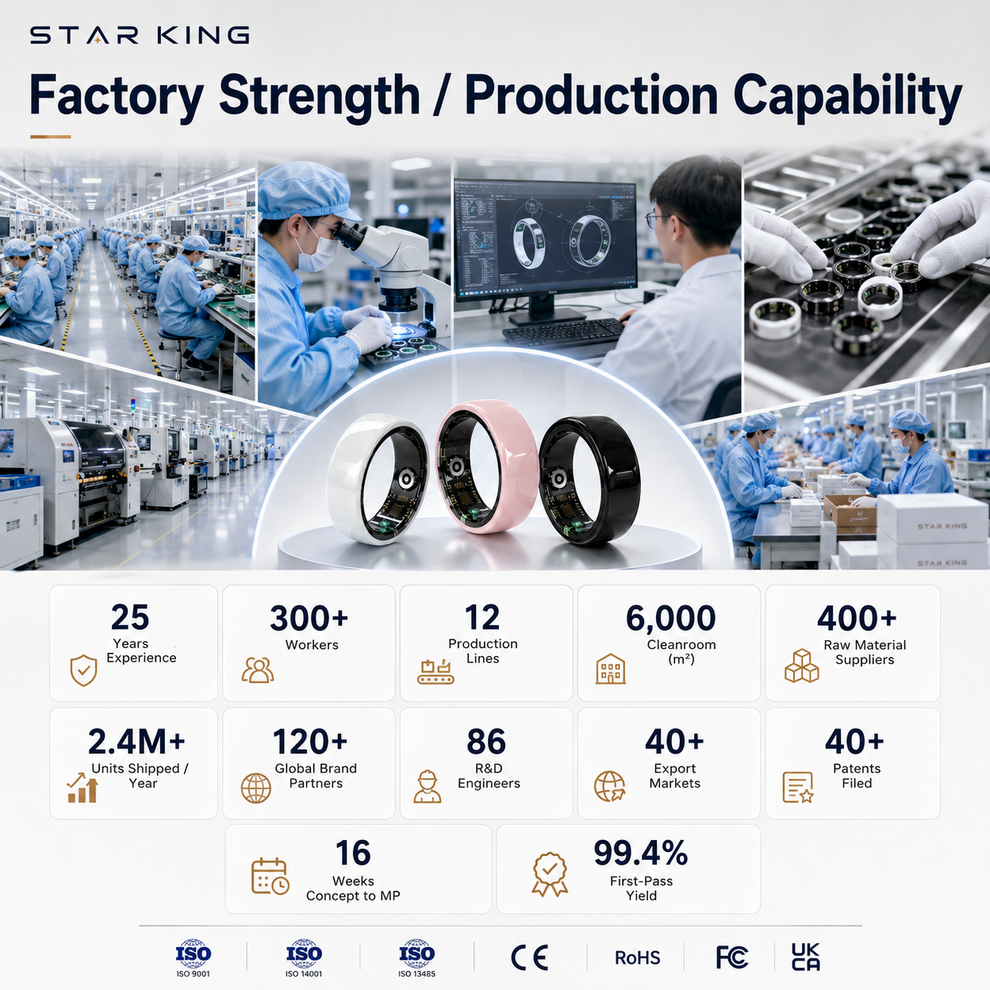
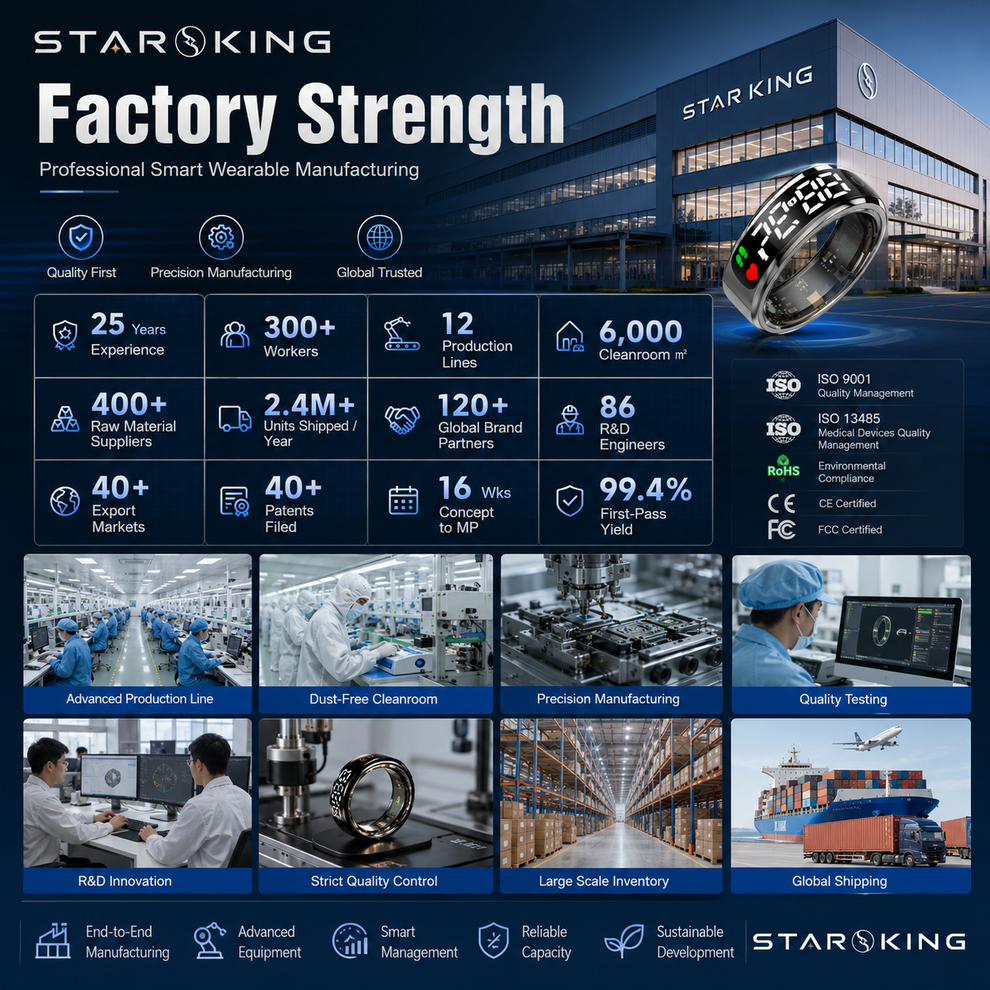
Smart ring OEM means a brand contracts a factory to build rings using an existing or adapted hardware platform, then sells them under its own label. Startup brands typically choose ODM (ready platform plus custom branding and app) because it lowers engineering cost and shortens time to market. The quotation you request should cover hardware, tooling, packaging, app customization, certification support, MOQ tiers and lead times, not just unit price.
Key Takeaways
- Decide the health use case first; it determines the sensor set you must quote.
- ODM is usually the cheapest route for a first launch, OEM the middle option, full private label the most expensive.
- MOQ, tooling and app customization are the three biggest cost drivers before certification.
- Battery shipping rules for lithium cells affect your logistics and landed cost.
- Certification depends on product configuration and destination market; always confirm per SKU.
- A structured RFQ gets accurate quotes instead of vague price ranges.
Key Facts for Buyers
| Item | What Buyers Should Confirm |
|---|---|
| Platform type | Existing ODM platform, modified OEM design, or fully custom tooling |
| MOQ | Per model, per color and per packaging version: [STAR KING TO CONFIRM] |
| Tooling | One-time cost and ownership of molds: [STAR KING TO CONFIRM] |
| App | White-label app vs SDK integration and who owns the data |
| Certification | Target-market requirements, cost coverage and per-SKU status |
| Battery shipping | Lithium-cell documentation and carrier rules for your route |
| Lead time | Sample, mass production and packaging schedules |
Step 1: Define Your Use Case Before You Ask for a Quote
Suppliers quote very different prices depending on the use case you describe. A ring marketed for sleep and recovery needs different firmware priorities than one marketed for fitness tracking or women’s health. Write one sentence for each primary and secondary use case, and decide whether the product is a wellness consumer device or a workplace program device.
This matters because consumer wellness marketing and any medical claims have very different compliance implications. In many markets, a wellness device must not be presented as a diagnostic tool. When you describe the product to a supplier, use the same language you will use on your product page, so the quoted firmware and sensor set match your claims.
Step 2: Choose OEM, ODM or Private Label
For startups, the right model depends on budget and how much differentiation you need. ODM uses a proven platform with your logo, packaging and app skin. OEM modifies an existing design further. Full private label builds a new enclosure and tooling from scratch. Most first-time brands start with ODM and upgrade to custom tooling once volume supports it.
If you sell mainly through Amazon or direct-to-consumer, private label branding and packaging often matter more to buyers than a unique enclosure. If you sell to corporate wellness or healthcare programs, differentiation tends to come from the app, reporting and data handling instead. STAR KING offers a private label OEM/ODM solution that covers these models.
Step 3: Lock the Bill of Materials and Sensor Set
Ask for a component-level list: sensor set, battery capacity, display or indicator, charging method, ring materials and sizes. Compare what each sensor adds to cost and to your marketing claims. If your brand promises heart rate or blood oxygen trends, the firmware and sensor must support it; if you only promise sleep and activity, you can quote a simpler build and lower your unit cost.
Ring sizing is a hidden procurement issue. Because sizing affects the enclosure and fit, confirm the size range offered and how sizing kits are supplied to early customers or reviewers. A vague size plan slows down sample validation and retail rollout.
Step 4: Plan App, Firmware and Data Ownership
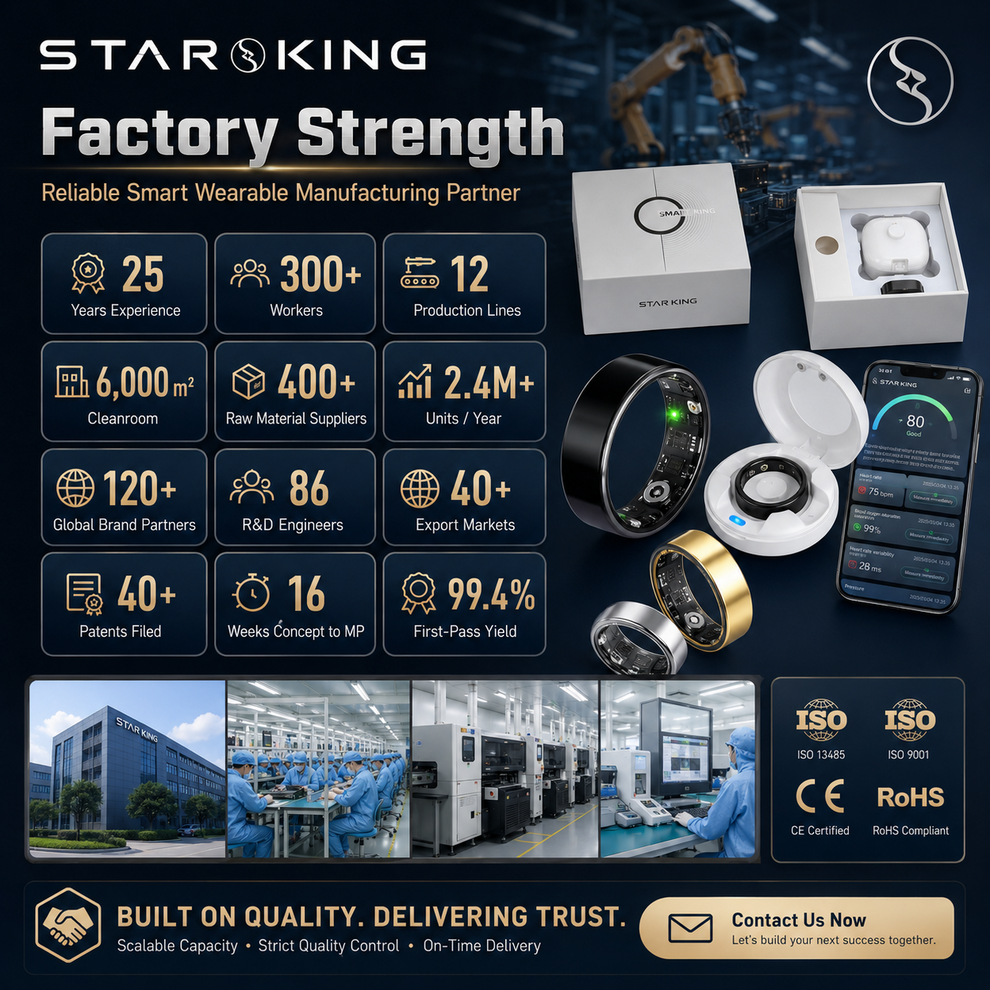
Most smart ring buyers spend more time in the app than the ring itself. Before RFQ, decide whether you want a white-label app with your brand, an SDK to integrate into an existing app, or a fully custom build. Ask who owns the user data, where it is stored and how deletion requests are handled, because privacy expectations vary by region.
Firmware settings such as sampling frequency, notifications and syncing behavior should be listed as line items you can request to change. This turns “customization” from a vague promise into a measurable deliverable.
Step 5: Understand MOQ, Tooling and Price Drivers
MOQ is usually the first thing a startup negotiates, and it is only one part of the cost equation. Unit price falls with volume, but tooling, packaging and app work are mostly one-time costs. The right question is not “what is your lowest MOQ” but “what is the total cost at the volume I can realistically sell in the first two quarters?”
Price drivers to list in your RFQ: sensor configuration, battery capacity, enclosure material, ring sizing complexity, packaging tier, app customization depth, and certification support. Ask for a tiered quote so you can see how unit price moves as you scale.
Step 6: Validate Samples, QC and Certification
Sample testing should follow a written checklist, not a quick look. Test fit across sizes, battery behavior across charge cycles, app pairing, syncing stability and waterproof performance according to the claimed rating. Ask what the factory tests before shipment and whether pre-shipment inspection is available.
Certification depends on product configuration, radio modules and target market. Wireless devices often require regional radio approvals, and battery-powered devices may require specific lithium-battery documentation. Requirements typically depend on the market, so buyers should verify current rules before committing. Useful reference points include the FCC equipment authorization pages, the EU CE marking rules, and the IATA lithium battery guidance for shipping. We cover this in more detail in our Quality & Compliance resources.
Step 7: Build the RFQ, Lead Time and Landed Cost
A strong RFQ is short and complete. State the product, use case, target markets, expected first-year volume by quarter, customization needs, packaging plan and required delivery date. Ask separately for sample cost, tooling cost, unit cost at two or three volumes, certification support cost and estimated production lead time.
Landed cost should include freight, duties, packaging inserts, and any third-party inspection. If your route crosses borders, confirm how lithium-containing rings are documented and shipped, because undeclared batteries can stall a shipment.
Soft CTA: If your specifications are still open, the fastest way to tighten the RFQ is a short technical conversation. You can discuss your smart ring OEM requirements with the STAR KING team before you finalize volumes.
OEM vs ODM vs Private Label Comparison
| Factor | ODM Platform | OEM Modification | Full Private Label |
|---|---|---|---|
| Upfront cost | Lowest | Medium | Highest |
| Time to market | Fastest | Medium | Longest |
| Differentiation | Branding, app skin, packaging | Enclosure and features | Own design and tooling |
| MOQ | Usually lowest | Medium | Highest |
| Best for | First launch, e-commerce brands | Brands needing design separation | Funded brands with volume and IP plans |
Common Mistakes and Buyer Red Flags
Common Mistakes
- Asking for unit price only and ignoring tooling, packaging and app costs.
- Requesting medical-style claims that the hardware and firmware cannot support.
- Choosing the lowest MOQ without confirming size range and color availability.
- Assuming a single certification covers every market and every SKU.
- Leaving packaging and artwork to the last week before production.
Buyer Red Flags
- A supplier who quotes a firm price without asking about your app, packaging or target market.
- No documented testing process or refusal to allow pre-shipment inspection.
- Vague answers about who owns tooling and molds.
- Claims of certification for all products without per-SKU evidence.
- Pressure to pay for tooling before specifications are frozen.
Practical Buyer Checklist
- Written use case and marketing claims for each SKU.
- Chosen model: ODM, OEM or private label.
- Frozen sensor set and battery specification.
- Ring size range and sizing kit plan.
- App model chosen: white-label, SDK or custom.
- Data ownership and privacy plan documented.
- MOQ tiers requested per model and color.
- Tooling cost and mold ownership clarified.
- Packaging and logo templates prepared.
- Sample validation checklist ready.
- Target-market certification requirements listed.
- Lithium-battery shipping documentation confirmed.
- Lead time and delivery date agreed in writing.
- Landed cost calculated for at least two volumes.
FAQ
What is the typical MOQ for a smart ring OEM order?
MOQ typically depends on whether you use an existing platform or new tooling, and on color and packaging variations. Ask the factory to quote two volume tiers so you can see the price step. Exact tiers: [STAR KING TO CONFIRM].
Can startup brands get private label smart rings without custom tooling?
Yes. Many startups launch on an existing platform with custom logo, packaging and app branding. Custom tooling is usually added later when volume justifies the one-time investment.
Who owns the app and user data in an ODM project?
This should be defined in the contract. Ask whether the app is white-labeled under your brand, where servers are located, and how user deletion requests are handled. Data ownership terms are not automatic and must be negotiated.
How long does smart ring production usually take?
Timelines depend on sample approval, tooling, packaging and certification steps. A realistic schedule separates sample lead time, tooling time and mass production time, and includes buffer for certification review. Confirm each stage in writing: [STAR KING TO CONFIRM].
Which certifications does a smart ring need?
Requirements typically depend on the product configuration, radio module and destination market. Wireless products often need regional radio certification, and lithium-battery products may need specific shipping documentation. Buyers should verify current rules with a qualified compliance partner or the relevant authority.
Can I ship smart rings by air with lithium batteries?
Lithium cells are regulated for transport. Carriers and countries apply different documentation requirements, so confirm the applicable rules and paperwork with your freight forwarder before booking.
How do I compare smart ring suppliers fairly?
Send the same structured RFQ to every supplier and compare the total package: unit price at two volumes, tooling, app scope, certification support, lead time and QC process. Unit price alone is not a valid comparison.
Conclusion
Smart ring OEM decisions made before the first quote shape your margin, your launch date and your compliance workload. Define the use case, pick the right model, freeze the specification, plan the app and data, then request tiered pricing with certification and lead time in writing. Startup brands that follow these 7 steps usually get faster, cleaner quotes and fewer surprises at mass production. For related reading, see the STAR KING blog resources and the sleep and recovery application page if sleep tracking is your lead feature.
Ready to Request Your Smart Ring OEM Quotation?
Send your specification, target markets and expected volumes, and the STAR KING team will return platform options, MOQ tiers and customization scope for your smart ring OEM project. Request a smart ring OEM quotation or ask for product samples to begin validation.
Image placement note: insert a smart ring OEM assembly photo after Step 3, a QC/testing photo after Step 6, and an app customization screenshot after Step 4.
Discuss Your Smart Wearable OEM/ODM Project
Planning a smart ring, smart watch, smart band, AI glasses, AI translator, or AI voice mouse project? Contact STAR KING to discuss product positioning, sample testing, customization scope, certification requirements, lead time, and quotation details.

Team Star King

Scan WhatsApp QR code
Leave a Reply