smart bands for EU retail: How EU Retail Chains Should Source Smart Bands in 2026: 7 Steps to Private-Label Success
How EU Retail Chains Should Source Smart Bands in 2026: 7 Steps to Private-Label Success
This guide answers how EU retail chains should source smart bands in 2026: treat it as a compliance-first RFQ project, lock down classification, certification, battery documentation, and unit economics before signing a tooling or production PO, and work with a verified smart band OEM that can scale a private-label program across your store network.
Table of Contents
Table of Contents
Direct Answer
Smart bands for EU retail succeed when the buyer defines a private-label specification, verifies CE RED and RoHS documentation plus UN38.3 battery test summaries, confirms MOQ and lead time with the factory, and validates the first production run with an accredited lab and a pilot store deployment before full rollout.

Key Takeaways
- For retail chains, the biggest risks are compliance gaps, battery shipping documentation, and software/app liability—not the hardware display itself.
- CE marking for smart bands is usually validated through RED (radio), RoHS, EMC, and battery-related documentation, but the exact file set always depends on the product configuration and intended market.
- A realistic private-label MOQ for smart bands is often in the 1,000–5,000 unit range per SKU, though some OEMs may accept lower trial quantities. Buyers should verify current minimums directly.
- Total landed cost in the EU is typically 25–45% above ex-works FOB once you add freight, duties, VAT, and packaging adjustments.
- The fastest path to a safe launch is a two-stage RFQ: a small sample/tooling deposit first, then a production PO only after lab validation and a 30–60 day pilot in 5–10 stores.
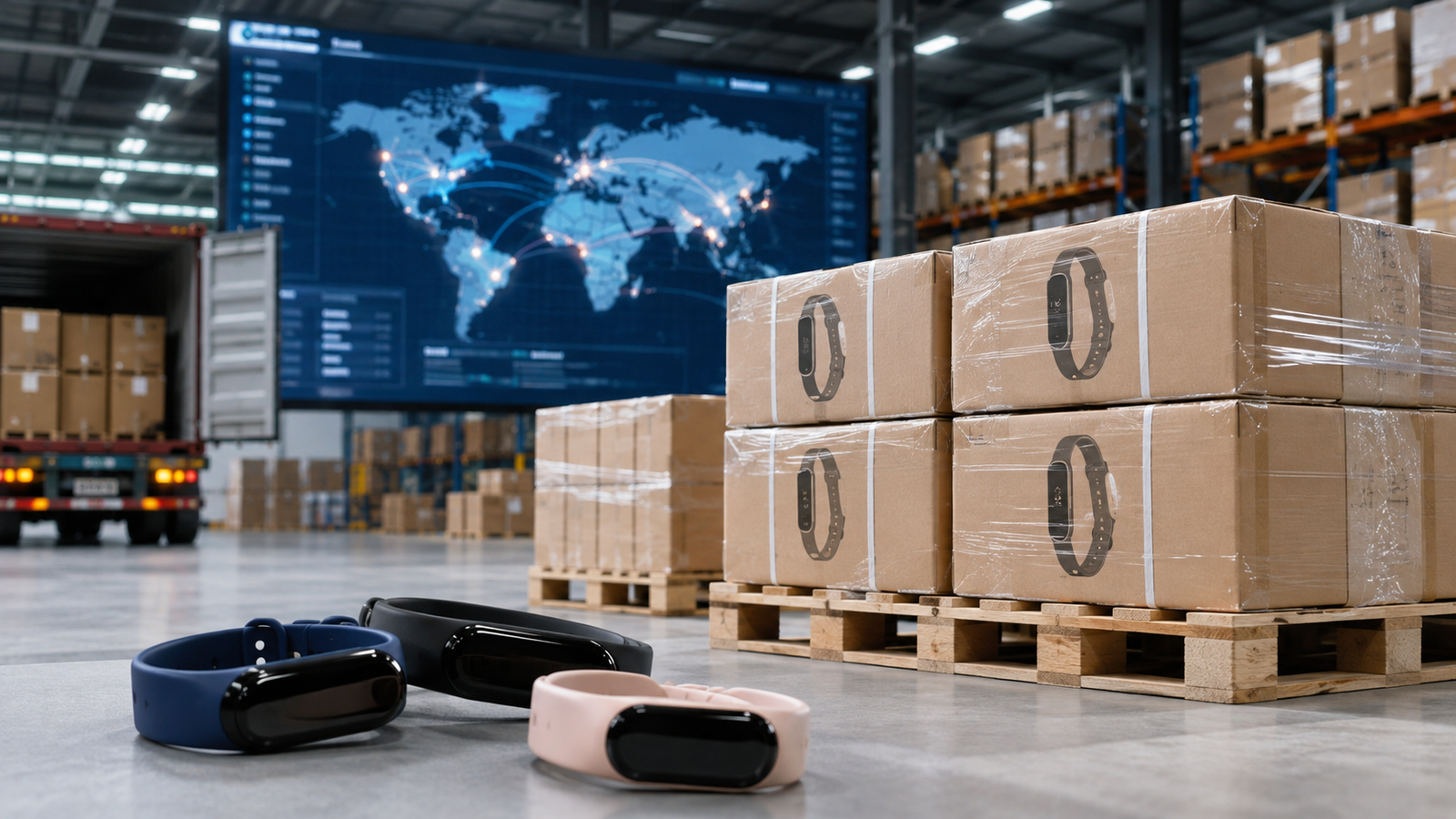
What Are Smart Bands and Why Do EU Retail Chains Care in 2026?
Smart bands are wrist-worn devices that combine a fitness tracker, basic health-sensing sensors (for example optical heart-rate and blood-oxygen monitoring), and a companion app. They sit between simple pedometers and full smartwatches, and for retail chains they offer a strong private-label opportunity for several reasons.
1. Retail economics favor smart bands
Smart bands typically land at attractive retail price points—often €39–€99 in EU consumer channels—which makes them easy to slot into multiple store formats, from electronics to grocery to pharmacy. For retail chains, this means a single wearable SKU can serve multiple end-caps and seasonal campaigns without a heavy per-store investment.
2. Health and fitness demand is durable
European consumers continue to adopt wearables for fitness tracking and sleep insight. While no consumer device should be marketed as a medical diagnostic tool, the general demand for self-tracking has stabilized into a year-round category rather than a holiday spike.
3. Private label builds margin and brand control
Private-label wearables allow retail chains to own the packaging, the app experience, and the price ladder. This shifts the conversation from commodity buying to brand building, and it is exactly the moment to bring in an OEM/ODM partner early.
4. But the EU raises the bar on compliance
Under EU rules, most smart bands are classed as radio equipment and must carry CE marking to be placed on the EU market. The specific documentation and test evidence depend on the wireless configuration, the sensors, and the power source. This is where many first-time buyers underestimate the work.
If your team is building a broader wearable range, you can compare form factors on the smart bands product page and pair it with adjacent SKUs from the private label OEM/ODM solution.
If your chain is preparing RFQs for Q2 or Q3 2026, it helps to structure the first supplier response before you request quotes, so every OEM answers the same technical and compliance questions.

Key Facts for Buyers
| Buyer question | Typical answer | What to verify |
|---|---|---|
| Do smart bands need CE marking for the EU? | Yes, most wireless smart bands are CE marked radio equipment | RED test report, declaration of conformity, EU authorized representative |
| Which standards apply? | RED (radio), EMC, RoHS, battery safety | Harmonized standard list cited in the test report |
| Can a consumer device claim medical use? | No—consumer metrics are for wellness, not diagnosis | Marketing copy avoids medical claims |
| Is UN38.3 required for shipping? | Typically yes for lithium batteries by air/sea | UN38.3 test summary, MSDS, and packing instruction |
| What MOQ should a retail chain plan for? | Often 1,000–5,000 units per SKU | Supplier’s current MOQ policy and tooling amortization |
| What lead time is realistic? | 30–60 days production plus tooling and shipping | Written production schedule and buffer |
| Who owns the app and firmware? | Usually a mix of OEM base and buyer customization | IP and data-processing clauses in the contract |

Table of Contents
- What Are Smart Bands and Why Do EU Retail Chains Care in 2026?
- 7 Steps to Source Smart Bands for EU Retail
- OEM vs ODM vs Private Label: What Retail Chains Should Choose
- EU Compliance: CE, RED, RoHS and Battery Rules
- Cost, MOQ and Landed Cost Drivers
- Sample Testing and Product Validation
- Common Mistakes and Buyer Red Flags
- Practical Buyer Checklist
- FAQ
- Conclusion
7 Steps to Source Smart Bands for EU Retail
The following sequence is designed for retail chain buyers who need a defensible RFQ process. It aligns with how experienced sourcing teams in Europe structure wearable launches.
Step 1 — Define the private-label specification before you request quotes
Write down the non-negotiables: screen size and type, battery target, sensors (heart-rate, SpO2, accelerometer), water resistance rating, wireless stack (Bluetooth version), app platform (iOS/Android), and packaging format. Without this spec, every supplier quote will be built on different assumptions and cannot be compared.
Buyer tip: Attach a one-page spec sheet to the RFQ and require suppliers to quote against it line by line.
Step 2 — Screen suppliers on manufacturing and compliance capability
Ask for proof of CE test reports, RoHS declarations, and UN38.3 battery summaries before you discuss pricing. A supplier that cannot share sample documentation quickly is a supplier that will slow down your EU launch.
Step 3 — Choose OEM, ODM or Private Label
For a retail chain in the EU, ODM is often the fastest path because you start from an existing hardware platform and customize branding, app skin, and packaging. OEM makes sense when you need unique industrial design and are willing to fund tooling.
See the private label OEM/ODM page for the scope of customization options.
Step 4 — Agree MOQ, tooling and sampling terms
Negotiate three numbers in writing: sample quantity, trial order quantity, and mass-production MOQ. For smart bands, a trial order is often significantly smaller than the full production MOQ, which lets you validate quality before committing to a large PO. Buyers should verify current minimums directly with the factory.
Step 5 — Validate with an accredited lab and a pilot run
Send the first production samples to an accredited EU-recognized lab for RED, EMC, RoHS and battery-related testing. In parallel, deploy 50–200 units across 5–10 pilot stores to capture real return rates and customer feedback before full rollout.
Step 6 — Lock the packaging, app and language requirements
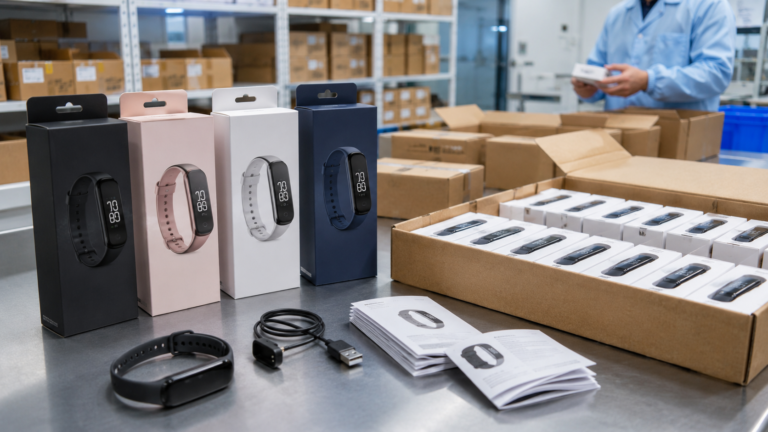
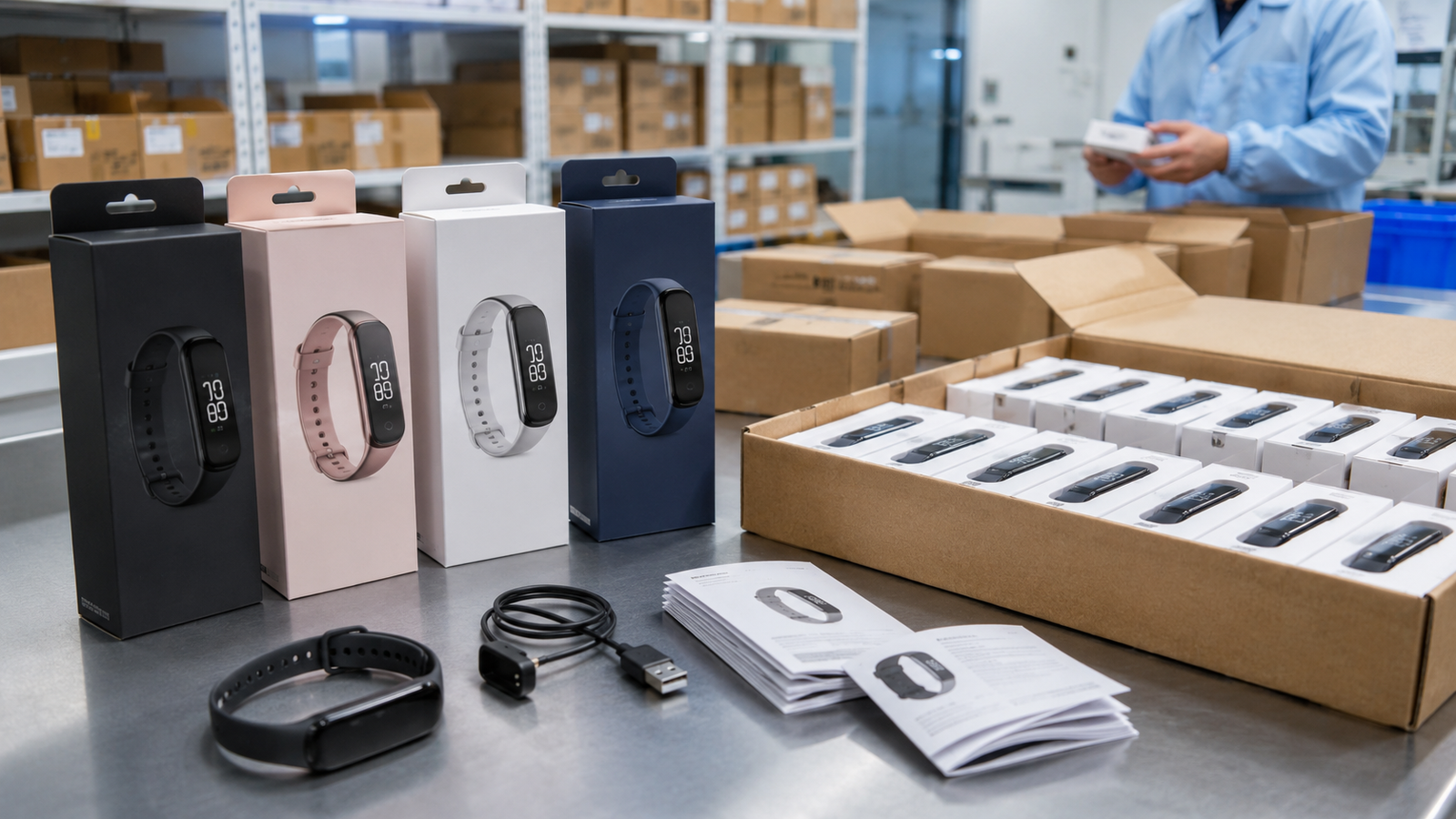
EU retail requires multi-language packaging, correct CE marking placement, importer identity, and waste-recycling symbols. Your app should also support the languages of your target markets. Build these into the packaging artwork cycle, not after.
Step 7 — Plan production, shipping and after-sales
Confirm the production schedule, shipping lane for lithium batteries (UN38.3), and warranty terms. Establish a spare-parts and replacement policy for the first 12 months of retail sales.
Soft CTA: If your chain is comparing factories for a wearable launch, you can review the current STAR KING smart band platform and request specifications matched to your EU markets.
OEM vs ODM vs Private Label: What Retail Chains Should Choose
| Model | Typical use case | MOQ | Tooling cost | Time to market |
|---|---|---|---|---|
| Private Label | Branding on existing ODM hardware | Lower | Low | Fast |
| ODM | Semi-custom hardware and app skin | Medium | Medium | Medium |
| OEM | Unique industrial design and firmware | Higher | High | Longer |
For most retail chains, Private Label or ODM is the pragmatic first step. It limits tooling risk and lets you test the category before investing in a fully custom device.
EU Compliance: CE, RED, RoHS and Battery Rules
Placing smart bands on the EU market is a regulated activity. The following requirements typically apply, but the exact scope depends on the radio functions, sensors, and battery configuration of each model.
CE marking and RED
Most wireless smart bands fall under the Radio Equipment Directive (RED). The manufacturer or importer must be able to produce a technical file, a declaration of conformity, and test evidence against the applicable harmonized standards. You can check the official texts on the EU Radio Equipment Directive 2014/53/EU page.
RoHS and REACH
Restrictions on hazardous substances apply to electronics sold in the EU. RoHS declarations should be model-specific, not generic.
Battery and transport documentation
Lithium batteries require UN38.3 test summaries and an MSDS for transport. For airfreight and ocean freight, packing instructions also apply. Buyers should verify that the factory provides these files per shipment, not once per contract.
Medical claims
Consumer smart bands are wellness devices, not medical devices. Do not describe heart-rate or SpO2 features as diagnostic tools. If you intend to make medical claims, you will need a different regulatory pathway, and buyers should verify requirements with a qualified regulatory consultant.
Cost, MOQ and Landed Cost Drivers
Unit price is only one line in the total EU landed cost. Retail chain buyers should model the following:
- Ex-works price: base unit cost
- Freight: air vs sea, plus battery handling surcharge
- Duty: depends on HS code and origin
- VAT and import processing: country-specific
- Packaging and localization: multi-language artwork, inserts
- Warranty reserve: typically a percentage of retail value
As a rule of thumb, EU landed cost often lands 25–45% above ex-works FOB. This is the number to use when you set retail pricing.
Sample Testing and Product Validation
Testing should cover four layers:
- Functional: battery life, sensor accuracy under normal use, app pairing stability
- Mechanical: drop, water resistance, strap durability
- Compliance: RED, EMC, RoHS, battery safety
- Field: pilot store returns and customer feedback
Document every test result. When you move to a larger production PO, this file becomes your quality baseline.
Common Mistakes and Buyer Red Flags
- Requesting quotes before a written specification exists → incomparable pricing
- Accepting a generic CE certificate that does not reference your model → compliance risk
- Using a low MOQ quote to win approval, then discovering the real production minimum later
- Marketing wellness metrics as medical measurements → regulatory and reputational exposure
- Ignoring battery logistics until the first shipment is booked
- Not defining app and data-processing ownership in the contract
- No agreed warranty and spare-parts policy before the first retail sale
Practical Buyer Checklist
- Written private-label specification attached to the RFQ
- Model-specific CE and RED documentation reviewed
- RoHS declaration and battery UN38.3/MSDS available
- MOQ, trial order quantity and tooling amortization in writing
- Sample units tested in-house and by an accredited lab
- Pilot deployment across 5–10 stores before full rollout
- Multi-language packaging artwork approved
- App language coverage and update policy documented
- Production schedule and shipping plan agreed, including battery handling
- Warranty, spare parts and replacement policy defined
Multimedia Insertion Suggestions
Image 1 (Introduction): A retail shelf or end-cap display with private label smart bands, ALT: “Private label smart bands for EU retail sourcing 2026”.
Image 2 (Step 3): Factory packaging line with branding, ALT: “Smart bands OEM packaging customization for EU retail chain”.
Image 3 (Compliance): Close-up of CE marking and compliance documentation, ALT: “Smart bands CE certification documentation for EU market”.
Image 4 (Pilot): In-store pilot testing, ALT: “Pilot testing smart bands for EU retail chain launch”.
FAQ
Q1: Do smart bands for EU retail need CE marking?
Yes, most wireless smart bands are treated as radio equipment and require CE marking before they can be placed on the EU market. The exact test scope depends on the wireless and sensor configuration.
Q2: What documents should a factory provide before shipment?
Typically a declaration of conformity, test reports, RoHS declaration, UN38.3 test summary, MSDS, and packing instruction for lithium batteries.
Q3: Can a retail chain start with a small trial order?
Many OEMs allow a trial order below the full production MOQ, but buyers should confirm current limits in writing, as policies vary.
Q4: Can the app be localized for EU languages?
App localization is usually available as a customization item. Confirm which languages are supported and how updates are handled after launch.
Q5: How long does a private-label smart band launch take?
A typical timeline is 30–60 days for production after samples are approved, plus tooling, compliance testing, and shipping. Add buffer for first-run learning.
Q6: Who owns the app and firmware data?
This depends on the contract. Buyers should clarify IP ownership and data-processing responsibilities with the OEM before production.
Q7: What is the biggest red flag during sourcing?
A supplier that cannot produce model-specific compliance documents is the single largest risk for an EU retail launch.
Conclusion
Sourcing smart bands for EU retail in 2026 is a structured procurement project: define the spec, verify compliance, model the landed cost, validate with samples and a pilot, and lock after-sales terms before scaling. Retail chains that follow a disciplined RFQ process protect their brand, reduce returns, and build a wearable category that can be extended across seasons.
STAR KING CTA
Ready to move from evaluation to quotation? Request a quote for private-label smart bands tailored to your EU markets. Our team can review your specification, confirm MOQ and lead time, and outline the compliance documentation required for your target countries.
Request a Quote or Discuss Your OEM/ODM Smart Band Project →
Useful Official References for Buyers
- FCC equipment authorization guidance
- European Commission CE marking information
- Bluetooth SIG specifications
Discuss Your Smart Wearable OEM/ODM Project
Planning a smart ring, smart watch, smart band, AI glasses, AI translator, or AI voice mouse project? Contact STAR KING to discuss product positioning, sample testing, customization scope, certification requirements, lead time, and quotation details.

Team Star King

Scan WhatsApp QR code