smart rings private label: Smart Rings for Amazon Sellers: 7 Critical Checks Before Private Label Manufacturing
Smart Rings for Amazon Sellers: 7 Critical Checks Before Private Label Manufacturing
If you are an e-commerce seller evaluating smart rings private label manufacturing, the decision hinges on seven checks: supplier verification, sensor and app capabilities, MOQ and pricing, sample validation, quality control, certification coverage, and logistics. Skipping any one of these increases the risk of refunds, listing suspensions, or dead inventory. This guide walks through each check with concrete questions to ask suppliers and a buyer checklist you can use in your next sourcing call.
Table of Contents
Table of Contents
Amazon sellers face a specific set of pressures that general importers do not: listing compliance, review-driven demand, IP complaints, and battery shipping rules. The right smart ring supplier is not simply the one with the lowest quote. It is the one whose product, documentation, and production process can survive an Amazon launch and a second reorder.
smart rings private label: Table of Contents
- Short Answer
- Key Takeaways
- Key Facts for Buyers
- Check 1: Verify the Manufacturer, Not Just the Trading Company
- Check 2: Confirm Sensor and App Specifications That Match Your Listing Claims
- Check 3: Understand MOQ, Unit Cost, and Tooling
- Check 4: Validate Samples Before Committing to a PO
- Check 5: Lock Down Quality Control and Inspection Terms
- Check 6: Map Certification to Your Target Marketplaces
- Check 7: Plan Packaging, Logistics, and Lithium Battery Shipping
- Common Mistakes and Buyer Red Flags
- Practical Buyer Checklist
- FAQ
- Conclusion
Short Answer
Smart rings private label sourcing for Amazon sellers comes down to seven checks: verify the actual manufacturer, confirm sensor and app specs against your listing copy, model MOQ and landed cost, test samples before volume orders, contract quality control and inspection, align certifications with your marketplaces, and plan battery-compliant packaging and shipping. Treat each check as a gate: a supplier that cannot pass all seven is a risk to your listing, your reviews, and your reorder cycle.
Key Takeaways
- Verify whether your supplier owns assembly and testing or is reselling from another factory; this affects customization, MOQ, and lead time.
- Match advertised features (heart rate, SpO2, sleep tracking) to what the firmware and app actually support; Amazon listings are reviewed against claims.
- MOQ, tooling, and packaging costs interact; a lower unit price at higher MOQ is not always the lowest landed cost.
- Certification is configuration- and market-specific. Buyers should verify CE, FCC, RoHS, UN38.3, and MSDS status per SKU and destination.
- Battery shipping rules for lithium-powered wearables vary by carrier and country; confirm documentation before booking freight.
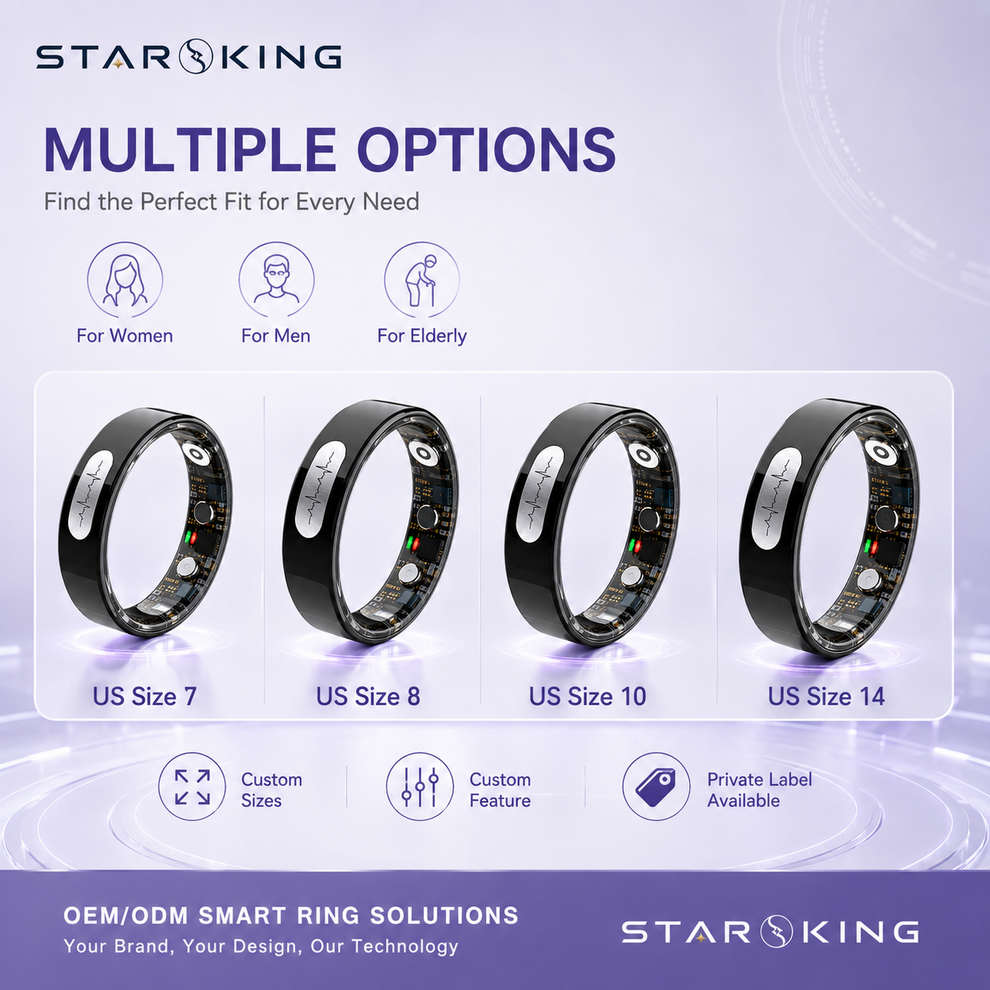
Key Facts for Buyers
| Item | Typical Consideration | What to Verify |
|---|---|---|
| Supplier type | Factory vs. trading company | Business license, factory audit report, production line photos |
| Sensor configuration | HR, SpO2, temperature, sleep | Firmware version, app screenshots, spec sheet |
| App/software | White-label app or SDK | Branding rights, data hosting, update cadence |
| MOQ | Varies by model and customization | Unit price tiers, tooling fees, logo/packaging MOQ |
| Certification | Per SKU, per market | CE, FCC, RoHS, UN38.3, MSDS certificates |
| Lead time | Samples vs. mass production | Sample lead time, production lead time, shipping method |
| Warranty & after-sales | Defect rate policy | Return window, spare parts, firmware support |
What Makes Smart Rings Different from Other Wearables
Smart rings sit at a different sourcing intersection than watches or bands. They are small, battery-constrained, and rely heavily on firmware and app algorithms to deliver meaningful data. For an Amazon seller, that means the product is only half hardware. The other half is the software experience, the accuracy consistency across units, and the documentation you can show if a marketplace asks questions.
Buyers evaluating this category should think in terms of a product system: ring hardware, charger, app, packaging, and regulatory file. A supplier that can speak to all five is usually better positioned to support a private label launch than one that only quotes a unit price.
Check 1: Verify the Manufacturer, Not Just the Trading Company
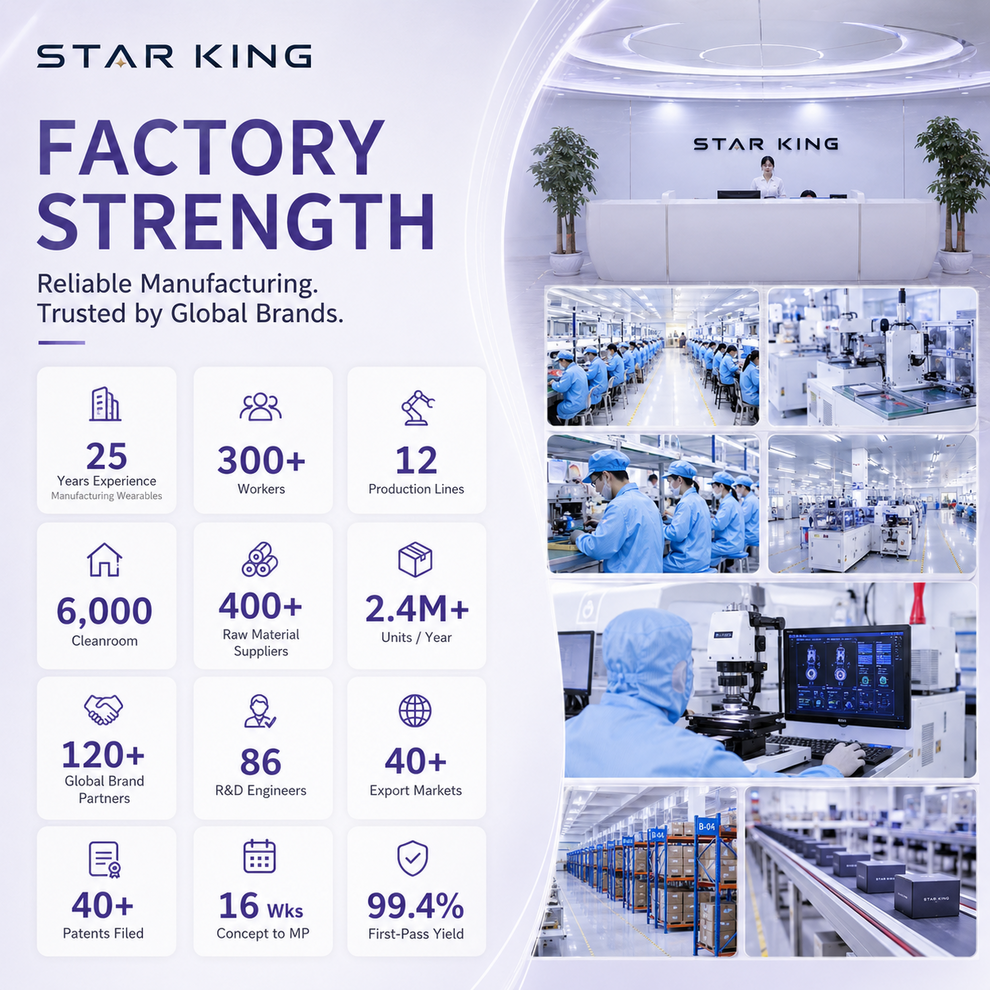
The first evaluation step is confirming who actually builds the ring. Many suppliers that present themselves as factories are trading companies that source from one or more assembly partners. That is not automatically a problem, but it changes your leverage on customization, MOQ flexibility, and quality escalation.
Questions to ask
- Do you own the assembly and testing lines, or do you subcontract?
- Can you share a recent factory audit report or permit you to schedule a video walkthrough?
- Which components are sourced in-house versus externally (sensor module, battery, MCU)?
- Who owns the tooling and firmware for the model you are quoting?
How to verify
Ask for the business license, a recent third-party inspection report, and a short live video call showing the production floor and testing stations. Cross-check the company name on official registries where available. If the supplier resists a walkthrough, treat that as a signal to slow down.
STAR KING supports OEM and ODM smart ring projects and can discuss factory capabilities, customization scope, and production planning during the evaluation stage. You can review the smart rings product page for baseline specifications before your call.
Check 2: Confirm Sensor and App Specifications That Match Your Listing Claims
Amazon and other marketplaces increasingly review product claims, especially around health monitoring. The gap between marketing language and firmware reality is one of the most common sources of listing problems for wearable sellers.
What to clarify
- Which sensors are physically present, and which are interpolated?
- What sampling rates and update intervals does the app display?
- Does the app support sleep stages, or only total sleep time?
- Can the supplier provide an SDK or API for a branded app?
- How are firmware updates delivered, and how often?
Ask for screen recordings, not just screenshots. A short video showing the ring pairing, syncing, and displaying data tells you more than a spec sheet. If your listing will claim blood oxygen or heart rate monitoring, confirm the feature works consistently and that your claims align with consumer-device language, not medical-device language.

For sellers building a broader wearable lineup, it helps to compare how different form factors handle app integration. See the private label OEM/ODM solution page for an overview of customization options across product categories.
Check 3: Understand MOQ, Unit Cost, and Tooling
MOQ is not a single number. It is a bundle of minimums: minimum order for the base model, minimum for logo printing, minimum for custom packaging, and sometimes minimum for a new color or size. Sellers who only ask about unit MOQ often discover later that their branding plan triggers a higher threshold.
Cost drivers to model
| Cost element | What drives it | Buyer action |
|---|---|---|
| Unit cost | Component choice, sensor set, battery capacity | Request tiered pricing at 2-3 MOQ levels |
| Tooling | Custom shell, mold, or size variants | Clarify one-time vs. amortized cost |
| Logo/printing | Method (laser, pad print) and placement | Confirm setup fee and per-unit fee |
| Packaging | Box structure, inserts, manual, outer carton | Ask for packaging MOQ and dieline ownership |
| Certification | New SKU or market | Confirm whether testing is included or billed separately |
| Freight | Weight, battery class, destination | Model air vs. sea and battery documentation |
Build a landed cost model that includes unit price, packaging, certification, freight, duties, and Amazon fees. A supplier quoting a lower unit price at a higher MOQ may produce a higher landed cost once freight and storage are included.
If your volumes are still being validated, a soft CTA is appropriate here: ask the supplier whether they offer a smaller pilot run or sample-based validation before a full MOQ commitment. That single question often separates flexible manufacturers from rigid ones.
Check 4: Validate Samples Before Committing to a PO
Sample evaluation is where most sourcing decisions are actually made. A sample should be tested the way your customer will use it, not just unboxed and photographed.
Sample validation checklist
- Pair the ring with the app on both iOS and Android.
- Wear it for at least 5-7 days to test comfort, charging, and battery claims.
- Compare sensor readings across two units of the same model.
- Test the charger and cable for fit and durability.
- Review the manual and packaging for language quality and accuracy.
- Confirm the sample matches the spec sheet you were quoted.
Order samples from at least two suppliers when possible. The differences in app polish, firmware stability, and packaging quality are usually visible within a week of use. Document your findings in a simple scoring sheet so the comparison is objective.

Check 5: Lock Down Quality Control and Inspection Terms
Quality control is not a single step at the end of production. It is a set of checkpoints. For smart rings, the critical points are incoming component inspection, assembly, firmware flashing, functional testing, aging or burn-in, and final packaging inspection.
Terms to agree in writing
- Acceptable quality limit (AQL) and sampling plan for final inspection.
- Defect classification: critical, major, minor.
- Who pays for third-party inspection, and when it happens.
- How functional failures are handled before shipment.
- Pre-shipment inspection report format and photo requirements.
If your order value justifies it, a third-party pre-shipment inspection is a reasonable safeguard. Buyers should verify the inspection scope covers pairing, charging, and sensor functions, not just carton counts.
Check 6: Map Certification to Your Target Marketplaces
Certification requirements for smart rings typically depend on the product configuration, the radio modules used, the battery, and the destination market. A single certificate does not automatically cover every SKU or every country.
Documents to request
- CE documentation for EU markets, where applicable.
- FCC documentation for the United States, where applicable.
- RoHS compliance statements for restricted substances.
- UN38.3 test summary for lithium battery transport.
- MSDS for battery shipping documentation.
Ask the supplier to state clearly which certificates apply to the exact model and configuration you are buying, and whether new testing is required for a private label variant. Buyers should verify certificates against the issuing laboratory and the model number on the document.
For official reference, review the FCC equipment authorization procedures and the European Commission CE marking guidance. These pages explain the framework but do not replace supplier-specific documentation.
If your line includes multiple products, compare how certification scope changes across categories on the health and fitness wearables solution page.
Check 7: Plan Packaging, Logistics, and Lithium Battery Shipping
Smart rings contain lithium batteries, which triggers additional shipping requirements for air and some ground services. Packaging also affects both damage rates and customer perception, so it deserves its own planning step rather than being treated as an afterthought.
Packaging decisions
- Retail box structure and material.
- Insert design for the ring, charger, and cable.
- Manual language and regulatory labeling.
- Outer carton strength and drop protection.
- Storage conditions stated on the label.
Shipping decisions
- Confirm the battery class and the documentation your carrier requires.
- Compare air and sea options against your launch date.
- Plan inventory split if you fulfill from multiple Amazon regions.
- Agree on who handles import clearance and duty payment.
Buyers should verify current carrier rules before booking, because lithium battery shipping requirements change and vary by country.
Common Mistakes and Buyer Red Flags
Across sourcing conversations, certain patterns recur among sellers who later run into trouble.
| Mistake | Why it hurts | Red flag signal |
|---|---|---|
| Buying on unit price alone | Ignores tooling, freight, and returns | Supplier avoids landed cost questions |
| Skipping app testing | Poor reviews and returns | No app demo or SDK discussion |
| Assuming one certificate covers all | Marketplace or customs issues | Vague answers about model numbers |
| No written QC terms | Disputes at shipment | Refusal to define AQL |
| Ignoring battery shipping rules | Delayed or rejected freight | No UN38.3 or MSDS on request |
| No sample comparison | Weak product-market fit | Pressure to pay deposit before samples |
Other red flags include quotes that change without explanation, reluctance to name the factory, and requests for full payment upfront without a contract.
Practical Buyer Checklist
- Supplier identity and factory location verified.
- Sensor list and app features confirmed against listing claims.
- Tiered pricing, MOQ, tooling, and packaging costs documented.
- At least one sample tested for 5-7 days across two units.
- QC plan, AQL, and inspection terms agreed in writing.
- Certification and battery documents mapped to each target market.
- Packaging dieline, manual, and labeling reviewed.
- Freight method and battery documentation confirmed.
- Warranty, returns, and spare parts policy agreed.
- Contract covers tooling ownership and IP terms.
Keep this checklist in your sourcing file and update it as you move from evaluation to purchase. It is also a useful internal document for aligning marketing, operations, and finance before a launch.

FAQ
What is a realistic MOQ for smart rings private label?
MOQ varies widely by model, customization, and supplier. It typically depends on whether you choose an existing model with logo printing or a new tooling project. Ask for tiered MOQs so you can compare the cost of a pilot run against a full production order.
Can I use my own app for a private label smart ring?
Some suppliers offer a white-label app with your branding, while others provide an SDK or API for a custom build. Confirm data hosting, update responsibility, and branding rights in writing before committing.
Which certifications do I need for Amazon?
Amazon may request documentation such as CE, FCC, RoHS, UN38.3, or MSDS depending on the product and marketplace. Requirements typically depend on the configuration and destination. Buyers should verify with the supplier and, where needed, with a compliance consultant.
How long does sample and production lead time take?
Sample lead time is often shorter than production lead time, and both can vary by customization and seasonality. Ask for a written timeline covering sample approval, tooling, mass production, inspection, and shipping.
What should I check in a pre-shipment inspection?
A useful inspection covers pairing, charging, sensor function, firmware version, packaging integrity, and carton labeling. Confirm the inspection scope and AQL with the supplier before production begins.
Who owns the tooling and design files?
Tooling and IP ownership terms should be defined in the contract. Buyers should clarify whether tooling is shared, exclusive, or transferable, and how that affects future orders if the relationship changes.
How do I reduce the risk of returns on wearable health features?
Align listing language with actual firmware capabilities, avoid medical claims, test samples thoroughly, and provide clear setup instructions. Returns often trace back to mismatched expectations rather than hardware defects.
Conclusion
The evaluation stage is where smart rings private label projects are won or lost. The seven checks in this guide give Amazon sellers a structured way to compare suppliers: verify the manufacturer, confirm sensor and app specs, model MOQ and landed cost, validate samples, lock down QC, map certification, and plan packaging and battery-compliant logistics.
None of these checks requires a large team. They require discipline and a willingness to ask for documentation before paying a deposit. Sellers who treat each check as a gate usually enter production with fewer surprises and a clearer path to a second order.
STAR KING CTA
If you are evaluating smart rings private label manufacturing, the next step is to request product samples and test the app, sensors, and charging experience against your listing plan. You can also compare baseline specifications on the smart rings product page or review customization options on the private label OEM/ODM page before your sourcing call.
Discuss Your Smart Wearable OEM/ODM Project
Planning a smart ring, smart watch, smart band, AI glasses, AI translator, or AI voice mouse project? Contact STAR KING to discuss product positioning, sample testing, customization scope, certification requirements, lead time, and quotation details.

Team Star King

Scan WhatsApp QR code