
smart watches for retail chains: Sourcing Smart Watches for US Retail Chains: 7 Checks Before You Commit
November 21, 2026 · Team Star King
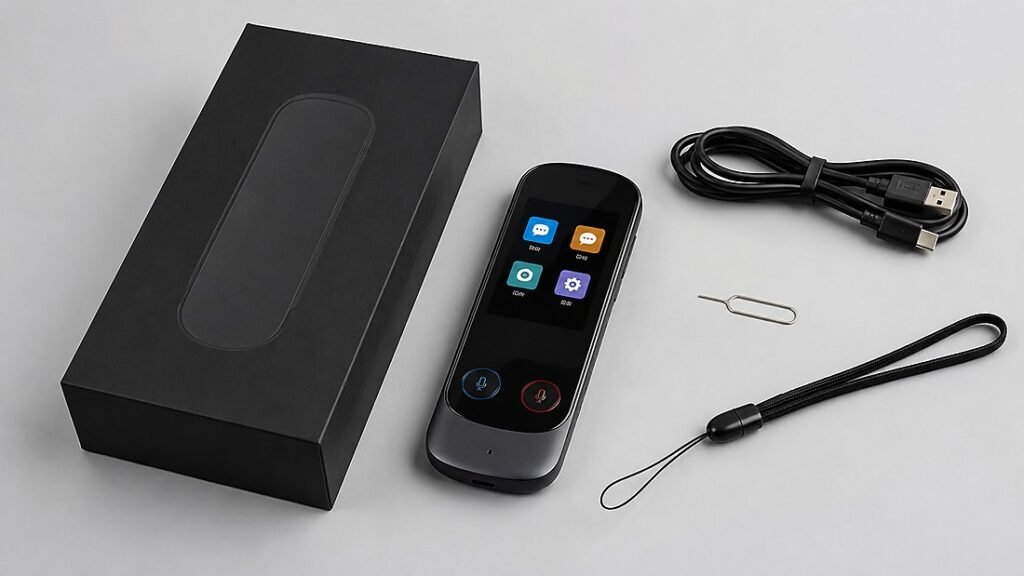
Sourcing Smart Watches for Retail Chains: 7 Checks Before You Commit
Sourcing smart watches for retail chains means matching a sellable assortment to your shelf format, price ladder, and US compliance obligations before you place a bulk order. The right supplier should be able to show model-level test documentation, confirm minimum order quantities (MOQ) and lead times in writing, and support private label packaging and app customization. Buyers should verify FCC equipment authorization and lithium battery shipping documents themselves rather than relying on a catalog claim.
Table of Contents
Table of Contents
Short Answer
Sourcing smart watches for US retail chains usually comes down to seven checks: assortment and price-ladder fit, display and comfort specifications, FCC and battery compliance, MOQ and landed cost, packaging and private label capability, App and firmware support, and lead time with replenishment planning. Retail buyers who verify these points early reduce markdown risk and avoid shipment delays caused by missing test reports. Confirming documents at the sample stage is faster than resolving them after a purchase order is issued.
Table of Contents
- Why Retail Chains Approach Smart Watch Sourcing Differently
- What Are Smart Watches for Retail Chains Actually Judged On?
- Check 1: Assortment and Price-Ladder Fit
- Check 2: Display, Size, and Wearability Specifications
- Check 3: FCC, Battery, and Import Compliance
- Check 4: MOQ, Landed Cost, and Payment Structure
- Check 5: Packaging and Private Label Capability
- Check 6: App, Firmware, and Data Handling Support
- Check 7: Lead Time and Replenishment Planning
- Key Facts for Buyers
- Common Mistakes and Buyer Red Flags
- Practical Buyer Checklist
- FAQ
- Conclusion
Key Takeaways
- Retail chains buy an assortment and a price ladder, not a single SKU, so supplier range depth matters as much as unit price.
- FCC equipment authorization and lithium battery transport documentation are the two compliance areas that most often delay US retail launches.
- MOQ, packaging, and App support should be negotiated together, because each affects the other’s cost.
- Samples should be tested against your own returns and warranty assumptions, not only against spec sheets.
- Lead time planning should account for Chinese New Year, ocean freight variability, and restock cycles for holiday resets.
Why Retail Chains Approach Smart Watch Sourcing Differently
A single-brand e-commerce seller can launch one hero SKU and scale it. A retail chain cannot. Buyers in this channel typically need a small family of models that fills price points, fits planogram space, and supports returns handling across many stores. That changes how a supplier should be evaluated.
Three structural differences drive most sourcing decisions in this channel. First, shelf space is finite, so the assortment must cover entry, mid, and gifting price points without overlapping too heavily. Second, retail chains usually need consistent packaging, barcodes, and warranty language across the range. Third, compliance expectations are higher because several buyers, category managers, and sometimes a compliance team review the same product file.
The practical result is that retail buyers should evaluate a supplier’s ability to deliver a coordinated range, not only a favorable quote on one model. If you are still mapping the category, the smart watches product range is a reasonable starting point for comparing form factors and feature tiers before you define your own price ladder.
What Are Smart Watches for Retail Chains Actually Judged On?
Smart watches for retail chains are judged on four commercial criteria: sell-through at a defined price point, return rate, compliance readiness, and replenishment reliability. Feature lists matter, but only insofar as they support those four criteria. A model with excellent specifications that arrives without an FCC file or with unclear battery documentation is a liability, not an asset.
Buyers should therefore evaluate every candidate model against a consistent scorecard. The scorecard below reflects the questions a category manager typically asks in an awareness-stage review, before any purchase order is discussed.
Definition: How Buyers Should Evaluate a Smart Watch Supplier
A supplier evaluation for this category should compare the manufacturer on documented evidence rather than catalog claims. Evidence includes model-level test reports, stated MOQ per SKU and per configuration, written lead times, packaging samples, firmware update practice, and named after-sales responsibility. Where a supplier cannot provide a document, treat the gap as an open risk item and price it accordingly.
Check 1: Assortment and Price-Ladder Fit
The first commercial question is not “which model is best” but “which three to five models cover my shelf plan without cannibalizing each other.” A workable retail range often includes an entry model for impulse or back-to-school placement, a mid-tier model with a larger display and longer battery life, and a gifting or premium model for holiday and Q4 programs.
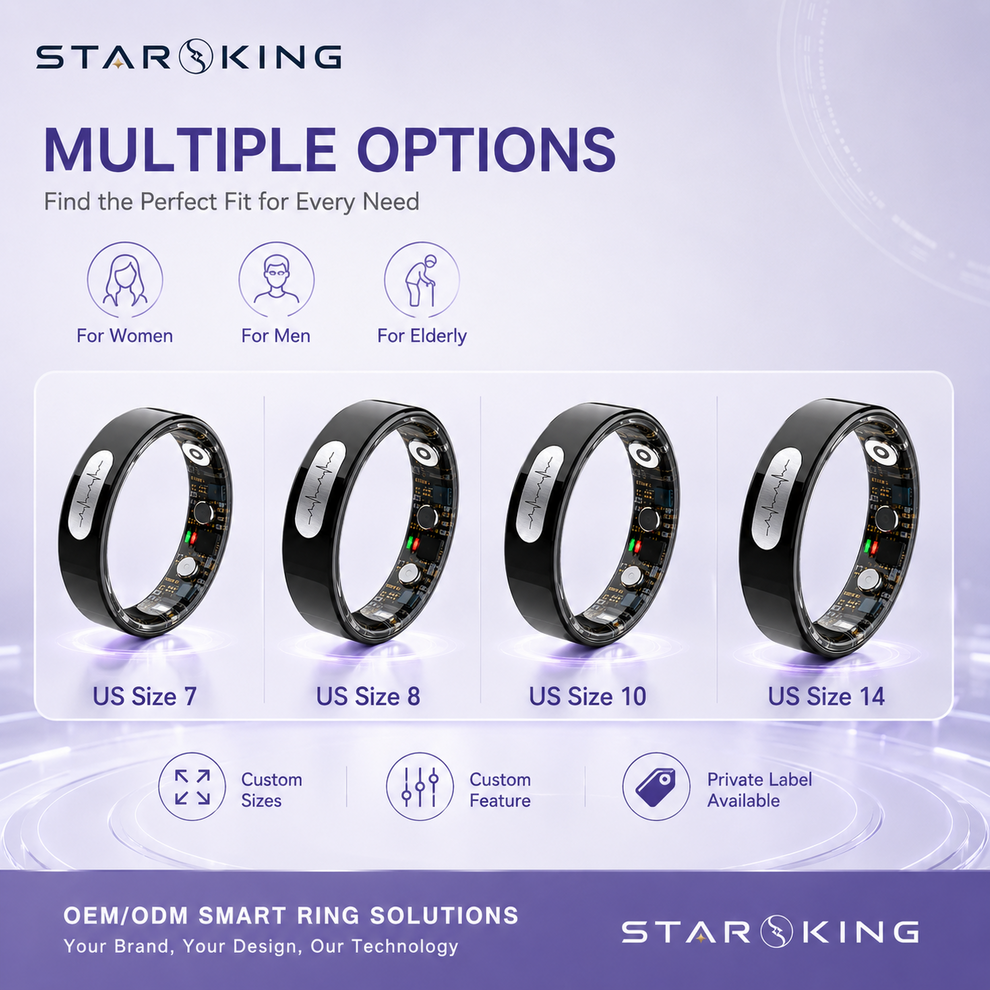
Ask the supplier to map its range against your intended retail price points, including room for promotions. Confirm whether display sizes, case materials, and strap options differ enough between tiers to be visually distinct on shelf. Retail shoppers make comparisons quickly, and two models that look nearly identical tend to confuse rather than expand the range.
If your chain also carries bands or rings, consider whether the wearable family should share an App. A shared App reduces support complexity at the store level. STAR KING’s smart retail and e-commerce solutions page outlines how a coordinated wearable assortment is typically structured.
Check 2: Display, Size, and Wearability Specifications
Specification choices drive return rates more than most buyers expect. Display type, brightness, touch response, case thickness, and strap material all influence how a customer perceives value in the first thirty seconds. For retail, those first impressions decide whether a unit sells or comes back.
Two specifications deserve particular attention. Display brightness affects outdoor readability and is often tested by shoppers under store lighting. Water resistance claims should be verified against the supplier’s stated test method, because waterproof performance is frequently overstated relative to the actual rating. Ask for the specific rating claimed and the test basis behind it.
Battery life claims also deserve scrutiny. Published figures are frequently measured under light-use conditions. Ask the supplier to clarify the usage scenario behind the claim so your packaging language and in-store signage stay accurate. For a broader look at how health and fitness features are positioned across wearables, the health and fitness wearables overview is useful background.
Check 3: FCC, Battery, and Import Compliance
For US retail, two compliance areas dominate the launch timeline: radio frequency equipment authorization and lithium battery transport. Both are document-driven, and both can delay a shipment if handled late.
FCC equipment authorization
Smart watches with Bluetooth or Wi-Fi contain intentional radiators and typically require FCC equipment authorization before US marketing. The applicable procedure depends on the device’s radio configuration. Buyers should verify the specific authorization type and the grantee name on the equipment authorization record rather than accepting a certificate image at face value. The FCC equipment authorization process is published on the Commission’s website and is the reference point for verification.
Lithium battery shipping documents
Wearables ship with lithium-ion or lithium-polymer cells. Air transport generally requires a UN 38.3 test summary and appropriate shipping documentation. Phrase this carefully: requirements typically depend on cell capacity, packaging configuration, and the mode of transport. Buyers should verify that the test summary applies to the exact cell used in the model being purchased. The IATA Dangerous Goods Regulations and the UN Model Regulations provide the underlying framework.
Other market requirements
Additional requirements vary by product configuration and by retailer. Some chains ask for RoHS documentation, Proposition 65 statements, or specific labeling. A buyer should confirm which documents the retailer’s own vendor compliance team requires, and then confirm which of those the factory can supply for the exact SKU. Where a document is not yet available, treat it as a project milestone with a date, not a verbal assurance.
| Document | Typical Trigger | Who Should Verify | Risk if Missing |
|---|---|---|---|
| FCC equipment authorization | Bluetooth/Wi-Fi enabled models | Buyer + supplier compliance contact | Shipment hold, retailer rejection |
| UN 38.3 test summary | Lithium battery in the product | Buyer + freight forwarder | Air shipment refused |
| RoHS documentation | Retailer vendor requirements | Buyer | Compliance review failure |
| MSDS / SDS | Battery transport and storage | Buyer + forwarder | Handling delays |
| Packaging artwork proof | Private label programs | Buyer + supplier | Reprint cost and delay |
Because document requirements shift with the exact radio configuration and cell, buyers should request model-specific files rather than accepting a generic certificate package. STAR KING can confirm which documents apply to a given configuration during the sample stage; documentation status should be verified per model before any purchase order.
Check 4: MOQ, Landed Cost, and Payment Structure
MOQ in this category is usually quoted per model and per configuration, and it can change materially when you add custom packaging or an App modification. A retail chain testing a new category often wants low MOQs across several SKUs; a factory, meanwhile, prefers volume on fewer SKUs. The negotiation is therefore about total program volume and configuration standardization, not a single number.
Landed cost should be modeled before price is finalized. The main components are:
- Unit FOB price, which varies with display type, sensor set, case material, and strap.
- Custom tooling or packaging setup, if applicable, which is usually amortized across the order.
- Freight, insurance, and duties, which depend on mode of transport and product classification.
- Retailer compliance or labeling costs, including barcode and artwork changes.
- Expected return and warranty reserve, which should be estimated from sample testing.
Payment structure also matters in this channel. Retail chains often face long payment cycles from their own customers, so a deposit-and-balance schedule that aligns with shipment milestones is usually more workable than full prepayment. Buyers should confirm the schedule and any inspection rights in writing.
Check 5: Packaging and Private Label Capability
For retail chains, packaging is part of the product. A watch that performs well but ships in a generic box with unclear instructions will struggle on shelf and generate preventable returns. Private label programs should cover the box, the manual, the warranty insert, the barcode label, and the language set required by the retailer.
Ask for a printed proof before committing to a print run, and confirm color accuracy expectations. Confirm whether the supplier owns the tooling and artwork files, and clarify who retains them at the end of the program. Buyers should also confirm whether the logo appears on the device itself, on the strap, or only on packaging, because these are different manufacturing steps.
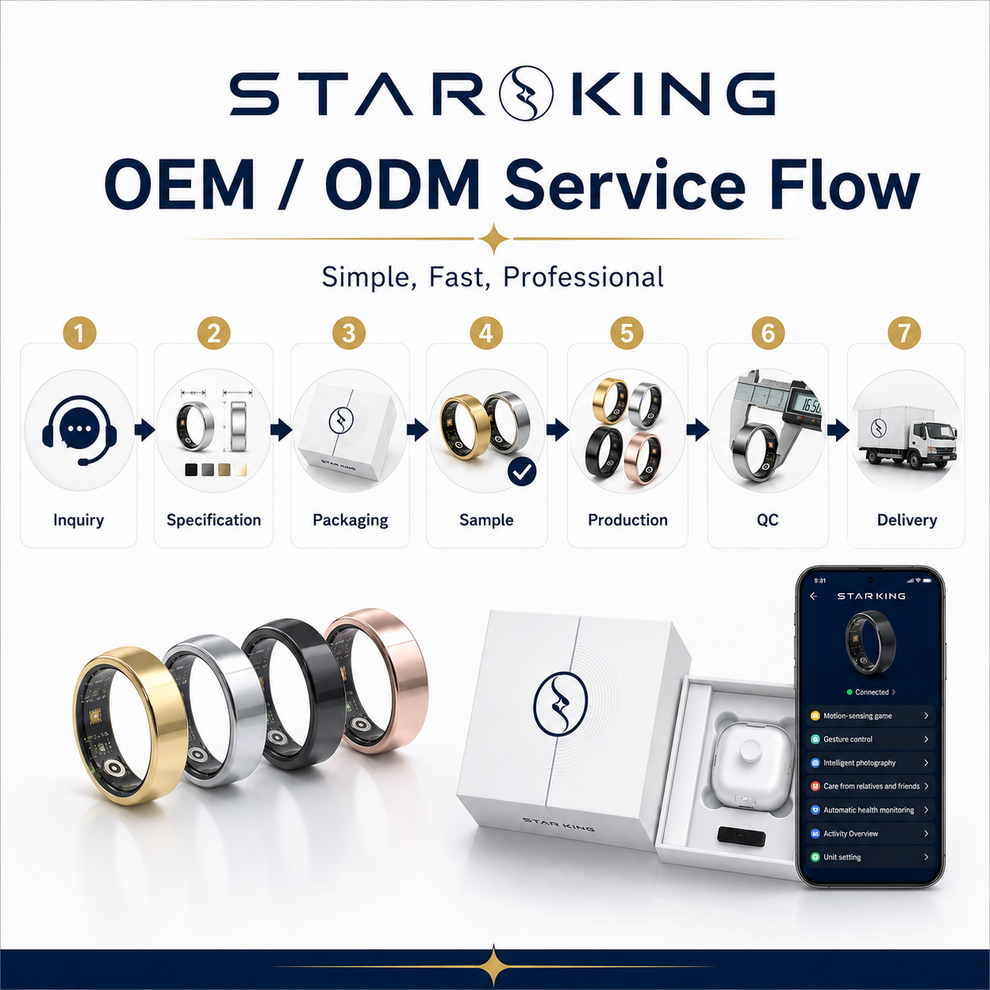
The private label OEM/ODM solution overview explains how customization layers are typically sequenced, from logo and packaging through firmware and App changes. For awareness-stage planning, the key point is that packaging and branding decisions should be made before the sample round closes, because they affect MOQ and lead time.
Check 6: App, Firmware, and Data Handling Support
A smart watch is a hardware-plus-software product. The App experience affects reviews, return rates, and store-level support calls. Buyers should understand what the supplier can change and what is fixed.
Practical questions include: Is the App provided as a standard build, or can the interface, language, or onboarding flow be customized? How are firmware updates delivered, and how often? What happens to existing devices if the App is updated? Who handles user support questions at the retail level? Data handling and privacy statements should also be reviewed, because the App may collect health-related information that carries disclosure obligations in the US market.
For health and fitness oriented SKUs, confirm how the sensor data is presented. Consumer wellness metrics such as heart rate or sleep estimates are typically described as wellness features, not medical diagnostics, and packaging and manual language should reflect that distinction. Buyers should verify the wording on any health-related claim against the supplier’s own documentation.
Check 7: Lead Time and Replenishment Planning
Lead time for repeat orders and lead time for first orders are different numbers, and both should be stated in writing. First orders typically include sample approval, artwork approval, component procurement, production, and inspection. Repeat orders are usually shorter but still depend on component availability.
Retail chains should plan backward from the shelf reset date. That means building in buffers for artwork revisions, ocean freight variability, and the factory slowdown period around Chinese New Year. A replenishment plan that assumes a fixed weekly output without accounting for these factors tends to produce stockouts during peak selling periods.
Ask for a written production schedule with milestone dates, and confirm which party is responsible at each checkpoint. If the supplier cannot commit to dates in writing, that is a planning risk to price into the program.
Key Facts for Buyers
| Decision Point | What to Confirm | Typical Timing |
|---|---|---|
| Assortment and price ladder | 3–5 models mapped to retail price points | Before sampling |
| Display and battery claims | Usage scenario behind each claim | Sample stage |
| FCC authorization | Authorization type and grantee for the exact model | Sample stage to pre-order |
| UN 38.3 and battery documents | Cell-level test summary | Before booking freight |
| MOQ per SKU and configuration | Volume tiers and tooling amortization | Quotation stage |
| Packaging and logo | Artwork proof and print run approval | Before production |
| App and firmware | Customization scope and update practice | Sample stage |
| Lead time | First-order and repeat-order schedules | Before PO |
Common Mistakes and Buyer Red Flags
Mistakes buyers make
- Selecting a single model and assuming it can serve the whole shelf plan.
- Accepting a certificate image without checking that the model number on the document matches the SKU.
- Negotiating unit price before packaging and App scope are defined, then discovering later that both raise MOQ.
- Planning a launch date without a buffer for artwork approval and freight variability.
- Skipping a returns simulation during sample testing, so warranty exposure is estimated rather than measured.
Red flags with suppliers
- No model-level documentation available for review.
- Lead time quoted verbally with no milestone schedule.
- Unwillingness to state warranty terms or spare-part availability in writing.
- Unclear ownership of artwork files and tooling at end of program.
- Pressure to commit to volume before samples are tested.
If several of these red flags appear in the same conversation, it usually makes sense to compare a second supplier before continuing. For a wider supplier comparison framework, the STAR KING resources blog covers related sourcing and verification topics.
Practical Buyer Checklist
- Assortment mapped to at least three price points with visual differentiation.
- Display brightness, case size, and strap options confirmed on physical samples.
- Battery claim usage scenario documented in writing.
- FCC equipment authorization record reviewed for the exact model.
- UN 38.3 test summary confirmed for the actual cell used.
- Retailer-specific compliance documents listed and dated.
- MOQ stated per SKU and per configuration, with tooling costs itemized.
- Landed cost model built before price negotiation closes.
- Packaging proof approved and barcode requirements confirmed.
- App customization scope, update practice, and support responsibility defined.
- First-order and repeat-order lead times provided in writing.
- Warranty terms, spare parts, and after-sales contact confirmed.
FAQ
What MOQ should a US retail chain expect for smart watches?
MOQ is usually quoted per model and per configuration, and it can rise when custom packaging, logo placement, or App changes are added. Buyers should ask for a volume tier table and confirm how tooling or setup costs are handled across orders.
Do smart watches need FCC certification before US retail sale?
Models with Bluetooth or Wi-Fi contain intentional radiators and typically require FCC equipment authorization. The specific procedure depends on the radio configuration, so buyers should verify the record for the exact model rather than relying on a general claim.
How long does a first order usually take?
First-order lead time is longer than repeat-order lead time because it includes sample approval, artwork approval, component procurement, production, and inspection. Ask for a written milestone schedule and build in buffer ahead of shelf reset dates.
Can retail chains request private label packaging and App changes?
Private label programs commonly cover packaging, manual, logo, and in some cases App branding. The exact scope depends on the supplier’s firmware and App architecture, so the customization list should be confirmed in writing before the quotation is finalized.
What battery documents are needed for air shipment?
Air transport of lithium battery products generally requires a UN 38.3 test summary and appropriate shipping documentation. Requirements typically depend on cell capacity and packaging configuration, and buyers should verify documents against the exact cell used.
How should a retail chain test samples?
Test samples under realistic conditions: store lighting for display readability, daily wear for comfort, and a simulated return scenario to estimate failure rates. Compare results against your own warranty and markdown assumptions rather than against the spec sheet alone.
Conclusion
Sourcing smart watches for US retail chains is a documentation and coordination task as much as a product selection task. The models must fill a price ladder, the packaging must match the chain’s brand standards, the App must be supportable, and the compliance file must be complete before the shipment is booked. Buyers who verify these points during the sample stage make faster decisions later and avoid the costly revisions that come from resolving them after a purchase order is issued.
The most reliable approach is to treat each of the seven checks as a gate. Assortment and specification decisions close first, then compliance and packaging, then MOQ and lead time. That sequence keeps the commercial negotiation aligned with what the factory can actually document and deliver.
Next Step
If you are evaluating smart watches for a US retail program, the practical next step is to request samples and the associated documentation for the exact configurations you are considering. You can request product samples and confirm FCC, battery, packaging, MOQ, and lead-time details for each model before your category review. Sharing your target price points and shelf plan in the first message helps the supplier respond with a relevant range rather than a generic catalog.
Discuss Your Smart Wearable OEM/ODM Project
Planning a smart ring, smart watch, smart band, AI glasses, AI translator, or AI voice mouse project? Contact STAR KING to discuss product positioning, sample testing, customization scope, certification requirements, lead time, and quotation details.

Team Star King

Scan WhatsApp QR code
Leave a Reply