
Smart Watches for Retail Chains: 7 Checks Before You Choose an OEM Partner in 2026
October 10, 2026 · Team Star King
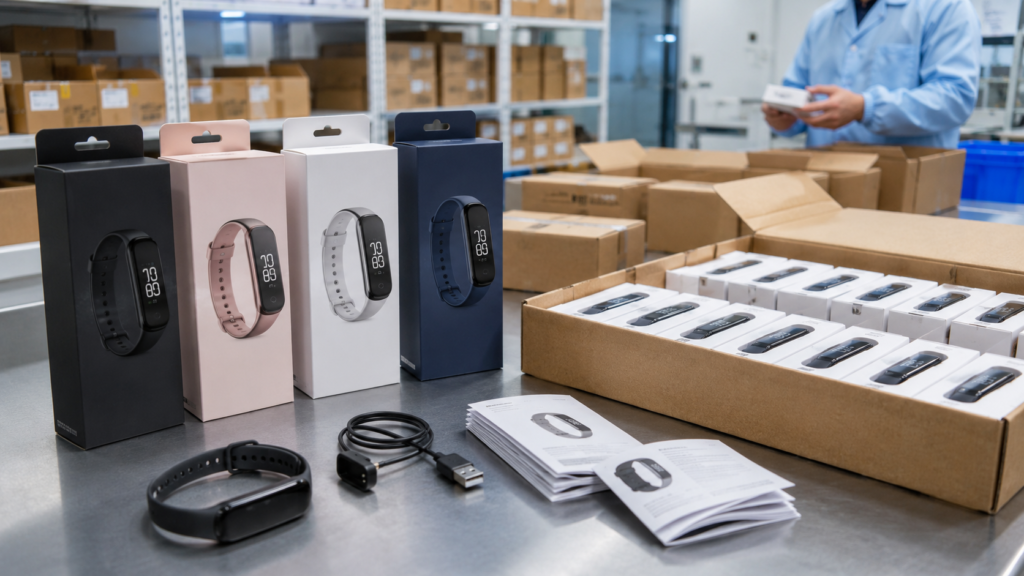
Smart Watches for Retail Chains: 7 Checks Before You Choose an OEM Partner in 2026
Smart watches for retail chains should be evaluated on FCC authorization, documented MOQ, app and firmware ownership, sample verification, packaging scope, and landed cost — not brochure specifications. This guide walks US retail buyers through seven checks that separate OEM partners who can support shelf-ready programs from suppliers who only quote a unit price.
Table of Contents
Table of Contents
smart watches for retail chains: Short Answer
US retail chains typically need a smart watch supplier that can provide FCC-compliant hardware, defined MOQ per SKU, owned or licensed app and firmware, retail-ready packaging, and clear lead times for replenishment. The right partner is the one whose documentation and sample performance match your planogram, return policy, and margin targets — not simply the lowest quote.

Table of Contents
- What Is a Retail-Ready Smart Watch Program?
- Key Facts for Buyers
- Check 1: FCC and Market Compliance
- Check 2: MOQ and Planning
- Check 3: App, Firmware and Data
- Check 4: Sample Testing and Verification
- Check 5: Packaging and Brand Identity
- Check 6: Battery, Shipping and Returns
- Check 7: Cost Structure and Landed Cost
- Comparison Table: Quote-Only vs Retail-Ready Supplier
- Common Mistakes and Buyer Red Flags
- Practical Buyer Checklist
- FAQ
- Conclusion

Key Takeaways
- FCC authorization is a baseline for US retail, but the exact scope depends on the radio configuration and must be verified per model.
- MOQ is rarely a single number; it changes with tooling, color, packaging, and firmware customization.
- App and firmware ownership affect your long-term brand value and your ability to switch suppliers.
- Sample testing should include real-world battery, sensor, pairing, and drop scenarios before you commit to a purchase order.
- Landed cost — not unit price — determines shelf margin once duties, freight, and returns are included.

What Is a Retail-Ready Smart Watch Program?
A retail-ready smart watch program is a supply relationship that delivers more than devices. It includes documented compliance, consistent color and packaging across replenishment cycles, an app your customers can install and trust, and a repair or replacement path that fits your retail policy. For US retail chains, this means every SKU must survive scrutiny from buyers, compliance teams, and store-level operations.
Buyers often compare suppliers on price first. However, retail failures rarely come from price. They come from inconsistent quality between batches, missing certification documents, or an app that stops updating. Evaluating smart watches for retail chains therefore means evaluating the supplier system behind the device.
Why Retail Chains Evaluate Differently Than E-commerce Sellers
Online sellers can update a listing quickly when a product changes. Retail chains commit to planogram space, shelf labeling, and seasonal calendars. A delayed shipment or a batch with a different casing finish can force markdowns. Before shortlisting a smart watch supplier, retail buyers should confirm that the factory can repeat the approved sample consistently.
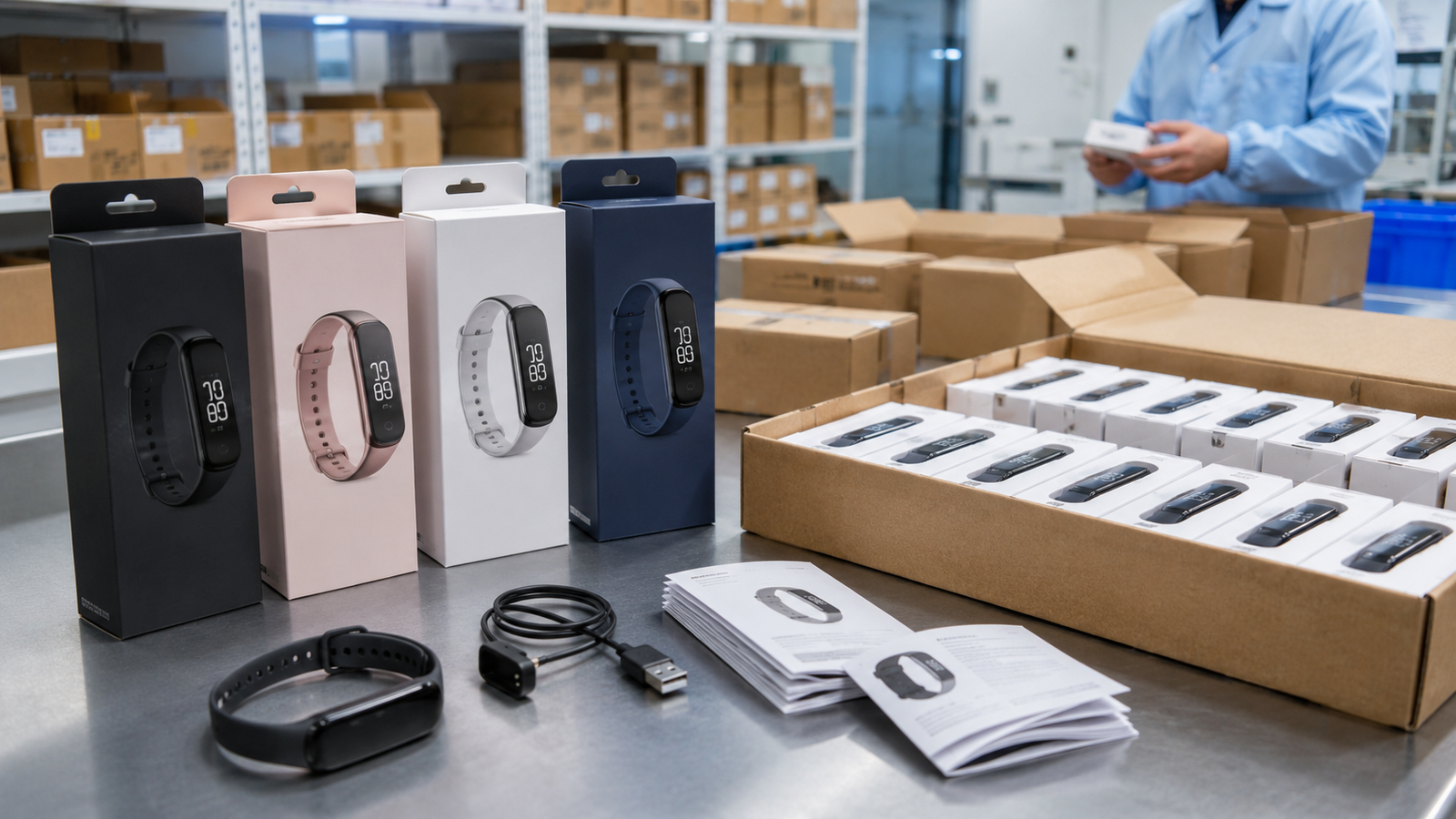
Key Facts for Buyers
| Item | Typical Range | What to Verify |
|---|---|---|
| MOQ per SKU | [STAR KING TO CONFIRM] | Confirmed in writing with color and packaging assumptions |
| Sample lead time | [STAR KING TO CONFIRM] | Includes firmware build and packaging mock-up |
| Mass production lead time | [STAR KING TO CONFIRM] | Stated by SKU and season |
| FCC scope | Model and radio dependent | FCC ID and test report on file |
| Battery documentation | UN38.3 and MSDS as applicable | Per battery pack and shipping method |
| Warranty | [STAR KING TO CONFIRM] | Written terms and spare parts policy |
| Tooling ownership | Contract dependent | IP and mold ownership clause |
Check 1: FCC and Market Compliance for US Retail
In the United States, radio-frequency devices such as Bluetooth smart watches are generally subject to FCC equipment authorization rules. The exact requirement — certification versus supplier’s declaration — depends on the product’s radio modules and configuration. Buyers should request the FCC ID for each retail SKU and verify it in the FCC ID database rather than relying on a PDF alone.
Beyond the radio, retail chains often ask for battery test summaries, safety documentation, and materials declarations. Requirements vary by retailer, by state, and by product category. A supplier that understands these differences can prepare documents for your compliance team instead of forwarding generic certificates.
Documents to Collect Before the First PO
- FCC ID and the associated grant for each radio configuration
- Battery test summary and shipping documentation such as UN38.3 and MSDS where applicable
- RoHS and REACH statements if your compliance team requires them
- Declaration of conformity templates for private label packaging
Note that compliance is configuration-specific. A supplier cannot responsibly claim that every model in a catalog is certified for every market. Verify the documents against the exact model you intend to stock.
Check 2: MOQ and Production Planning
MOQ discussions should start with your planogram, not the supplier’s catalog. A retail chain that plans 12 SKUs across 300 stores faces a different MOQ structure than one testing a single holiday SKU in 50 doors. A practical supplier will quote MOQ by product family and explain which variables change it.
What Usually Drives MOQ Up
- Custom casing color or finish requiring dedicated production runs
- Custom tooling or a new mold
- Fully custom packaging with inserts and printed manuals
- Firmware builds with retailer-specific defaults
When a supplier presents MOQ, ask which parts are fixed and which are negotiable. Buying guide discussions often miss that MOQ and lead time are linked. A smaller first order may be possible, but it usually moves your production slot later in the calendar.
Check 3: App, Firmware and Data Ownership
For retail chains, the companion app is part of the product experience and part of your risk profile. Buyers should clarify who owns the app source, who publishes updates, and what happens if the relationship ends. A white-label app that the supplier controls may limit your ability to move to another factory later.
Privacy is another evaluation point. Health-related data collected by wearables may fall under evolving US state privacy laws, and requirements typically depend on the state and the data type. Your legal team, not the supplier, should confirm obligations. The supplier’s role is to document what data the app collects and where it is stored.
Questions to Ask the Supplier
- Is the app published under your developer account or ours?
- Can firmware defaults be customized for our retail brand?
- What update cadence is committed, and for how long?
- Which data is transmitted off-device, and to which servers?
If you are exploring broader wearable customization options, STAR KING’s overview of private label and OEM/ODM solutions explains how app, firmware, and packaging scope are usually structured. Buyers comparing hardware families may also review the smart watch product line alongside other wearable formats.
Check 4: Sample Testing and Verification
Samples are the cheapest risk reduction in a retail program. However, a single golden sample is not enough. Request production-representative samples from the actual line, not hand-built evaluation units. Then test them the way your customers will.
A Practical Sample Test Plan
- Screen brightness and readability under store lighting
- Battery life over at least five charge cycles, logged
- Heart rate and blood oxygen readings compared against a reference device (as consumer wellness features, not medical measurements)
- Bluetooth pairing and reconnection after phone restart
- Charging port and strap durability over repeated use
- Water exposure consistent with the claimed IP rating
- Packaging drop test at retail shipping conditions
Document every deviation between the sample and the specification sheet. Suppliers that welcome this process tend to have stronger quality systems. If the supplier resists sample testing or sends units that differ from the quoted configuration, treat it as an early warning.
Check 5: Packaging and Brand Identity
Retail packaging carries your brand and your compliance obligations. It should include the correct model identifiers, regulatory markings, and language required by your market and your retail partner. The supplier should provide a dieline, a printed proof, and a color standard before production.
Ask how the supplier handles version control. A packaging change that ships against an old artwork file can put non-compliant claims on shelf. For multi-SKU programs, request a packaging matrix that maps each SKU to its artwork revision and compliance markings.
Check 6: Battery, Shipping and Returns
Lithium batteries introduce shipping and after-sales complexity. Air and ground transport requirements depend on battery capacity, packaging, and carrier rules, and buyers should verify current requirements with the carrier and, where relevant, the applicable regulations. The IATA Dangerous Goods Regulations are a common reference for air transport.
Returns also matter at retail scale. Confirm the warranty period, the spare parts policy, and whether the supplier supports a repair center or a replacement pool. A written after-sales process is more valuable than a verbal promise, especially when you operate hundreds of doors.
Check 7: Cost Structure and Landed Cost
Unit price is only one component. Landed cost includes freight, duties, insurance, packaging, and the cost of returns or defects. Retail buyers should model landed cost per SKU at the expected defect rate, not at zero defects.
Cost Inputs to Request From the Supplier
- FOB price by SKU and by volume tier
- Packaging cost per unit and per master carton
- Estimated shipping weight and carton dimensions
- Tooling or setup fees, if any
- Sample and courier costs
This is where comparison tools help. A structured comparison across suppliers keeps the discussion on total cost and total risk. If you are evaluating several vendors at once, STAR KING can provide a sample request so you can benchmark hardware and packaging directly.
Comparison Table: Quote-Only Supplier vs Retail-Ready Supplier
| Evaluation Area | Quote-Only Supplier | Retail-Ready Supplier |
|---|---|---|
| Compliance | Sends a generic certificate | Provides FCC ID and model-specific documents |
| MOQ | Single number, no explanation | MOQ by SKU, color, and packaging scope |
| App | Supplier-controlled, limited transparency | Documented ownership and update policy |
| Samples | One evaluation unit | Production-representative samples with test plan |
| Packaging | Standard box only | Dieline, proof, and artwork version control |
| After-sales | Verbal warranty | Written warranty and spare parts policy |
| Cost | Unit price focus | Landed cost model with defect allowance |
Common Mistakes and Buyer Red Flags
Common Mistakes
- Approving a purchase order based on a hand-built sample rather than a production sample
- Assuming a catalog-wide certificate covers every model you plan to stock
- Ignoring app ownership until after launch
- Planning promotions without confirming replenishment lead time
- Comparing suppliers on unit price while excluding freight and defect costs
Buyer Red Flags
- Certification documents that do not match the model number you intend to buy
- Refusal to allow a third-party pre-shipment inspection
- No written statement on firmware or app ownership
- Specifications on the quote that differ from the sample
- No spare parts or repair process defined
None of these red flags are automatically disqualifying. However, each one should be resolved in writing before you commit shelf space.
Practical Buyer Checklist
- Confirm FCC ID and compliance documents for each retail SKU
- Obtain written MOQ by SKU, color, and packaging scope
- Clarify app and firmware ownership and update commitments
- Request production-representative samples and run a documented test plan
- Approve packaging dieline, proof, and artwork revision control
- Confirm battery shipping documentation for the intended transport mode
- Define warranty, spare parts, and returns handling
- Build a landed cost model including freight, duties, and defects
- Agree on pre-shipment inspection terms and acceptance criteria
- Confirm tooling and IP ownership in the supply agreement
FAQ
What is a realistic MOQ for smart watches for retail chains?
MOQ depends on tooling, color, and packaging scope rather than a single catalog number. Retail programs usually negotiate MOQ by product family, with higher quantities required for custom colors or fully custom packaging. Request the MOQ in writing with the assumptions stated.
Are all smart watches sold in the US required to have FCC certification?
Radio-frequency devices are generally subject to FCC equipment authorization rules, but the exact procedure depends on the radio configuration. Buyers should verify the FCC ID for each model and confirm the applicable requirement for their specific product.
Can a retail chain buy private label smart watches without owning the app?
Yes, but the trade-off is control. If the supplier owns the app, your ability to change features or move suppliers later may be limited. Clarify publishing accounts, source ownership, and update commitments before signing.
How long should sample evaluation take before a purchase order?
Most retail buyers allow two to four weeks for sample testing, including battery cycles and packaging review. The timeline should match the size of the order and the number of SKUs under evaluation.
What documents should accompany a smart watch shipment to the US?
Typical documents include commercial invoice, packing list, and battery-related shipping documentation. The exact set depends on the carrier, the battery configuration, and the shipping method. Confirm requirements with your freight forwarder.
How do retail buyers avoid quality differences between production batches?
Use an approved golden sample, a written inspection standard, and pre-shipment inspection for each production run. Batch-to-batch consistency is a process question, so the supplier’s quality system matters more than a single test result.
Who owns the mold and tooling for a custom smart watch?
Ownership depends on the contract. Buyers investing in tooling should confirm IP and mold ownership clauses in writing, along with the conditions for transferring tooling to another manufacturer.
Conclusion
Smart watches for retail chains are a systems purchase. Compliance documents, MOQ structure, app ownership, sample performance, packaging control, and landed cost all determine whether a program succeeds on shelf. The seven checks in this guide give US retail buyers a repeatable way to compare suppliers without relying on marketing claims.
Start with the compliance file and the sample, because those two items reveal how the supplier operates. If the documentation matches the model and the sample matches the specification, the commercial discussion becomes much simpler.
Next Step
If you are evaluating smart watches for a US retail program, request production-representative samples and a written MOQ and lead time schedule. STAR KING can support sample requests, packaging review, and OEM/ODM discussions based on your target specifications. Request smart watch samples and MOQ details to compare configurations against your planogram.
Discuss Your Smart Wearable OEM/ODM Project
Planning a smart ring, smart watch, smart band, AI glasses, AI translator, or AI voice mouse project? Contact STAR KING to discuss product positioning, sample testing, customization scope, certification requirements, lead time, and quotation details.

Team Star King

Scan WhatsApp QR code
Leave a Reply