smart watch suppliers: 7 Critical Checks When Sourcing Smart Watches for Amazon US in 2026
smart watch suppliers buyers need a supplier evaluation process that checks product fit, OEM/ODM capability, compliance documents, quality control, pricing, lead time, and after-sales support before placing a bulk order.
Table of Contents
Table of Contents
7 Critical Checks When Sourcing Smart Watches for Amazon US in 2026
Sourcing smart watches for Amazon US in 2026 means you must verify FCC equipment authorization, UN38.3 lithium battery shipping documents, MOQ, firmware quality, and IP protection before you pay a deposit. The U.S. market is attractive but unforgiving: platform compliance checks, strict battery rules, and intense price competition can wipe out margins if your supplier is not properly vetted. This guide gives Amazon sellers, importers, and private-label brands a practical, seven-point procurement framework to evaluate suppliers, avoid red flags, and build a saleable smart watch line.
smart watch suppliers: Table of Contents
- Direct Answer: What Should You Check First?
- Key Takeaways
- Key Facts for Buyers
- 1. Verify FCC and RF Compliance for the U.S. Market
- 2. Confirm Battery Certification and Air Shipping Documents
- 3. Pin Down MOQ, Tooling and Unit Economics
- 4. Evaluate the App Ecosystem and Firmware Support
- 5. Qualify Quality Control and Pre-Shipment Inspection
- 6. Protect Your Brand, Packaging and IP
- 7. Plan Samples, Lead Time and After-Sales
- Comparison: Standard vs. Private-Label vs. Full ODM Smart Watches
- Common Mistakes and Buyer Red Flags
- Practical Buyer Checklist
- FAQ
- Conclusion

Direct Answer: What Should You Check First?
Before signing a supply agreement for smart watches destined for Amazon US, confirm three things in writing: (1) proof of FCC equipment authorization for the exact radio configuration you will import, (2) a valid UN38.3 test report and battery test summary for the lithium battery, and (3) the true MOQ, tooling cost, and lead time for your chosen customization level. If any of these three cannot be documented, pause the order and keep sourcing.
Key Takeaways
- FCC authorization applies to each wireless product configuration; a report for one model may not cover a variant with a different radio or antenna.
- Lithium batteries require UN38.3 testing and, in most air shipments, a test summary and Shipper’s Declaration.
- MOQ is often driven by tooling, display module order lots, and packaging, not only by assembly capacity.
- App quality and firmware update policy decide your return rate and review score as much as the hardware does.
- Pre-shipment inspection and IP/mold ownership terms belong in the contract, not in a friendly chat.
Key Facts for Buyers
| Item | What It Means for Amazon US Sellers | Typical Check |
|---|---|---|
| FCC equipment authorization | Required for intentional and many unintentional radiators; each radio variant generally needs its own approval | FCC ID or Supplier’s Declaration of Conformity |
| UN38.3 lithium battery test | Required for lithium cells/batteries to be shipped by air | UN38.3 test report + test summary |
| MOQ | Determines cash flow and storage risk | Written quotation with unit price tiers |
| Pre-shipment inspection | Reduces defective units and chargebacks | Inspection report + AQL plan |
| App and firmware | Affects returns, reviews, and repeat sales | iOS/Android test, update policy |
| IP/mold ownership | Protects your private-label investment | Contract clause + tooling invoice |
1. Verify FCC and RF Compliance for the U.S. Market
What the FCC Actually Requires
The FCC regulates radio frequency devices. Smart watches that include Bluetooth, Wi-Fi, or cellular radios are generally intentional radiators and require equipment authorization. Many devices use Supplier’s Declaration of Conformity (SDoC) procedures; transmitters subject to certification must obtain an FCC ID. The specific route depends on the device and radio. Buyers should verify the current FCC equipment authorization database and the supplier’s documentation for the exact model and configuration they intend to import.
How to Check It as a Buyer
- Ask for the FCC ID and confirm it in the official FCC database.
- Confirm the tested model number matches your purchase order.
- If your version uses a different radio module or antenna, request confirmation that the approval still applies.
- Request the test report summary and the grant or SDoC documentation.
Why this matters: Amazon can require compliance documentation, and U.S. customs can stop or seize non-compliant radio devices. Confirm the requirement before production, not after arrival.
2. Confirm Battery Certification and Air Shipping Documents
UN38.3 and Air Transport
If your watches ship by air, the lithium battery cells and packs typically need UN38.3 testing. The UN38.3 test covers altitude simulation, thermal, vibration, shock, external short circuit, impact, overcharge, and forced discharge. The UN Manual of Tests and Criteria is the underlying standard; IATA Dangerous Goods Regulations and national rules govern how the shipment is declared.
Documents to Request
- UN38.3 test report and test summary (the summary is often required to be available).
- MSDS/SDS for the battery type.
- Shipper’s Declaration for Dangerous Goods, when applicable.
- Packaging photos and a packing method statement.
Battery rules vary by carrier, route, and pack size. Buyers should verify requirements with the freight forwarder and confirm the documentation matches the battery actually loaded.
3. Pin Down MOQ, Tooling and Unit Economics
What Drives MOQ
MOQ is usually set by the lowest-cost production runs of tooling, display modules, sensor modules, PCB lots, and custom packaging. A private-label logo on a standard housing may need only a modest order, while a new enclosure or custom strap shape can raise MOQ and add tooling cost.
| Customization Level | What Changes | Typical Cost Pressure |
|---|---|---|
| Standard model, logo on caseback and packaging | Laser/print logo, retail box | Low, mostly packaging |
| Standard housing, custom strap and UI | Strap tooling/molding, firmware and app branding | Medium, strap mold + firmware |
| Full ODM new design | New enclosure, PCB, sensors, tooling | High, full tooling + development |
Request unit price tiers (for example at 500, 1,000, and 3,000 units) so you can model landed cost. Landed cost should include unit price, freight, duty, inspection, platform fees, and returns reserve.
4. Evaluate the App Ecosystem and Firmware Support
For Amazon sellers, the app can generate more complaints than the hardware. Check the companion app for iOS and Android, account creation flow, notification reliability, sleep and heart rate accuracy claims (clearly framed as consumer wellness, not diagnosis), language support, and data privacy policy.
Questions to Ask
- Is the app white-labeled under our brand? Who hosts the data?
- How are firmware updates delivered, and for how long will you support this model?
- Can we get an API or export for our own dashboard?
- What happens if the app is discontinued?
You can review typical smart watch features and form factors on our smart watches product page and compare how app and firmware customization are handled in our private-label OEM/ODM solution. If your catalog also includes rings, see our guide to sourcing smart rings.
If you are evaluating program options, our team can send samples and walk through app and firmware customization before you commit to tooling.
5. Qualify Quality Control and Pre-Shipment Inspection
Quality control should be verifiable, not promised. Ask for the supplier’s inspection plan, defect classification, and AQL level. For wearables, testing typically includes waterproof/water-resistance checks, drop testing, aging/burn-in, and battery safety checks. A pre-shipment inspection should be performed on a random sample before the balance payment.
| Stage | What to Inspect | Evidence |
|---|---|---|
| Incoming components | Display, sensors, battery lot | Component inspection records |
| In-process | Assembly, sealing, firmware flashing | Process check sheets |
| Final | Function, charging, pairing, appearance | AQL inspection report |
| Pre-shipment | Packing, carton drop, label accuracy | Inspection photos and report |
Water resistance claims should be qualified: IP ratings describe protection under specific test conditions and do not mean the watch is suitable for all water activities.
6. Protect Your Brand, Packaging and IP
Private-label sellers need clear ownership of logos, artwork, tooling, and molds. Put the following in the contract:
- Mold and tooling ownership, including who stores them and who pays for maintenance.
- Exclusivity terms for your design and packaging.
- Confidentiality and non-disclosure for your brand assets and sales data.
- Packaging customization specs: box size, insert, manual languages, warning labels, and barcodes (UPC/EAN).
Request packaging proofs before mass production. Incorrect retail packaging can force relabeling or cause Amazon listing issues.
7. Plan Samples, Lead Time and After-Sales
Sampling and Lead Time
Golden samples should be signed and retained by both parties. Typical timelines vary: standard models may ship in weeks, while ODM development with new tooling can take longer. Confirm the schedule in writing, including component long-lead items.
After-Sales
- Warranty period and what it covers (unit replacement vs. parts).
- Spare parts availability: straps, chargers, and screen protectors.
- Defect rate thresholds and replacement policy.
- Technical support for your customer service team.
Ask who pays return freight for defective units and how replacements are shipped. This directly affects your Amazon return costs.
Comparison: Standard vs. Private-Label vs. Full ODM Smart Watches
| Factor | Standard (White-Label) | Private Label | Full ODM |
|---|---|---|---|
| Branding | Supplier brand | Your logo, packaging | Your brand and design |
| Tooling cost | None | Low, mostly packaging | New enclosure/PCB |
| MOQ | Often low | Moderate | Higher |
| Time to market | Fast | Moderate | Longer |
| Differentiation | Low | Medium | High |
Common Mistakes and Buyer Red Flags
- Accepting a compliance certificate that names a different model or radio band.
- No UN38.3 documents until the forwarder asks at the airport.
- Paying full deposit before a pre-shipment inspection is agreed.
- Assuming app branding is included in the unit price.
- No mold ownership clause for custom enclosures.
- Relying on verbal promises about lead time during peak season.
- Treating consumer wellness metrics as medical data in marketing copy.
Practical Buyer Checklist
- FCC ID or SDoC for the exact configuration, verified in the official database.
- UN38.3 test report, test summary, and SDS on file before booking freight.
- Written quote with MOQ tiers, tooling, and payment terms.
- App test on iOS and Android; firmware update policy confirmed.
- Signed golden sample and inspection plan with AQL.
- Mold/tooling ownership and exclusivity terms in the contract.
- Packaging proof approved before mass production.
- Warranty, spare parts, and defect replacement terms documented.
FAQ
Do I need FCC certification to sell smart watches on Amazon US?
Wireless smart watches are generally subject to FCC equipment authorization. The exact route depends on the radio and device type. Verify the FCC ID or SDoC for your specific model in the official FCC database, and confirm with the supplier that it covers your configuration.
What is a typical MOQ for private-label smart watches?
MOQ depends on customization. Logo and packaging on a standard model may start lower, while custom straps or a new enclosure raise MOQ and add tooling cost. Ask for tiered pricing to plan cash flow.
Can smart watches ship by air to the U.S.?
Lithium-battery devices can usually ship by air when UN38.3 testing is complete and the shipment is declared correctly. Rules depend on carrier and route, so confirm with your forwarder and ensure documents match the battery installed.
Are the health features medical-grade?
Most smart watch health metrics are consumer wellness features, not diagnostic tools. Marketing should avoid medical claims. If you need medical-adjacent positioning, seek regulatory advice for your target market.
How do I protect my private-label design?
Use a contract that assigns mold and tooling ownership to you, defines exclusivity, and includes confidentiality terms. Keep records of tooling payments and design files.
How long does production take?
Lead time varies with customization and component availability. Standard models may take weeks, while new tooling and ODM development take longer. Get a written schedule with milestones.
What certifications should I ask for beyond FCC?
Depending on the product and market, you may also need RoHS documentation, battery UN38.3, and packaging compliance. Requirements vary by configuration and destination, so verify with the supplier and your compliance advisor.
Conclusion
Sourcing smart watches for Amazon US in 2026 rewards sellers who treat compliance, batteries, app quality, and IP protection as core procurement steps, not afterthoughts. Use the seven checks above to compare suppliers on documented evidence: FCC authorization for the exact configuration, UN38.3 and SDS files, clear MOQ and tooling terms, tested app and firmware, inspection plans, and written IP and after-sales terms. Sellers who verify these items before paying a deposit reduce the risk of customs holds, listing issues, and margin-killing returns. If your catalog needs more options, review our smart watch product page and the private-label OEM/ODM solution to compare configuration paths.
Next Step
Ready to move from research to evaluation? Request smart watch samples, share your target configuration, and confirm the FCC and battery documentation you need for the U.S. market. Our team can discuss OEM/ODM options, MOQ tiers, and packaging customization so you can compare real quotes before committing to production. Request product samples and start your supplier comparison with documented specifications.
Discuss Your Smart Wearable OEM/ODM Project
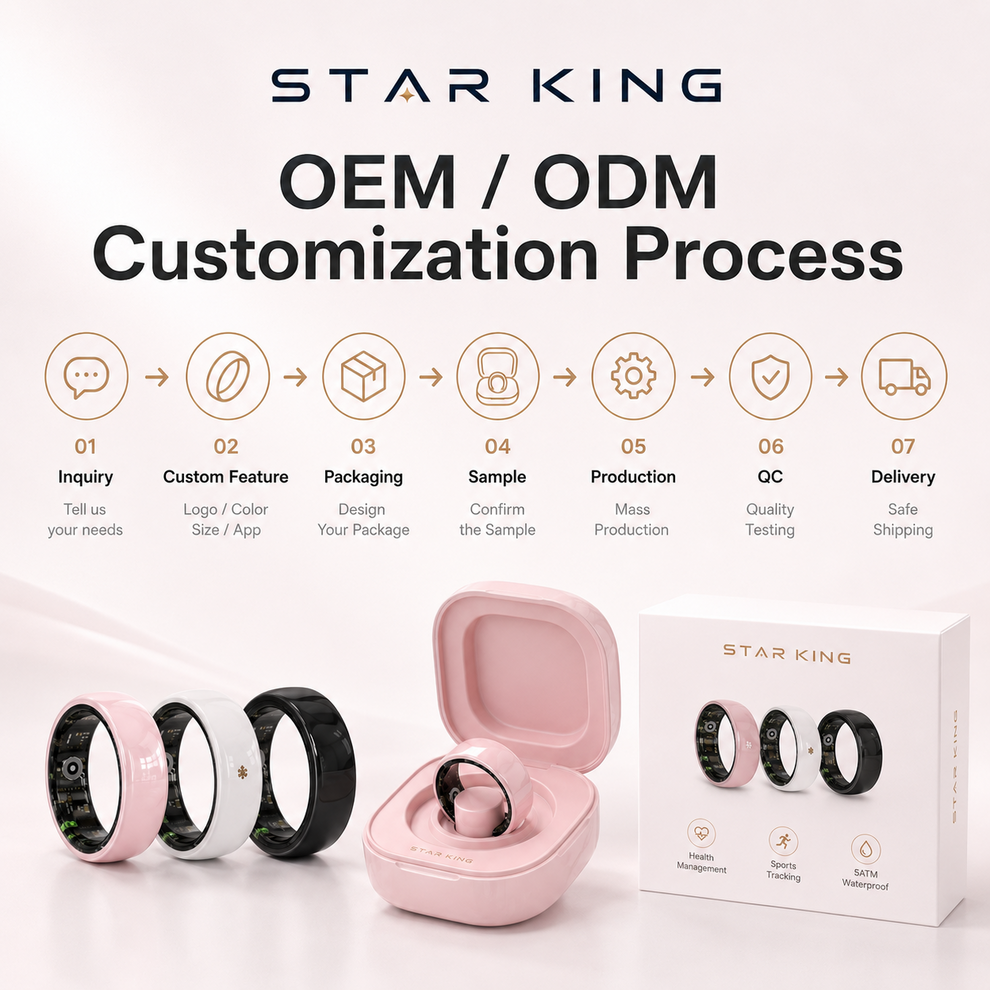
Planning a smart ring, smart watch, smart band, AI glasses, AI translator, or AI voice mouse project? Contact STAR KING to discuss product positioning, sample testing, customization scope, certification requirements, lead time, and quotation details.

Team Star King
Scan WhatsApp QR code