
smart rings OEM: Smart Rings for Retail Chains: 9 Proven Steps to Select a Reliable OEM Supplier in 2026
October 12, 2026 · Team Star King
Smart Rings for Retail Chains: 9 Proven Steps to Select a Reliable OEM Supplier in 2026
This guide delivers a practical 9‑step framework for retail chains evaluating smart rings OEM suppliers. It covers specification alignment, supplier verification, private‑label feasibility, MOQ, compliance, sample testing, lead times, logistics, and after‑sales. Use it to compare factories consistently, reduce sourcing risk, and run a structured RFQ. In short, the goal is to approve a supplier that can deliver repeatable quality at your target landed cost, not just the lowest quote.
Table of Contents
Table of Contents
Table of Contents
- Short Answer: How Should Retail Chains Choose a Smart Rings OEM Supplier?
- Key Takeaways
- Key Facts for Buyers
- What “Smart Rings OEM” Means for a Retail Chain
- Step 1: Define the Retail Use Case and Product Tier
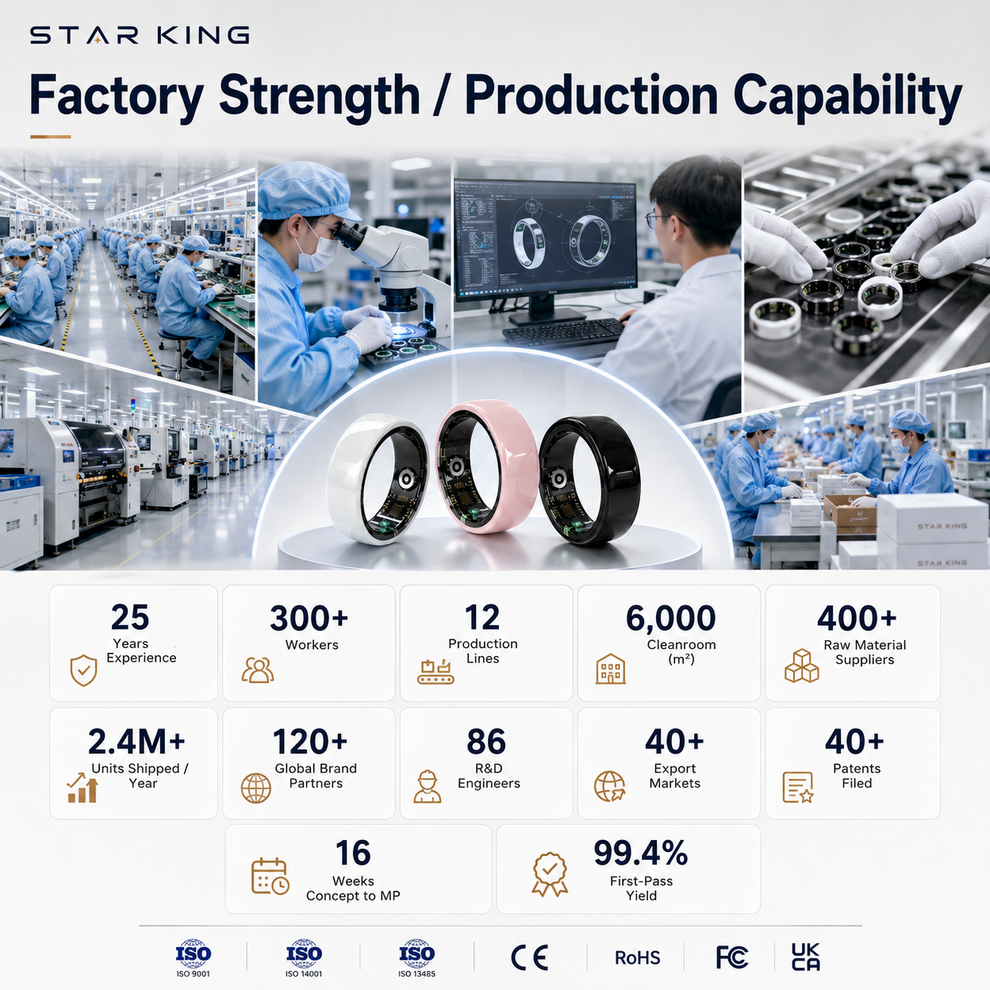
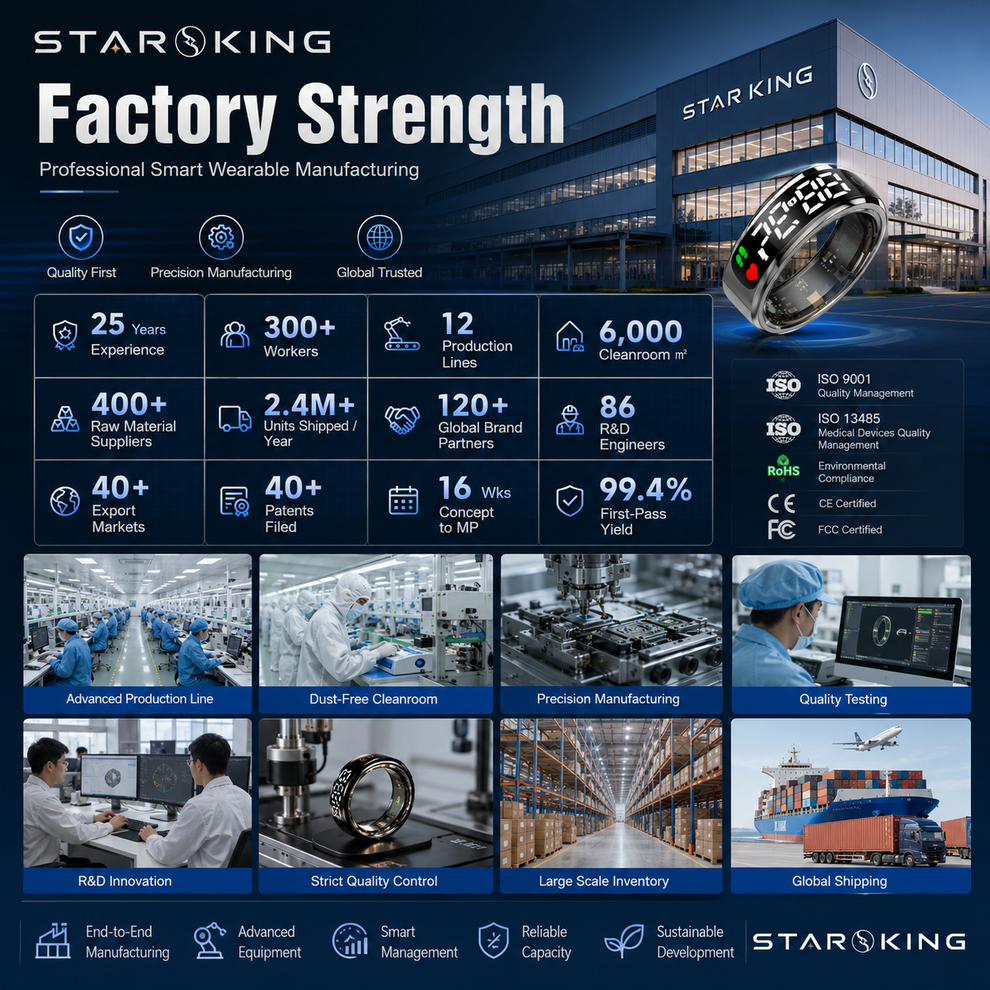
- Step 2: Verify the Manufacturer Before You Discuss Price
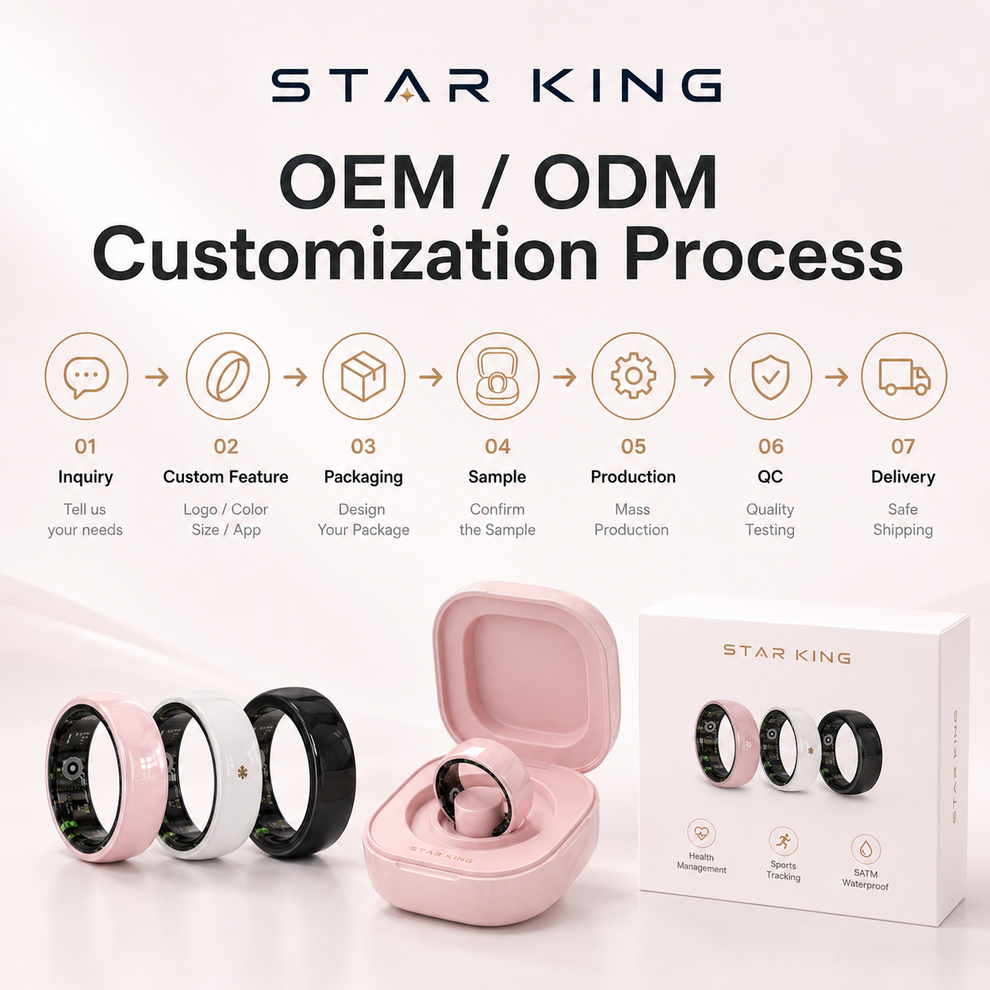
- Step 3: Compare Private Label, ODM, and Full OEM
- Step 4: Confirm Specifications and Sensor Claims
- Step 5: Set MOQ and Price Expectations
- Step 6: Plan Compliance and Certification by Market
- Step 7: Test Samples with a Retail Validation Protocol
- Step 8: Lock Lead Times, Packaging, and Logistics
- Step 9: Agree on After‑Sales, Warranty, and Spare Parts
- Decision Matrix: Which Supplier Model Fits Your Chain?
- Common Mistakes Retail Buyers Make
- Practical Buyer Checklist
- FAQ: Smart Rings OEM for Retail Chains
- Conclusion
Short Answer: How Should Retail Chains Choose a Smart Rings OEM Supplier?
Retail chains should select a smart rings OEM supplier by first defining the product tier and use case, then verifying the factory’s quality system and compliance preparation, comparing private label versus ODM versus full OEM models, and validating samples against a written protocol. MOQ, lead time, packaging, and after‑sales terms should be negotiated before committing to a purchase order. The strongest supplier is the one that can repeat quality at scale, not the one with the lowest first quote.
Key Takeaways
- Separate consumer marketing claims from verifiable product specifications.
- Audit supplier documents, not just the sales presentation.
- Confirm MOQ, tooling ownership, and customization boundaries in writing.
- Map certification requirements to each destination market.
- Run a structured sample test before mass production.
- Treat logistics and battery shipping as part of product design.
Key Facts for Buyers
| Item | Typical Range / Note | What to Verify |
|---|---|---|
| MOQ | Often 500–1,000+ units per SKU; varies by model and customization | Written MOQ per SKU and per color |
| Sample lead time | Commonly 5–10 days for standard samples | Sample cost, refund policy, and shipping terms |
| Production lead time | May be 20–45 days after deposit and sample approval | Deposit percentage and balance terms |
| Certifications | CE, FCC, RoHS, UN38.3 may be required depending on market | Test reports and certificate validity, model numbers |
| Battery shipping | Lithium cells may require UN38.3 and MSDS | Air/sea carrier acceptance and labeling |
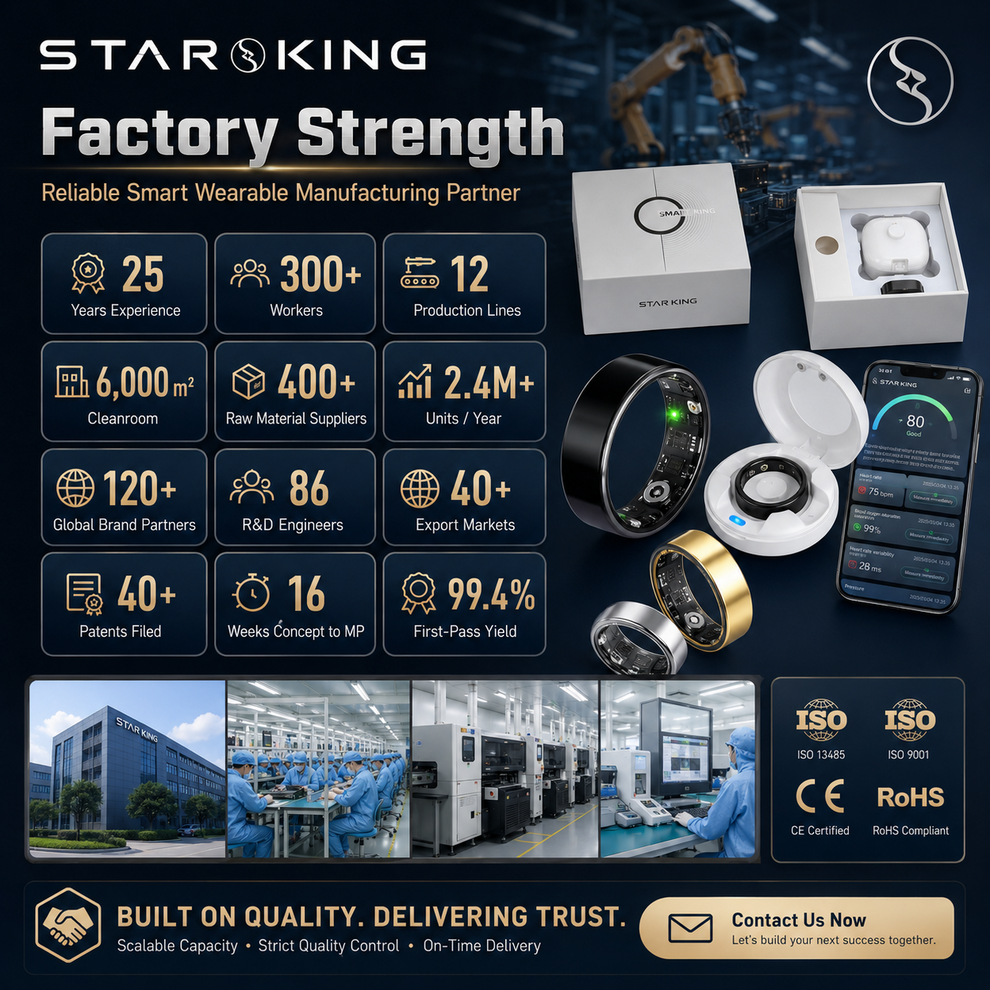
What “Smart Rings OEM” Means for a Retail Chain
For a retail chain, smart rings OEM is not a single service. It is a set of manufacturing and customization options that range from choosing an existing model with your logo and packaging, up to a fully custom hardware design. Understanding the difference prevents mismatched expectations during supplier selection.
“OEM” in its strict sense means the buyer provides the design or specification and the factory manufactures it. In practice, many wearable factories also offer ODM (original design manufacturing), where the factory owns a platform you can modify, and private label, where you brand an existing product. Each model carries different implications for cost, timeline, exclusivity, and intellectual property.
Retail chains typically need three things from an OEM partner: consistent product quality across batches, packaging and branding that meet retail standards, and documentation that supports import and marketplace compliance. A supplier that cannot provide all three will create downstream costs even if the unit price looks attractive.
Before shortlisting suppliers, it helps to align the product with the retail category it will sit in. Health and fitness wearables, sleep and recovery, and corporate wellness programs each imply different feature priorities, which in turn affect the OEM specification.
Step 1: Define the Retail Use Case and Product Tier
Retail chains buy differently from DTC brands. Shelf space, price bands, and return rates drive decisions. Start by defining the use case: general wellness tracking, sleep optimization, fitness performance, or corporate gifting. This determines which features matter and which premium is justified.
Where the ring will be sold
- Consumer electronics shelf: prioritize broad feature set and competitive price.
- Health and pharmacy channel: prioritize accurate tracking and clear disclaimers that the product is not a medical device.
- Corporate or B2B gifting: prioritize packaging, branding, and onboarding simplicity.
Price band and margin target
Set a target landed cost and retail price before OEM discussions. This keeps the conversation anchored on the specification that achieves your margin, rather than on features you do not need.
Step 2: Verify the Manufacturer Before You Discuss Price
Retail chain procurement teams should treat supplier verification as a gate, not a formality. Request documents and cross‑check them. At minimum, ask for business registration, factory profile, quality management evidence, and test reports relevant to the specific model.
Documents to request
- Business license and factory location.
- Quality certificates such as ISO 9001 or equivalent, if claimed.
- Test reports for the exact model SKU, not a similar model.
- Certification documents relevant to your markets.
Questions that reveal capability
- Which components are sourced in‑house versus subcontracted?
- How are firmware updates controlled after shipment?
- What is the rework process if a batch fails inspection?
A supplier that answers these clearly is more likely to support a long‑term retail relationship. To understand how OEM and private label delivery models differ, review the Private Label OEM/ODM solution before finalizing your shortlist.
Step 3: Compare Private Label, ODM, and Full OEM
The Three models differ in cost, timeline, and control. Retail chains with fast time‑to‑market often start with private label, while chains building a differentiated own‑brand line may move toward ODM or full OEM.
| Model | Customization Level | Typical Timeline | Best Fit |
|---|---|---|---|
| Private label | Logo, packaging, app branding | Fastest | Chains testing the category |
| ODM | Modified hardware, firmware, app features | Moderate | Chains building a differentiated line |
| Full OEM | Custom design, tooling, firmware, app | Longest | Chains with scale and exclusivity needs |
Exclusivity is a critical negotiation point. Buyers should confirm whether the chosen model will be sold to other retailers in the same market, and under what terms.
Step 4: Confirm Specifications and Sensor Claims
Smart ring specifications should be validated against the intended retail claim set. Consumer‑grade health tracking is not the same as medical diagnosis, and marketing language must reflect that distinction.
Specifications to lock down
- Sensor type and sampling frequency.
- Battery capacity and expected usage per charge.
- Water resistance rating and its test method.
- Companion app platform support and data sync behavior.
- Sizing range and sizing kit availability for retail.
How to evaluate sensor claims
Ask the supplier to explain how each metric is derived and to provide the test conditions used. Buyers should verify claims through independent sample testing rather than accepting datasheet values alone. For broader context on wearable health features, see the Sleep & Recovery application page.
Step 5: Set MOQ and Price Expectations
MOQ in the smart ring category is driven by components, tooling, and packaging. MOQ and price are linked: lower volumes usually mean higher unit cost, and customization increases MOQ. Retail chains should negotiate MOQ per SKU and per color, not just as a total order.
What drives unit price
- Sensor and chipset selection.
- Battery capacity and enclosure materials.
- Tooling amortization for custom designs.
- Packaging complexity and retail‑ready presentation.
- Certification and testing scope.
Buyers should ask for a cost breakdown rather than a single number. This makes it easier to compare suppliers on a like‑for‑like basis and to identify where cost can be reduced without compromising quality. Review the smart rings product page for baseline configurations.
Step 6: Plan Compliance and Certification by Market
Certification requirements depend on the product configuration and the destination market. A model sold in the EU may require CE marking, while a model sold in the United States may require FCC authorization for its radio components. Lithium battery shipping may require UN38.3 test summaries and MSDS documentation.
Buyers should verify with the supplier which certificates apply to the exact SKU, and should not assume that one certificate covers all variants. For radio and wireless compliance, the FCC equipment authorization procedures provide an official reference. For battery transport requirements, buyers can consult the IATA Dangerous Goods Regulations for air shipping guidance.
Where certification status is unclear, buyers should request the test report and certificate number and verify validity with the issuing body. STAR KING can support documentation aligned with common market requirements; specific certification coverage should be confirmed per product and destination. [STAR KING TO CONFIRM]
Step 7: Test Samples with a Retail Validation Protocol
Sampling is a decision point, not a courtesy. Retail chains should test samples against a written protocol that mirrors real‑world use and retail handling.
Sample testing checklist
- Battery life under continuous tracking.
- App pairing success rate across major phone models.
- Water resistance behavior after repeat exposure.
- Charging cycle reliability.
- Sizing accuracy against your target customer base.
- Packaging durability during transit simulation.
Document results and share them with the supplier. Suppliers that respond with corrective actions are stronger long‑term partners than those that dispute findings. For chains building fitness or corporate wellness programs, align sample testing with the intended use case in the Corporate Wellness application.
Step 8: Lock Lead Times, Packaging, and Logistics
Lead time planning should include sample approval, tooling if applicable, mass production, quality inspection, and shipping. Buyers should agree on a production schedule and build in buffer for certification or customs delays.
Packaging and retail readiness
- Bilingual or multilingual packaging per market.
- Barcode and regulatory labeling.
- Quick‑start guide and app download instructions.
- Sizing kit inclusion for retail shelf.
Logistics considerations
Battery‑powered devices may be restricted for air transport, so buyers should confirm carrier acceptance and labeling early. Landed cost should include freight, duties, and inspection fees.
Step 9: Agree on After‑Sales, Warranty, and Spare Parts
Retail chains carry return risk. The supplier agreement should define warranty terms, defect thresholds, replacement procedures, and spare part availability. Buyers should also confirm who handles firmware updates and whether the app continues to receive support after the warranty period.
Terms to define in writing
- Warranty duration and coverage.
- Defective rate allowance and remedy.
- Spare parts and sizing kit reordering.
- Firmware and app maintenance responsibilities.
- Tooling ownership and transfer conditions.
Decision Matrix: Which Supplier Model Fits Your Chain?
| Buyer Scenario | Recommended Model | Key Priority |
|---|---|---|
| First smart ring test in stores | Private label | Speed and low MOQ |
| Differentiated own‑brand line | ODM | Feature customization and app control |
| Large chain with exclusivity needs | Full OEM | Tooling ownership and IP terms |
| Corporate wellness reseller | ODM or private label | App onboarding and data privacy |
Common Mistakes Retail Buyers Make
- Comparing unit price without comparing specifications.
- Accepting sample units that differ from mass production.
- Assuming one certification covers all SKUs and markets.
- Ignoring battery shipping restrictions until late in the project.
- Failing to define tooling ownership and exclusivity.
- Overlooking app and firmware maintenance after launch.
Practical Buyer Checklist
- Product tier and use case defined.
- Supplier documents requested and verified.
- OEM/ODM/private label option selected.
- Specifications and sensor claims confirmed.
- MOQ, price, and cost breakdown reviewed.
- Certification needs mapped per market.
- Sample protocol completed and documented.
- Lead time and logistics confirmed.
- Warranty, spares, and app support agreed.
- Tooling ownership and IP terms in writing.
FAQ: Smart Rings OEM for Retail Chains
What MOQ should a retail chain expect for smart rings OEM?
MOQ depends on the model and customization. Many factories quote from a few hundred to over a thousand units per SKU and color. Buyers should confirm MOQ per variant and per color, not just as a total order.
Are CE and FCC certifications automatically included?
No. Certification requirements depend on the product configuration and destination market. Buyers should request test reports for the exact SKU and verify certificates with the issuing body.
Can we brand the app as well as the product?
App customization is often available through ODM and OEM models. Scope, cost, and timeline should be defined in the supplier agreement.
How long does sample approval usually take?
Standard samples may ship within one to two weeks, while customized samples take longer. Buyers should agree on a sample approval deadline to protect the production schedule.
What is the typical production lead time?
Production commonly begins after deposit and sample approval, and may take several weeks depending on volume and customization. Buffer should be added for certification and shipping.
Do smart rings require special shipping documentation?
Lithium battery devices may require UN38.3 documentation and MSDS. Buyers should confirm carrier requirements before booking freight.
Conclusion
Selecting a smart rings OEM supplier is a structured process, not a single negotiation. Retail chains that define the use case, verify the manufacturer, compare customization models, validate samples, and lock commercial and compliance terms build a supply relationship that protects margin and brand reputation. The suppliers worth keeping are those that answer hard questions with documentation and repeatable processes.
Next Step for Your Retail Chain
Ready to compare smart ring configurations and customization options for your chain? To move forward, request a smart rings OEM quotation with your target specifications, markets, and volume. STAR KING can review your requirements and confirm current MOQ, lead time, packaging, and certification support for your destination markets. Reach the sales team at Contact STAR KING Sales to discuss your OEM/ODM project.
Discuss Your Smart Wearable OEM/ODM Project
Planning a smart ring, smart watch, smart band, AI glasses, AI translator, or AI voice mouse project? Contact STAR KING to discuss product positioning, sample testing, customization scope, certification requirements, lead time, and quotation details.

Team Star King

Scan WhatsApp QR code
Leave a Reply