
Smart Rings for Retail Chains: 7 Critical Checks Before You Place a Bulk Order
October 22, 2026 · Team Star King
Smart Rings for Retail Chains: 7 Critical Checks Before You Place a Bulk Order
If you are a retail chain sourcing smart rings for a private-label or branded program, the RFQ stage is where most costly mistakes begin. The right supplier must prove not only product quality but also retail readiness: stable firmware, app onboarding, packaging compliance, and scalable production. This guide gives you seven critical checks—covering supplier capability, app integration, MOQ, quality control, certification, lead time, and after-sales support—so you can issue an RFQ with confidence and avoid the common traps that surface after the first container ships.
Table of Contents
Table of Contents
smart rings for retail chains: Short Answer
Before placing a bulk order for smart rings, retail chains should verify seven areas: supplier manufacturing credentials, app and firmware stability, MOQ and pricing structure, sample testing and QC protocols, target-market certification, production lead time, and after-sales/return terms. Each check should be documented and tied to your retail launch schedule. Skipping any one of them increases the risk of launch delays, compliance holds, or high return rates.
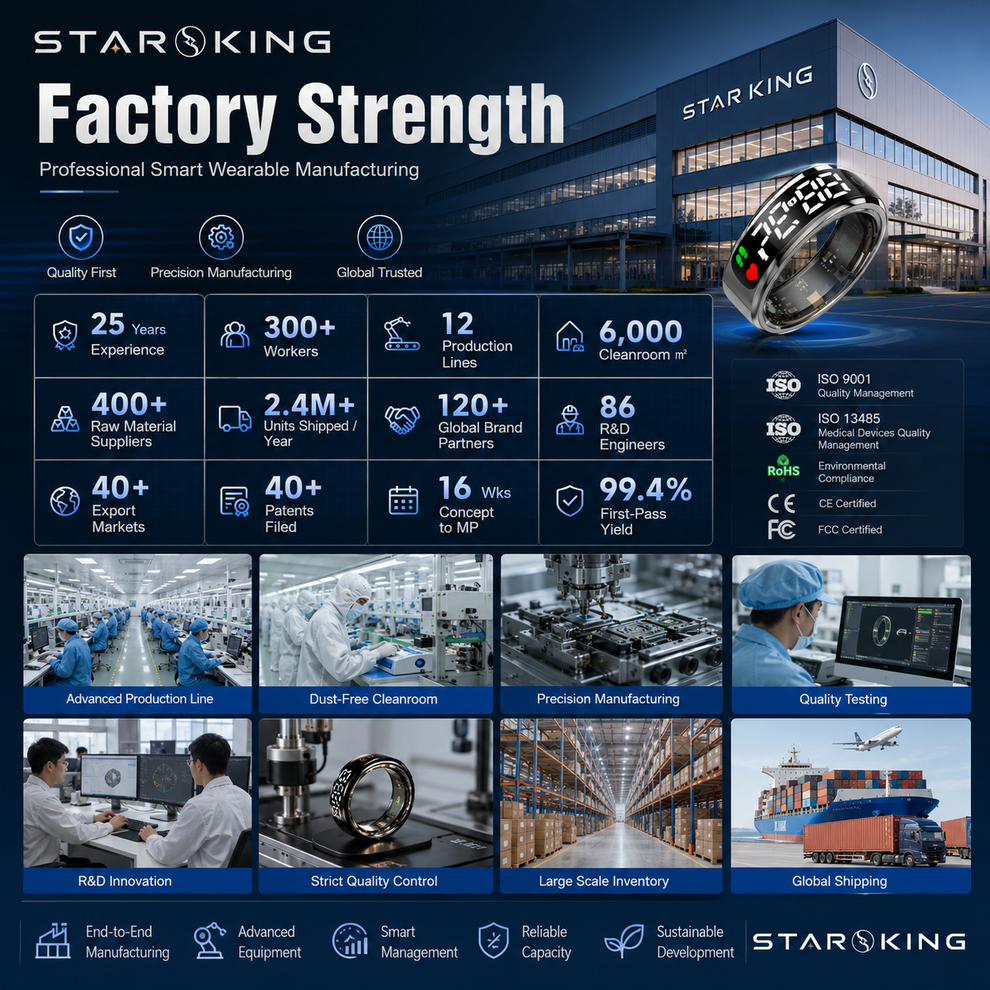
Table of Contents
- Why Retail Chains Need Different Checks for Smart Rings
- Check 1: Supplier Capability and Manufacturing Transparency
- Check 2: App, Firmware, and Software Integration
- Check 3: MOQ and Pricing Structure
- Check 4: Sample Testing and Quality Control
- Check 5: Certification and Import Compliance
- Check 6: Lead Time and Production Scheduling
- Check 7: After-Sales Support and Spare Parts
- Common Mistakes and Buyer Red Flags
- Practical Buyer Checklist
- FAQ
- Conclusion
Key Takeaways
- Retail chains need smart ring suppliers that can demonstrate retail-ready packaging, app stability, and documented QC—not just low unit cost.
- Always request physical samples and test the companion app across iOS and Android before finalizing MOQ.
- Certification requirements (CE, FCC, RoHS, UN38.3) depend on the product configuration and destination market; confirm scope with the supplier and your compliance team.
- MOQ and lead time should be written into the RFQ and purchase agreement with clear penalties for non-compliance.
- Plan for after-sales: a defined RMA process and spare-parts availability protect your retail margin and brand reputation.
Key Facts for Buyers
| Decision Area | What to Verify | Typical Range or Note |
|---|---|---|
| Supplier capability | Factory audit report, production lines, in-house testing | Request recent audit; verify ownership of tooling |
| App & firmware | iOS/Android compatibility, OTA update policy, data privacy | Test both platforms; confirm update cadence |
| MOQ | Per-SKU and per-color minimums | Varies by customization level; negotiate trial orders |
| Sample testing | Battery life, sensor accuracy, water resistance, drop test | Request test reports; conduct your own wear test |
| Certification | CE, FCC, RoHS, UN38.3, MSDS | Scope depends on model and market; verify certificates |
| Lead time | Production and shipping schedule | Typically depends on order volume and customization |
| After-sales | RMA rate, warranty terms, spare parts | Define in contract; request historical RMA data |
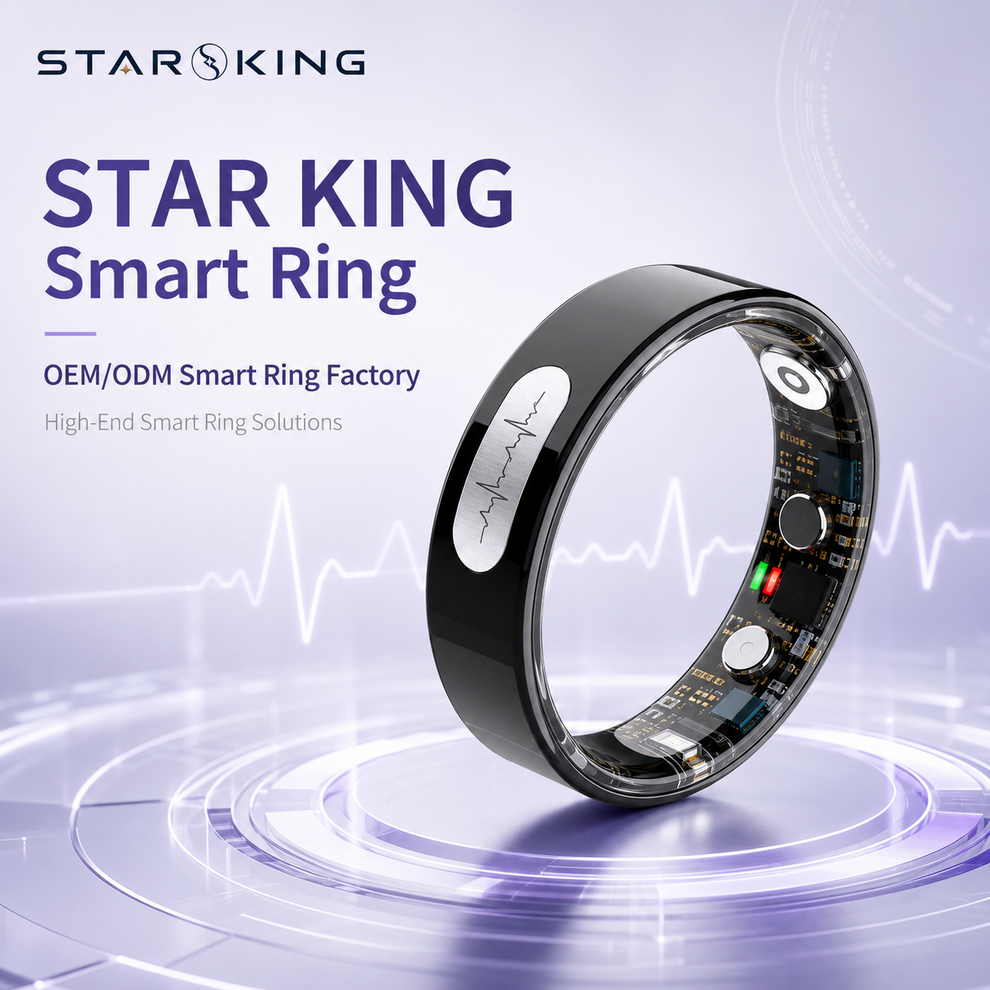
Why Retail Chains Need Different Checks for Smart Rings
Retail chains face pressures that individual e-commerce sellers often do not: multiple store locations, seasonal planogram deadlines, centralized quality standards, and higher visibility for product failures. A smart ring that works well in a single online review may still fail at retail scale if the packaging does not meet local labeling laws, if the app crashes on certain phone models, or if the battery does not survive shipping and storage conditions. For a retail buyer, the RFQ process is therefore a risk-management exercise as much as a price negotiation.
Smart rings are compact, battery-powered wearable devices with software dependencies. That combination means the supplier must control not only hardware assembly but also firmware stability, app updates, and battery safety documentation. When you evaluate smart rings for retail distribution, ask for evidence of how the supplier manages these dependencies over the product lifecycle—not just at the sample stage.
Check 1: Supplier Capability and Manufacturing Transparency
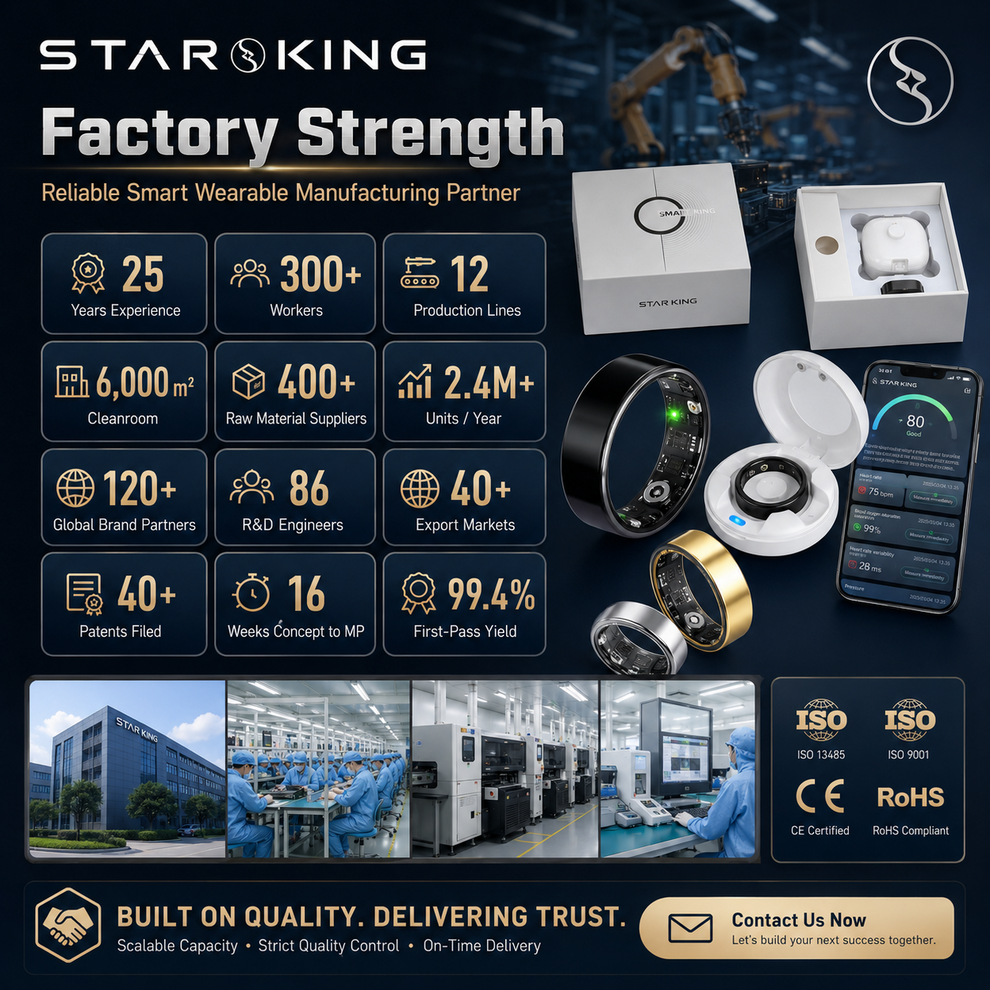
Start with the basics: can the supplier demonstrate that it manufactures or reliably sources the smart ring you need? Request a recent factory audit report, a list of production and testing equipment, and a clear explanation of which steps are done in-house versus outsourced. For retail chains, transparency matters because your brand is attached to the final product.
What to ask
- Who owns the tooling and molds for the ring housing? Confirm in writing that tooling ownership and transfer terms are defined if you fund custom tooling.
- Which components are sourced from third parties (sensors, batteries, chipsets), and what is the supplier’s incoming inspection process?
- Can the supplier provide references from other retail or distribution clients? (Ask for case studies without confidential details.)
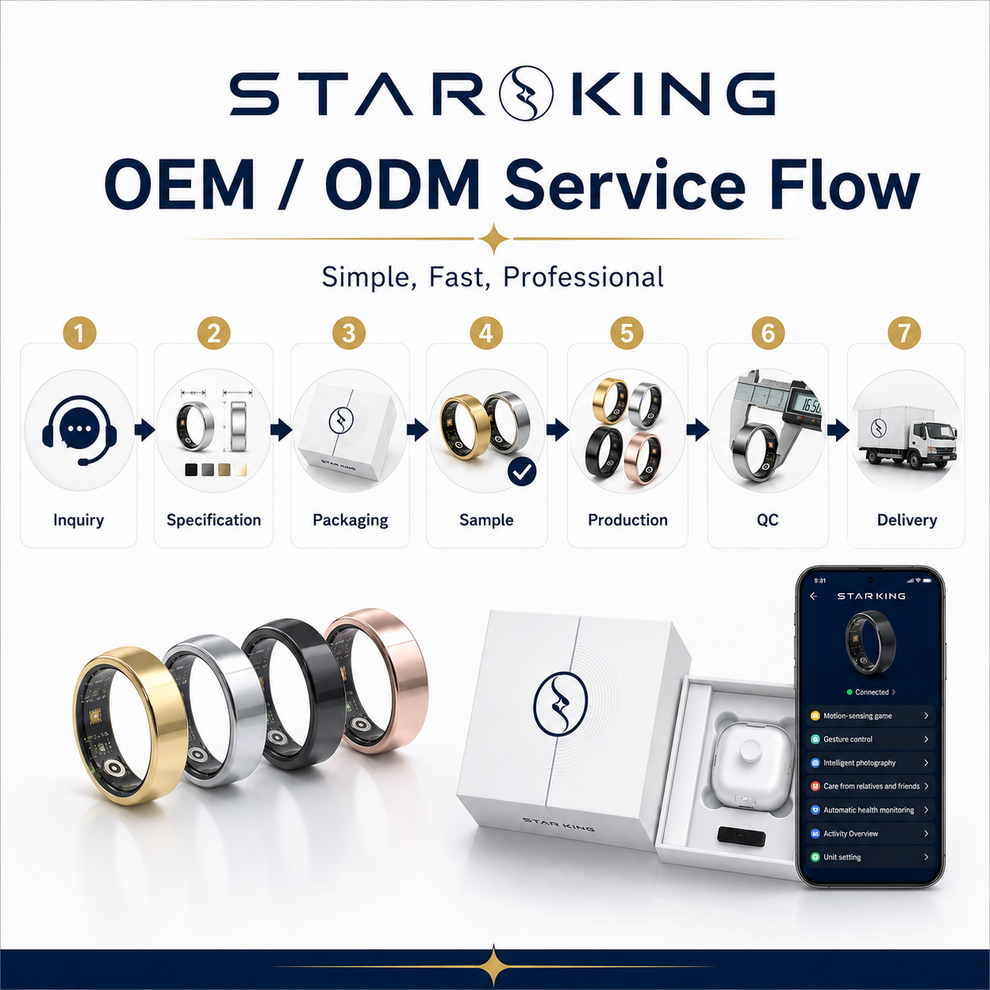
STAR KING provides OEM/ODM and private-label manufacturing for smart wearables. Buyers should request [STAR KING TO CONFIRM: latest factory audit report and production capacity data] as part of the RFQ package.
Check 2: App, Firmware, and Software Integration
Smart rings depend on a companion app for setup, health data display, and firmware updates. A retail chain cannot afford an app that fails on popular phone models or stops receiving updates after launch. During the RFQ stage, request a test build of the app and verify the following:
- Platform coverage: Test on both iOS and Android, including older OS versions still common among your target customers.
- Update policy: Ask how often firmware and app updates are released and how critical fixes are communicated.
- Data privacy: Confirm where health data is stored and whether the app complies with applicable privacy regulations in your market (e.g., GDPR in the EU). Buyers should verify data-handling terms with legal counsel.
- Private-label options: If you need a branded app, clarify whether the supplier supports app customization, white-label deployment, and ongoing maintenance fees.
For retail chains planning a private-label program, app customization is often a gating factor. Review private-label OEM/ODM options early so software scope is included in the RFQ rather than added later.
Check 3: MOQ and Pricing Structure
MOQ (minimum order quantity) and pricing are interrelated. Suppliers may offer lower unit prices at higher volumes, but retail chains often need to test multiple SKUs, colors, and sizes before committing to large quantities. Ask for a tiered price list and clarify what drives cost:
- Base unit cost at different MOQ tiers.
- Tooling or setup fees for custom colors, logos, or packaging.
- Cost of private-label app development or customization.
- Packaging design and printing costs, including compliance labeling.
Be cautious with suppliers that quote unusually low prices without explaining component quality or testing standards. For retail, landed cost—including freight, duties, and compliance testing—matters more than FOB price. Use a landed-cost worksheet during the RFQ to compare suppliers fairly.
Check 4: Sample Testing and Quality Control
Always test physical samples before committing to a bulk order. A smart ring sample should be evaluated for fit, comfort, battery life under real use, sensor consistency, and app pairing stability. Request the supplier’s QC documentation, including:
- Incoming component inspection records.
- In-process and final assembly checks.
- Functional testing (charging, Bluetooth pairing, sensor readings).
- Reliability testing such as drop, water-resistance, and aging tests.
Ask whether pre-shipment inspection is standard and whether third-party inspection is permitted. For retail chains, a documented AQL (acceptable quality limit) sampling plan is recommended. STAR KING’s quality processes can be reviewed in more detail; buyers should request [STAR KING TO CONFIRM: standard AQL levels and testing protocols for smart rings].
Check 5: Certification and Import Compliance
Certification requirements for smart rings depend on the product configuration (e.g., Bluetooth radio, battery type) and the destination market. Common requirements include CE marking for the EU, FCC for the US, RoHS for hazardous substances, UN38.3 for lithium battery transport, and MSDS documentation. Retail chains should not assume a supplier’s existing certificates cover every model or market.
During the RFQ, request the specific certificate numbers and test reports for the exact model you intend to order, and verify them with the issuing laboratory or authority where possible. For reference, see the FCC radio frequency device certification and the European Commission CE marking pages. Note that compliance responsibility ultimately rests with the importer or brand owner in many jurisdictions; buyers should confirm obligations with a compliance specialist.
Check 6: Lead Time and Production Scheduling
Lead time for bulk smart rings typically depends on order volume, customization complexity, and component availability. Retail chains run on fixed launch calendars, so a supplier’s ability to meet a schedule is as important as price. Ask for:
- Sample lead time and production lead time for your estimated order quantity.
- Production capacity per month and current order backlog.
- Shipping method options and estimated transit times to your destination.
- Buffer recommendations for peak seasons or Chinese New Year.
Build penalties or incentives into the purchase agreement for on-time delivery, and plan a buffer of several weeks for ocean freight and customs clearance.
Check 7: After-Sales Support and Spare Parts
Retail chains need a clear after-sales path for defective units. Before ordering, confirm:
- Warranty period and what it covers (e.g., battery degradation, charging issues, sensor failure).
- RMA (return merchandise authorization) process and expected turnaround time.
- Availability of spare parts (chargers, sizing kits) for the product lifecycle.
- Whether the supplier provides technical support documentation for your store staff.
A supplier that cannot explain its RMA process in writing is a red flag for retail programs.
Common Mistakes and Buyer Red Flags
Even experienced retail buyers can overlook these issues during an RFQ:
- Accepting generic certificates: Certificates that do not match the exact model or that come from unfamiliar labs should be questioned.
- Skipping app testing: Failing to test the app on multiple devices can lead to high return rates after launch.
- Ignoring packaging compliance: Retail packaging must often include specific warnings, language, and recycling information for each market.
- No defined QC standard: Without an agreed AQL or inspection protocol, quality disputes become difficult to resolve.
- Underestimating lead time buffers: Production delays compound with shipping and customs, risking missed retail windows.
Practical Buyer Checklist
Use this checklist as part of your RFQ to suppliers of smart rings for retail chains:
- ☐ Supplier provides recent factory audit and production capacity data.
- ☐ Companion app tested on iOS and Android; update policy documented.
- ☐ Private-label app and packaging options quoted separately.
- ☐ MOQ tiers and tooling/setup fees clarified in writing.
- ☐ Physical samples tested for fit, battery, and sensor performance.
- ☐ QC process and AQL sampling plan agreed.
- ☐ Certificates (CE, FCC, RoHS, UN38.3, MSDS) reviewed for the exact model and market.
- ☐ Lead time confirmed with buffer for freight and customs.
- ☐ Warranty, RMA, and spare-parts terms defined in the purchase agreement.
FAQ
What is a typical MOQ for private-label smart rings?
MOQ varies by supplier and customization level. Simple logo and packaging customization may have lower minimums, while custom colors or app development often require higher quantities. Buyers should request tiered MOQ quotes and negotiate trial orders where possible.
How can retail chains verify smart ring certifications?
Request certificate numbers and test reports for the exact model you plan to order, and verify them with the issuing laboratory or relevant authority. Certification requirements depend on the destination market and product configuration.
What should be tested in a smart ring sample?
Test fit and comfort, battery life under normal use, sensor consistency (e.g., heart rate and blood oxygen readings), Bluetooth pairing stability, app performance on multiple devices, and charging reliability. Also review the supplier’s drop and water-resistance test reports.
How long does bulk production typically take?
Production lead time typically depends on order volume, component availability, and customization. Standard models may ship faster than fully custom designs. Always confirm lead time in writing and plan a buffer for shipping and customs.
Can retail chains get a branded app for smart rings?
Some suppliers offer private-label app options with varying levels of customization. Clarify whether the app can carry your brand, what development and maintenance fees apply, and how data privacy is handled.
What are common red flags when sourcing smart rings?
Red flags include vague answers about manufacturing, certificates that do not match the model, no documented QC process, unusually low prices with no quality explanation, and reluctance to provide samples or references.
Conclusion
Sourcing smart rings for retail chains requires a disciplined RFQ process that goes beyond unit price. By verifying supplier capability, app stability, MOQ terms, sample quality, certification, lead time, and after-sales support, you reduce the risk of launch delays and protect your brand. Use the checklist and questions in this guide to structure your next supplier conversation, and document every commitment in your purchase agreement.
If you are preparing an RFQ for a smart ring program, request a quotation or discuss your private-label requirements with our team. We can provide sample timelines, MOQ options, and customization details based on your target market and retail schedule.
Discuss Your Smart Wearable OEM/ODM Project
Planning a smart ring, smart watch, smart band, AI glasses, AI translator, or AI voice mouse project? Contact STAR KING to discuss product positioning, sample testing, customization scope, certification requirements, lead time, and quotation details.

Team Star King

Scan WhatsApp QR code
Leave a Reply