
smart ring supplier: 7 Proven Steps for System Integrators to Select a Smart Ring Supplier in 2026
October 7, 2026 · Team Star King

7 Proven Steps for System Integrators to Select a Smart Ring Supplier in 2026
Direct Answer: To select a smart ring supplier as a system integrator, evaluate seven criteria in order: SDK and API completeness, OEM/ODM flexibility, MOQ and lead-time transparency, sample-testing capability, certification status by target market, data-privacy and app integration, and after-sales support. Prioritize suppliers that provide documented firmware/API access, verifiable test reports, and written MOQ tiers.
Table of Contents
Table of Contents
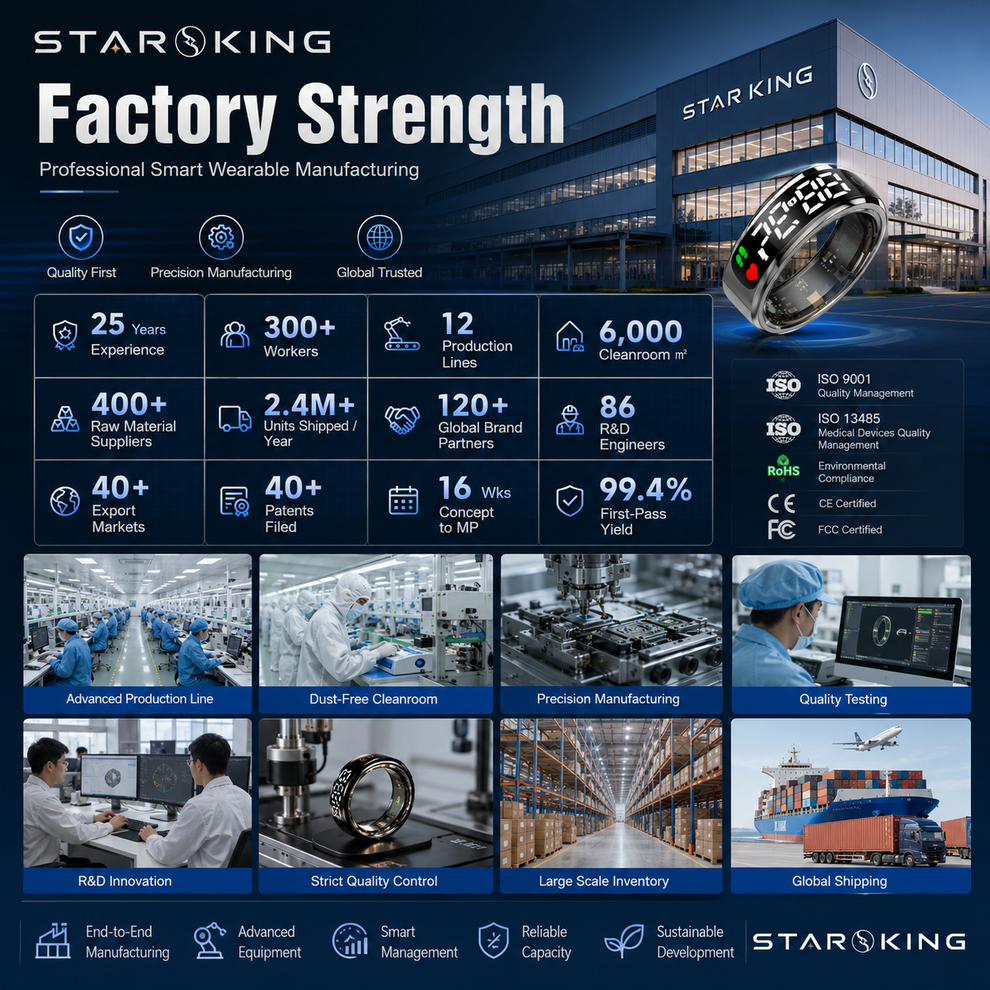
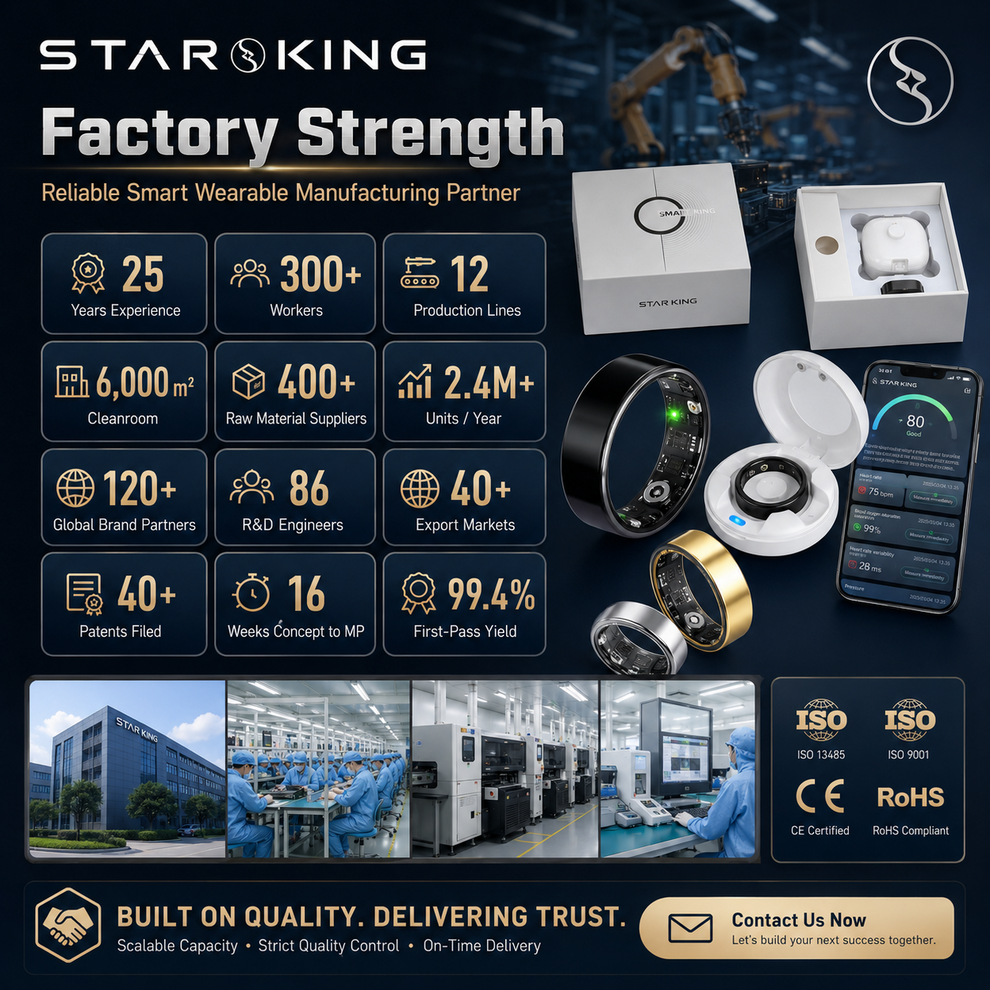
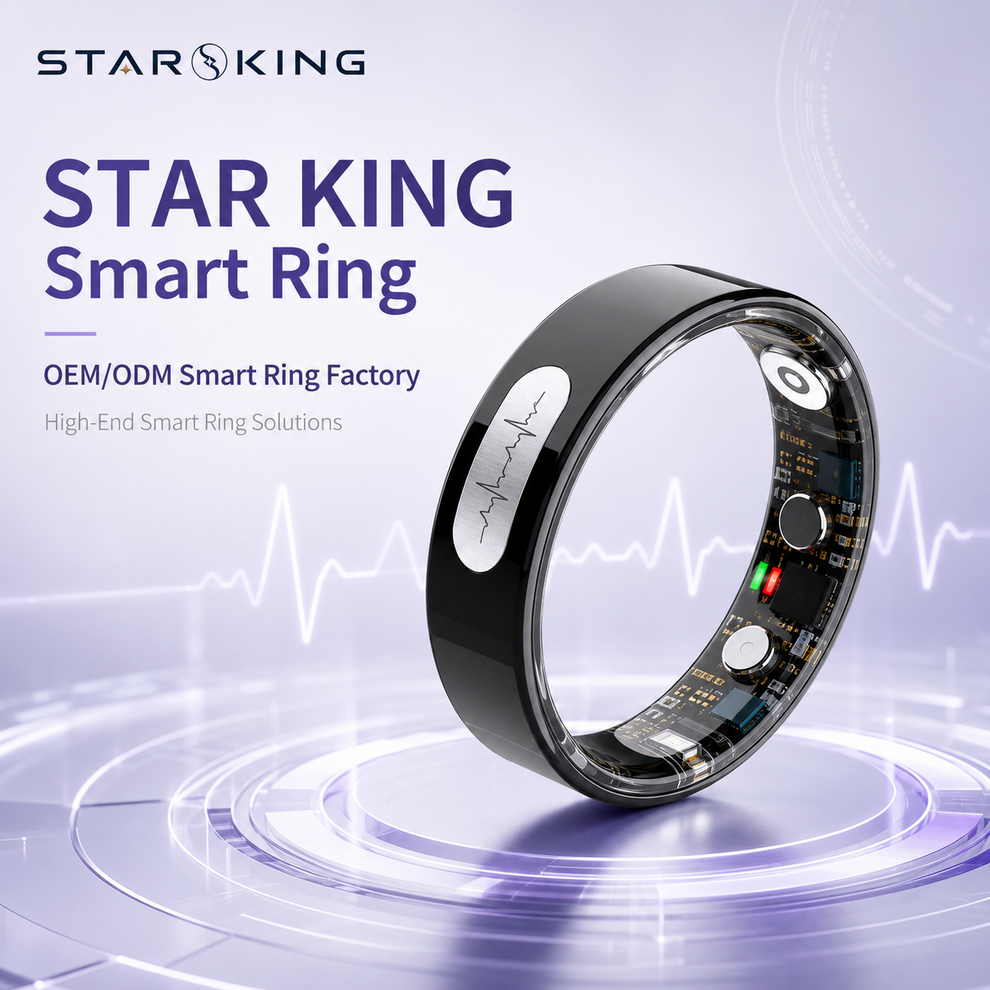
System integrators rarely buy smart rings as standalone consumer devices. They embed the ring into a larger solution—corporate wellness platforms, remote patient-monitoring pilots, insurance engagement programs, or field-workforce safety systems—where the ring is one hardware node inside a software stack. That changes supplier selection. A smart ring supplier must deliver a stable SDK, documented APIs, firmware update paths, and predictable manufacturing, not just a finished product. This guide is written for that use case and gives you a repeatable 7-step screening process for 2026. STAR KING supplies smart rings and other wearables to integrators and OEM/ODM buyers; the criteria below are written to apply to any candidate supplier you evaluate. View smart ring hardware options for integrators.
Table of Contents
- Short Answer
- Key Takeaways
- Key Facts for Buyers
- Step 1: Define Your Integration Architecture Before You Contact Any Smart Ring Supplier
- Step 2: Score SDK, API, and Firmware Capability
- Step 3: Separate OEM, ODM, and Private Label Options
- Step 4: Price the Full MOQ and Lead-Time Picture
- Step 5: Validate Samples Against Your Real Use Case
- Step 6: Confirm Certification and Battery Shipment Requirements
- Step 7: Lock Down Support, Warranty, and Mold Ownership
- Smart Ring Supplier Comparison Table
- Common Mistakes and Buyer Red Flags
- Practical Buyer Checklist
- FAQ
- Conclusion
Short Answer
The best smart ring supplier for a system integrator is the one whose hardware can be integrated into your platform with the least software risk and the clearest manufacturing terms. Rank candidates on SDK/API documentation, OEM/ODM flexibility, MOQ tiers, sample-testing support, market-specific certification, and post-sales engineering response. Treat price as a tiebreaker, not the first filter.
Key Takeaways
- For integrators, software interoperability (SDK, API, firmware) usually matters more than cosmetic customization.
- Request written MOQ tiers, tooling cost, and lead time before samples ship, so you can budget accurately.
- Certification is market- and configuration-specific; a supplier should state exactly which markets and SKUs are covered, and which are not.
- Sample testing should simulate your real deployment: duration, sensor cadence, data export, battery conditions, and app handoff.
- Confirm battery shipping documentation early, because lithium cells trigger air-transport rules and customs checks.
- Ownership of tooling, molds, and firmware modifications should be in writing if you fund development.
Key Facts for Buyers
| Decision Factor | What to Verify | Typical Evidence | Risk If Ignored |
|---|---|---|---|
| SDK/API | Endpoints, data schema, sample code, rate limits | Developer docs, test build | Custom integration cost balloons |
| OEM/ODM scope | Which parts are customizable | Written scope + sample quote | Rework fees, delays |
| MOQ | Tiers by model and customization level | Written tier sheet | Budget mismatch |
| Certification | Which markets/SKUs covered | Certificate copies, test reports | Customs hold, legal exposure |
| Battery shipping | UN38.3/MSDS data availability | Documents on request | Shipment blocked |
| Firmware updates | OTA path, versioning, rollback | Release notes, update policy | Field failures, security gaps |
| Warranty/support | Response time, spare parts, RMA flow | Written SLA | High downtime, churn |
If your team already knows which hardware form factor and data fields you need, it is faster to discuss a concrete integration than a generic catalog. You can open a technical conversation and share your architecture at contact sales.
Step 1: Define Your Integration Architecture Before You Contact Any Smart Ring Supplier
Most integration failures start before the first supplier email. Integrators who write down their data architecture first screen suppliers twice as effectively, because they can ask precise questions instead of comparing marketing sheets.
Document These Five Inputs
- Data fields you need: heart rate, heart-rate variability, blood oxygen trends, temperature trends, sleep and recovery stages, activity, and step data are common; list exactly which ones your platform consumes.
- Delivery format: Bluetooth raw data, phone-gateway cloud API, or SDK-direct BLE access. This single choice eliminates many candidates.
- Update and refresh cadence: continuous streaming versus scheduled sync changes battery and firmware requirements.
- Endpoint environment: iOS, Android, or both, plus whether your app or the supplier app is the system of record.
- Compliance boundary: whether your program is wellness-only or positioned as a monitoring service, which affects how you describe the hardware and where data may be stored.
With those five inputs written down, you can screen suppliers in a single call rather than a month of samples. For programs that combine rings with other hardware, it also helps to map your broader platform early, for example through the Private Label OEM/ODM solution overview.
Step 2: Score SDK, API, and Firmware Capability
For system integrators, the software layer is the product. A ring with excellent sensors and a weak SDK is a maintenance liability.
What to Ask and What to Accept
| Capability | Strong Answer | Weak Answer |
|---|---|---|
| Developer documentation | Versioned docs, example code, changelog | “We will send a demo app” |
| Data access | Documented API or SDK data model | Only in supplier’s own app |
| Firmware updates | Defined OTA process and rollback | No stated update path |
| Stability commitments | Deprecation and version-support policy | Undefined |
| Test environment | Sandbox or test ring for integration | Production units only |
Ask the supplier to describe a real, non-confidential integration scenario: how a partner retrieves a specific data field, how often it refreshes, and what happens if the BLE link drops. Vague answers here predict slow integration later. Firmware customization, when offered, should be documented as a scope with milestones rather than a verbal promise. Bluetooth interoperability itself is governed by published specifications you can reference for baseline expectations, such as the standards published by the Bluetooth SIG at Bluetooth SIG specifications.
Step 3: Separate OEM, ODM, and Private Label Options
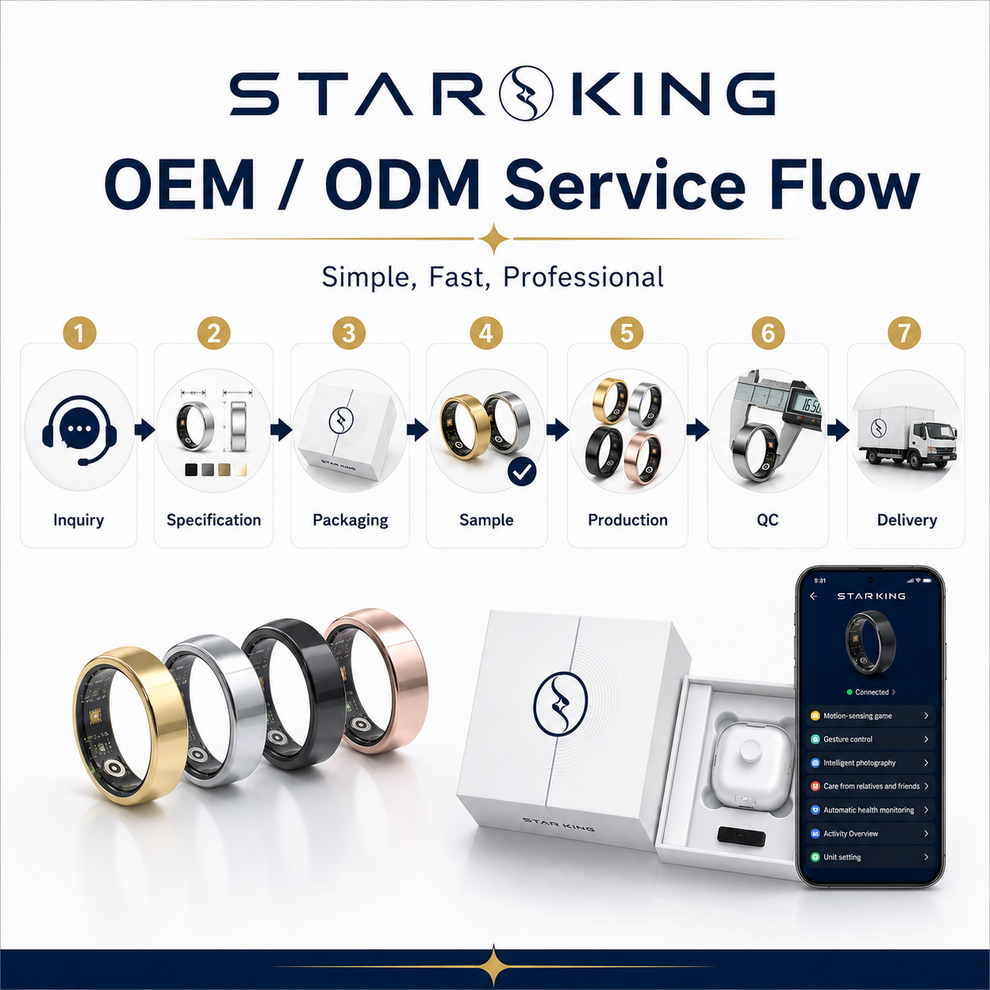
Integrators often assume they need full ODM. In practice, most programs start with OEM-level customization (logo, packaging, app branding, limited firmware settings) and move to deeper ODM only when volumes justify new tooling.
Model Comparison
| Model | Typical Scope | Best Fit | Lower MOQ Signal |
|---|---|---|---|
| Private Label | Brand, packaging, app naming | Pilot programs, distributors | Yes, usually lowest |
| OEM | Above plus limited firmware/UI options | Integrators launching a branded service | Moderate |
| ODM | New industrial design, tooling, custom board or firmware | Scale programs with differentiation needs | Highest, tooling-driven |
Ask each candidate to mark, line by line, which of your requirements fall inside standard scope and which trigger tooling, certification renewal, or MOQ increases. That single exercise exposes hidden cost faster than any price list.
Step 4: Price the Full MOQ and Lead-Time Picture
Unit price without MOQ, tooling, and lead time is not a price—it is a headline. Integrators should build a simple landed-cost model before choosing a smart ring supplier.
Cost Components to Request in Writing
- Per-unit price at each MOQ tier, by model and customization level.
- One-time tooling or setup fees, itemized.
- Sample and sample-refund terms.
- Certification or re-testing costs when you change branding, radio configuration, or battery.
- Packaging, inserts, and language variants.
- Freight mode, battery documentation, and incoterms.
- Payment milestones tied to production stages.
Lead time should be quoted in segments—sample, tooling, first-article approval, mass production, and shipping—not as a single number. A supplier unwilling to break lead time into stages usually cannot defend a schedule when something slips.
Step 5: Validate Samples Against Your Real Use Case
Generic sample testing produces generic confidence. Integrator-grade testing mirrors deployment conditions.
A Practical Sample Test Plan
- Duration: run at least two full weeks to capture sleep, recovery, and battery behavior.
- Data handoff: export data through the SDK/API and feed it into your platform, not just the supplier app.
- Wear conditions: test on multiple finger sizes and skin tones represented in your user base.
- Charging cycle: measure real battery life against your refresh cadence, not the spec sheet.
- Connectivity stress: test pairing loss, re-connection, and background sync on both iOS and Android.
- Documentation check: confirm the ring you tested matches the firmware and configuration you would buy.
Record results in a scored sheet so multiple candidates are compared on identical criteria. Where sleep-oriented programs are involved, you can align test scenarios with the use cases described in Sleep & Recovery applications.
Step 6: Confirm Certification and Battery Shipment Requirements
Certification is one of the most misrepresented areas in wearable sourcing. A supplier may hold certificates for one configuration, one market, or one battery variant—and those may not cover your branded SKU.
What to Confirm, Market by Market
- Which specific markets the certificates cover, and for which exact model and radio/battery configuration.
- Whether changing your brand name, packaging, or companion app invalidates or requires updates.
- Availability of test reports, not just certificate numbers.
- Battery transport documentation, including UN38.3 test summaries and MSDS, when lithium cells are shipped.
- Whether your target market imposes additional registration obligations on the importer of record.
Requirements typically depend on the product configuration, radio module, battery, and destination market, and buyers should verify current rules with the relevant authority or a compliance consultant. As general references, radio-frequency equipment rules in the United States are administered by the FCC (FCC), and product rules for the European market are summarized through the EU’s official portal (European Union official portal). Treat any blanket statement such as “all our products are certified” as a prompt for a configuration-level follow-up.
Step 7: Lock Down Support, Warranty, and Mold Ownership
The supplier relationship continues long after the purchase order. Integrators should confirm support terms before committing to a first production run.
Non-Negotiables to Put in Writing
- Engineering response time for integration issues, with a named contact.
- Warranty period, defect definition, and whether replacement units ship before returns are processed.
- Spare-part availability and expected end-of-life notice for the model.
- Firmware security update expectations and how vulnerabilities are communicated.
- Ownership of tooling, molds, and any custom firmware developed with your funding.
- Confidentiality covering your data schema, user flows, and program design.
If you fund new tooling, the ownership clause is not administrative—it determines whether you can move production later or must repurchase your own development.
Smart Ring Supplier Comparison Table
Use this scoring grid across your shortlist. Weight each row according to your program’s risk profile.
| Criteria | Weight | Supplier A | Supplier B | Supplier C |
|---|---|---|---|---|
| SDK/API completeness | 20% | Score 1-5 | Score 1-5 | Score 1-5 |
| OEM/ODM flexibility | 15% | Score 1-5 | Score 1-5 | Score 1-5 |
| MOQ and lead time clarity | 15% | Score 1-5 | Score 1-5 | Score 1-5 |
| Sample test results | 15% | Score 1-5 | Score 1-5 | Score 1-5 |
| Certification coverage | 15% | Score 1-5 | Score 1-5 | Score 1-5 |
| Support and warranty terms | 10% | Score 1-5 | Score 1-5 | Score 1-5 |
| Landed cost at target volume | 10% | Score 1-5 | Score 1-5 | Score 1-5 |
Common Mistakes and Buyer Red Flags
Mistakes Integrators Make
- Choosing a supplier on unit price before confirming SDK and API capability.
- Accepting verbal MOQ and lead-time answers that never appear in writing.
- Assuming a certificate for one model or market covers a rebranded SKU.
- Testing samples only in the supplier app rather than through the integration path.
- Leaving tooling, mold, and firmware ownership undefined when funding development.
- Underestimating lithium battery documentation needs until shipping day.
Supplier Red Flags
- No versioned developer documentation or sample code.
- Refusal to itemize tooling, certification, or re-test costs.
- Certification claims that cannot be tied to a specific model, radio, battery, and market.
- No defined firmware update or security-response process.
- Lead time quoted as one number with no stage breakdown.
- Unwillingness to name an engineering contact for integration support.
Practical Buyer Checklist
- ☐ Integration architecture documented (data fields, cadence, environment, compliance boundary).
- ☐ SDK/API documentation and sample code reviewed by your developers.
- ☐ Firmware update policy and rollback path defined.
- ☐ OEM/ODM scope mapped line by line, with tooling triggers identified.
- ☐ Written MOQ tiers, tooling fees, sample terms, and payment milestones.
- ☐ Lead time quoted by stage: sample, tooling, first article, production, shipping.
- ☐ Two-week sample test completed against your real deployment scenario.
- ☐ Certification coverage confirmed per model, configuration, and market, with reports.
- ☐ Battery shipping documentation availability confirmed (UN38.3 summary, MSDS).
- ☐ Warranty, RMA flow, spare parts, and end-of-life notice in writing.
- ☐ Tooling, mold, and custom firmware ownership and confidentiality clauses reviewed.
FAQ
What should a system integrator check first in a smart ring supplier?
Start with the software layer: SDK/API documentation, data schema, and firmware update policy. If your developers cannot answer how they would retrieve and refresh a specific data field after reading the docs, the hardware details will not save the project.
Do I need ODM or is OEM enough for an integrator program?
Most integrator programs launch successfully on OEM-level customization (branding, packaging, app naming, limited firmware options) at lower MOQ. Move to ODM with new tooling only when volume and differentiation justify the added cost and lead time.
How do I verify certification claims for a smart ring?
Ask for certificate copies and test reports tied to the exact model, radio configuration, battery, and target market. If you change branding, packaging, or the companion app, confirm whether re-testing or updated documentation is required in your destination market.
What should sample testing include for integrator use cases?
Run at least two weeks, export data through the SDK/API into your own platform, test across finger sizes and device types, stress BLE reconnection, and measure real battery life against your refresh cadence rather than the spec sheet.
How is lead time usually structured for smart ring orders?
Ask for a stage breakdown: sample production, tooling (if applicable), first-article approval, mass production, and shipping. A single-number lead time rarely survives first contact with certification, battery documentation, or component availability.
What documentation is needed to ship smart rings with lithium batteries?
Lithium-cell shipments typically require battery transport documentation such as UN38.3 test summaries and MSDS, and air transport may face additional restrictions. Confirm which documents the supplier provides and which your freight forwarder requires before booking.
Who should own the tooling and molds if I fund development?
If you fund tooling, mold, or custom firmware development, the ownership terms should be written into the agreement. Without them, moving production later may require repurchasing development you already paid for.
Conclusion
Selecting a smart ring supplier as a system integrator is a structured evaluation, not a catalog comparison. Define your architecture, score software capability, separate OEM from ODM scope, price MOQ and lead time in stages, test samples in your real environment, confirm certification and battery documentation at configuration level, and lock down support and ownership terms. Vendors that score well across all seven steps are the ones that keep integration projects on schedule. STAR KING works with integrators and OEM/ODM buyers on smart rings and broader wearable hardware; the evaluation criteria in this guide are designed to be applied consistently to every candidate you shortlist. For programs that extend beyond rings, you can review related integrations on the wearable and smart hardware blog.
STAR KING CTA
Ready to move from shortlist to specification? Share your integration requirements—data fields, SDK needs, target market, and expected volumes—and request a quotation for smart rings or an OEM/ODM consultation. Our team can confirm MOQ tiers, customization scope, sample terms, and certification requirements for your configuration. Request a quotation or discuss your OEM/ODM project.
Discuss Your Smart Wearable OEM/ODM Project
Planning a smart ring, smart watch, smart band, AI glasses, AI translator, or AI voice mouse project? Contact STAR KING to discuss product positioning, sample testing, customization scope, certification requirements, lead time, and quotation details.

Team Star King

Scan WhatsApp QR code
Leave a Reply