
Smart Ring Supplier Selection for Corporate Procurement: 9 Checks Before You Issue a PO
October 26, 2026 · Team Star King

Smart Ring Supplier Selection for Corporate Procurement: 9 Checks Before You Issue a PO
Smart ring supplier selection is the process corporate procurement teams use to verify that a wearable manufacturer can deliver consistent quality, documentation, app support and delivery timelines across a multi-unit corporate order. A practical evaluation covers nine checks: factory verification, MOQ structure, specification fit, certification and compliance evidence, firmware and app support, sample validation, quality control process, packaging and branding, and landed cost versus lead time. These checks help buyers avoid prototype-to-production quality drift and undocumented health-data risks before a purchase order is issued.
Table of Contents
Table of Contents
Short Answer
For corporate procurement, the safest smart ring supplier selection method is a documented, staged review rather than a single lowest-price quote. Buyers should confirm factory identity, ask for MOQ tiers and tooling terms in writing, validate certification scope for the exact target market, test samples against written specifications, and clarify app, firmware and data-handling obligations. A supplier that answers these points in writing before a PO is usually better positioned to support a corporate wellness rollout than one that only shares product photos and price sheets.
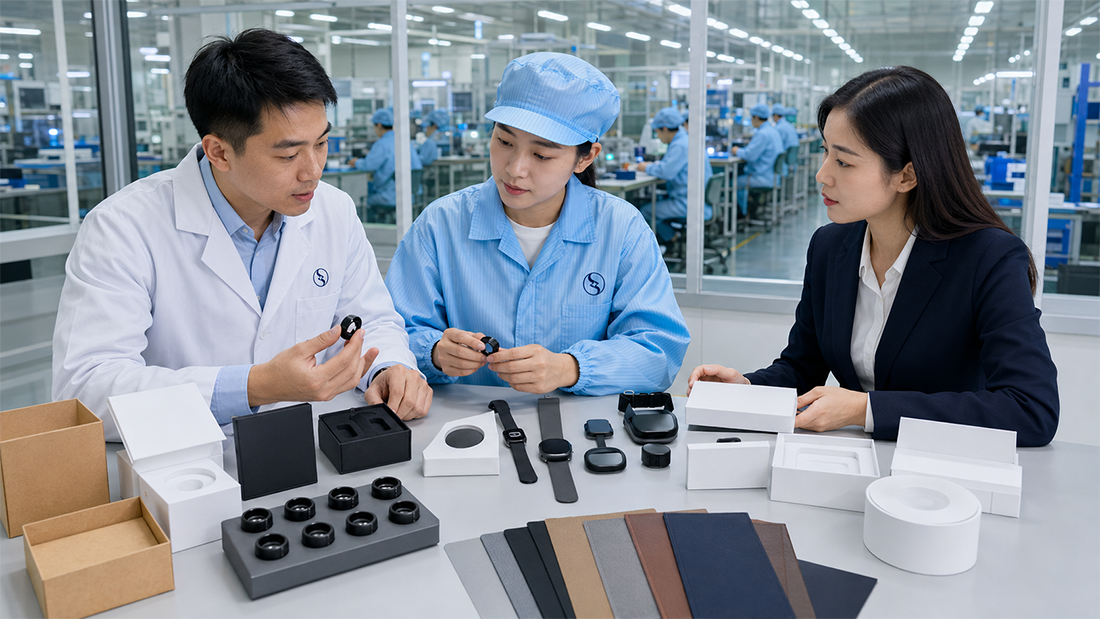
Table of Contents
- Why Corporate Smart Ring Procurement Differs from Consumer Buying
- What Is Smart Ring Supplier Selection?
- Key Facts for Buyers
- The 9 Smart Ring Supplier Selection Checks
- Comparison Table: Order Model Options for Corporate Buyers
- Common Mistakes and Procurement Red Flags
- Practical Buyer Checklist
- FAQ
- Conclusion
Why Corporate Smart Ring Procurement Differs from Consumer Buying
Consumer smart ring purchases are individual decisions based on fit, features and reviews. Corporate procurement is a risk-management exercise. Your organization may distribute rings to hundreds of employees for a corporate wellness program, include them in a benefits package, or resell them under a private label. Each scenario brings contractual, data protection, warranty and brand obligations that rarely appear in a single-unit purchase.
Procurement teams also typically need documentation that individual consumers never see: bills of materials summaries, battery test reports, declarations of conformity, warranty terms, and support commitments that survive beyond the first production run. For that reason, smart ring supplier selection should be built around evidence and written commitments, not marketing pages.
The stakes are higher because wearable health devices involve personal data. Even when a ring is positioned as a general wellness product rather than a medical device, buyers should confirm how health data is stored, whether the app collects data on vendor servers, and how data protection obligations are handled for employees in different jurisdictions. These questions belong in supplier selection, not after deployment.
What Is Smart Ring Supplier Selection?
Smart ring supplier selection is a structured evaluation of a hardware manufacturer’s capability to deliver a defined wearable product at a specified quality, cost and schedule. For corporate buyers it usually includes four layers: the legal entity and factory, the product configuration, the software and service layer, and the commercial terms.
A useful way to frame the evaluation is to ask what you are actually buying. You are buying hardware with a defined bill of materials, a firmware stack, a companion app, packaging, documentation and a warranty process. Each of these can be sourced from one integrated OEM/ODM supplier or split across multiple vendors, and the split affects accountability. Buyers who map responsibilities early reduce finger-pointing when a firmware update breaks app connectivity or when a shipment arrives with inconsistent battery performance.
Definition of a reliable smart ring supplier
A reliable smart ring supplier is one that can show verifiable evidence of manufacturing, testing and documentation processes, provide a written specification and quality agreement, and support the product through its lifecycle. Evidence can include factory audit reports, sample test records and certification test summaries. The specific certification list typically depends on the product configuration and target market, so buyers should verify the exact models they intend to order.
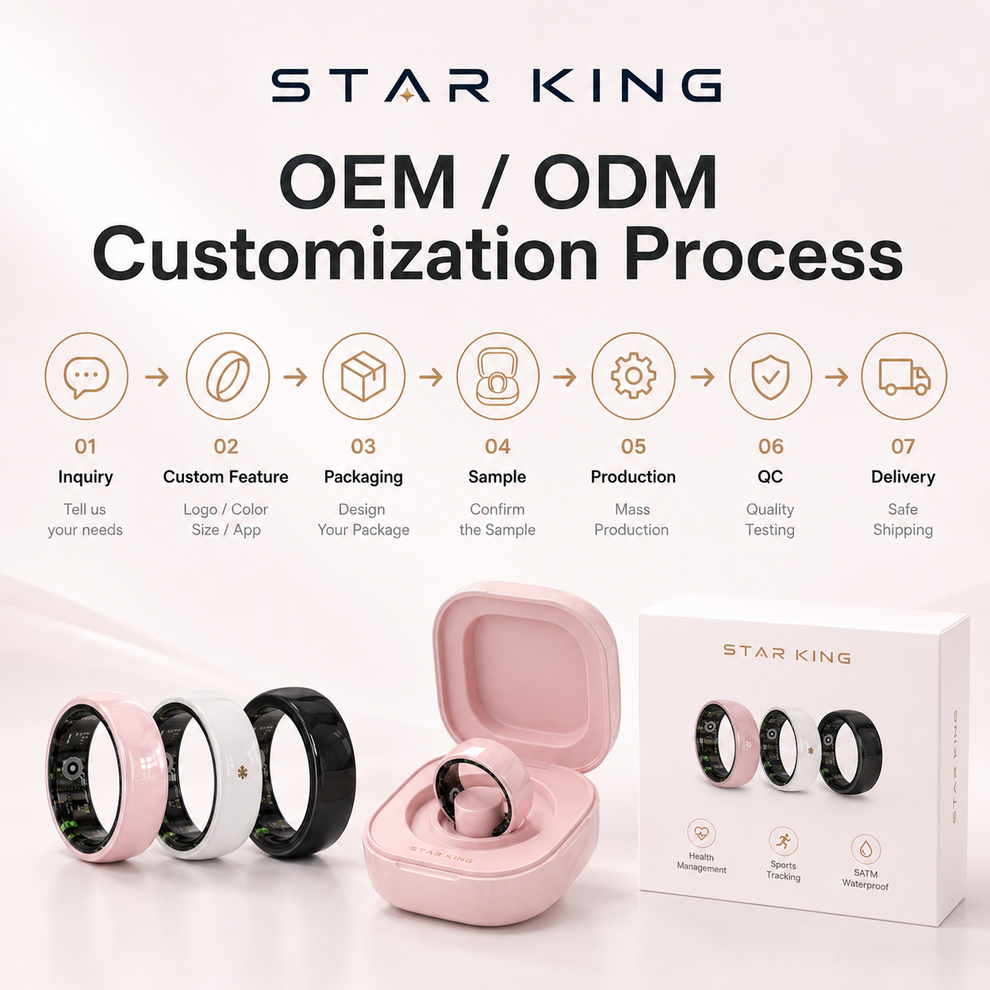
STAR KING’s private label OEM/ODM program is an example of a model where branding, packaging and firmware adjustments are handled within one supply relationship, but buyers should still apply the same nine checks described below to any supplier, including STAR KING.
Key Facts for Buyers
| Decision Area | What to Confirm | Typical Evidence |
|---|---|---|
| Supplier identity | Legal entity, factory location, export experience | Business license, factory audit report, [STAR KING TO CONFIRM] factory profile |
| Order volume | MOQ per model and per configuration | Written quotation with MOQ tiers |
| Product specification | Sensor set, battery life, size range, app compatibility | Datasheet plus sample verification |
| Compliance | CE, FCC, RoHS, UN38.3 status by model and market | Test reports and declarations of conformity |
| Software support | App lifecycle, SDK or API availability | Technical documentation, [STAR KING TO CONFIRM] |
| Quality process | Incoming inspection, ageing, waterproof tests | Quality agreement and inspection records |
| Commercial terms | Lead time, warranty, spare parts, tooling ownership | Contract terms and schedule |
The 9 Smart Ring Supplier Selection Checks
1. Verify the supplier’s legal and factory identity
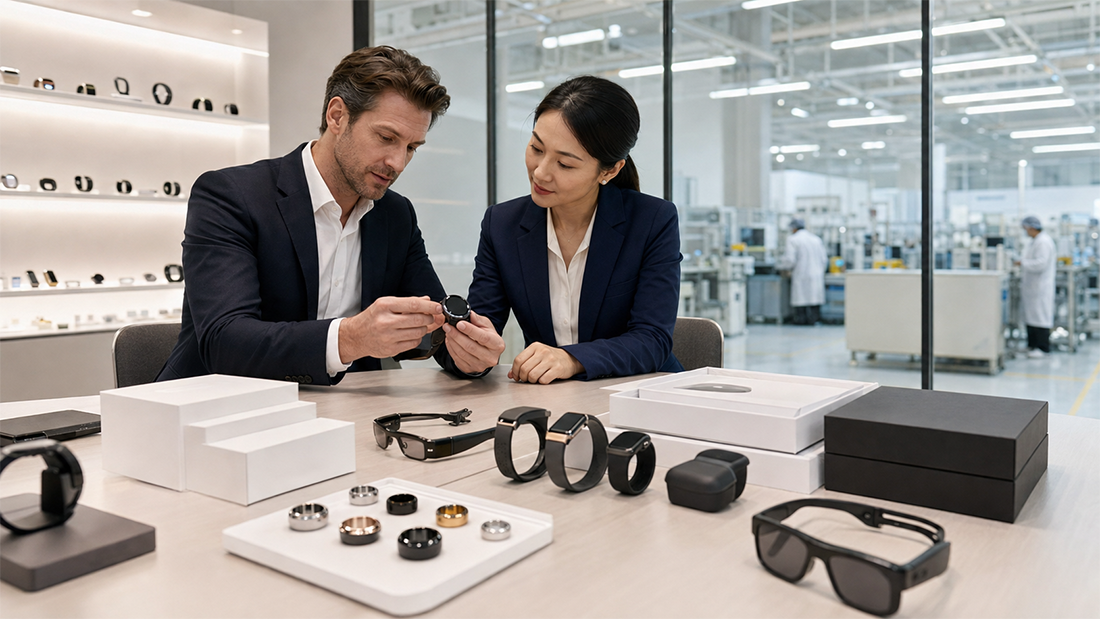
Start with the basics: confirm the legal entity name, factory address and export history. Ask for a business license, and for a recent factory audit report if one exists. Where a trading company represents a factory, request the manufacturing relationship in writing. This matters because a supplier that cannot control production capacity or quality processes cannot reliably commit to lead times on a multi-unit corporate order.
Where to verify: national company registries, third-party audit databases, and direct video or on-site factory tours. If a supplier declines a live tour or documented audit, treat it as a warning sign, not a scheduling issue.
2. Understand MOQ structure and tooling terms
MOQ for smart rings is rarely a single number. It usually varies by model, color, ring size, packaging type and customization depth. Private label orders may require a higher volume than neutral-brand orders because of packaging setup and logo tooling. Ask for a written MOQ matrix covering:
- Neutral product with existing packaging
- Private label logo and packaging
- Custom housing or color finishes
- Firmware or app customization
Tooling and mold ownership should be clarified in writing. If the supplier builds custom tooling, buyers should confirm who owns it, whether it can be transferred, and how it is maintained. [STAR KING TO CONFIRM: tooling ownership policy] This is especially important for buyers planning multi-year programs with a single brand identity.
3. Match product specification to the actual corporate use case
Corporate wellness and remote health programs do not all need the same sensor set. A ring used for step and sleep awareness has different requirements from one used in a pilot with heart rate and blood oxygen tracking. Buyers should write a specification document before requesting quotes: ring sizes needed, battery life expectations, sensor features, waterproof rating, charging method, and app platforms supported.
More sensors and features usually raise unit cost, power consumption and validation effort. For many corporate programs, a well-validated core feature set with stable battery life is more valuable than a long feature list that is difficult to support.
4. Collect certification and compliance evidence for the exact market
Certification is one of the most common sources of delay in corporate wearable procurement. Requirements typically depend on the product configuration, radio modules and destination market. Common documents requested include CE and RoHS evidence for the EU, FCC authorization for the United States, and UN38.3 test summaries for lithium battery transport. Some markets add radio or telecom approvals.
Buyers should request test reports for the exact model and configuration they intend to order, not a generic certificate for a different model. Official references include the FCC for US equipment authorization and the European Commission CE marking guidance. Battery and transport requirements are set by regulators such as IATA for air transport. [STAR KING TO CONFIRM: certification status for each smart ring model and target market]
5. Assess firmware, app and data-handling support
Software is often the deciding factor in corporate deployments. Ask which app will be distributed, whether it is maintained by the supplier or a third party, how updates are released, and whether an SDK or API is available for integration with wellness platforms or HR systems. Data handling terms, including where data is stored and how consent is managed, should be documented. [STAR KING TO CONFIRM: app support model and SDK/API availability]
Buyers should also clarify the support window: how long the supplier commits to firmware updates and app store compatibility. A hardware warranty without software support can leave a corporate fleet unusable after a mobile OS update.
6. Run a structured sample validation before committing
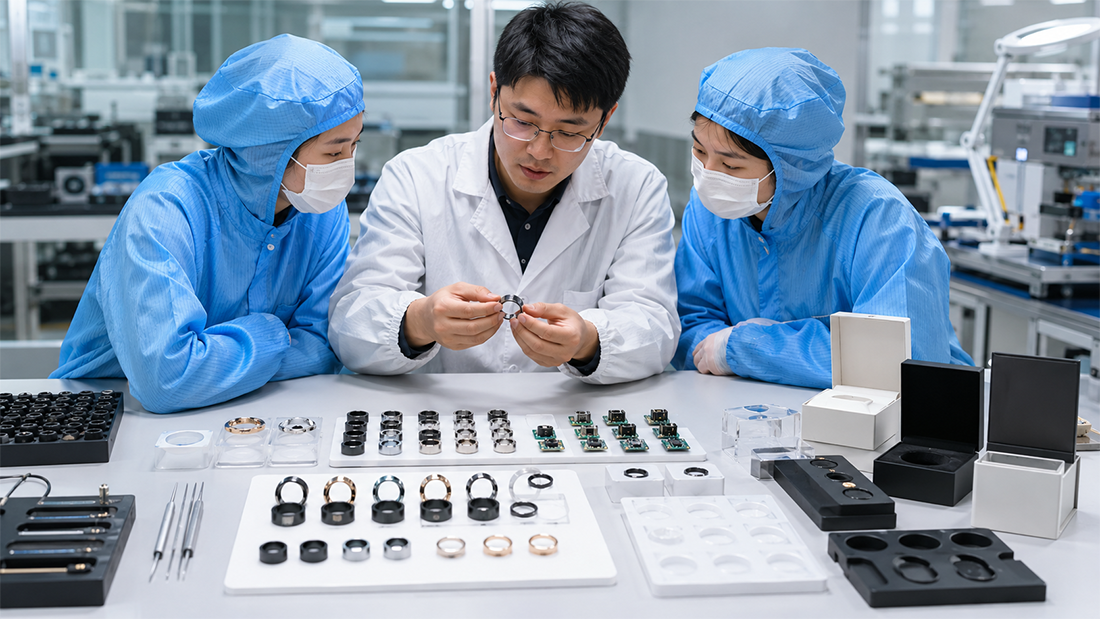
Samples should be tested against the written specification, not just worn for a day. A structured sample validation typically includes:
- Battery life test under realistic use
- Charging cycle and charging case check
- Water resistance test at the declared rating
- Sensor accuracy check versus a reference device
- App pairing, connectivity and update testing
- Ring size fit across a target user group
- Drop and wear testing for casing durability
Document results and share them with the supplier so deviations are corrected before mass production. This step is where supplier selection decisions are often validated or revised.
7. Confirm the quality control process in writing
Ask for a quality agreement covering incoming material inspection, in-process checks, ageing tests, waterproof testing, and pre-shipment inspection. Confirm whether inspection is performed by the supplier, a third party, or both. For corporate orders, it is reasonable to request inspection records and a sample of test data for the production lot. Buyers should also agree on acceptable quality limits and the process for handling defects.
8. Define packaging, branding and documentation deliverables
Corporate buyers often need more than a branded box: user manuals in local languages, warranty cards, regulatory statements, and retail-ready or bulk packaging depending on the channel. Confirm artwork approval steps, printing tolerances and language requirements early. Packaging changes usually add lead time, so agree on the schedule before ordering.
9. Calculate landed cost and realistic lead time
Unit price is only one component. Landed cost includes shipping, duties, taxes, insurance, certification testing, and internal handling. For lithium-battery devices, air freight may require specific documentation and packaging. Lead time should be requested in stages: sample lead time, production lead time after deposit and artwork approval, and shipping transit time. Buyers should also confirm whether spare parts and replacement units are available during the warranty period.
When comparing suppliers, use a common quotation template so responses are comparable. The table below shows the main order models corporate buyers typically consider.
Comparison Table: Order Model Options for Corporate Buyers
| Order Model | Best For | Customization Level | Typical Trade-offs |
|---|---|---|---|
| Neutral product resale | Pilot programs, small deployments | Logo and packaging only | Lower MOQ, limited differentiation |
| Private label | Established wellness brands, retail programs | Logo, packaging, app branding | Higher MOQ, longer setup |
| OEM/ODM | Programs needing custom specification or firmware | Hardware, firmware, app adjustments | Highest MOQ, longer development cycle |
| Multi-vendor split | Buyers sourcing hardware and software separately | Depends on contracts | Clear accountability risk between vendors |
For a closer look at available smart ring configurations, see the smart rings product range. If your procurement team is building a corporate wellness or benefits program, the corporate wellness application page outlines relevant use cases. You can also review our sourcing and product resources for related buying guides.
If you are currently comparing suppliers for a corporate deployment, sharing your volume, target market and specification with a supplier early usually produces a more accurate quotation and reduces later rework. STAR KING can review your requirements and confirm which configurations fit your program.
Common Mistakes and Procurement Red Flags
The following patterns frequently appear in corporate wearable sourcing and should trigger additional due diligence.
- Accepting a certificate for a different model. Certification usually applies to specific configurations; verify model numbers.
- Comparing unit prices without a common specification. Different sensor sets and packaging make prices incomparable.
- Ignoring software support terms. Hardware without app maintenance can become unusable after OS updates.
- No written quality agreement. Verbal quality commitments are difficult to enforce.
- Unclear data handling. Health data obligations should be documented before deployment.
- No tooling or IP terms. Custom designs should have ownership documented.
- Unrealistic lead times. Very short lead times on customized orders may indicate unverified capacity.
- Pressure tactics. Urgency without documentation is a warning sign in B2B sourcing.
Red flags are not proof of a problem, but they justify asking for documentation before committing budget.
Practical Buyer Checklist
- Legal entity and factory address verified
- MOQ matrix received in writing for each configuration
- Specification document agreed and attached to quotation
- Certification evidence requested for exact model and target market
- App, firmware and data handling terms documented
- Sample validation completed against specification
- Quality agreement and inspection process confirmed
- Packaging artwork, languages and approval steps defined
- Landed cost calculated with duties and freight
- Lead time broken into sample, production and shipping stages
- Warranty, spare parts and replacement process agreed
- Tooling and IP ownership terms reviewed
FAQ
How long does smart ring supplier selection usually take?
It varies by program complexity. A neutral-product order may move from enquiry to PO in a few weeks, while private label and OEM projects typically require sample rounds, artwork approval and specification review that can extend the process. Buyers should plan for sample validation time in the schedule.
What MOQ should a corporate buyer expect for smart rings?
MOQ typically depends on the model, customization level and packaging. Private label orders generally carry higher minimums than neutral product orders. Request a written MOQ tier table rather than a single figure. [STAR KING TO CONFIRM: standard MOQ tiers for corporate orders]
Which certifications should corporate buyers request?
Common requests include CE and RoHS for the EU, FCC for the US, and UN38.3 for lithium battery transport. The exact list depends on the product configuration and destination market, so buyers should verify requirements with the supplier and, where needed, a local compliance advisor.
Can a smart ring be integrated with a corporate wellness platform?
Integration depends on whether the supplier provides an SDK or API and how the app handles data export. Buyers should confirm integration capabilities and data terms in writing before ordering. [STAR KING TO CONFIRM: SDK/API capabilities]
Is a smart ring a medical device?
Most consumer smart rings are positioned as general wellness devices rather than medical devices. Buyers should not assume diagnostic capability. If a program requires regulated medical functions, the applicable regulatory pathway typically depends on the target market and intended use, and should be verified separately.
How should buyers handle warranty and spare parts?
Agree on warranty duration, defect handling, replacement process and spare parts availability in the supply agreement. For corporate fleets, replacement logistics should be planned before deployment.
Conclusion
Smart ring supplier selection for corporate procurement is a documentation exercise as much as a commercial one. The nine checks in this guide help buyers verify identity, specification, compliance, software support, quality process, packaging, cost and schedule before issuing a purchase order. Applying the same checks to every candidate, including STAR KING, keeps comparisons fair and reduces the risk of quality drift after mass production begins.
Talk to STAR KING About Your Smart Ring Program
If your organization is evaluating smart rings for a corporate wellness, benefits or private label program, STAR KING can review your specification, target market and volume, and respond with configuration options and customization details. Request a quotation or discuss an OEM/ODM project to confirm MOQ, certification requirements and lead time for your program.
Discuss Your Smart Wearable OEM/ODM Project
Planning a smart ring, smart watch, smart band, AI glasses, AI translator, or AI voice mouse project? Contact STAR KING to discuss product positioning, sample testing, customization scope, certification requirements, lead time, and quotation details.

Team Star King

Scan WhatsApp QR code
Leave a Reply