
smart ring distributors: Smart Ring Distributor Playbook: 7 Checks That Reveal a Reliable OEM Partner in 2026
October 6, 2026 · Team Star King
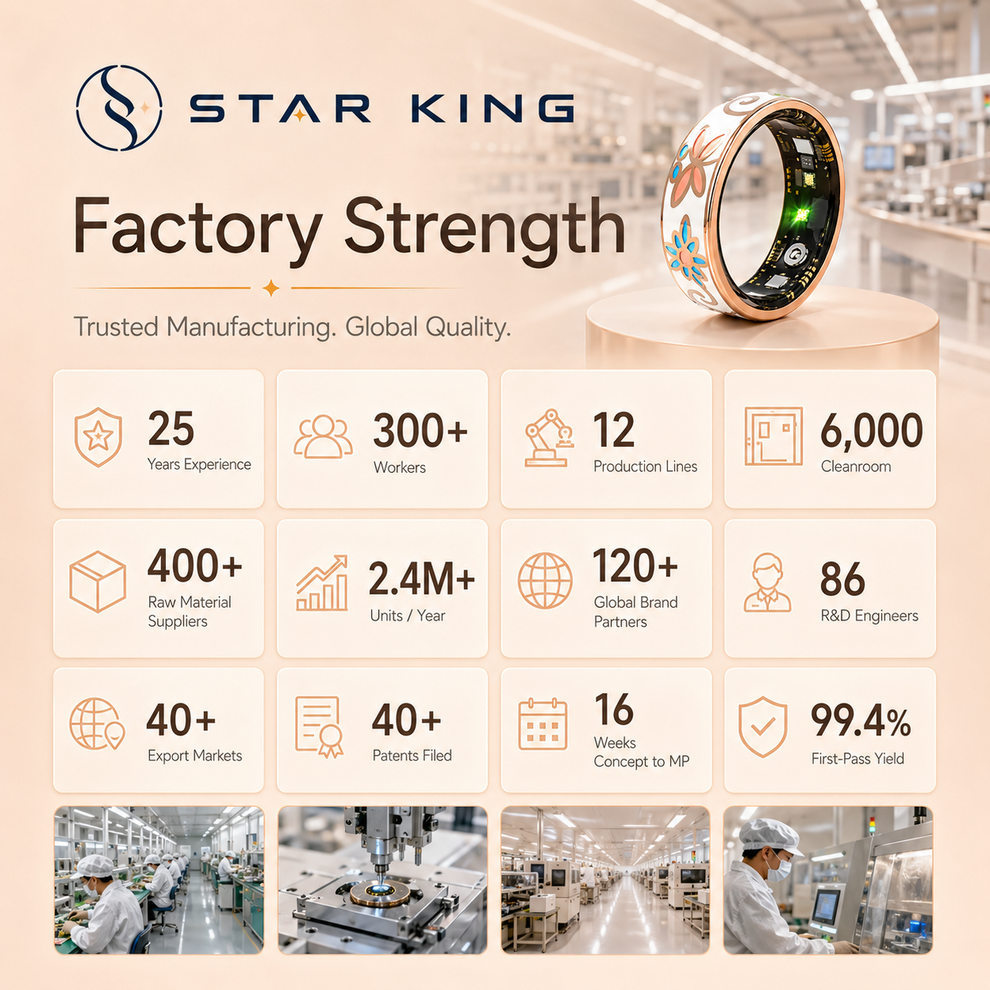
Smart Ring Distributors: 7 Checks That Reveal a Reliable OEM Partner in 2026
Smart ring distributors should evaluate an OEM on seven checks: MOQ and ladder pricing, app and firmware ownership, sensor and battery specifications, certification evidence, sample validation, lead time planning, and warranty/after-sales capability. The most common distribution failures—app abandonment, battery shipping delays, and certification gaps—are decided long before the first container ships, during supplier selection. This guide walks through each check with the questions to ask, the documents to request, and the red flags that should stop a purchase order.
Table of Contents
Table of Contents
Short Answer
For smart ring distributors, the highest-risk OEM weaknesses are unclear app ownership, unverified certification, and MOQ that ignores your inventory cycle. A reliable smart ring OEM manufacturer provides verifiable test reports, a written app roadmap, transparent MOQ tiers, and documented lead times. Buyers should request samples with the exact firmware and app they intend to sell, then confirm those terms in the supply agreement before committing to volume.
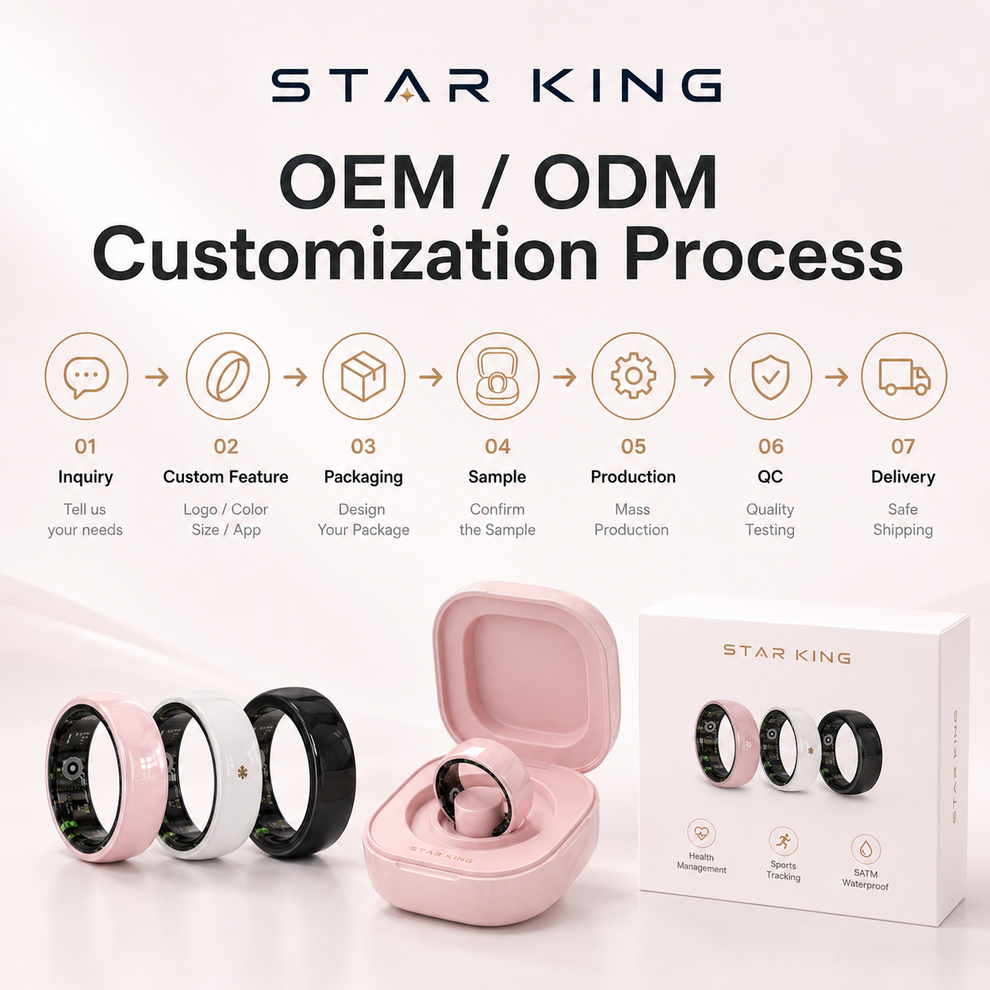
Table of Contents
- Key Takeaways
- Key Facts for Buyers
- What Smart Ring Distributors Are Actually Buying
- Check 1: What Is Your Real MOQ and Price Ladder?
- Check 2: Who Owns the App, Firmware, and User Data?
- Check 3: Are Sensor and Battery Specs Verifiable?
- Check 4: Can the OEM Show Certification Evidence?
- Check 5: How Do You Validate Samples Before Bulk?
- Check 6: What Are Realistic Lead Times?
- Check 7: What Warranty and Spare Parts Support Exists?
- Comparison: Weak vs. Strong OEM Responses
- Common Mistakes and Buyer Red Flags
- Practical Buyer Checklist
- FAQ
- Conclusion
Key Takeaways
- Smart ring distributors should treat app ownership and firmware update policy as a first-tier evaluation criterion, not a technical footnote.
- MOQ and pricing tiers should be confirmed in writing with volume breakpoints that match your sell-through, not just the factory’s minimum run.
- Certification is product- and market-specific; buyers should verify the exact SKU, the issuing lab, and the markets covered.
- Battery shipping documentation (UN38.3, MSDS, and depending on configuration, a test summary) affects both air freight options and landed cost.
- Sample validation before bulk production is the cheapest risk control available to distributors.
Key Facts for Buyers
| Evaluation Area | What to Request | Why It Matters for Distributors |
|---|---|---|
| Pricing & MOQ | Written price ladder with 3–4 volume tiers | Protects margin across mixed-order channels |
| App & Firmware | App name, developer, update cadence, data hosting region | Prevents app abandonment and privacy exposure |
| Sensors & Battery | Component datasheets, rated capacity, charge cycle spec | Reduces return rate and review complaints |
| Certification | CE, FCC, RoHS, UN38.3, MSDS per SKU | Facilitates customs clearance and retail listing |
| Sampling | Golden-sample seal, QC plan, AQL level | Defines the enforceable quality benchmark |
| Lead Time | Working-day ranges for standard and customized orders | Supports channel launch and replenishment planning |
| After-Sales | Warranty terms, DOA policy, spare parts availability | Reduces total cost of ownership and channel friction |
What Smart Ring Distributors Are Actually Buying
A distributor evaluating smart rings is not buying a consumer gadget. The distributor is buying a repeatable supply relationship: consistent firmware, predictable lead times, defensible pricing, and documentation that clears customs and satisfies retail compliance teams. That distinction changes which questions matter most.
The Product Is Only Half the Deal
The physical ring—shell material, sensor array, battery, charging case—is the visible half. The invisible half is the app, the firmware update pipeline, the quality plan, and the commercial terms. Distributors who evaluate only the sample ring routinely discover six months later that the app has stopped updating, the battery capacity was overstated at the sample stage, or the MOQ on a color variant is far higher than the demand for that variant.
Where Distribution Margin Is Won or Lost
Margin in wearable distribution is determined less by the unit price than by return rate, freight configuration, and inventory turns. A marginally cheaper ring with a 6% return rate and an abandoned app can cost more than a slightly higher-priced ring with a 2% return rate and an active app team. This is why the seven checks below weight operational factors alongside price.
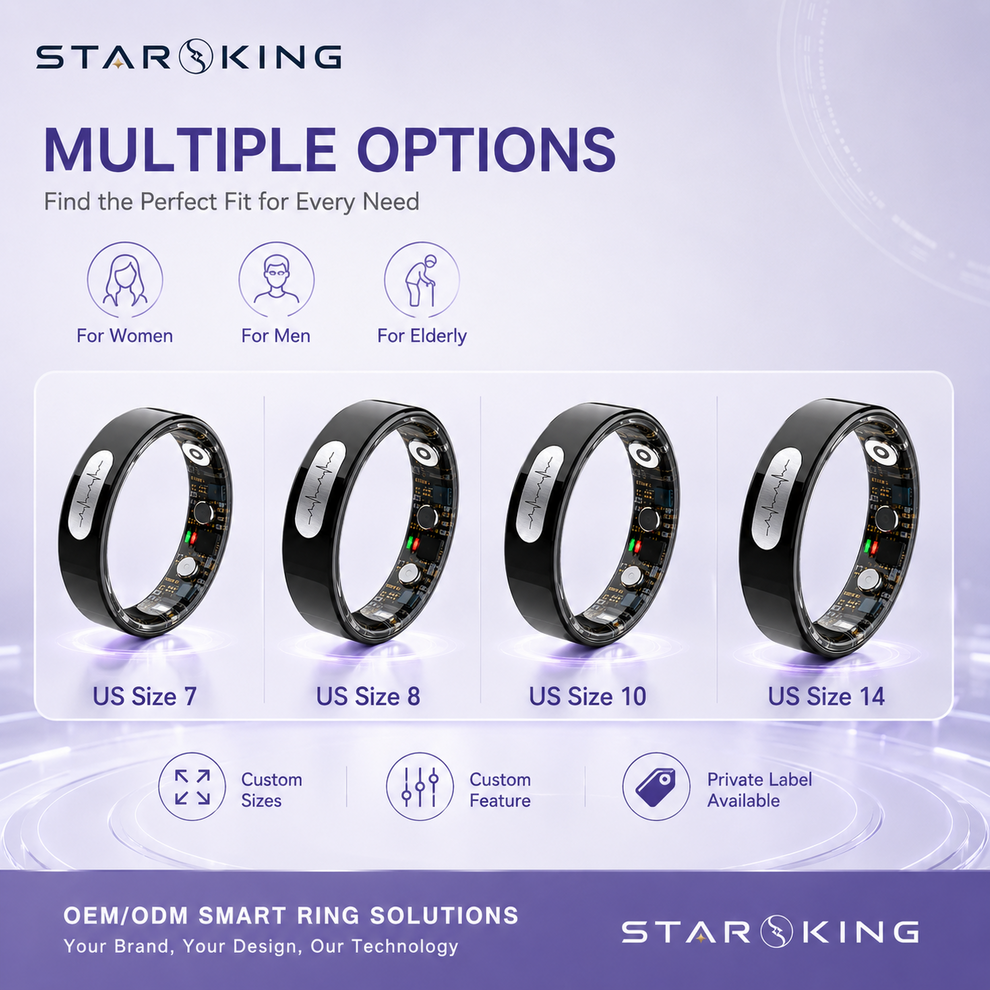
Buyers comparing form factors should also review the full smart rings product range to match sensor packages and charging cases to the specific retail channel they serve.
Check 1: What Is Your Real MOQ and Price Ladder?
MOQ questions often get a single-number answer that collapses under follow-up. A useful evaluation asks for the price ladder and the conditions attached to each tier.
Questions to Ask
- What is the MOQ per SKU, per color, and per ring size assortment?
- Are sizes sold as a pre-defined assortment or individually?
- Does the price break at 500, 1,000, 3,000, and 5,000 units, or only at the extremes?
- What is the MOQ uplift for logo printing, custom packaging, or custom app branding?
- Is tooling or mold cost amortized into unit price, or invoiced separately?
Why This Matters
A distributor with four regional sales channels may need to split one production run across several variants. If the OEM’s MOQ is calculated per variant rather than per order, the effective order size can be two to three times larger than expected. Requesting the ladder in writing reveals this before deposit, not after.
Validation Method
Ask for a formal quotation with tiered pricing and the corresponding MOQ for each tier. Confirm whether the quoted price includes the charging case, cable, retail packaging, and any bundled accessories. Discrepancies between the verbal and written quote are a common early red flag.
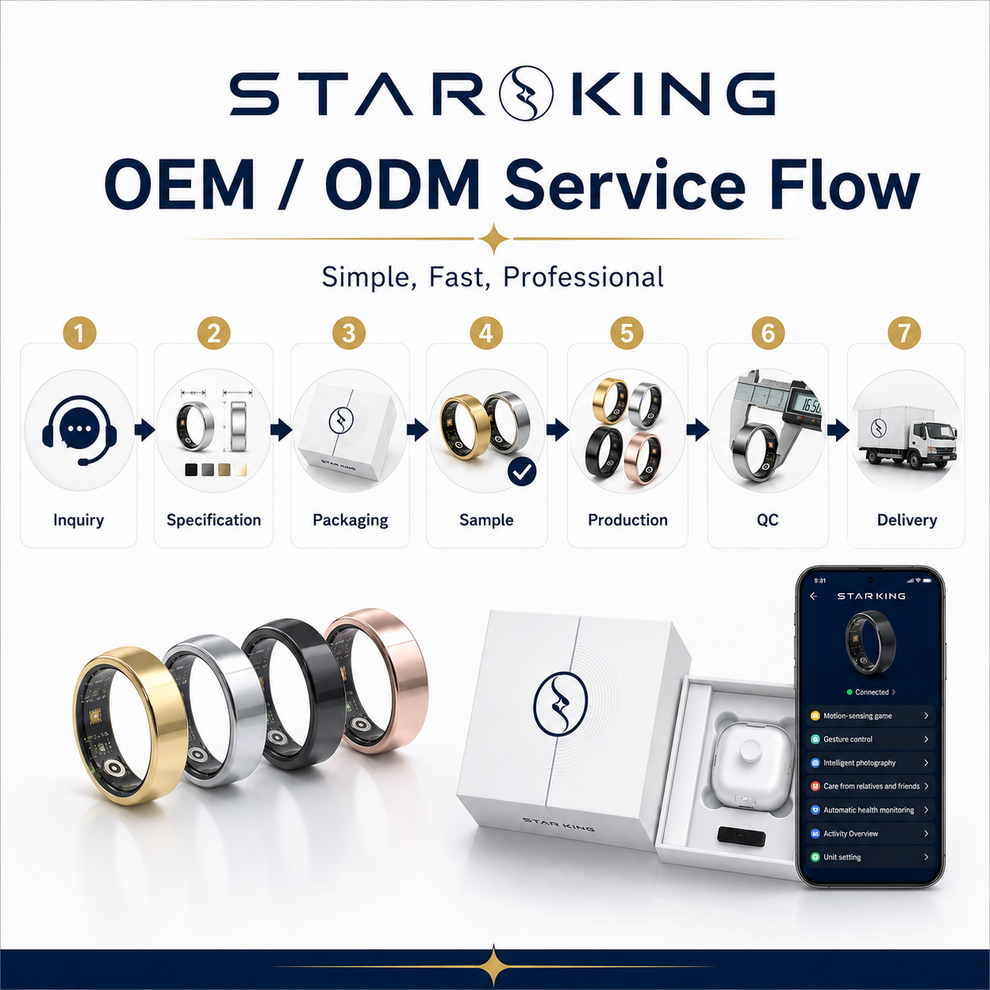
For broader sourcing context on how MOQ and lead time interact across wearable categories, see related guidance on private label OEM/ODM programs.
Check 2: Who Owns the App, Firmware, and User Data?
For a distributor, the app is the long-tail product. The ring may ship in 30 days, but the app determines reviews, retention, and repeat orders for years.
App and Firmware Questions
- Is the app developed in-house or licensed from a third party?
- Which app stores is it published on, and under whose developer account?
- What is the firmware update cadence, and who decides feature priorities?
- Where is user health data stored, and which privacy frameworks apply?
- Is a white-label or private-label app version available, and at what MOQ?
- What happens to the app if the distributor ends the relationship?
Why This Matters
A distributor running a private-label channel needs the app to carry their brand, not the factory’s. If the app is published under the manufacturer’s developer account, brand identity is diluted and the distributor cannot control version releases.
Validation Method
Request a written statement on app ownership, update responsibility, and data hosting. Confirm the data storage region, since privacy regulations vary by market and buyers should verify applicable requirements with qualified counsel. Health and fitness data handling may require additional disclosures depending on the destination market.
Check 3: Are Sensor and Battery Specs Verifiable?
Sensor and battery claims are the most frequently overstated specifications in smart ring sourcing. Distributors should distinguish between sensor type claims and performance claims, and should treat performance claims as needing testing evidence.
Questions to Ask
- Which sensor components are used, and are datasheets available?
- What is the rated battery capacity, and under what test conditions?
- What is the typical battery life at a defined usage profile?
- What is the rated charging cycle count?
- How does battery performance change across ring sizes?
Why This Matters
Consumer smart ring features are wellness and fitness oriented. They are not medical diagnostic devices unless the specific product has regulatory clearance, which is uncommon for consumer wearables. Distributors who market wellness metrics as medical claims create regulatory exposure in multiple markets.
Validation Method
Request component datasheets and any internal test summaries. Confirm the usage profile used to derive battery-life claims, since claims without a defined profile are not comparable across suppliers. Buyers can also review the application context for fitness tracking use cases to align marketing language with what the device actually measures.
Check 4: Can the OEM Show Certification Evidence?
Certification is product-, configuration-, and market-specific. A factory statement that “we are CE certified” is not sufficient for a distributor; the relevant question is which SKU, which configuration, which lab, and which markets.
Documents to Request per SKU
- CE documentation for applicable EU directives and standards
- FCC equipment authorization records for US-bound products
- RoHS compliance declaration or test report
- UN38.3 test summary for lithium battery transport
- MSDS for the battery configuration
- Any additional market-specific approvals required by the destination country
Why This Matters
Certificates issued for one SKU do not automatically cover a different SKU with a different radio module, battery, or charging case. Distributors who import a variant without matching documentation may face customs holds, marketplace delisting, or forced relabeling.
Validation Method
Request certificates by SKU and verify that the model numbers match the purchase order. Buyers should verify current requirements for their specific destination markets, as rules change. Useful official references include the FCC equipment authorization database for US radio products and the European Commission CE marking guidance for EU compliance obligations. Battery transport rules are governed by international dangerous goods frameworks, and buyers should confirm current requirements with their freight forwarder.
Check 5: How Do You Validate Samples Before Bulk?
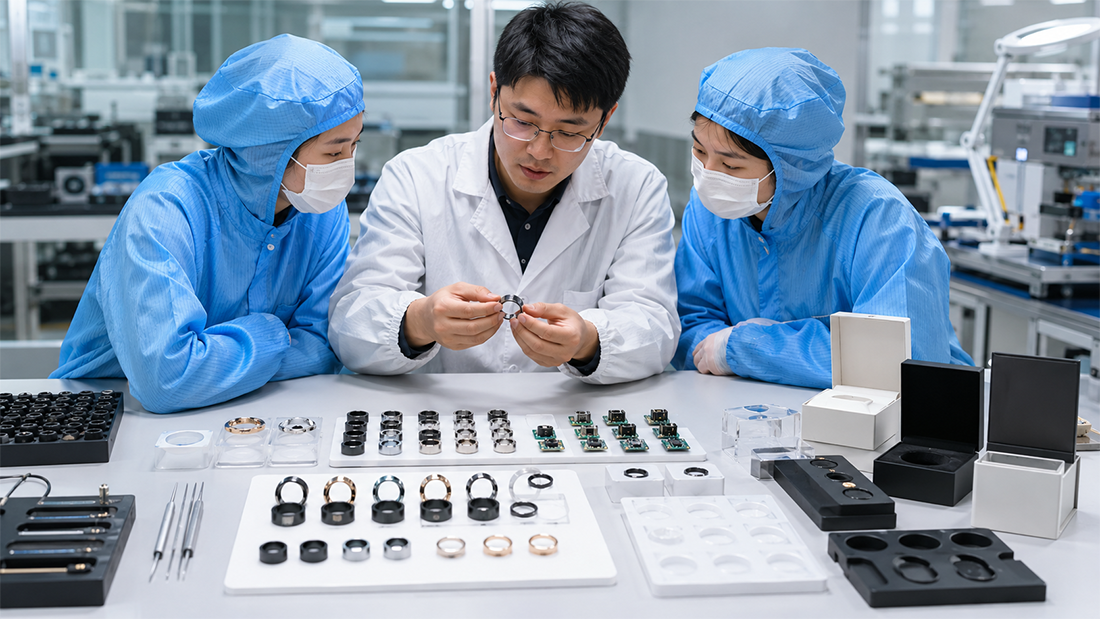
Sampling is the cheapest risk control in the sourcing process, and the stage where distributors most often under-invest.
Sample Validation Steps
- Order production-intent samples with the exact firmware and app build intended for sale
- Test across at least two ring sizes and two skin tones if optical sensors are involved
- Confirm pairing, syncing, and app stability over a multi-day wear test
- Seal the approved sample as a golden reference with both parties retaining a signed copy
- Translate the golden sample into a written QC specification with AQL levels
Why This Matters
Without a sealed golden sample and a written QC plan, disputes about “within specification” become subjective. A documented golden-sample standard converts a quality argument into a measurable inspection.
Validation Method
Confirm the inspection standard the factory applies (commonly an AQL-based plan), who performs inspection, and whether third-party pre-shipment inspection is permitted. Downloadable resources on wearable sourcing and manufacturing can help buyers structure these criteria.
Check 6: What Are Realistic Lead Times?
Lead time for smart rings depends on whether the order uses standard configuration or custom elements, and on battery shipping constraints.
| Order Type | Typical Planning Range | Key Variable |
|---|---|---|
| Standard configuration, no customization | Shorter cycle; confirm in writing | Component stock at factory |
| Logo printing only | Standard cycle plus a small uplift | Print queue and setup |
| Custom packaging | Standard cycle plus packaging lead time | Packaging tooling and print |
| Custom app branding | Extended cycle | App development scope |
| New tooling or custom shell | Longest cycle | Tooling development and validation |
Exact day counts should be quoted per project in working days. Buyers should request a project schedule with milestones rather than a single number, and should plan launch marketing after confirmed inspection, not after a verbal ship date.
Battery Shipping Constraint
Smart rings contain lithium batteries, which are subject to dangerous goods transport rules. Air freight options and documentation requirements vary by configuration and carrier. Distributors should confirm with the factory and forwarder which documentation is available for the specific SKU, and should factor any resulting routing changes into landed cost.
Check 7: What Warranty and Spare Parts Support Exists?
After-sales terms determine the distributor’s true cost of ownership, especially in channels with lenient return policies.
Questions to Ask
- What is the warranty period, and does it start at shipment or at end-user purchase?
- What is the DOA (dead-on-arrival) policy and the replacement process?
- Are spare charging cases, cables, and ring shells available separately?
- Who bears return freight for defective units?
- Is there a defined process for firmware-related field issues?
Why This Matters
A distributor selling into regions with strong consumer protection rules may face returns that are not covered by a narrow factory warranty. Aligning warranty terms with the destination market’s expectations reduces channel friction and protects margin.
A soft next step for buyers comparing suppliers is to request samples and inspect the app, sensor behavior, and battery performance directly before narrowing the list. STAR KING supports sample requests and can discuss which configuration best matches a distributor’s channel mix.
Comparison: Weak vs. Strong OEM Responses
| Evaluation Area | Weak Response | Strong Response |
|---|---|---|
| MOQ | Single number, no tiers | Tiered pricing per SKU, color, and size assortment |
| App ownership | Vague, or app under factory account only | Written statement on ownership, updates, and data hosting |
| Sensors | Marketing claims only | Component datasheets and defined test conditions |
| Certification | “We are certified” | Certificates matched to SKU and target markets |
| Sampling | Generic sample, no seal | Production-intent sample, sealed golden reference, written QC plan |
| Lead time | One verbal number | Milestone schedule in working days |
| Warranty | Unspecified | Documented warranty, DOA policy, spare parts availability |
Common Mistakes and Buyer Red Flags
Common Mistakes
- Evaluating the sample ring without evaluating the app and firmware pipeline
- Accepting a verbal MOQ and discovering the per-variant interpretation after deposit
- Assuming a certificate for one SKU covers a different configuration
- Skipping sealed golden samples, leaving quality disputes unmeasurable
- Marketing consumer wellness metrics with medical-sounding language
- Planning launch dates against a single verbal ship date
Red Flags
- The supplier cannot name the app developer or the data hosting region
- Certificates are shown for a different model number than the quoted product
- MOQ changes between the first email and the formal quotation
- Battery documentation requests are deflected or delayed without explanation
- No written warranty or spare-parts policy is available at the evaluation stage
- Pricing cannot be broken down by component, packaging, and tooling
Practical Buyer Checklist
| Item | Confirm Before Deposit |
|---|---|
| Price ladder | Written tiers with MOQ per SKU, color, and size |
| App | Ownership, developer account, update cadence, data region |
| Firmware | Update policy and feature roadmap responsibility |
| Sensors | Component datasheets and defined test conditions |
| Battery | Rated capacity, cycle count, usage profile definition |
| Certification | SKU-matched certificates for each destination market |
| Battery transport docs | UN38.3 test summary and MSDS for the SKU configuration |
| Sampling | Production-intent sample, sealed golden reference, written QC plan |
| Inspection | AQL level, inspection party, third-party inspection permitted |
| Lead time | Milestone schedule in working days |
| Packaging | Artwork, tooling cost, and approval workflow |
| Warranty | Period, DOA policy, spare parts, return freight responsibility |
| Intellectual property | Tooling ownership, brand asset rights, app code terms |
FAQ
What MOQ should smart ring distributors expect?
MOQ varies widely by supplier and configuration. Custom logo, packaging, or app branding usually raises the minimum. Request a written ladder showing MOQ per SKU, color, and ring size assortment so the effective order size matches your sell-through.
How can a distributor verify smart ring certification?
Request certificates matched to the exact SKU and model number on the quotation, and confirm which markets they cover. Certificates for one configuration do not automatically transfer to a different radio module, battery, or charging case.
Is the smart ring app included, or does it cost extra?
Basic app access is typically included, but private-label app versions, custom branding, and additional feature development usually carry separate scope and cost. Clarify app ownership and update responsibility in writing.
What battery documentation is needed for shipping?
Lithium battery shipments typically require a UN38.3 test summary and MSDS, and sometimes additional carrier-specific documentation. Requirements depend on configuration, quantity, and routing, so buyers should verify current rules with the factory and forwarder.
How long does bulk production take?
Standard configurations generally move faster than custom packaging, app branding, or new tooling projects. Rather than a single number, ask for a milestone schedule in working days and build launch planning around confirmed inspection.
Can distributors get a custom-branded app?
Private-label app options exist, but scope, cost, and MOQ depend on the supplier and the extent of customization. Buyers should confirm whether the app is published under their developer account and who controls future updates.
Are consumer smart ring health metrics medical-grade?
Consumer smart ring health features are generally wellness and fitness oriented, not medical diagnostic functions, unless a specific product has regulatory clearance. Distributors should align marketing claims with the device’s actual measurement capability.
Conclusion
Smart ring distributors reduce supply risk by evaluating the invisible half of the product: pricing structure, app ownership, firmware policy, verifiable specifications, certification matched to SKU, sampling discipline, lead time planning, and after-sales terms. Suppliers that answer these seven checks with documents rather than assurances are the ones that hold up across multiple reorders and multiple markets. Buyers should treat each check as a gate, not a formality, and confirm key terms in the supply agreement before committing volume.
STAR KING CTA
If you are evaluating smart ring supply for distribution, the next step is a sample you can test against your own channel requirements. Request smart ring samples and discuss OEM/ODM configuration options, MOQ tiers, and certification documentation for your target markets.
Request smart ring samples and OEM/ODM details
Discuss Your Smart Wearable OEM/ODM Project
Planning a smart ring, smart watch, smart band, AI glasses, AI translator, or AI voice mouse project? Contact STAR KING to discuss product positioning, sample testing, customization scope, certification requirements, lead time, and quotation details.

Team Star King

Scan WhatsApp QR code
Leave a Reply