
Smart Bands Private Label Sourcing: 7 Checks for EU Buyers
October 20, 2026 · Team Star King
Smart Bands Private Label Sourcing: 7 Checks for EU Buyers
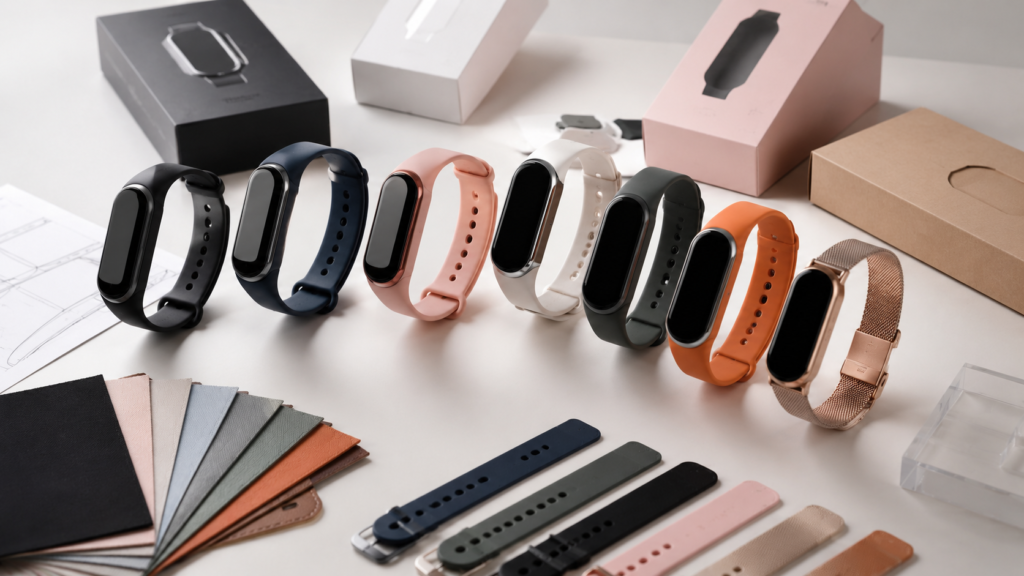
Smart bands private label sourcing means selecting a manufacturer that can supply smart bands under your own brand, with agreed hardware, firmware, app integration, packaging, certification, and delivery terms. For EU buyers, the right supplier is not simply the one with the lowest quotation: it is the one that can document compliance, control quality, and support your brand after launch. Before negotiating price, use this seven-check framework to separate reliable smart band manufacturers from trading intermediaries and unverified suppliers.
Table of Contents
Table of Contents
Table of Contents
- Short Answer
- Key Takeaways
- Key Facts for Buyers
- What Is Smart Bands Private Label?
- Check 1: Product Configuration and Firmware
- Check 2: Compliance for the EU Market
- Check 3: Quality Control and Testing
- Check 4: Customization and MOQ
- Check 5: App, Firmware, and Data Handling
- Check 6: Sampling, Lead Times, and Logistics
- Check 7: Commercial Terms and After-Sales
- Supplier Comparison Table
- Common Mistakes and Buyer Red Flags
- Practical Buyer Checklist
- FAQ
- Conclusion

Short Answer
To source smart bands private label for the EU, shortlist manufacturers that can provide product-specific compliance documents, show a documented quality process, and accept sample validation before mass production. Confirm MOQ, tooling ownership, app data handling, and lead times in writing. The best supplier is the one that reduces your regulatory and quality risk, not only your unit price.

Key Takeaways
- Evaluate smart band suppliers on compliance, quality documentation, customization capability, and communication speed, not price alone.
- EU market access typically depends on CE marking, RoHS compliance, battery transport documentation, and the applicable RED or WEEE requirements.
- Request product-specific certificates and test reports; do not accept generic or expired documents.
- Agree on sample approval, pre-shipment inspection, and packaging artwork before placing a bulk order.
- Clarify MOQ, tooling ownership, app/firmware support, and after-sales terms in the purchase agreement.
- Plan for lithium battery shipping documentation and EU import requirements early.

Key Facts for Buyers
| Buying Factor | What EU Private-Label Buyers Should Check | Why It Matters |
|---|---|---|
| Compliance | CE marking basis, RoHS test report, battery documents (UN38.3, MSDS), WEEE registration responsibility | Customs clearance and market access |
| Product specification | Sensor set, battery life, display, waterproof rating, app compatibility | Market fit and return rate |
| Quality control | Incoming inspection, aging test, drop/waterproof test, pre-shipment inspection | Consistent batch quality |
| Customization | Logo, packaging, app skin, firmware features, language packs | Brand differentiation |
| MOQ | MOQ per SKU, per color, and per packaging version | Cash flow and inventory risk |
| Lead time | Sample lead time, production lead time, shipping time to EU | Launch planning |
| After-sales | Warranty period, spare parts, RMA process | Customer satisfaction and cost control |

What Is Smart Bands Private Label?
Smart bands private label is a supply model in which a manufacturer produces fitness bands, health-monitoring bands, or hybrid smart bands to your specification and applies your brand to the product, packaging, app, and documentation. Unlike simple logo printing, private label smart bands usually involve a combination of hardware selection, firmware configuration, app integration, and packaging design. The manufacturer may offer a standard hardware platform with configurable options, or develop a customized band based on your requirements.
For EU buyers, private label also means taking responsibility for product compliance and after-sales service. The manufacturer supplies the technical file and test evidence, but the importer or brand owner must ensure that the product meets applicable EU rules. This is why supplier selection should start with compliance and quality capability, not with the lowest unit price.
Check 1: Product Configuration and Firmware
Start by mapping the exact smart band configuration you need. Fitness tracking bands, sleep-tracking bands, and bands with heart rate or blood oxygen monitoring use different sensor sets and firmware. Ask the supplier to provide a written specification sheet covering display type, battery capacity, charging method, waterproof rating, supported sensors, Bluetooth version, and app compatibility.
Define which features are standard and which require firmware changes. For example, adding a custom watch face, changing the metric display order, or enabling a specific language may require firmware customization. Clarify whether the supplier can support over-the-air (OTA) firmware updates and who owns the firmware source code or update process.
If you are building a fitness-focused range, review the fitness tracking application page to understand how wearable data is typically presented to end users. For a broader view of the product category, see smart bands.
Check 2: Compliance for the EU Market
EU compliance is the most common source of delay for private-label smart band projects. Requirements depend on the product configuration, wireless functions, battery type, and target countries. Buyers should verify each item directly with the supplier and, where needed, with a notified body or compliance consultant.
Typical items to request include:
- CE marking documentation and the applicable directives, such as the Radio Equipment Directive for Bluetooth-enabled products.
- RoHS test reports for restricted substances.
- Battery transport documents, including UN38.3 test summary and MSDS for lithium batteries.
- WEEE and packaging registration responsibilities, which typically depend on the importer’s country.
- REACH declarations for materials in contact with skin.
Do not accept a certificate that does not list your specific model or that has expired. Ask for the full test report, not only the certificate cover page. For official reference, see the European Commission CE marking page and the FCC equipment authorization procedures if you also plan to sell in the United States.
Certification status varies by product and configuration. Ask the supplier to confirm which certificates apply to your exact model and target markets. [STAR KING TO CONFIRM]
Soft CTA: If your team is comparing EU compliance options for smart bands private label, you can discuss certification requirements with STAR KING before finalizing your specification.
Check 3: Quality Control and Testing
Quality control separates manufacturers from traders. Ask how the supplier inspects incoming components, how it tests assembled bands, and what happens when a batch fails. A documented process should include incoming material inspection, in-process checks, functional testing, aging or burn-in testing, and pre-shipment inspection.
Common tests for smart bands include:
- Functional test of display, touch, charging, Bluetooth pairing, and sensors.
- Battery charging and discharging test.
- Waterproof or splash-resistance test, depending on the rated IP level.
- Drop test for housing and strap durability.
- Aging test to catch early failures before shipment.
Ask for sample inspection reports and, for larger orders, arrange a third-party pre-shipment inspection. The inspection criteria should reference your approved sample and specification sheet. If the supplier cannot explain its test process clearly, that is a warning sign.
Check 4: Customization and MOQ
Private-label smart bands can be customized at several levels: logo on the strap or housing, packaging design, app name and icon, language selection, and firmware features. Each level has a different cost and minimum order quantity. Ask for a customization matrix that shows MOQ, tooling cost, sample cost, and lead time for each option.
| Customization Level | Typical Buyer Question | What to Confirm |
|---|---|---|
| Logo printing | Can the logo go on the strap or buckle? | MOQ per color, artwork format, durability test |
| Packaging | Can we use our own retail box? | MOQ per box version, dieline approval, packaging test |
| App skin | Can the app carry our brand? | App name, icon, splash screen, data ownership |
| Firmware features | Can you change the metric display? | Development fee, testing time, OTA support |
| New housing or tooling | Can we create a unique design? | Tooling cost, mold ownership, development schedule |
Clarify whether tooling and mold ownership transfer to you after payment. For a broader overview of private-label options, see private label OEM/ODM solutions.
Check 5: App, Firmware, and Data Handling
The companion app is part of the product experience and part of your compliance footprint. Ask whether the supplier provides a white-label app, a configurable app, or an SDK/API for integration with your existing platform. Confirm which party hosts user data, where servers are located, and how the app handles privacy consent.
For EU buyers, data protection deserves early attention. The General Data Protection Regulation (GDPR) applies to personal data processed in connection with the app, including health-related data. Clarify roles: are you the data controller and the supplier a processor, or does the supplier operate the app independently? Request the app privacy policy and data processing agreement template. For official reference, see the GDPR portal.
Also ask about firmware update responsibility. If a sensor or Bluetooth issue appears after launch, who provides the fix and how quickly? A supplier that can support firmware maintenance reduces long-term risk.
Check 6: Sampling, Lead Times, and Logistics
Always validate a sample before committing to bulk production. The sample should match the final specification, including firmware version, language pack, packaging, and accessories. Test the app pairing, charging, battery life, and sensor accuracy in your own environment. Record your approval in writing with photos and version numbers.
Lead time planning should separate sample lead time, production lead time, and shipping time. Smart bands contain lithium batteries, so air and sea shipping require proper documentation and packaging. Confirm who prepares the UN38.3 test summary, MSDS, and battery labels. Ask whether the supplier has experience shipping to your EU destination country and can support your freight forwarder.
Build a buffer into your launch plan. Certification review, packaging approval, and customs clearance can add time that is not visible in the production quotation.
Check 7: Commercial Terms and After-Sales
Review the commercial terms as carefully as the product specification. Confirm payment terms, Incoterms, warranty period, defect handling, and spare parts policy. Ask how the supplier handles DOA (dead on arrival) units and what evidence is required for a warranty claim.
For private-label brands, after-sales support affects customer reviews and return rates. Clarify whether spare straps, chargers, and packaging are available for replacement orders. Ask for the RMA process and expected response time. If the supplier cannot describe a clear after-sales process, the lowest quotation may become the most expensive choice.
Supplier Comparison Table
| Evaluation Area | Weak Signal | Strong Signal |
|---|---|---|
| Compliance | Generic certificates, no model number | Product-specific reports, clear scope, valid dates |
| Quality | No test process described | Documented inspection and aging tests |
| Customization | Unclear MOQ and tooling cost | Written customization matrix |
| App support | No privacy or data discussion | Clear data roles and update process |
| Communication | Slow, vague answers | Specific answers with documents |
| After-sales | No RMA process | Defined warranty and spare parts policy |
Common Mistakes and Buyer Red Flags
- Choosing on price alone. A low quotation may exclude certification support, testing, or packaging.
- Accepting generic certificates. Certificates must match the model and configuration you are buying.
- Skipping sample approval. Without a written approved sample, mass production has no reference point.
- Ignoring app data handling. GDPR responsibilities should be agreed before launch, not after a complaint.
- Underestimating battery logistics. Lithium battery shipping documents take time to prepare.
- No tooling ownership clause. Clarify who owns molds and custom tooling after the project ends.
- Verbal promises only. MOQ, lead time, and warranty terms should be in the purchase agreement.
Practical Buyer Checklist
- Specification sheet with model number, sensors, battery, and waterproof rating.
- Product-specific CE, RoHS, UN38.3, and MSDS documents where applicable.
- Sample approval record with photos and firmware version.
- Quality control process description and pre-shipment inspection plan.
- Customization matrix with MOQ, tooling cost, and lead time.
- App privacy policy and data processing terms.
- Written lead times for sampling, production, and shipping.
- Warranty, RMA, and spare parts terms.
- Tooling ownership and IP clauses in the agreement.
For a wider view of how wearables fit into health and fitness programs, the health and fitness wearables solution page outlines common use cases. You can also review the STAR KING blog for related sourcing guides.
FAQ
What does smart bands private label include?
It typically includes hardware selection, your logo and packaging, app branding, and product documentation. The exact scope depends on the supplier and the customization level you choose.
Which certifications do EU buyers need for smart bands?
Requirements typically depend on the product configuration and target countries. Buyers commonly request CE marking documentation, RoHS test reports, and lithium battery transport documents such as UN38.3 and MSDS. Verify the specific requirements with the supplier and a compliance specialist.
What MOQ should a private-label brand expect?
MOQ varies by supplier, model, color, and packaging version. Ask for MOQ per SKU and per customization option, and confirm whether sample orders are available before bulk production.
How long does sampling and production take?
Sample lead time and production lead time depend on the model and customization. Request a written schedule that separates sampling, mass production, and shipping, and add buffer time for certification and customs.
Can the app carry our brand and handle EU data rules?
Many suppliers offer configurable or white-label apps. Confirm app branding, hosting location, privacy policy, and data processing roles before launch, because GDPR obligations may apply.
Who owns the mold or tooling for a custom design?
Ownership should be stated in the purchase agreement. Ask whether tooling costs are one-time, whether ownership transfers to you, and what happens to the tooling if the project ends.
How should buyers handle lithium battery shipping?
Confirm that the supplier prepares UN38.3 test summaries, MSDS, and proper battery packaging. Work with a freight forwarder experienced in lithium battery shipments to your EU destination.
Conclusion
Smart bands private label sourcing for the EU rewards preparation. By evaluating suppliers on compliance, quality, customization, app support, lead times, and commercial terms, private-label brands can reduce launch risk and protect their reputation. Use the seven checks in this guide as a structured scorecard, request documents rather than promises, and validate a sample before committing to bulk production.
Next step: Ready to compare smart band options for your EU private-label launch? Contact STAR KING sales to request product samples, review customization options, and confirm certification requirements for your target markets.
Discuss Your Smart Wearable OEM/ODM Project
Planning a smart ring, smart watch, smart band, AI glasses, AI translator, or AI voice mouse project? Contact STAR KING to discuss product positioning, sample testing, customization scope, certification requirements, lead time, and quotation details.

Team Star King

Scan WhatsApp QR code
Leave a Reply