Smart Bands for EU Distributors: 2026 RFQ Guide to Sourcing Wholesale Smart Bands
Smart Bands for EU Distributors: A 2026 RFQ Guide to Sourcing Wholesale Smart Bands
Smart bands for EU distributors are wholesale wearable devices sourced from OEM/ODM factories and resold through retail, e-commerce, and B2B channels across the European Union. For an RFQ, distributors should request: confirmed CE RED and RoHS documentation, UN38.3 and MSDS for the battery, tiered pricing at 500/1,000/3,000 units, IP-rated water resistance, app localization, and DDP or DAP delivery terms to a named EU warehouse. A complete RFQ also specifies stable firmware, two-year warranty terms, and the right to sell under your own brand.
Table of Contents
Table of Contents
smart bands for EU distributors: Table of Contents
- Direct Answer
- Key Takeaways
- Key Facts for Buyers
- Specifications That Decide Your Retail Price
- Landed Cost: Where the Money Goes
- MOQ, Tooling, and Private Label
- EU Compliance and the Battery Question
- Sample Validation and Quality Control
- Lead Time and Production Planning
- Common Mistakes and Buyer Red Flags
- Practical RFQ Buyer Checklist
- RFQ Email Template
- FAQ
- Conclusion

Direct Answer
Sourcing smart bands for EU distributors is a compliance-first exercise. Before you compare quotes, confirm the supplier can provide CE RED and RoHS documentation, a UN38.3 test summary and MSDS for the lithium battery, and a stable app that supports your target languages. For a realistic RFQ, plan around 500–1,000 units for a stock model, 1,000–3,000 units for a custom logo and packaging run, and 8–14 weeks for production plus freight. The lowest unit price is rarely the lowest landed cost once certification gaps, returns, and customs delays are priced in.
Key Takeaways
- Compliance comes before cosmetics. CE RED, RoHS, and battery documentation decide whether the shipment clears EU customs and survives retail compliance reviews.
- MOQ is negotiable, tooling is not. Logo and packaging changes usually cost less than custom enclosures, which require tooling and longer timelines.
- Landed cost is the real number. Duty, freight, certification amortization, and expected return rates can shift your sell-through margin by several points per unit.
- Sample validation is your only proof. RFQ-stage promises about sensor accuracy and battery life should be verified with two independent sample units before you commit a deposit.
- Software is part of the product. App stability, firmware update policy, and data handling terms matter as much as the hardware for EU distribution.

Key Facts for Buyers
| RFQ Item | Typical EU Distributor Baseline | Why It Matters |
|---|---|---|
| Production MOQ (stock model) | 500–1,000 units | Keeps initial inventory risk manageable |
| Production MOQ (custom logo/packaging) | 1,000–3,000 units | Amortizes setup and print costs |
| Sample lead time | 5–10 business days | Allows testing before deposit |
| Production lead time | 3–6 weeks after deposit | Affects retail launch dates |
| Certification docs | CE RED, RoHS, UN38.3, MSDS | Required for EU customs and retail |
| Water resistance | IP67 or IP68 | Supports fitness and daily-wear claims |
| Warranty | 12–24 months | Protects distributor margin |
Confirm these figures with your shortlisted supplier before issuing a purchase order. Certification scope, MOQ, and lead times depend on the specific product configuration and target country.
Specifications That Decide Your Retail Price
Smart bands sit in a crowded retail segment. Two distributors can sell visually similar devices at very different price points because of a handful of specification choices. Use the table below to align RFQ questions with your planned retail tier.
Display and Housing
AMOLED displays support higher shelf prices and better sunlight readability than basic TFT panels. Aluminum or reinforced composite housings improve perceived quality, while soft TPU or silicone straps keep the unit comfortable for 24-hour wear. Ask the supplier for the exact display type, resolution, and cover-glass material — not a general description.
Sensor Set and Health Features
Most wholesale smart bands include optical heart-rate and blood-oxygen (SpO2) sensors, plus accelerometers for step and sleep tracking. Note that consumer wellness features are not medical devices. If you intend to market toward senior health monitoring or remote health wearables, confirm with your supplier and your own regulatory advisor which claims are permissible in your market. See how monitoring features are positioned in the Remote Health Wearables application.
App and Firmware
The companion app is where end users spend the most time. Confirm language support, iOS and Android versions, account creation flow, and how the app syncs data. EU distributors should ask how personal data is stored and whether a data processing agreement is available. For related software questions, review the smart bands product page for the current platform overview.
Battery and Charging
Battery life claims vary widely by usage profile. A band marketed as 10 days may deliver that only with notifications and continuous heart-rate tracking disabled. Ask for the tested conditions behind any battery claim so your product listing stays accurate.
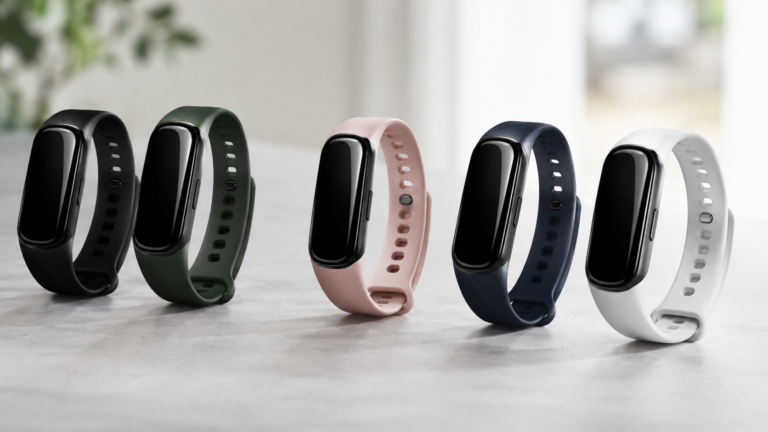
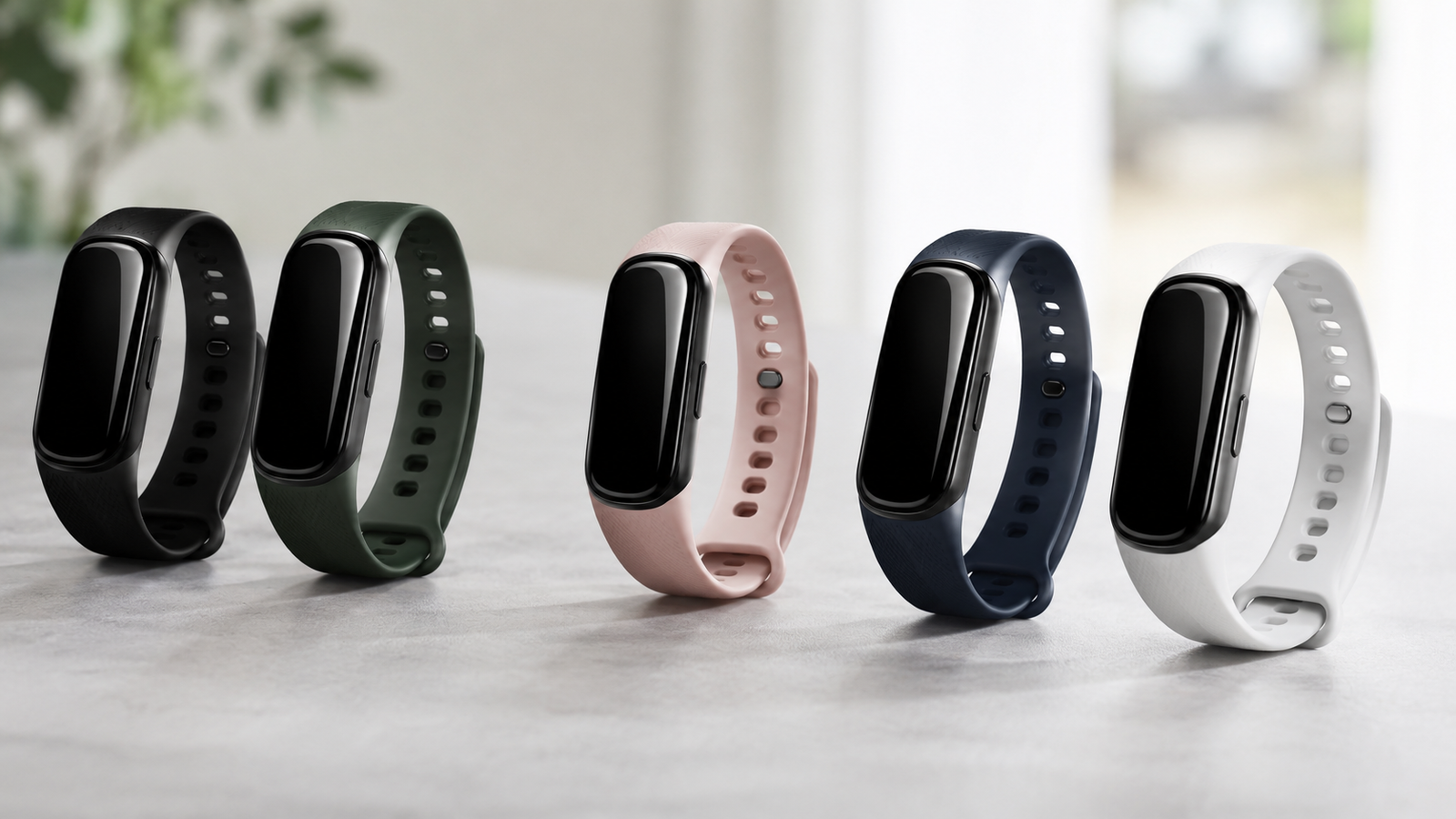
[Image suggestion: front and side view of a wholesale smart band on a white background — mark as hero image]
Landed Cost: Where the Money Goes
Unit price is only one line in your landed cost model. For EU distribution, build the full picture before you negotiate.
| Cost Component | Typical Driver | RFQ Question |
|---|---|---|
| FOB unit price | Screen type, sensors, memory | What changes between tiers? |
| Private label setup | Logo, packaging, firmware | One-time or per-unit cost? |
| Certification support | CE RED, RoHS, battery docs | Provided free or shared cost? |
| Freight | Air vs. sea, lithium handling | Who handles dangerous goods paperwork? |
| Import duty and VAT | HS code and country rules | What HS code is used? |
| Returns allowance | Hardware and software defects | What failure rate is expected? |
| App localization | Language and support cost | Who owns translation updates? |
Confirm the HS code your supplier uses and verify duty rates with a customs broker in your country. Duty treatment for wearable electronics with lithium batteries can vary by classification and by member state practice, so buyers should verify before finalizing margins.
MOQ, Tooling, and Private Label
For a distributor entering the EU market, the fastest path is usually a Private Label run on an existing platform. You are not paying for new tooling; you are paying for logo printing, retail packaging, an app skin, and possibly a firmware splash screen. This keeps MOQ lower and timelines shorter than full ODM development.
Stock Model Private Label
- Logo on the case back or strap
- Custom paperboard or blister retail packaging
- Manuals in your target languages
- App name, icon, and splash screen
ODM Modification
- New enclosure color or material
- Different sensor or display module
- Custom strap design and clasp
- Tooling ownership negotiated in writing
Tooling ownership is a frequent RFQ sticking point. Clarify who owns the molds, what happens if you change suppliers, and whether you receive a copy of the drawing and maintenance records. STAR KING can support private label and OEM/ODM programs — see the Private Label OEM/ODM solution page for the workflow.
Soft CTA: If you are preparing an RFQ and want to compare private label options against stock models, request a specification sheet and pricing tiers from our team.
EU Compliance and the Battery Question
Compliance is the part of an RFQ that most often determines whether a container clears customs. For EU distribution, the core document set typically includes:
- CE RED declaration of conformity for the wireless radio
- RoHS documentation for restricted substances
- UN38.3 test summary for the lithium battery
- MSDS for the battery and shipment
- GPSR contact point for EU market products
Ask for documentation that matches the exact model and firmware version you are ordering. A certificate for a different model in the same family does not automatically cover your configuration. Note also that the EU’s Radio Equipment Directive and related acts fall on the importer as well as the manufacturer — distributors should understand their own obligations as the EU responsible person. The European Commission’s Radio Equipment Directive page is a practical starting reference. For battery transport, the IATA lithium battery guidance explains why UN38.3 testing and correctly classified shipping papers are required.
If the supplier cannot share documentation, treat that as a red flag rather than a paperwork delay. You can also review how compliance topics are handled under the Health & Fitness Wearables solution.
Sample Validation and Quality Control
An RFQ is a hypothesis. Sample testing is how you test it. Ask for at least two sample units from the same production batch as your planned order, and run a structured validation:
| Test | What to Check | Acceptance Signal |
|---|---|---|
| Charging | Full charge time, cable fit | Consistent with spec |
| Sensor accuracy | Heart rate vs. reference device | Close trend, no dropouts |
| App pairing | iOS and Android connection | Stable reconnection |
| Water resistance | Hand wash and sweat test | No fogging or dead units |
| Firmware update | OTA process | Completes without bricking |
| Drop test | 1 m drop on hard floor | No screen or strap failure |
For production orders, agree on a pre-shipment inspection standard and an acceptable quality level (AQL) before deposit. Ask who performs the inspection, whether third-party inspection is allowed, and how defects are handled. Document the process in the purchase order so there is no ambiguity at shipment.
Lead Time and Production Planning
Smart band production runs are relatively short, but certification, packaging printing, and lithium battery shipping add time. A realistic EU distributor timeline looks like this:
- Sample approval: 1–2 weeks
- Deposit and documentation check: 1 week
- Production: 3–6 weeks for stock models
- Packaging and private label printing: 1–2 weeks
- Pre-shipment inspection: 1 week
- Air freight to EU: 5–10 days
- Sea freight to EU: 4–6 weeks
Plan your retail launch around the slower of the two freight modes if you need buffer stock. Ask the supplier for a written production schedule with milestones, not a single delivery date. For related hardware timelines, the smart watches product page shows how comparable wearable programs are structured.
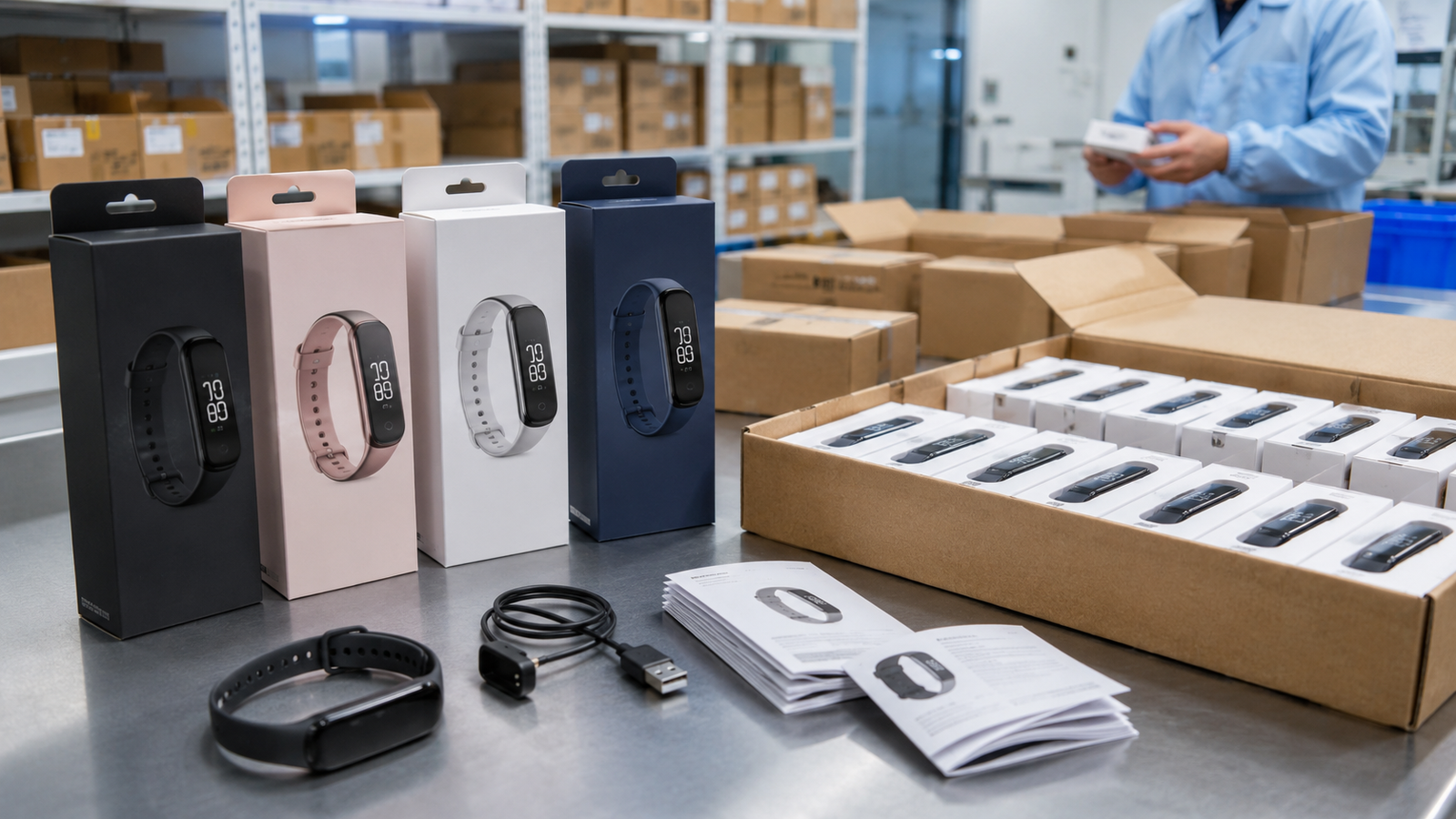
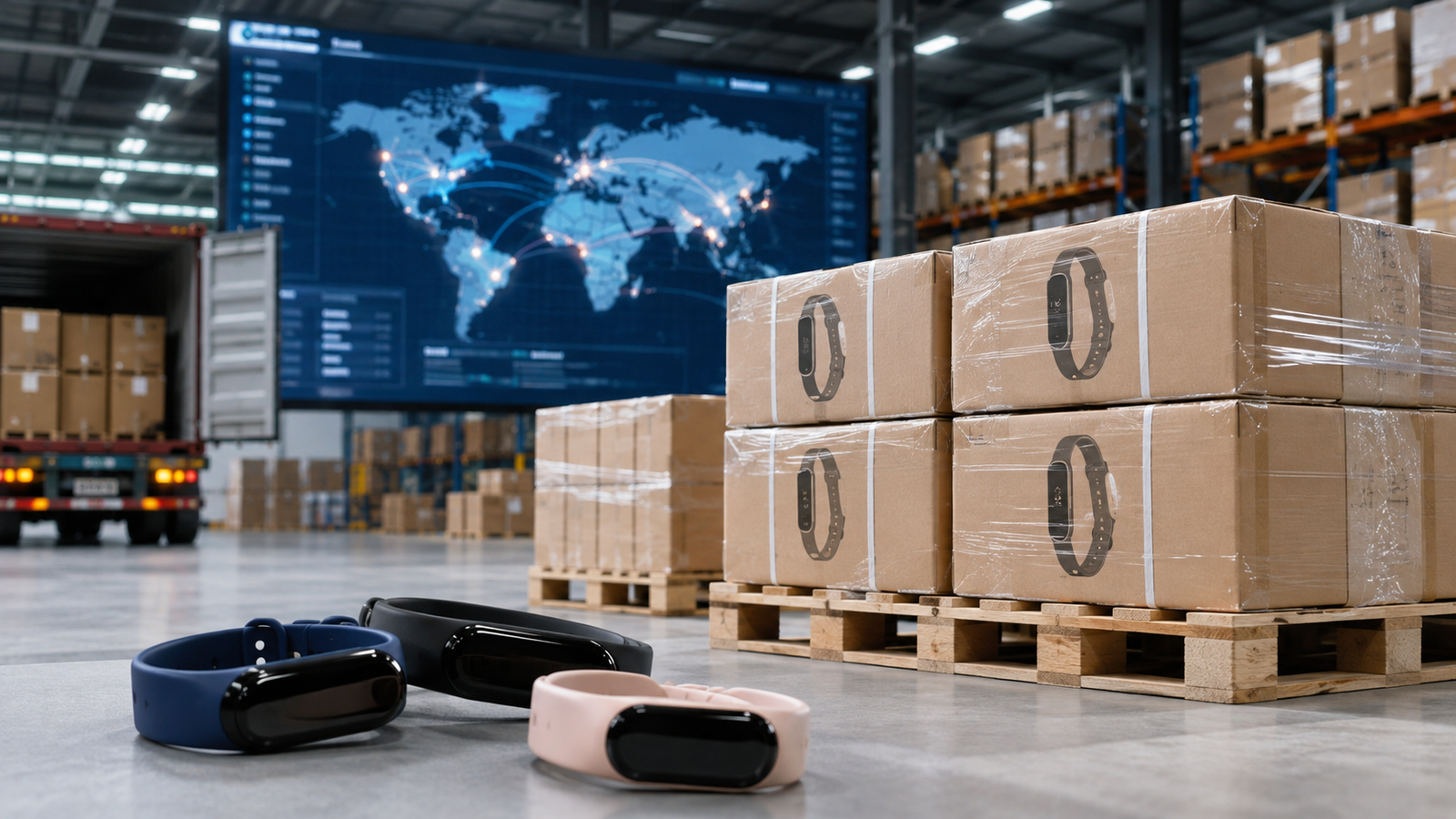
[Image suggestion: warehouse line of boxed wholesale smart bands ready for export labeling]
Common Mistakes and Buyer Red Flags
- Choosing on unit price alone. A quote that omits certification support, inspection, or app localization is not cheaper — it is incomplete.
- Accepting a certificate for a different model. Match documentation to the exact configuration you order.
- Skipping the app test. A polished demo app can behave differently on your target devices and languages.
- Ignoring the EU responsible person. Distributors can carry compliance duties that a supplier’s certificate does not transfer.
- No warranty terms in writing. Verbal assurances do not cover returns.
Red flags at the RFQ stage include refusal to share battery documentation, vague answers about the app developer, pressure to pay a deposit before sampling, and prices that fall far below the market without a clear explanation.
Practical RFQ Buyer Checklist
- Confirm supplier identity and, where possible, conduct a factory or video audit.
- Request CE RED, RoHS, UN38.3, and MSDS documents for the exact model.
- Ask for tiered pricing at 500 / 1,000 / 3,000 units.
- Confirm MOQ for logo, packaging, and firmware changes separately.
- Request two sample units and a written test report format.
- Define AQL and pre-shipment inspection terms in the purchase order.
- Clarify app language support and data processing terms.
- Confirm warranty period, spare-parts policy, and return handling.
- Agree HS code, Incoterms, and lithium battery shipping method.
- Confirm tooling ownership and drawing transfer if applicable.
RFQ Email Template
A structured RFQ gets a comparable answer. Use a short template like this:
Subject: RFQ — Private Label Smart Bands, EU Distribution
We distribute wearables in the EU and are evaluating suppliers for a private label smart band program. Please provide: (1) tiered FOB pricing at 500, 1,000, and 3,000 units; (2) MOQ for logo, packaging, and app customization; (3) CE RED, RoHS, UN38.3, and MSDS documentation for the quoted model; (4) sample lead time and cost; (5) production lead time and Incoterms; (6) warranty terms and spare-parts policy. Our target launch is [month] and our target retail tier is [tier]. Please confirm which specifications are fixed and which can be customized.
FAQ
What is the typical MOQ for private label smart bands?
For stock models with logo and packaging changes, 500–1,000 units is common. Custom enclosures or new tooling usually require 1,000–3,000 units. Confirm the exact figure for your configuration.
Which certifications do EU distributors need for smart bands?
At minimum, CE RED and RoHS documentation, plus UN38.3 and MSDS for the lithium battery. Marketplace and retail requirements may add more. Buyers should verify what applies to their specific product and country.
How long does production take after an RFQ is approved?
Stock-model production typically runs 3–6 weeks after deposit, with private label printing adding 1–2 weeks. Add freight and inspection time when planning your launch.
Can I customize the app for my brand?
Many suppliers offer app renaming, icon, and splash-screen changes. Deeper firmware customization depends on the platform. Confirm what is included, what costs extra, and who maintains updates.
Who is responsible for EU importer compliance?
The importer or the EU responsible person carries specific obligations for products placed on the EU market. This is separate from the supplier’s declarations. Distributors should confirm their duties before ordering.
What warranty should I expect?
12–24 months is a common range. Confirm what the warranty covers, how replacements are shipped, and who pays return freight.
How should lithium batteries be shipped?
Smart bands contain lithium batteries, which require UN38.3 testing and correct classification for air or sea freight. Confirm the supplier’s shipping method and paperwork before booking.
Conclusion
Sourcing smart bands for EU distributors is a sequence, not a single negotiation: confirm compliance first, validate specifications with samples, agree MOQ and packaging, then lock lead times and freight. The distributors who protect their margin are the ones who price landed cost instead of unit cost and who get documentation in writing before the deposit. Use the checklist and RFQ template in this guide as a working document for your next supplier conversation.
Ready to Build Your Smart Band Program?
STAR KING supports distributors with private label and OEM/ODM smart band programs, including logo, packaging, and app customization. To move from RFQ to a comparable quote, request a quote and specify your target volume, market, and customization scope. You can also review more sourcing guides before you shortlist suppliers.
Discuss Your Smart Wearable OEM/ODM Project
Planning a smart ring, smart watch, smart band, AI glasses, AI translator, or AI voice mouse project? Contact STAR KING to discuss product positioning, sample testing, customization scope, certification requirements, lead time, and quotation details.

Team Star King

Scan WhatsApp QR code