
Smart Bands for EU Distributors: 7-Point Checklist to Source Winning Wearables in 2026
October 3, 2026 · Team Star King
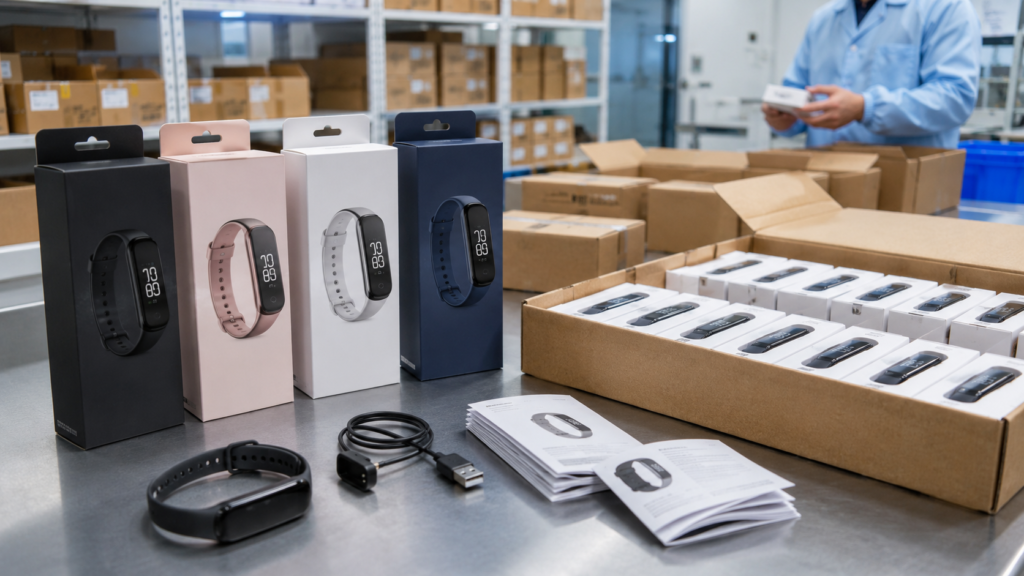
Smart Bands for EU Distributors: 7-Point Checklist to Source Winning Wearables in 2026
smart bands for EU distributors: Direct Answer
To source smart bands for EU distributors successfully, qualify suppliers on seven points: product specifications and sensor accuracy, OEM/ODM flexibility, MOQ and landed cost, sample and pilot-lot testing, CE/RoHS/UN38.3 compliance, lead-time planning, and after-sales support. Any weak point tends to surface later as returns, customs delays, or thin margins.
Table of Contents
Table of Contents

Introduction
Most EU distributors lose money on smart bands not because the product is bad, but because one sourcing step was skipped. The band might track heart rate well and look premium, yet the importer discovers halfway through Q2 that the charging cradle lacks a RoHS test report, or that the MOQ for a private-label colour cannot be met until September.
This guide is written for distributors, importers, and private-label brands selling into the European Union. It gives you a 7-point checklist you can apply during supplier conversations, plus a decision table, a buyer checklist, and seven procurement questions EU buyers typically ask. It is not a consumer review. It assumes you already know what a smart band is and you need to choose a factory, a model, and a commercial arrangement that protects your margin.

Table of Contents
- Direct Answer
- What Buyers Should Evaluate Before Ordering Smart Bands for the EU
- The 7-Point Sourcing Checklist for EU Distributors
- OEM vs ODM vs Private Label: Which Model Fits an EU Distributor?
- Key Facts for Buyers
- Comparison Table: Sourcing Options for Smart Bands
- Common Mistakes and Buyer Red Flags
- Practical Buyer Checklist
- FAQ
- Conclusion

Key Takeaways
- EU compliance is configuration-specific: CE, RoHS, and battery transport documents must match the exact model and SKU you import.
- Sensor performance and firmware quality vary more between factories than between price tiers, so sample testing is not optional.
- MOQ and lead time usually move in the same direction; a lower MOQ often means a longer or less predictable schedule.
- Private-label packaging and app customisation are the two levers that most affect perceived value for EU retail channels.
- Landed cost, not FOB price, is the number that determines whether the deal works at your target retail price.

What Buyers Should Evaluate Before Ordering Smart Bands for the EU
Smart bands are one of the most competitive wearable categories in Europe. Prices are visible, channels are crowded, and small differences in battery life or app stability decide whether a retail listing survives a review cycle.
For a distributor, the evaluation is not only about the band. It is about the manufacturing relationship behind it. Four questions should guide the entire sourcing process:
- Can the supplier document what it claims? A heart-rate or SpO2 demonstration is not the same as a repeatable test report. Ask for the test method and the sample size.
- Can the configuration be locked and repeated? EU distributors often need the same SKU across two or three purchase cycles. If the factory cannot confirm a stable BOM (bill of materials), your second order may not match your first.
- Does compliance follow the configuration, or the brand? Certificates are typically issued for a specific model, sometimes for a specific variant. Buyers should verify that the certificate covers the exact colour, strap material, and charger in the purchase order.
- What happens after the first container? Spare straps, chargers, and replacement units are part of the offer. A factory that cannot supply spares weakens your after-sales position.
This is also where the choice between a trading company and a manufacturer matters. A factory gives you more control over firmware, packaging, and tooling, but usually requires a higher MOQ. A trading company can be faster for mixed orders, but traceability is weaker. Neither is automatically correct. The right answer depends on your channel and your volume forecast.
For a broader view of how wearables fit into distribution portfolios, see our overview of smart bands and the related smart retail solution.
The 7-Point Sourcing Checklist for EU Distributors
1. Specification and Sensor Review
Start with the specification sheet, then test the claims. For EU distribution, the items that generate the most returns are heart-rate consistency during exercise, step-count drift, sleep-stage accuracy, and battery life under real notifications.
Ask the supplier for:
- Sensor model and firmware version.
- Battery capacity in mAh and measured endurance under a defined test condition.
- Charging method, charging time, and charger certification.
- Display type, brightness, and touch performance.
- Supported app languages, particularly for your target EU markets.
Do not accept a demonstration video as evidence. A short pilot order of 50-200 units, tested by your own team for two to three weeks, reveals more than any datasheet. For a broader look at wearable health features, our overview of health and fitness wearables explains how these functions are typically implemented.
2. OEM, ODM and Private Label Flexibility
EU distributors rarely compete on price alone. They compete on assortment and brand. This makes customisation a sourcing criterion, not a nice-to-have.
Typical options:
- Logo printing or laser marking on the case back or buckle.
- Strap material and colour for seasonal ranges.
- Packaging with your brand, EU importer information, and language-specific inserts.
- App and firmware customisation, such as splash screen, app name, and selected language sets.
Each of these adds tooling, artwork, or firmware work. Ask the supplier to separate one-time costs from per-unit costs, because this directly affects your break-even volume.
3. MOQ and Price Influencers
MOQ for smart bands typically depends on the following factors. Buyers should verify current terms with the supplier, as they change with components and production load.
- Whether the model is a standard ODM design or a new tooling project.
- Whether packaging is neutral, existing brand, or fully custom.
- Whether the app requires customisation.
- Component availability, especially displays and battery cells.
Price increases usually come from: higher battery capacity, advanced sensors such as SpO2 or ECG-adjacent modules, larger AMOLED displays, higher ingress protection rating, and custom packaging. Price reductions come from: larger order quantities, fewer colour SKUs, simpler packaging, and longer scheduling windows.
For an EU distributor, it is important to calculate landed cost, not FOB. Landed cost includes freight, duty, VAT treatment, customs clearance, and inspection. A 4% FOB saving can disappear after freight and duty are applied.
4. Sample and Pilot-Lot Testing
Sample testing is where you discover whether a supplier is reliable. Test the band as your end customer will test it, and document the results.
A reasonable protocol:
- Order three to five sample units in the exact configuration you intend to sell.
- Test pairing, app stability, and firmware update behaviour.
- Measure battery life under a defined usage pattern.
- Wear it during exercise and sleep to check sensor consistency.
- Verify charging from a standard EU USB charger.
Then move to a pilot lot. This confirms that mass production matches the sample. If a factory cannot or will not supply a pilot lot, treat that as a signal.
5. Compliance and Certifications for the EU Market
This is the section where distributors carry the most risk. EU market obligations rest with the importer, not only the factory. A supplier can provide documents, but the distributor is responsible for ensuring the product carries the required conformity assessment and marking.
Documents and declarations commonly requested for smart bands include:
- CE marking supported by an EU Declaration of Conformity and relevant test reports. Depending on the device, this may involve the Radio Equipment Directive, EMC Directive, and electrical safety requirements.
- RoHS compliance for substances restrictions.
- REACH considerations for materials in contact with skin.
- UN38.3 test summary for lithium batteries, plus the applicable transport documentation.
- Battery directive and WEEE registration obligations, which are typically handled by the importer in each member state.
- Packaging and language requirements, which vary by country.
Because certification requirements depend on the exact product configuration and target countries, buyers should verify scope with the supplier and, where needed, with a local compliance advisor. Useful references include the European Commission guidance on CE marking and the IEC standards database.
For a manufacturing-oriented view of testing and documentation, see our private label OEM/ODM solution.
6. Lead Time and Production Planning
EU distributors usually buy against a retail calendar. Back-to-school, Black Friday, and Q1 fitness campaigns are the main planning anchors.
A realistic timeline includes:
- Sample approval and artwork confirmation.
- Component procurement, which can extend during display or battery shortages.
- Production run.
- Quality inspection and pre-shipment inspection.
- Freight, customs clearance, and inland delivery.
Ask for a written schedule with milestone dates, and build in a buffer for customs and port congestion. Distributors who plan lead time as a single number, rather than a sequence of steps, are the ones who end up airfreighting partial orders at their own cost.
7. After-Sales, Warranty and Spares
Retail channels in the EU expect a clear returns process. Your supplier should support it.
Confirm:
- Warranty terms on the band and the charger.
- Availability of replacement straps, chargers, and units.
- Defect rate expectations and how replacements are handled.
- Whether firmware fixes are delivered through the app or require new production.
If the supplier cannot explain its own defect-handling process, your customer service team will absorb the problem.
OEM vs ODM vs Private Label: Which Model Fits an EU Distributor?
ODM means you buy an existing design, usually with limited cosmetic changes. It is the fastest route to market and carries the lowest tooling cost, but your assortment may look similar to competitors selling from the same factory.
Private label sits on top of ODM: the hardware is standard, while the brand, packaging, app identity, and documentation carry your name. For most EU distributors entering the category, this is the practical first step because it balances speed and differentiation.
OEM means the product is developed or substantially modified for you. It gives the strongest differentiation and lets you define sensor configuration, form factor, and tooling ownership, but it requires a larger commitment and a longer development cycle.
A short, direct conversation with the factory — covering volume expectations, target retail price, and channel — usually clarifies which model is realistic faster than any spreadsheet.
Key Facts for Buyers
| Item | Typical Consideration for EU Distribution | What to Verify |
|---|---|---|
| Product configuration | Standard ODM model vs modified design | Exact SKU, BOM stability, colour options |
| MOQ | Varies by model, packaging, and app customisation | Written MOQ per SKU and per colour |
| Compliance | CE, RoHS, battery transport documents | Certificates match exact configuration |
| Battery | Larger capacity raises cost and weight | Measured endurance, not marketing claim |
| App and firmware | Language coverage and update frequency | Demo account access before order |
| Lead time | Typically the longest single sourcing variable | Milestone schedule with buffer |
| After-sales | Spares and warranty affect returns cost | Documented defect process |
Comparison Table: Sourcing Options for Smart Bands
| Option | Differentiation | Setup Cost | Best For | Main Risk |
|---|---|---|---|---|
| Ready ODM model | Low | Low | Fast entry, test market | Price competition |
| Private label on ODM hardware | Medium | Medium | Retail chains, e-commerce brands | Packaging/artwork delays |
| OEM customisation | High | High | Distributors with volume commitment | Longer development, tooling ownership questions |
Common Mistakes and Buyer Red Flags
Mistake 1: Buying on FOB price alone. Landed cost is the only number that matters at your retail price point.
Mistake 2: Accepting a certificate without checking scope. A CE document for one model does not automatically cover a different strap material or charger.
Mistake 3: Skipping the pilot lot. Sample units are often hand-selected. The pilot lot reveals what mass production actually delivers.
Mistake 4: Assuming app languages cover your market. Confirm the exact language list and how new languages are added.
Mistake 5: Not agreeing on spare parts. Return rates for straps and chargers are frequently higher than for the band itself.
Red flags to watch:
- Spec sheets with no battery capacity or sensor model listed.
- Vague answers on MOQ that change after the price is quoted.
- No willingness to supply a pilot lot.
- Certificates that cannot be matched to a model number.
- Pressure to pay a large deposit before sample approval.
Practical Buyer Checklist
- Confirm the exact SKU, colour, strap, and charger you will import.
- Request the current MOQ in writing, per SKU.
- Test 3-5 samples, then place a pilot lot of 50-200 units.
- Map every required compliance document to the exact configuration.
- Calculate landed cost including freight, duty, and inspection.
- Agree a milestone-based production schedule.
- Confirm warranty, spares, and defect-handling process.
- Decide OEM, ODM, or private label before discussing pricing.
- Check that packaging languages match your target countries.
- Review the app with a demo account before committing.
FAQ
What MOQ should an EU distributor expect for smart bands?
MOQ depends on the model, packaging, and app customisation. Standard ODM models typically allow lower quantities than fully custom projects. Buyers should request a written MOQ per SKU and per colour before comparing suppliers.
Are CE certificates issued per model or per brand?
CE documentation is typically tied to a specific model or variant. A certificate for one configuration does not automatically cover a different strap, charger, or radio module. Buyers should verify that the documents match the exact product they import.
How long does production usually take for smart bands?
Lead time varies with component availability and order size. It typically includes sample approval, component procurement, production, inspection, and freight. A milestone schedule with a buffer is more reliable than a single delivery date.
Can smart bands be private-labelled with a custom app?
Many ODM platforms support app branding, splash screens, and selected language sets. The scope and cost depend on the supplier and the firmware. Confirm what is included and what is a one-time development fee. If your project needs a different app architecture, it may move into OEM territory.
What documents are needed for lithium battery shipping?
Lithium batteries in consumer devices generally require a UN38.3 test summary and transport documentation. Depending on the shipping method and quantity, additional requirements may apply. Buyers should confirm documents with the supplier and the freight forwarder.
Which EU regulations apply to smart bands?
Requirements typically depend on the device features and target countries. Relevant areas can include CE marking under the applicable directives, RoHS, REACH, WEEE, and battery-related obligations. Distributors should verify obligations with a compliance advisor for each market.
How should a distributor compare two smart band suppliers?
Compare on configuration stability, MOQ, documented compliance, sample performance, lead time, and after-sales support. Price should be compared at landed-cost level, not FOB. A supplier that answers all six areas clearly is usually the safer partner.
Conclusion
Sourcing smart bands for EU distributors is a packaging problem as much as a product problem. The hardware is one part of the offer; the configuration, documentation, packaging, schedule, and after-sales process are the rest. The 7-point checklist in this article is designed to be used in supplier conversations, not read once and filed away.
If you apply it consistently, you will reject some suppliers early — which is the point. The cost of a bad first order in this category is measured in returns, customs delays, and damaged retail listings, not just in the purchase price.
Next Step
To compare configurations, confirm MOQ, and review compliance documents for your target EU markets, start a conversation with our team: Request a quotation.
Useful Official References for Buyers
- FCC equipment authorization guidance
- European Commission CE marking information
- Bluetooth SIG specifications
Discuss Your Smart Wearable OEM/ODM Project
Planning a smart ring, smart watch, smart band, AI glasses, AI translator, or AI voice mouse project? Contact STAR KING to discuss product positioning, sample testing, customization scope, certification requirements, lead time, and quotation details.

Team Star King

Scan WhatsApp QR code
Leave a Reply