
smart bands for Amazon EU: How to Buy Smart Bands for Amazon EU: 2026 Compliance & Production Guide
October 17, 2026 · Team Star King
How to Buy Smart Bands for Amazon EU: 2026 Compliance & Production Guide
Short Answer: Sourcing smart bands for Amazon EU means selecting a supplier who can combine product performance with EU compliance. Amazon sellers should verify which directives and obligations apply, confirm factory test evidence, agree MOQ and lead time, and validate the app experience before scaling. Poor compliance management can cause listing removal, storage delays, or lost inventory. The 2026 rules, including Market Surveillance Regulation (EU) 2019/1020 and the General Product Safety Regulation (EU) 2023/988, make documentation and traceability a core purchasing requirement, not an afterthought.
Table of Contents
Table of Contents
Table of Contents
- Why Smart Bands for Amazon EU Require a Different Sourcing Approach
- Product Selection for Amazon EU: What Sells and What Gets Rejected
- OEM, ODM or White Label: Which Model Fits Your Brand Stage
- MOQ and Price Drivers in 2026
- Samples and Validation: The 30-Day Test Plan
- Quality Control: What to Inspect Before Shipment
- Certification and Market Compliance for Amazon EU
- Lead Time and Production Planning
- Packaging, Branding and Private Label
- App, Firmware and Data: The Hidden Risk
- Shipping, Batteries and Amazon FBA Rules
- Warranty, Spare Parts and After-Sales
- Amazon EU Sales Channels and Pricing Strategy
- Common Mistakes and Buyer Red Flags
- Practical Buyer Checklist
- FAQ
- Conclusion and Next Step
Key Takeaways
- A smart band sold on Amazon EU is a regulated product, not only a consumer device. CE marking, RED compliance, RoHS, WEEE and battery transport rules all apply depending on the exact configuration.
- EU Market Surveillance Regulation (EU) 2019/1020 requires a responsible economic operator established in the EU for many product categories; Amazon sellers should plan this before manufacturing.
- MOQ, tooling, packaging and app development are the four biggest cost variables. Buyers should separate one-time NRE costs from per-unit costs.
- Sample validation should cover hardware, firmware, app stability, battery behavior, sensor accuracy trends and packaging drop safety.
- The safest suppliers are those who can provide test reports, batch traceability, firmware update records and a clear after-sales process in writing.
Key Facts for Buyers
| Item | What to Verify | Why It Matters |
|---|---|---|
| CE marking | Signed EU Declaration of Conformity, applicable directives | Market access and Amazon listing eligibility |
| RED 2014/53/EU | Radio test report for Bluetooth or other wireless functions | Required for wireless devices sold in the EU |
| EU responsible person | Name and address on product, packaging, or documentation | Required under Regulation (EU) 2019/1020 for many categories |
| Battery documentation | UN38.3 test summary, MSDS, safe packaging | Air and sea transport acceptance, FBA intake safety |
| MOQ | Optional per SKU, per color, per packaging version | Cash flow, inventory risk, first-order flexibility |
| Lead time | Sample, tooling, mass production, shipping windows | Launch dates, restock planning, Q4 readiness |
| App | Stability, privacy policy, update cadence, account region | Reviews, retention, GDPR/UK GDPR exposure |
Why Smart Bands for Amazon EU Require a Different Sourcing Approach
Amazon EU is not one market. Germany, France, Italy, Spain, the Netherlands, Poland and Sweden each have local language expectations, return habits and pricing sensitivity. A smart band that succeeds in the United States may fail in the EU because of language support, sizing, app localization, packaging text, or compliance documentation. Sellers who treat the EU as a single homogeneous market often discover the gap only after inventory is already in FBA.
Procurement decisions therefore need to be compliance-aware. The EU places obligations on manufacturers, importers and distributors. Under Regulation (EU) 2019/1020 on market surveillance, many products need an economic operator established in the EU. Under General Product Safety Regulation (EU) 2023/988, traceability and safety documentation expectations have tightened further. Amazon itself also requires compliance documents for some categories and can request them during listing review.
This guide is written for Amazon sellers preparing a purchase decision: which model to choose, what evidence to request, how to structure first orders, and how to avoid problems that appear after launch.

Product Selection for Amazon EU: What Sells and What Gets Rejected
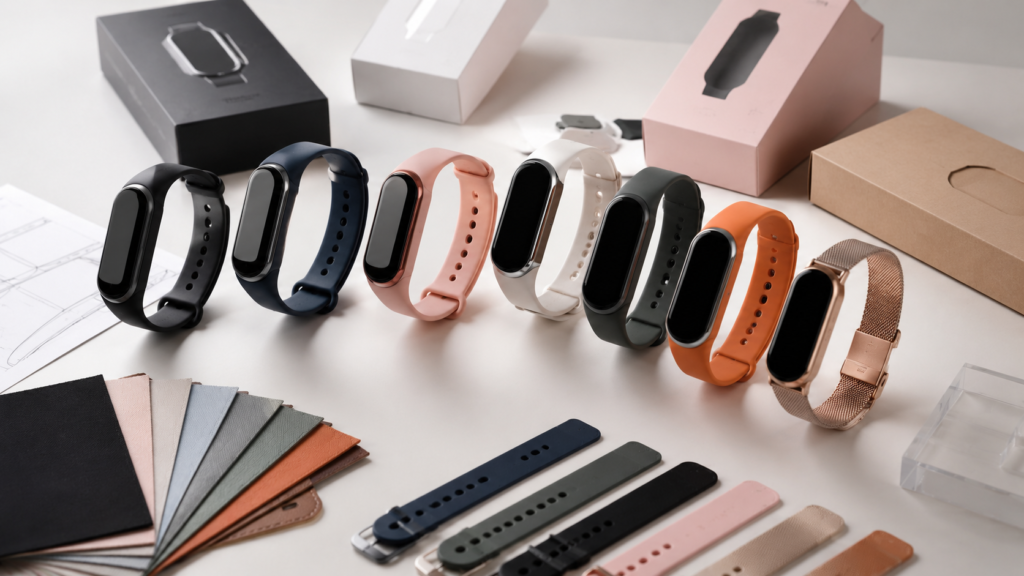
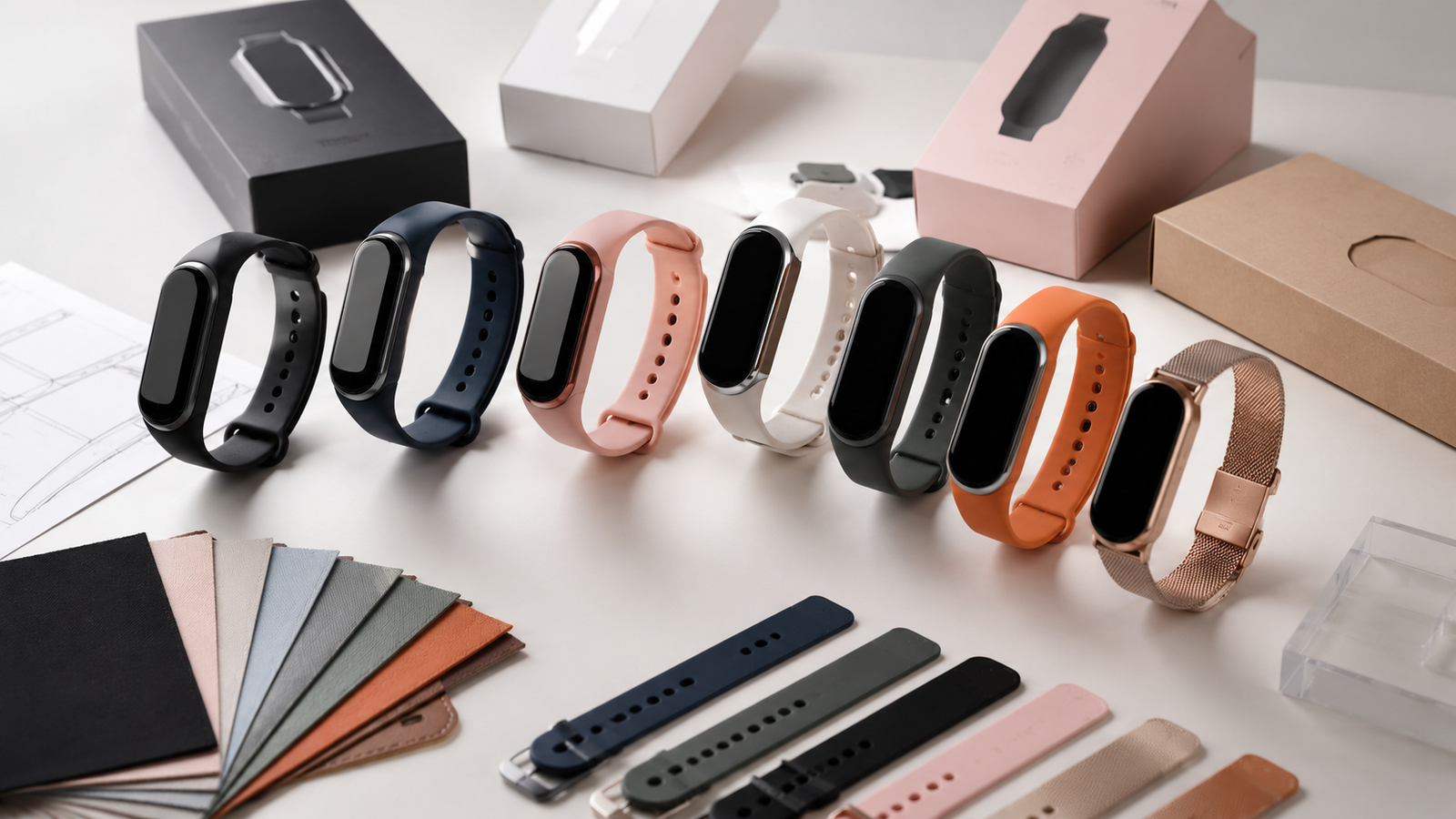
Smart bands occupy a practical position in the wearable lineup: lower unit cost than smart watches, longer battery expectations, and lighter packaging for FBA. STAR KING’s smart bands product page illustrates the range of configurations available for private label and OEM projects, including display, sensor and strap options.
Core features buyers should evaluate
- Display type: AMOLED vs TFT changes cost, battery draw and perceived quality.
- Sensors: heart rate, blood oxygen trends, sleep staging. These are wellness features, not medical diagnostics, and marketing claims should reflect that.
- Battery life: expected life depends on screen brightness, continuous monitoring and notification load. Buyers should ask for measured usage assumptions, not a single headline number.
- Water resistance: IP67 vs 5ATM changes use cases and returns risk. Test method matters.
- Strap and buckle: material, hypoallergenic considerations, and interchangeability.
- App localization: EU buyers expect at least English, German, French, Italian, Spanish and Dutch for major marketplaces.
Commercially, smart bands for Amazon EU tend to sell in three tiers: entry-level promotional bands, mid-tier fitness bands with AMOLED display, and premium bands with advanced sensors and metal case options. Each tier has different return rates, review sensitivity and advertising efficiency. A common strategy is to launch one hero SKU and two color variants, then expand only after review velocity and return data are understood.

If your roadmap also includes smart rings for a premium tier, compare sensor and app requirements early, because a unified app can reduce support load across both product lines. See smart rings for reference configurations.
OEM, ODM or White Label: Which Model Fits Your Brand Stage
Amazon sellers usually move through three sourcing models. Each has a different cost structure and risk profile.
| Model | What It Means | Best For | Typical Investment |
|---|---|---|---|
| White label | Existing product with your logo and packaging | Fast launch, validate demand | Lowest; logo and packaging NRE only |
| ODM | Existing platform with firmware, app, or cosmetic modifications | Building differentiation without full tooling | Medium; firmware, app skin, packaging |
| OEM / full custom | Custom ID, tooling, custom PCB or sensor spec | Long-term brand with defensible design | Highest; tooling, certification, mold ownership |
The right choice depends on your review base, cash cycle and target price point. A brand with fewer than 200 reviews usually should not spend on tooling before the app and sensor combination has been validated in the EU market. Conversely, a brand with strong repeat purchase and A+ content usually benefits from OEM differentiation because generic bands are easy for competitors to undercut.
When discussing projects, ask about firmware and app customization ownership, firmware update policy, and whether the tooling is dedicated to your brand. STAR KING’s Private Label OEM/ODM solution page outlines typical customization paths; specific commercial terms should be confirmed in writing.
Soft CTA: If you are comparing first-order structures, it may help to review a quoted white-label vs ODM scenario with your target retail price in hand, so the MOQ and NRE trade-offs are visible before you commit.
MOQ and Price Drivers in 2026
MOQ in wearable manufacturing is rarely a single number. It is usually a combination of: product MOQ, color MOQ, packaging MOQ, and printed accessory MOQ. A supplier might accept 500 units total but require 200 per color and 1,000 per custom gift box. Buyers should normalize all of these before comparing quotes.
| Cost Driver | Nature | Negotiation Angle |
|---|---|---|
| Unit BOM | Recurring | Sensor tier, display, strap material |
| Tooling / mold | One-time NRE | Who owns the mold, amortization over volume |
| Firmware / app customization | One-time NRE | Scope control, source code or binary |
| Packaging | One-time + recurring | Custom box vs sticker, EU multilingual print |
| Certification | One-time per configuration | Share test reports, avoid duplicate testing |
| Freight | Recurring | Air vs sea, FBA vs 3PL transit |
Unit price should be evaluated together with returns rate expectations, packaging damage rate, and app-related support cost. A cheaper band with an unstable app can cost more per order after refunds and negative reviews than a slightly more expensive model with a stable app.
Samples and Validation: The 30-Day Test Plan
Amazon EU sellers should test before committing to mass production. A structured 30-day plan works better than casual use.
- Days 1-3: Unbox, check packaging language, verify accessories, confirm power-on and pairing.
- Days 4-7: Install and test the app, including account creation, language switching and data sync. Record crash events.
- Days 8-14: Wear in daily use, track battery drain per feature, compare heart rate and step counts against a known reference device.
- Days 15-21: Test strap comfort, water splash behavior, notification handling and firmware update flow.
- Days 22-30: Drop test packaged units, inspect charge cable durability, and request pre-production sample with final packaging.
Document everything. Reviewers in Germany and the Netherlands often comment on packaging accuracy and app quality, not only hardware. Sample evidence also supports later conversations about defect rates and after-sales terms.

Quality Control: What to Inspect Before Shipment
Pre-shipment inspection is where most sourcing risk is reduced. The specific AQL level and sampling plan should be agreed in the purchase order. Typical inspection points include:
- Function test: power on, pairing, touch response, charging.
- Sensor calibration trend: heart rate and step counts within an agreed tolerance against reference.
- Battery: charge/discharge behavior and aging spot-check.
- Cosmetic and assembly: screen gap, glue overflow, strap fit, button feel.
- Packaging: barcode correctness, EU language coverage, correct model labeling.
- Accessories: cable continuity, manual completeness.
- Traceability: batch or serial number on unit and carton.
Buyers should also decide whether aging testing is required before shipment for high-volume orders. If your supplier operates aging racks, ask for the set duration and pass criteria. Where such processes are not offered, treat that as a planning factor rather than assuming it exists.
Certification and Market Compliance for Amazon EU
EU compliance is not a single stamp. It is a set of obligations that vary by product configuration and channel. Common items for a Bluetooth smart band may include: CE marking under applicable directives, radio equipment compliance under Directive 2014/53/EU (RED), RoHS restrictions, WEEE registration in some member states, and battery transport documentation. Whether each applies depends on the exact SKU, wireless functions and packaging.
Other relevant references include the FCC equipment authorization database at fcc.gov/oet/ea/fccid for market comparison, the Bluetooth SIG qualification program at bluetooth.com for wireless interoperability, and the European Commission Access2Markets portal for import duty estimation.
A practical compliance checklist
- Signed EU Declaration of Conformity covering the exact model configuration.
- Test reports for the radio module and EMC behavior.
- RoHS declaration and, where relevant, REACH information.
- EU responsible person name and address on product, packaging, or accompanying document.
- WEEE and packaging registration planned for your selling countries.
- UN38.3 test summary and MSDS for the lithium battery cells and packs.
- Instructions in required languages, with safety warnings.
Amazon may request compliance documentation during listing creation or review. Keep digital copies organized by model and configuration. Avoid assuming that a generic certificate covers a different battery or display variant.
Lead Time and Production Planning
Lead time is the sum of several stages, not a single factory number.
| Stage | Typical Range | Buyer Action |
|---|---|---|
| Sample approval | 1-3 weeks | Lock specs in writing |
| Tooling / packaging artwork | 1-4 weeks | Approve proofs before tooling cut |
| Mass production | 2-4 weeks | Confirm deposit and material readiness |
| QC and inspection | 3-7 days | Agree AQL and inspection window |
| Freight to EU | Air 5-10 days; sea 25-40 days | Book peak-season capacity early |
| FBA intake | Varies by warehouse | Plan restock buffer |
For Q4 launches, production planning usually needs to begin in Q2. Air freight can rescue a delayed schedule, but at a significant cost per unit, especially with lithium batteries that have specific handling requirements.
Packaging, Branding and Private Label
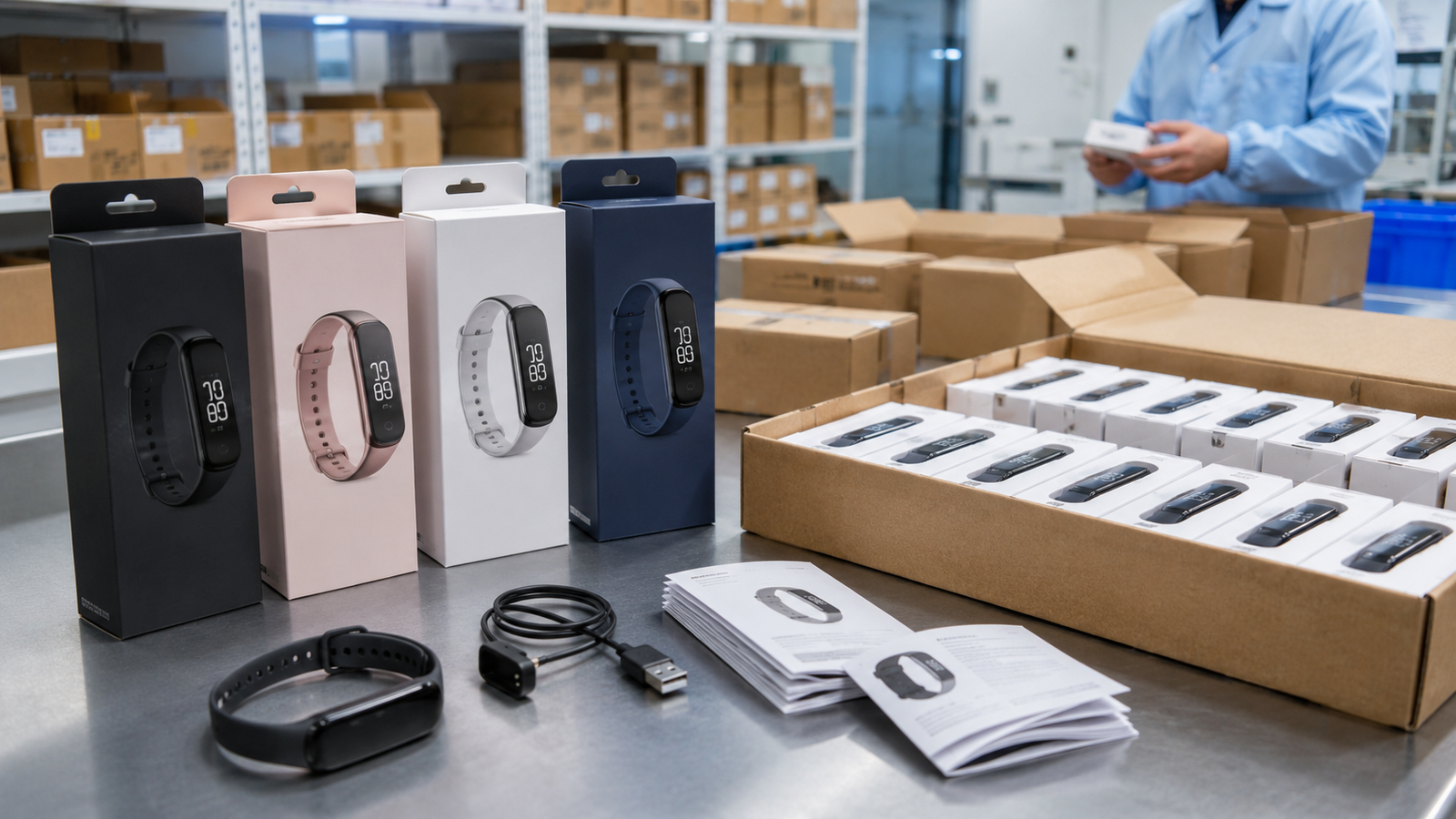
Packaging is both a marketing asset and a compliance surface. For EU marketplaces, packaging typically needs multilingual text, model identification, warnings and manufacturer or importer details. Sellers often underestimate the cost of custom foam inserts or rigid boxes at low volume.
- Logo printing on the band, buckle or case back.
- Retail-ready box with EU language panels.
- Quick-start guide and safety leaflet.
- Barcode and FNSKU label placement plan.
- Optional bundled accessories such as a spare strap or screen protector.
If you are exploring adjacent categories such as smart watches for a higher price tier, plan packaging architecture once to keep the brand consistent across SKUs.
App, Firmware and Data: The Hidden Risk
The app is where most returns and negative reviews originate. Buyers should evaluate app stability, update history, account region handling, and data practices. If the app collects personal data, the seller and the app operator may have GDPR or UK GDPR obligations depending on their roles and establishment. Buyers should ask who is the data controller, where data is hosted, and how account deletion works.
Firmware customization should be scoped precisely: notification behavior, language strings, watch face library, and over-the-air update policy. Ask for a written change-control process, because a firmware change after certification can affect compliance. Where app or API support is offered, request documentation and a test environment before signing off.
Shipping, Batteries and Amazon FBA Rules
Smart bands contain lithium batteries. This triggers transport rules for air, sea and road. Typical documentation includes UN38.3 test summary and MSDS. Packaging must meet IATA or IMDG requirements for the chosen transport mode. Amazon FBA has its own intake requirements, including labeling and battery declarations.
Buyers should plan for the possibility of customs checks in the destination country and keep compliance documents accessible to their freight forwarder. For cross-border planning, review the Access2Markets portal from the European Commission as a starting reference for duties and rules of origin, then confirm with a customs broker.
Warranty, Spare Parts and After-Sales
Warranty structure affects account health on Amazon. Sellers should agree in writing on: warranty duration, defect criteria, replacement or credit policy, spare strap and cable availability, and RMA handling time. An after-sales policy that depends on goodwill rather than a documented process creates margin risk during peak periods.
Ask about spare parts availability for at least 12-24 months after production, and whether the same battery and display module will remain available for reorders.
Amazon EU Sales Channels and Pricing Strategy
The EU is a multi-country marketplace, and pricing must reflect VAT, marketplace fees, returns and advertising costs. Many sellers launch in one or two marketplaces, then expand. Localized listing content and localized app content improve conversion and reduce returns.
- Launch with 1 hero SKU and 2 colors.
- Use A+ content to explain app features and warranty.
- Track return reasons early and feed them back to the supplier.
- Plan a firmware or app update cycle before Q4.
Common Mistakes and Buyer Red Flags
- Assuming a generic certificate covers a different battery or display variant.
- Accepting MOQ without clarifying per-color and per-packaging minimums.
- Testing the app only in English and discovering localization issues after launch in Germany or France.
- Skipping pre-shipment inspection to save a small fee, then paying for it in returns.
- Ignoring EU responsible-person requirements until Amazon requests documents.
- Failing to confirm who owns the mold or custom tooling.
- Choosing a supplier who cannot provide firmware update records or after-sales process documentation.

Practical Buyer Checklist
- Confirm which EU directives apply to your exact SKU configuration, including battery and wireless functions.
- Request and review the EU Declaration of Conformity, RED test report and RoHS declaration.
- Verify EU responsible-person details appear on product, packaging, or documentation.
- Confirm UN38.3 and MSDS documents for the battery pack used in your model.
- Agree MOQ per SKU, per color and per packaging version in writing.
- Separate one-time NRE costs from recurring unit costs before comparing quotes.
- Run a 30-day sample validation plan covering hardware, app and battery behavior.
- Approve packaging artwork including EU language panels and barcode placement.
- Define QC sampling, AQL and pre-shipment inspection responsibilities.
- Set lead time milestones and pre-book freight before peak season.
- Confirm warranty, spare parts availability and RMA handling terms.
- Clarify firmware and app update responsibilities and data-processing roles.
FAQ
1. Do smart bands for Amazon EU need CE marking?
Wireless smart bands typically fall under the Radio Equipment Directive and therefore require CE marking and a Declaration of Conformity for the specific model configuration. The exact obligations depend on the product’s functions, so confirm the applicable directives with your supplier and, where needed, a compliance specialist.
2. What is the typical MOQ for private label smart bands?
MOQ varies by supplier and customization level. A logo-only project may start lower than a custom tooling project. Many suppliers set separate minimums for total units, per color and per packaging version. Buyers should request these in writing before comparing quotes.
3. How long does production take for a first smart band order?
Sample approval, tooling or artwork, mass production, QC and freight together often require 8-14 weeks depending on customization depth and shipping mode. Air freight shortens transit but increases cost, particularly for lithium-battery products.
4. Can I sell smart bands on Amazon EU without an EU responsible person?
For many product categories, Regulation (EU) 2019/1020 requires an economic operator established in the EU who can act as the responsible party. Sellers should verify the current obligations for their specific product and marketplace before manufacturing or listing.
5. What documents should a supplier provide for battery shipping?
Buyers commonly request a UN38.3 test summary and an MSDS for the battery cells and packs. Packaging must meet the requirements of the chosen transport mode. Exact requirements depend on carrier and route, so confirm with your forwarder.
6. How do I reduce app-related returns?
Test the app in each target language before launch, confirm data-sync stability, and document the firmware update policy. Publishing clear setup instructions on the listing and in the box also reduces avoidable support contacts.
7. Who owns the tooling if I pay for it?
Tooling ownership should be defined in the purchase agreement. Buyers who fund molds usually expect ownership or exclusive use, but the terms must be documented. Clarify transfer, storage and maintenance responsibilities in writing.
Conclusion
Buying smart bands for Amazon EU is a procurement exercise as much as a product exercise. Success depends on alignment between product tier, compliance evidence, MOQ structure, app quality and logistics. Sellers who plan these elements before the first purchase order avoid the most expensive mistakes: listings held for missing documents, inventory stuck at customs, and returns driven by app instability.
Use the checklist and FAQ in this guide as a working document with your supplier. Request evidence, test samples on a schedule, and keep all documentation organized by model and configuration.
Next Step: Request a Quote or Discuss Your OEM/ODM Project
STAR KING supports international buyers with smart wearables, AI hardware and private-label manufacturing. To move from planning to purchase, you can request a quotation, discuss an OEM/ODM project, or ask for product samples and customization options through our quote request page. Share your target price, marketplaces and volume range so the discussion can focus on the right configuration and compliance path.
Discuss Your Smart Wearable OEM/ODM Project
Planning a smart ring, smart watch, smart band, AI glasses, AI translator, or AI voice mouse project? Contact STAR KING to discuss product positioning, sample testing, customization scope, certification requirements, lead time, and quotation details.

Team Star King

Scan WhatsApp QR code
Leave a Reply