
private label smart bands: 7 Critical Checks for Private-Label Smart Bands in the EU: Cost, MOQ, Certification
October 9, 2026 · Team Star King
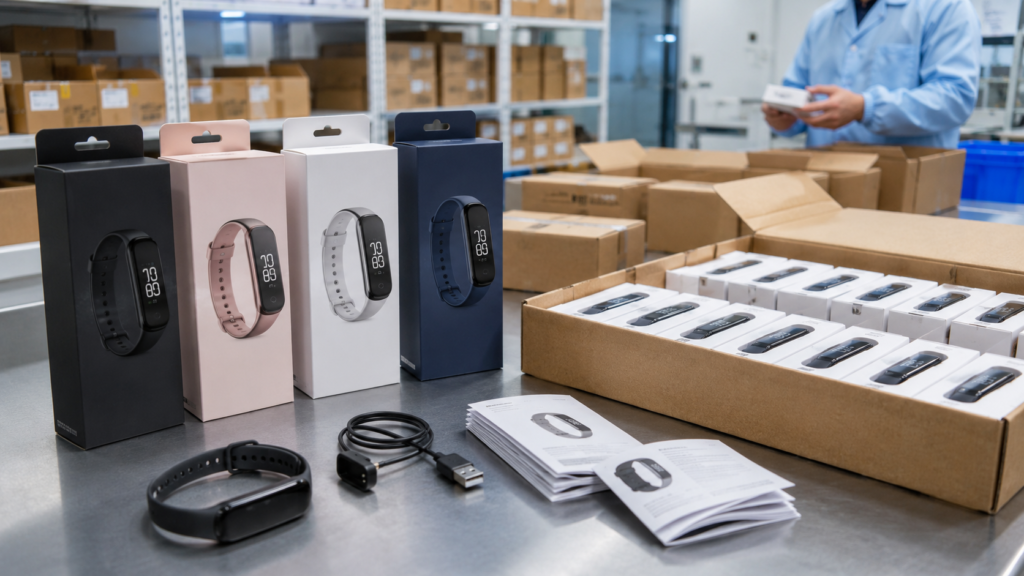
7 Critical Checks for Private-Label Smart Bands in the EU: Cost, MOQ, Certification
Private label smart bands for the European Union require seven critical checks before you commit to tooling or a first mass-production order: MOQ and lead time, unit cost structure, TDD exposure under EU RED, CE/RoHS and battery compliance, app and data ownership, packaging and logistics, and after-sales support. This guide is written for private-label brand owners evaluating a China-based smart band manufacturer in 2026. It assumes you already know the product category and now need a decision framework you can apply to quotes and samples from two or three candidate suppliers.
Table of Contents
Table of Contents
private label smart bands: Direct Answer
When buying private label smart bands for the EU, evaluate suppliers on seven decision points: (1) MOQ and tooling terms, (2) truly landed cost, (3) radio and CE compliance under EU RED, (4) battery safety and shipping documentation, (5) app, firmware and data ownership, (6) packaging and brand assets, and (7) after-sales and spare parts. Request the redacted test reports, a full landed-cost quote, and written app/data clauses before paying a tooling deposit.

Table of Contents
- 1. MOQ, Tooling and Lead Time Reality
- 2. Landed Cost, Not Unit Price
- 3. CE and EU RED: Why TDD Hits Your Brand
- 4. RoHS, REACH and Battery Compliance
- 5. App, Firmware and Data Ownership
- 6. Packaging, Branding and Logistics
- 7. After-Sales and Spare Parts Plan
- Supplier Evaluation Comparison Table
- Common Mistakes and Buyer Red Flags
- Practical Buyer Checklist
- FAQ
- Conclusion

Key Takeaways
- As the private-label brand owner, you will usually be the EU importer of record and legally responsible for CE compliance, even if the manufacturer supplies the test reports.
- Smart bands without standalone cellular or Wi-Fi connectivity typically have a lighter compliance path than connected watches, but they still fall under RED, RoHS and battery rules.
- MOQ is negotiable at the platform level (excess stock) but much less flexible once you order a custom mold, custom PCB layout or custom app build.
- Unit price is a poor decision metric. Compare suppliers on landed cost to your EU warehouse, including duties, VAT, freight and estimated failure rates.
- App ownership is the single most underestimated risk: if you cannot migrate users to a new companion app on 90 days’ notice, your brand’s data asset is not yours.
- Battery shipments must be classified and documented correctly (UN 38.3 test summary for lithium cells is the baseline) or your goods will be held at origin or destination.

Key Facts for Buyers
| Item | Typical EU Private-Label Smart Band Reality | What to Verify |
|---|---|---|
| Compliance framework | EU RED 2014/53/EU if BLE or any radio; RoHS 2011/65/EU; EU Battery Regulation 2023/1542 as it phases in | Redacted test reports with EUT photos and firmware version |
| EU importer obligation | Your EU entity or a contracted authorized representative becomes the importer of record | Written importer arrangement and GPSR-style responsible person details |
| Battery shipping | Lithium-ion cells shipped as UN3481 (contained in equipment) or UN3480 (standalone) | UN 38.3 test summary, MSDS, correctly declared packing instruction |
| MOQ | Standard platform builds may start lower than full custom builds; tooling deposits reset MOQ | MOQ per SKU, per colorway, per packaging variant |
| Lead time | Sample 7–20 days typical; mass production 20–45 days after deposit and material readiness | Calendar-day commitment in writing with penalty clause |
| App ownership | Commonly licensed by the ODM supplier; buyout is possible but must be contracted | Source code, SDK, data export rights and migration terms |
| After-sales | Warranty 12–24 months typical; DOA rates and spares pack negotiated | Defect definition, RMA window, spare parts SKUs and pricing |
Private label smart bands sit at the intersection of consumer hardware and regulated radio equipment. The EU market rewards brands that treat this as a procurement engineering problem rather than a logo-printing exercise. The seven checks below are written so that you can score each candidate supplier consistently, then either shortlist or disqualify.

1. MOQ, Tooling and Lead Time Reality
MOQ for private label smart bands usually has three tiers. The lowest tier is a standard platform band with your logo and packaging — the tooling already exists, only cosmetic changes are required. The middle tier adds custom colorways, strap material or a modified charging cradle. The highest tier adds custom PCB layout, custom mold for a unique case shape, or a bespoke companion app.
Ask the supplier to quote all three tiers separately. This forces transparency about which cost is actually flexible and which is not. A supplier who quotes one blended MOQ for a fully custom product and a logo-only product is either overcharging the simple order or underpricing the complex one.
What to confirm in writing
- MOQ per SKU, per colorway, per packaging variant, and per firmware version.
- Tooling and mold ownership: who owns the mold, and under what conditions can you move it to another factory? [STAR KING TO CONFIRM]
- Tooling amortization: is the deposit refundable or amortized across units?
- Lead time in calendar days from deposit and material readiness, not “after confirmation.”
- Whether certification samples come from the same production line as mass production.
A useful discipline is to ask for the ramp schedule in writing: sample approval, tooling sign-off, first article inspection, pilot run, mass production, pre-shipment inspection, and sailing date. Suppliers who plan in terms of a schedule rather than a promise usually behave better when something slips.
2. Landed Cost, Not Unit Price
The landed cost of private label smart bands to your EU warehouse is rarely the FOB unit price plus freight. It is a stack: FOB price, packaging, accessory cost, freight, insurance, duty, VAT recovery, port and customs handling, third-party QC, and a reserve for failure rates and returns.
Compare two or three suppliers on a landed cost per sellable unit — that is, per unit that actually reaches a paying customer in working condition. A supplier with a 5% higher FOB price but a tighter defect rate and better packaging usually wins over the cheapest quote.
Cost structure to model
- Unit cost at your target annual volume, not your first-order volume.
- Packaging: retail box, insert, manual languages, and any retail-ready requirements.
- Freight mode: air for launch, sea for replenishment, and the cash-flow difference.
- EU import duty (HS classification may vary by function) and recoverable VAT.
- Battery handling surcharge, if applicable.
- Reserve for DOA, warranty replacements and returns.
If your supplier cannot or will not help you map these line items, that is itself a signal about how they think about the commercial side of an OEM relationship.
If you are comparing two or three smart band suppliers for a private label program, it can help to review the smart bands product page and the private label OEM/ODM solution as a reference before you finalize your RFQ.
3. CE and EU RED: Why TDD Hits Your Brand
Smart bands with Bluetooth Low Energy fall under the Radio Equipment Directive 2014/53/EU (RED). Since the delegated regulation on common chargers and the RED cybersecurity delegated regulation started to apply, TDD (Technical Documentation and Declaration) expectations for connected products have tightened. As the brand owner, you will normally place your name and EU importer details on the product, which means the declaration of conformity is tied to your entity, not the factory’s.
This is the single most misunderstood point among first-time EU private-label brands. The factory may own a CE test report for a platform, but the declaration of conformity is a document you sign as the responsible economic operator. That document must reference the actual product, firmware version, and applicable standards.
How buyers should evaluate CE evidence
- Ask for the redacted test reports, not a PDF summary or a logo file.
- Check that the EUT (equipment under test) photos match the exact band you are buying.
- Confirm the tested firmware version and the supported standards listed (for example EN 300 328 for 2.4 GHz radios).
- Confirm whether the supplier will support re-testing if you change firmware, add features or change a radio module.
For EU radio equipment rules, see the official European Commission Radio Equipment Directive page. For Bluetooth technology details relevant to band connectivity, see the Bluetooth SIG specification index. Both are useful references to keep in the same folder as your supplier’s test reports.
[Image Placement 1 – after the CE/RED section]
Suggested file: private-label-smart-bands-eu-ce-test-report-review.jpg
Alt: Private label smart bands EU CE test report review on buyer desk
Caption: Auditing CE/RED evidence for private label smart bands before tooling sign-off.
4. RoHS, REACH and Battery Compliance
RoHS 2011/65/EU restricts certain hazardous substances in electrical equipment. For smart bands this is usually straightforward, but strap materials, coatings and adhesives can occasionally introduce REACH SVHC concerns. If your band includes skin-contact and textile elements, ask for relevant material declarations, not just a RoHS statement.
Battery is where shipments fail. Lithium-ion cells in smart bands are typically declared as UN3481 (lithium-ion batteries contained in equipment) for finished bands, or UN3480 if shipped as standalone cells. The baseline documentation is a UN 38.3 test summary, which is required for transport by air. In addition, an MSDS for the battery may be requested by carriers or forwarders.
Battery documentation checklist
- UN 38.3 test summary for the specific cell and pack configuration used in your band.
- MSDS for the shipped battery pack.
- Carrier declaration already reflected in the shipping documents.
- Country-specific waste-battery registration clarified for your EU market.
Confirm early whether the supplier’s default packing instruction matches your carrier’s acceptance rules. Retrofitting battery paperwork after goods are palletized at origin is expensive. If you are still mapping the general flow from a China supplier to a European warehouse, the resources blog carries related sourcing and compliance explainers.
5. App, Firmware and Data Ownership
For evaluation-stage buyers, app ownership is often the deciding factor. A private-label smart band is not just a physical device; it is a physical device plus a companion app, a cloud backend, and user data. If your supplier retains ownership of the app and cloud account, your ability to migrate users, change features or exit the supplier is constrained.
Ask three questions in writing. Who owns the app source code? Who owns the cloud infrastructure and user data? What are the migration terms if the relationship ends? Clear answers matter more than optimistic answers.
App and firmware decision list
- Is the app a shared white-label app used by other brands, or a dedicated build?
- Can the app be published under your Apple and Google developer accounts?
- Do you receive a data export of user data on demand, and in what format?
- What is the SDK/API path for integrating with Health Connect or Apple Health?
- Who patches security vulnerabilities, and within what time window?
- If firmware customization is required, what are the one-time and per-unit costs? [STAR KING TO CONFIRM]
For a broader view of how app integration fits into health and fitness use cases, see the health & fitness wearables solution page.
6. Packaging, Branding and Logistics
EU retail channels — especially drugstore chains, electronics retailers and Amazon EU marketplaces — impose packaging rules that may include language coverage, barcodes, responsible person references and, for some markets, extended producer responsibility registrations. Packaging is also where private label brands often cut quality unintentionally. A thin retail box and a cheap manual telegraph the price tier to the end customer before the band is even switched on.
Packaging and branding items to lock down
- Approved dielines, material and print finish for the retail box.
- Insert languages required by your target EU markets.
- Brand and importer information placed correctly on the packaging.
- Carton labels: SKU, EAN, box quantity, gross/net weight, battery class.
- Country of origin marking and, where relevant, waste-registration references.
Also decide early whether you want a premium-touch retail box or a fulfillment-friendly plain box for e-commerce marketplaces. The packaging decision drives tooling and MOQ more than most buyers expect.
[Image Placement 2 – packaging section]
Suggested file: private-label-smart-band-packaging-eu-retail.jpg
Alt: Private label smart bands EU retail packaging options for OEM buyers
Caption: Packaging choices for private label smart bands sold into EU retail and marketplace channels.
7. After-Sales and Spare Parts Plan
After-sales is the least glamorous part of a private-label program and the most likely to damage your brand. Define the defect policy in the purchase agreement, not in an email thread. Ask for the DOA (dead on arrival) allowance, the RMA window, the replacement flow, and the spare-parts program at the time of the first order.
After-sales items to negotiate
- Warranty length and what it covers (battery capacity degradation versus outright failure).
- Spare parts pack: straps, charging cables, charging cradles, and small component kits.
- Technical support channel and response times for firmware and app issues.
- Replacement shipment method and cost for confirmed defects.
- Documented process for firmware or app updates post-launch.
If your launch plan includes corporate wellness kits, senior health programs or remote patient engagement pilots, the spare-parts and support model needs to be part of the proposal to those buyers as well. Reviewing the corporate wellness application page can help you align the after-sales story with your end customer’s expectations.
Supplier Evaluation Comparison Table
Use the table below to score two or three candidate suppliers on the same criteria. Assign a score of 1 (weak) to 5 (strong) per row, then weight the rows according to your business model. A buyer whose main channel is Amazon EU should weight app integration and packaging higher; a corporate procurement buyer should weight after-sales higher.
| Evaluation Criterion | Supplier A | Supplier B | Supplier C | Weight (1–5) |
|---|---|---|---|---|
| MOQ flexibility across three tiers | 2 | 4 | 3 | 5 |
| Landed cost clarity (quote line items) | 3 | 4 | 2 | 5 |
| Redacted CE/RED test reports available | 2 | 5 | 3 | 5 |
| Battery documentation (UN 38.3 + MSDS) | 3 | 5 | 4 | 4 |
| App/firmware/data ownership clarity | 2 | 4 | 3 | 5 |
| Packaging and branding flexibility | 3 | 4 | 3 | 4 |
| After-sales and spare-parts program | 2 | 4 | 3 | 4 |
| Lead time commitments in writing | 3 | 4 | 2 | 4 |
If a supplier scores low on app ownership and CE evidence, no unit price advantage compensates for the resulting brand risk. Disqualify early.
Common Mistakes and Buyer Red Flags
Common mistakes by first-time EU buyers
- Choosing a supplier on unit price alone, without a landed cost model.
- Treating a supplier’s CE certificate as their own compliance document without confirming the product and firmware version.
- Accepting a shared white-label app without a data migration plan.
- Underestimating packaging tooling and MOQ impact on the whole program.
- Leaving battery documentation until the goods are ready to ship.
- Skipping the pilot run, then discovering a cosmetic issue at mass production scale.
Red flags in supplier conversations
- Unwillingness to share redacted test reports before an NDA is even required.
- Verbal-only MOQ and lead time commitments that never appear in a quotation document.
- Vague answers about app source code or cloud infrastructure ownership.
- No clear named account manager and no defined escalation path.
- Discomfort when you ask for the EUT photos next to the test report.
- Pressure to pay a tooling deposit before any specification document exists.
Practical Buyer Checklist
Print or save this checklist and score each supplier before you place a deposit. It is deliberately terse so that you can walk through it in a single supplier call.
- Quotation document with MOQ per tier, FOB and estimated landed cost.
- Redacted CE/RED test reports with EUT photos and firmware version.
- RoHS declaration and, where relevant, material declarations for skin contact components.
- UN 38.3 test summary and MSDS for the specific battery used.
- Written app and firmware ownership terms, plus data export rights.
- Packaging dieline approval flow and carton-level labeling sample.
- After-sales terms including DOA allowance, RMA window and spare-parts pricing.
- Named project manager and escalation contact, with response-time expectations.
- Pilot run and pre-shipment inspection plan agreed before mass production.
[Image Placement 3 – buyer checklist section]
Suggested file: private-label-smart-bands-buyer-checklist.jpg
Alt: Private label smart bands buyer checklist for EU OEM procurement teams
Caption: A short pre-deposit checklist for evaluating private label smart band suppliers.
FAQ
What is the typical MOQ for private label smart bands?
MOQ depends on how much customization you request. Logo and packaging on an existing platform usually sits at one tier [STAR KING TO CONFIRM]; a custom case shape, custom PCB layout or bespoke app pushes the MOQ higher. Ask each supplier to quote three tiers so the underlying cost drivers are visible.
Do I need CE certification if the supplier already has it?
The supplier may hold test reports for a platform, but the CE declaration of conformity for your branded product is normally signed by you as the EU importer. Verify the report references your exact product and firmware version, and confirm who signs the declaration.
How should smart bands be shipped from China to the EU?
Finished bands with built-in lithium-ion cells are typically shipped under UN3481 and require a UN 38.3 test summary for air transport; MSDS may also be requested by the carrier. Sea freight is common for replenishment. Confirm the packing instruction and documentation with your forwarder before production finishes.
Can I migrate users to a different app later?
Only if you negotiated data export and migration terms in the original contract. If the app and cloud are owned by the supplier and there is no export obligation, migrating users becomes a commercial negotiation rather than a technical formality. Lock this down before the first order.
How long does a private label smart band project take?
Sample rounds typically take between one and three weeks depending on customization; mass production commonly runs 20 to 45 days after deposit and material readiness. Packaging tooling and certification reviews can add time. Ask for a calendar-day schedule, not a verbal estimate.
What documentation should I receive before shipping?
At minimum: redacted CE/RED test reports, RoHS declaration, UN 38.3 test summary, MSDS, packaging approval sign-off, and a pre-shipment inspection report. If the supplier resists providing any of these, treat it as a serious red flag.
Conclusion
Private label smart bands for the EU are a procurement program, not a purchase order. The suppliers who deserve your tooling deposit are the ones who answer MOQ, landed cost, CE/RED, battery documentation, app ownership, packaging and after-sales questions in writing, with a named project manager and a calendar-day schedule. Score candidates against the same checklist above, compare landed cost rather than FOB price, and resolve app and data terms before any tooling work begins. Done well, this framework protects your brand in the EU market and makes the second, third and fourth SKU far faster to launch.
Request Samples for Your Private Label Smart Band
If your evaluation is at the point where you need to compare specifications and confirm compliance details, request samples and a full quotation from the STAR KING team. Share your target EU markets, packaging concept and expected first-order volume so the quotation reflects the actual customization scope.
Request product samples and a private label smart band quotation →
Discuss Your Smart Wearable OEM/ODM Project
Planning a smart ring, smart watch, smart band, AI glasses, AI translator, or AI voice mouse project? Contact STAR KING to discuss product positioning, sample testing, customization scope, certification requirements, lead time, and quotation details.

Team Star King

Scan WhatsApp QR code
Leave a Reply