
corporate smart watches: How to Evaluate Smart Watches for Corporate Wellness Programs in 2026: 12-Step RFQ Guide
How to Evaluate Corporate Smart Watches for Wellness Programs in 2026: A 12-Step RFQ Guide
To source corporate smart watches for a U.S. wellness program in 2026, procurement teams should issue a structured RFQ that specifies health sensors, battery life, privacy controls, compliance requirements, and OEM/private-label options. This guide walks through 12 steps—from defining employee needs to validating mass production—so you can compare suppliers on total cost of ownership, not just unit price. It is written for corporate procurement teams running RFQs for 500 to 50,000+ units.
Table of Contents
Table of Contents
Direct Answer
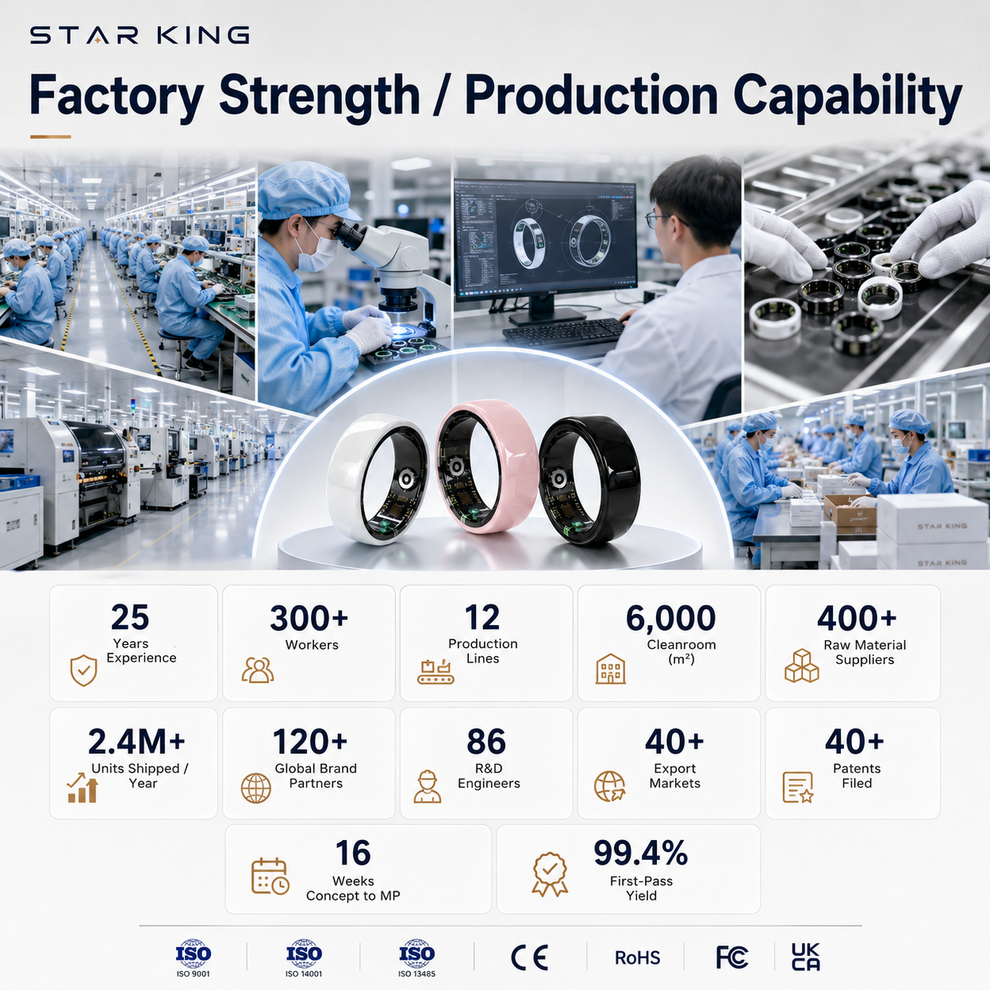
Corporate smart watches for employee wellness are best sourced through a formal RFQ that covers sensor accuracy, data privacy, app integration, and compliance. Focus on suppliers with proven OEM/ODM experience, clear MOQ terms, and documented testing. STAR KING provides [STAR KING TO CONFIRM] certification support and private-label options.
Table of Contents
- 1. Why Corporate Smart Watches Are a 2026 Wellness Priority
- 2. Step 1: Define Program Objectives and Employee Needs
- 3. Step 2: Choose Core Specifications
- 4. Step 3: Validate Health Sensor Capabilities
- 5. Step 4: Address Data Privacy and Security
- 6. Step 5: Evaluate App and Platform Integration
- 7. Step 6: Select OEM, ODM, or Private Label
- 8. Step 7: Understand MOQ and Price Factors
- 9. Step 8: Request and Test Samples
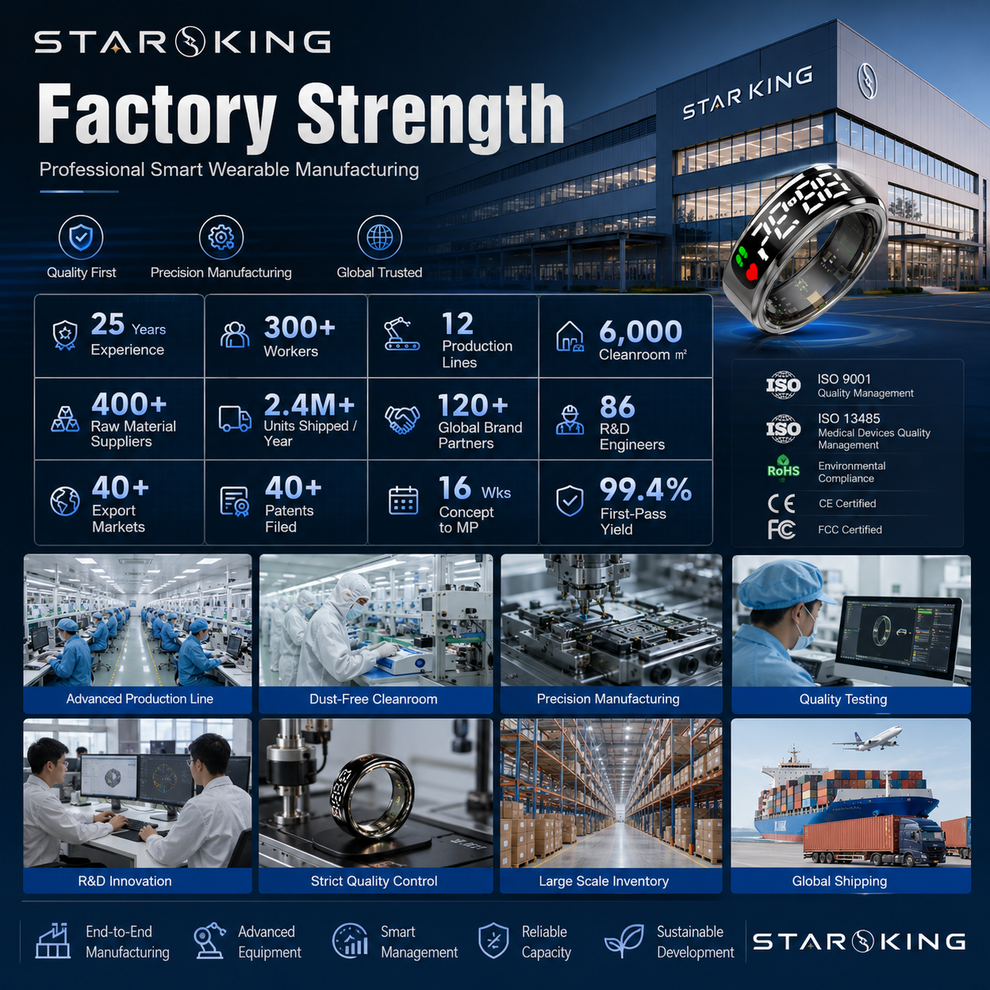
- 10. Step 9: Review Quality Control and Testing
- 11. Step 10: Confirm Compliance for the U.S. Market
- 12. Step 11: Plan Lead Time and Logistics
- 13. Step 12: Evaluate After-Sales and Warranty
- Key Facts for Buyers
- Common Mistakes in Corporate Smart Watch RFQs
- Practical Buyer Checklist
- FAQ

Why Corporate Smart Watches Are a 2026 Wellness Priority
Employee wellness programs increasingly use wearables to track activity, sleep, and recovery. Corporate smart watches offer a familiar form factor and wider feature set than rings or bands, making them suitable for diverse workforces. For procurement, the challenge is not finding a device—it is finding a supplier that can deliver consistent quality, customization, and compliance at scale. This guide assumes you are at the RFQ stage and need to compare suppliers methodically.
If your program also considers rings or bands, see our Health & Fitness Wearables solution for complementary options.

Step 1: Define Program Objectives and Employee Needs
Before contacting suppliers, clarify what the wellness program must achieve. Objectives shape specifications and avoid overbuying.
- Engagement: Do you need simple activity tracking or advanced health metrics?
- Population: Will devices be issued to all employees or a subset? Consider wrist sizes and comfort.
- Duration: One-year pilot or multi-year rollout?
- Data use: Will data be aggregated for HR reporting, or individual-only?
Document these points in your RFQ. Suppliers respond more accurately when they understand the end use.
Step 2: Choose Core Specifications
Corporate smart watches vary widely. Define must-have vs. nice-to-have features to control cost.
| Feature | Typical Options | Procurement Consideration |
|---|---|---|
| Display | LCD, OLED, AMOLED | AMOLED improves readability but adds cost |
| Battery Life | 5–14 days | Longer life reduces charging friction |
| Water Resistance | IP67, IP68, 5ATM | 5ATM supports swimming |
| Connectivity | Bluetooth 5.x | Verify Bluetooth SIG listing |
| Case Material | Plastic, aluminum, stainless steel | Affects durability and perceived value |
Request datasheets for each configuration. Avoid vague claims like “military-grade.”
Step 3: Validate Health Sensor Capabilities
Health sensors are central to wellness programs. Common sensors include heart rate, blood oxygen (SpO2), and accelerometer for sleep and activity.
Important: Consumer smart watches are wellness devices, not medical devices. Do not present them as diagnostic tools. If your program requires clinical-grade data, consult regulatory experts and consider FDA-cleared devices separately.
Ask suppliers for sensor specifications and, where available, third-party test summaries. STAR KING can provide [STAR KING TO CONFIRM] sensor validation reports for specific models.
For more on wearable health technology, see our Corporate Wellness application page.
Step 4: Address Data Privacy and Security
Employee health data is sensitive. In the U.S., programs may fall under HIPAA, ADA, or state privacy laws depending on structure. Buyers should verify requirements with legal counsel.
- Does the app encrypt data in transit and at rest?
- Can data be stored on U.S. servers?
- Is individual data visible to employers? (Best practice: aggregate only.)
- Does the supplier sign a data processing agreement?
Include these questions in your RFQ. Suppliers with clear privacy documentation are easier to onboard.
Step 5: Evaluate App and Platform Integration
The companion app determines user experience. Corporate programs often need:
- iOS and Android support
- Optional white-label branding
- API or SDK for integration with wellness platforms
- Aggregated reporting for HR
Ask for a demo account. Test onboarding time—if it takes more than a few minutes, adoption may suffer.
Step 6: Select OEM, ODM, or Private Label
Decide how much customization you need.
| Model | Customization Level | Typical Use |
|---|---|---|
| OEM | Logo, packaging, app skin | Fast launch with existing hardware |
| ODM | Hardware/firmware adjustments | Differentiated features |
| Private Label | Full branding under your name | Corporate identity programs |
STAR KING supports Private Label OEM/ODM projects. Clarify IP ownership and tooling costs early.
Step 7: Understand MOQ and Price Factors
MOQ and pricing vary by configuration. Typical factors:
- Order quantity
- Customization (logo, packaging, firmware)
- Sensor and display choices
- Certification needs
- Payment terms
Request a quote at several volumes (e.g., 500, 1,000, 5,000 units) to see volume breaks. Avoid assuming the lowest unit price equals the best value—consider support and warranty.
Step 8: Request and Test Samples
Samples reveal more than datasheets. Order 3–5 units to test:
- Comfort during a workday
- Sensor consistency across users
- App stability
- Battery performance
Document your findings in a scorecard. This becomes your RFQ evaluation matrix.
If you also need office productivity hardware, see our AI Office Productivity solutions.
Step 9: Review Quality Control and Testing
Ask suppliers about their QC process:
- Incoming material inspection
- In-line testing
- Pre-shipment inspection (PSI)
- Battery safety testing
Request test reports where available. For battery safety, UN38.3 and MSDS are commonly required for shipping lithium batteries. Confirm with the supplier.
Step 10: Confirm Compliance for the U.S. Market
U.S. market entry typically requires FCC certification for devices with Bluetooth or Wi-Fi. Other requirements may include:
- FCC Part 15 for unintentional radiators
- FCC RF exposure evaluation
- California Proposition 65 (if applicable)
- Customs and import documentation
Certification needs depend on the product configuration and target market. Buyers should verify with a compliance consultant. STAR KING can provide [STAR KING TO CONFIRM] certification status per model.
Refer to the FCC Equipment Authorization for official guidance.
Step 11: Plan Lead Time and Logistics
Lead time depends on customization and order size. Typical milestones:
| Stage | Estimated Time |
|---|---|
| Sample approval | 1–2 weeks |
| Mass production | 4–6 weeks |
| QC and packing | 1 week |
| Shipping (sea/air) | Varies |
Plan for Chinese New Year and other holidays. Confirm Incoterms and who handles customs.
Step 12: Evaluate After-Sales and Warranty
Corporate rollouts need support. Ask:
- Warranty period (typically 12 months)
- Repair or replacement process
- Availability of spare parts
- Technical support for app issues
A supplier with clear after-sales terms reduces long-term risk.
Key Facts for Buyers
| Item | Detail |
|---|---|
| Typical MOQ | 500–1,000 units for custom branding |
| Lead Time | 4–8 weeks after sample approval |
| Key Certifications | FCC, CE, RoHS, UN38.3 (varies by model) |
| Battery | Lithium-ion; UN38.3 and MSDS often required for shipping |
| App Integration | iOS/Android; API/SDK availability varies |
Common Mistakes in Corporate Smart Watch RFQs
- Ignoring data privacy: Failing to ask about encryption and data ownership.
- Assuming medical-grade accuracy: Treating wellness metrics as diagnostic.
- Skipping sample testing: Relying only on spec sheets.
- Underestimating lead time: Not accounting for holidays and shipping.
- Overlooking warranty: Focusing only on unit price.
Practical Buyer Checklist
- Define program objectives and employee needs.
- Specify must-have vs. nice-to-have features.
- Request sensor specifications and test summaries.
- Confirm data privacy and app security.
- Evaluate OEM/ODM/Private Label options.
- Get quotes at multiple volumes.
- Order and test samples.
- Review QC process and test reports.
- Verify FCC and other compliance requirements.
- Plan lead time and logistics.
- Confirm warranty and after-sales support.
- Check IP ownership and tooling terms.
Buyers can also review STAR KING Smart Watches OEM/ODM options to compare product positioning, customization scope, and sample planning.
FAQ
What is the typical MOQ for corporate smart watches?
MOQ often ranges from 500 to 1,000 units for custom branding, but can be lower for standard models. Confirm with the supplier.
Are corporate smart watches FDA approved?
Most consumer smart watches are not FDA-approved medical devices. They are wellness devices. If you need medical-grade monitoring, consider FDA-cleared alternatives.
What certifications do I need for the U.S. market?
FCC certification is commonly required for Bluetooth/Wi-Fi devices. Other requirements depend on the product and market. Verify with a compliance expert.
How long does production take?
Typical production is 4–8 weeks after sample approval, plus shipping. Customization may extend this.
Can we customize the app branding?
Many suppliers offer white-label app options. Ask about app customization and API access.
What about battery shipping regulations?
Lithium batteries require UN38.3 test reports and MSDS for shipping. Confirm documentation with your supplier and freight forwarder.
How do we ensure data privacy?
Ask about encryption, data storage location, and whether individual data is shared with employers. Consult legal counsel for compliance.
Conclusion
Sourcing corporate smart watches for a U.S. wellness program requires a structured RFQ that balances features, compliance, and total cost. By following these 12 steps, procurement teams can compare suppliers objectively and reduce risk. Start with clear objectives, validate samples, and confirm compliance early.
Next Step
Ready to move forward? Request a quotation for your corporate smart watch program, or discuss OEM/ODM customization options with our team.
Useful Official References for Buyers
- FCC equipment authorization guidance
- European Commission CE marking information
- Bluetooth SIG specifications
Discuss Your Smart Wearable OEM/ODM Project
Planning a smart ring, smart watch, smart band, AI glasses, AI translator, or AI voice mouse project? Contact STAR KING to discuss product positioning, sample testing, customization scope, certification requirements, lead time, and quotation details.

Team Star King
Scan WhatsApp QR code