
Smart Bands for EU Distributors: 10 Purchasing Checks Before You Commit
November 25, 2026 · Team Star King
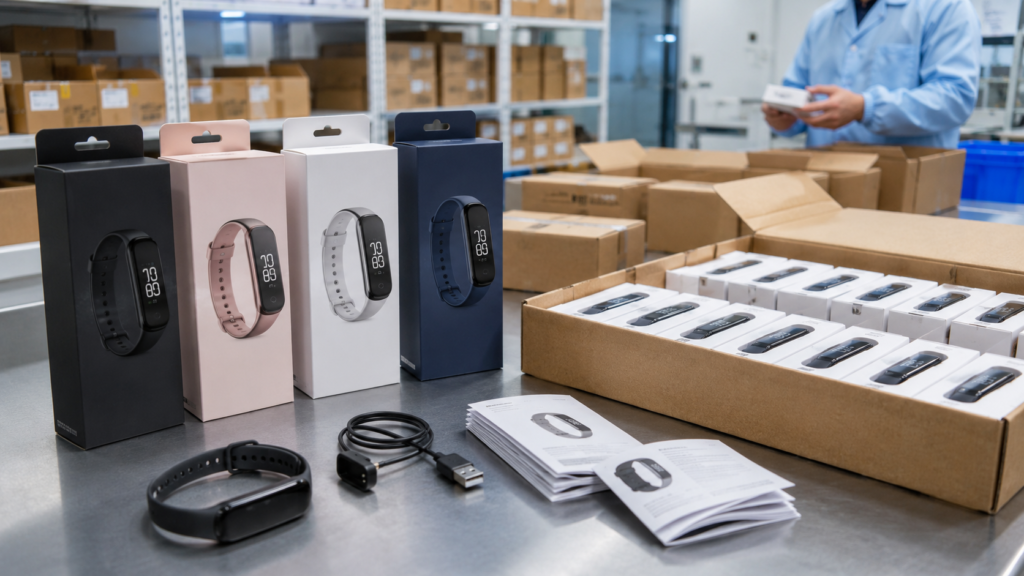
Smart Bands for EU Distributors: 10 Purchasing Checks Before You Commit
Smart bands for EU distributors should be purchased only after confirming ten items: EU market conformity documentation, battery transport rules, sample performance, MOQ and price logic, software and app ownership, quality control steps, packaging and labeling, lead time, warranty and spare parts, and landed cost. These checks reduce the risk of customs delays, returns, and margin loss before a purchase order is placed.
Table of Contents
Table of Contents
smart bands for EU distributors: Direct Answer
For EU distribution, smart bands are not a simple product purchase; they are a compliance and supply-chain commitment. Distributors should verify that each SKU has the correct conformity documentation for its configuration, that lithium battery shipping paperwork is complete, and that the supplier can support firmware updates and after-sales claims. A structured 10-point check is the fastest way to separate a reliable OEM partner from a trading risk.

Table of Contents
- What EU Distributors Should Know First
- Key Takeaways
- Key Facts for Buyers
- 1. Define the Smart Band SKU You Will Distribute
- 2. Verify EU Market Conformity Documentation
- 3. Confirm Lithium Battery Transport and Safety Rules
- 4. Test Samples Against Real Distribution Use
- 5. Understand MOQ, Price Breaks, and Cost Drivers
- 6. Review App, Firmware, and Data Handling
- 7. Confirm Quality Control and Inspection Steps
- 8. Plan Packaging, Labeling, and Private Label
- 9. Agree Lead Time, Warranty, and Spare Parts
- 10. Calculate Landed Cost Before You Commit
- Comparison Table: Low-Cost vs. Distribution-Ready Smart Bands
- Common Mistakes and Buyer Red Flags
- Practical Buyer Checklist
- FAQ
- Conclusion

Key Takeaways
- EU distribution requires documentation per SKU, not a generic certificate covering all products.
- Lithium battery rules affect shipping method, packaging, and paperwork, which can change landed cost.
- Sample testing should cover battery life, app pairing, heart rate trends, water resistance claims, and drop durability.
- MOQ and price are linked to tooling, packaging, and firmware customization, not only unit volume.
- Clarify who owns the app, firmware, and molding before signing a private-label agreement.
- Confirm warranty and spare-parts policy in writing; returns handling is a major hidden cost for distributors.

Key Facts for Buyers
| Buyer Question | What to Confirm | Why It Matters |
|---|---|---|
| Which EU rules apply? | CE marking scope, RoHS, WEEE, battery rules, radio equipment directive where applicable | Market access and customs clearance |
| Can the product ship by air? | UN38.3 test summary, MSDS, battery watt-hour rating | Freight options and transport cost |
| What is the minimum order? | MOQ per color, per packaging type, and per firmware version | Cash tied in stock and SKU complexity |
| Who owns the app? | App operator, data hosting, update responsibility | Long-term support and brand control |
| What is the real landed cost? | Unit price, freight, duties, VAT, packaging, returns reserve | Margin and retail pricing |

What EU Distributors Should Know First
Smart bands sold in the European Union are typically treated as radio equipment and electronic products. Depending on configuration, they may fall under the Radio Equipment Directive, RoHS, WEEE, and battery-related requirements. Bluetooth connectivity and health-related features may bring additional scrutiny. The exact obligations depend on the product’s features, packaging, and the distributor’s role in the supply chain, so buyers should verify with a compliance professional rather than rely on a supplier statement alone.
Distributors also sit between the factory and retailers. That means returns, firmware bugs, and packaging errors become the distributor’s problem. A smart band that is cheap per unit but poorly documented or hard to update can consume margin through support and reverse logistics.
1. Define the Smart Band SKU You Will Distribute
Before comparing quotations, define the SKU precisely. A smart band is not one product. Screen size, case material, strap type, sensor set, Bluetooth version, battery capacity, app platform, and packaging all change cost and compliance scope.
Questions to settle internally
- Is this an entry-level band for retail chains or a feature-rich model for specialist channels?
- Will you sell under your own brand or as a branded OEM product?
- Does the band need SpO2, heart rate, sleep tracking, or workout modes?
- Is the app required for first setup, or can the band run standalone?
If you plan to sell smart bands alongside other wearables, review the smart bands product range to compare form factors and features before locking a specification.
2. Verify EU Market Conformity Documentation
Ask for the conformity documentation that matches the exact SKU you intend to import. A certificate for a similar model is not the same as documentation for your configuration. The documentation set usually includes a declaration of conformity, test reports, and labeling information. The scope depends on the product’s wireless features, materials, and battery.
For reference, buyers can review the European Commission CE marking guidance and the Radio Equipment Directive 2014/53/EU. These sources explain the framework, but the supplier’s test reports and declarations must still be checked by your compliance team or a notified body where required.
What to request
- Declaration of conformity naming the exact model and variant
- Test reports covering radio, EMC, safety, and RoHS where applicable
- Battery documentation including UN38.3 summary and MSDS
- Label artwork showing manufacturer, importer, and CE marking placement
Do not accept a general statement that “all products are CE certified.” Certification depends on the configuration, and the distributor remains responsible for the product placed on the EU market.
3. Confirm Lithium Battery Transport and Safety Rules
Smart bands contain lithium batteries, so transport rules affect freight cost and scheduling. Air shipments usually require a UN38.3 test summary and MSDS, and some carriers request additional documentation. Battery watt-hour rating determines whether the product falls under stricter rules.
Buyers can check the IATA Dangerous Goods Regulations framework for air transport context. For EU market battery requirements, the EU batteries framework is a useful starting point, but obligations vary by battery type and product category. Confirm with your freight forwarder and compliance advisor.
Practical checks
- Request the UN38.3 test summary for the exact battery used in your SKU.
- Confirm the MSDS version and language.
- Ask whether the battery is removable or built-in; this affects repair and recycling.
- Confirm packaging meets carrier requirements for lithium batteries.
4. Test Samples Against Real Distribution Use
Sample testing should simulate distribution conditions, not just a demo. Charge and discharge the band repeatedly, pair and unpair the app on common phones, test notifications, and check sensor consistency during rest and movement. Record results so you can compare suppliers objectively.
Sample test plan
| Test Area | Method | Pass Criteria |
|---|---|---|
| Battery life | Continuous use and standby cycles | Matches supplier claim within agreed tolerance |
| App pairing | Test on at least 5 phone models common in your market | Stable pairing and reconnect |
| Heart rate trend | Compare resting and activity readings | Reasonable trend, not diagnostic accuracy |
| Water resistance | Review IP rating claim and test method | Claim matches documented test |
| Drop and strap | Controlled drop and strap flex | No functional failure in normal use |
Health features are consumer wellness features, not medical diagnosis. Do not market SpO2 or heart rate as clinical measurements without appropriate regulatory review.
5. Understand MOQ, Price Breaks, and Cost Drivers
MOQ is not a single number. It can differ by color, packaging, logo printing, and firmware version. Ask for a written MOQ matrix and price breaks. A supplier who cannot explain cost drivers is harder to negotiate with later.
Common cost drivers
- Display type and size
- Sensor set and accuracy requirements
- Battery capacity and charging method
- Case and strap materials
- Custom packaging and manual printing
- App or firmware customization
- Certification scope
If you need private-label branding, review the private label OEM/ODM solution to understand which elements are customizable and which are fixed by the platform.
6. Review App, Firmware, and Data Handling
The app is part of the product. Ask who operates the app, where data is stored, and how updates are delivered. Distributors need a clear answer on who fixes bugs after the warranty period and whether the app can be branded.
Questions for the supplier
- Is the app white-label or shared with other brands?
- Can firmware be updated over the air?
- Who owns the app account and data?
- What is the update policy after launch?
- Can you provide an API or SDK if we integrate with a retail system?
Data handling obligations under EU rules may apply depending on the app and the distributor’s role. Buyers should verify with legal counsel; this article does not provide legal advice.
7. Confirm Quality Control and Inspection Steps
Ask for the quality control plan, not just a promise of good quality. A practical plan includes incoming material checks, in-process testing, aging or burn-in, functional testing, and pre-shipment inspection. The exact steps should match the product’s risk profile.
What to request
- Inspection checklist with pass and fail criteria
- Aging and functional test records
- Pre-shipment inspection option and who pays
- Defect rate threshold and remedy
- Photos or video of production and packing
For a broader view of testing categories, see the STAR KING resources blog, where quality and compliance topics are covered in more detail.
8. Plan Packaging, Labeling, and Private Label
EU labeling needs to be planned before production, not after. Importer name and address, manufacturer information, CE marking, WEEE symbol where applicable, and battery disposal information may be required depending on the product. Packaging language should match the markets you sell into.
Packaging checklist
- Retail box artwork with barcode and importer details
- User manual in required languages
- Safety and battery disposal information
- Private-label logo and brand assets
- Master carton labeling and pallet configuration
Confirm which packaging elements are included in the MOQ and which require additional tooling or printing setup.
9. Agree Lead Time, Warranty, and Spare Parts
Lead time should be broken into sample approval, tooling or packaging setup, mass production, testing, and shipping. A single number hides risk. Warranty terms should be in writing, including who handles returns, who pays freight, and how spare parts are supplied.
Lead time breakdown to request
- Sample lead time
- Packaging proofing time
- Mass production time
- Pre-shipment inspection time
- Shipping transit time by method
Ask for the warranty period, the defect remedy process, and the spare-parts policy. Distributors should reserve a returns budget rather than assume zero failures.
10. Calculate Landed Cost Before You Commit
Landed cost includes unit price, freight, insurance, duties, VAT, packaging, inspection, and a returns reserve. A lower unit price can lose to a higher one after freight and returns are counted.
Landed cost worksheet
| Cost Element | How to Estimate | Notes |
|---|---|---|
| Unit price | Supplier quotation at target MOQ | Confirm Incoterm |
| Freight | Forwarder quote for battery shipment | Air vs. sea changes cost and time |
| Duty and VAT | Check current EU tariff and VAT rules | Verify with customs broker |
| Inspection | Third-party or supplier inspection cost | Decide who pays |
| Returns reserve | Percentage of units based on defect risk | Include support labor |
Comparison Table: Low-Cost vs. Distribution-Ready Smart Bands
| Factor | Low-Cost Option | Distribution-Ready Option |
|---|---|---|
| Documentation | Generic certificate | SKU-specific declaration and reports |
| Battery paperwork | MSDS only | UN38.3 summary and MSDS |
| App support | Shared app, unclear owner | Defined operator and update policy |
| Quality control | Final check only | In-process and pre-shipment inspection |
| Warranty | Verbal | Written terms and spare parts plan |
| Landed cost | Low unit price, high hidden cost | Transparent total cost |
Common Mistakes and Buyer Red Flags
- Accepting a certificate that names a different model number.
- Assuming all smart bands ship by air without battery documentation.
- Comparing unit prices without confirming Incoterms and packaging cost.
- Ignoring app ownership until after the first container arrives.
- Ordering multiple colors before checking MOQ per color.
- Marketing health features as medical without regulatory review.
- No written warranty or spare-parts commitment.
- Supplier cannot explain which tests were performed and when.
Practical Buyer Checklist
- SKU specification defined and documented
- Conformity documentation matches the exact model
- UN38.3 summary and MSDS received
- Samples tested on common local phones
- MOQ matrix and price breaks in writing
- App ownership and update policy confirmed
- Quality control plan reviewed
- Packaging and labeling proofs approved
- Lead time, warranty, and spare parts agreed
- Landed cost calculated with returns reserve
FAQ
Do smart bands for EU distributors always need CE marking?
Most smart bands sold in the EU fall within CE marking scope because they contain radio equipment and electronic components. The exact directives depend on the product configuration. Buyers should verify the applicable rules with a compliance professional and check the declaration of conformity for each SKU.
Can I ship smart bands by air from China to the EU?
Air shipment is often possible, but lithium batteries usually require a UN38.3 test summary and MSDS. Some carriers ask for additional documents. Confirm with your freight forwarder before booking, because requirements vary by battery and packaging.
What MOQ should a distributor expect for private-label smart bands?
MOQ depends on the model, packaging, and customization level. Standard models with existing packaging may have lower MOQ than fully custom packaging or firmware. Ask for a written MOQ matrix by color and packaging type. Specific STAR KING MOQ figures: [STAR KING TO CONFIRM].
Can the supplier help with EU importer labeling?
Many OEM suppliers can print importer details and required symbols on packaging and manuals. The distributor remains responsible for ensuring the information is accurate and compliant. Approve artwork proofs before mass production.
Are heart rate and SpO2 features medical devices?
Consumer smart bands typically present heart rate and SpO2 as wellness features, not medical diagnosis. If you intend to make medical claims, the product may require regulatory review. Do not market consumer features as clinical measurements without verification.
Who handles warranty claims in the EU?
The distributor or importer usually handles consumer warranty claims. The supplier’s warranty to the distributor should be in writing, including defect remedy and spare-parts terms. Clarify who pays return freight and how replacements are processed.
Conclusion
Smart bands for EU distributors can be a strong category when the purchasing process is structured. The ten checks in this guide move the conversation from unit price to total risk: documentation, battery transport, sample performance, MOQ logic, app ownership, quality control, packaging, lead time, warranty, and landed cost. Distributors who verify these items before ordering reduce customs delays, returns, and margin surprises.
Next Step
If you are comparing smart band suppliers for the EU market, request a quotation with your target specification, packaging needs, and destination country. STAR KING can review customization options and conformity requirements for your configuration. Request a smart band quotation to start the discussion.
Discuss Your Smart Wearable OEM/ODM Project
Planning a smart ring, smart watch, smart band, AI glasses, AI translator, or AI voice mouse project? Contact STAR KING to discuss product positioning, sample testing, customization scope, certification requirements, lead time, and quotation details.

Team Star King

Scan WhatsApp QR code
Leave a Reply