
Smart Rings for Distributors: 7 Checks Before You Sign a Supply Agreement
November 17, 2026 · Team Star King
Smart Rings for Distributors: 7 Checks Before You Sign a Supply Agreement
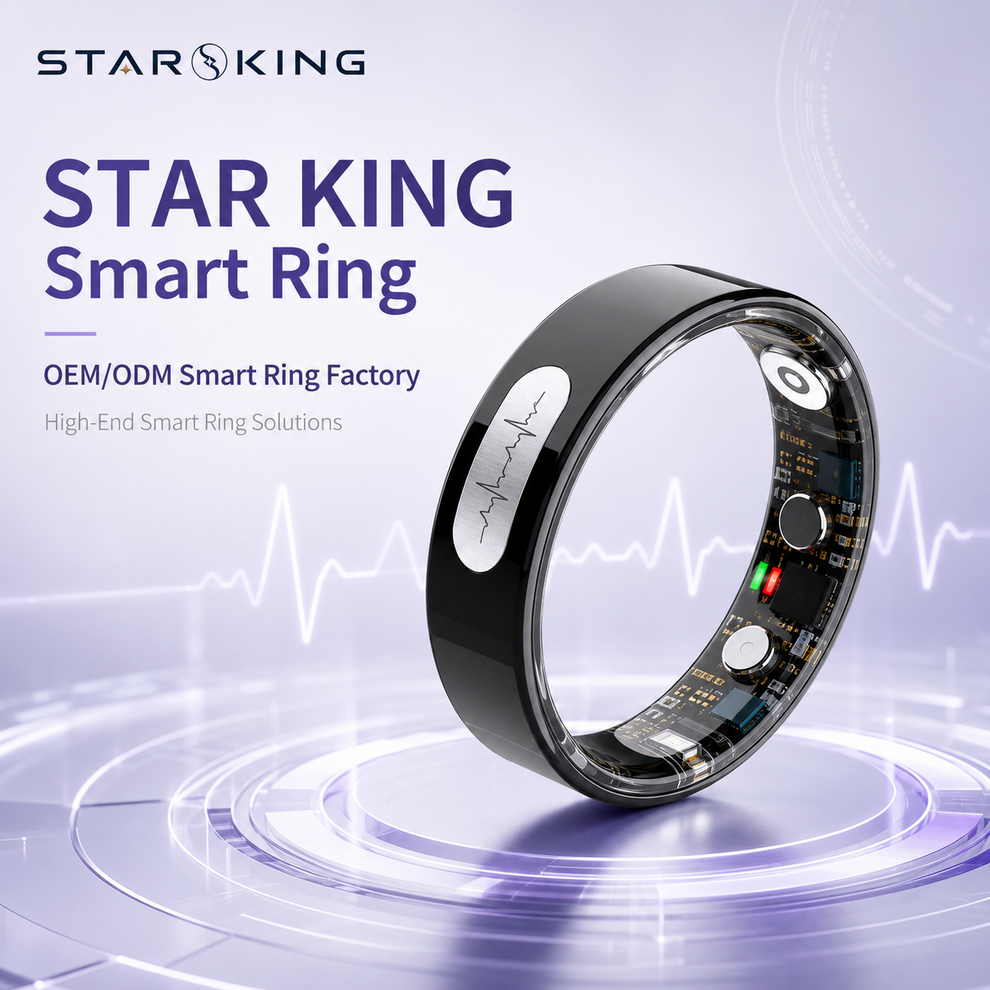
Smart rings for distributors are a category decision as much as a product decision: before you commit capital, you need to verify supplier capability, MOQ structure, app and firmware support, certification coverage, lead time reliability and after-sales terms. This guide gives distributors a seven-step evaluation framework, a buyer checklist and the red flags that most often derail a first smart ring program.
Table of Contents
Table of Contents
Distributors entering the wearable category usually have one advantage and one risk. The advantage is an existing retail, e-commerce or B2B channel. The risk is that a smart ring is sold as a connected system, not as a standalone accessory: the ring, the charging case, the companion app and the firmware all have to stay aligned for the life of the product. That is why a distributor’s due diligence should focus less on the sensor spec sheet and more on supply consistency, software continuity and documentation.
smart rings for distributors: Table of Contents
- Short Answer: What Should Distributors Check First?
- Key Takeaways
- Key Facts for Buyers
- What Is a Smart Ring Supply Program?
- Check 1: Supplier Type and Manufacturing Model
- Check 2: MOQ, Pricing Logic and Landed Cost
- Check 3: App, Firmware and Data Continuity
- Check 4: Certification and Import Documentation
- Check 5: Battery, Charging and Shipping Compliance
- Check 6: Quality Control and Sample Validation
- Check 7: Lead Time, Warranty and Spare Parts
- Comparison Table: Supply Models for Distributors
- Common Mistakes and Buyer Red Flags
- Practical Buyer Checklist
- FAQ
- Conclusion
Short Answer: What Should Distributors Check First?
Before signing a smart ring supply agreement, distributors should confirm five things in writing: who actually manufactures the product, the MOQ and price breaks, how the app and firmware will be supported after launch, which certifications cover the exact SKU and destination market, and the agreed lead time with a spare-part and warranty policy. These five points determine whether the product can be sold repeatedly through a channel, not just once.
Key Takeaways
- Smart ring sourcing is a system purchase: hardware, charging case, app and firmware must be evaluated together.
- MOQ is usually negotiable by SKU, color and packaging mix, but price breaks depend on total volume, not one line item.
- Certification must be verified against the exact model and target market; a general catalog claim is not enough.
- Lithium battery products typically require UN38.3 test documentation and an MSDS for air freight; buyers should verify current requirements with their freight forwarder.
- App and firmware support is often the weakest point in a low-cost supply offer; ask for a written support commitment.
- A pre-shipment inspection clause and a sample approval process protect margin more than a small unit-price discount.
Key Facts for Buyers
| Decision Area | What to Verify | Why It Matters for Distributors |
|---|---|---|
| Supplier type | Trading company vs. OEM/ODM manufacturer; factory audit report; production scope | Affects price structure, customization flexibility and escalation path |
| MOQ | Per-SKU MOQ, color/size mix, packaging MOQ, trial order policy | Determines inventory risk and cash tied up in slow-moving sizes |
| Pricing | FOB/EXW terms, tiered price breaks, tooling or NRE fees | Drives landed cost and resale margin |
| App and firmware | Who owns the app, update cadence, customization options, data handling | A broken app turns inventory into returns |
| Certification | SKU-specific CE/FCC/RoHS/UN38.3/MSDS documentation | Required for customs clearance and retail listing approval |
| Quality control | AQL level, pre-shipment inspection, aging and waterproof testing | Reduces defect-driven returns and channel complaints |
| Lead time | Sample lead time, production lead time, peak-season capacity | Prevents stockouts during launch and promotional windows |
| After-sales | Warranty period, DOA policy, spare parts, firmware support window | Protects distributor reputation and long-term margin |
If you are mapping the category for the first time, the smart rings product range is a useful reference point for form factor, sizing and feature tiers before you start comparing quotes.
What Is a Smart Ring Supply Program?
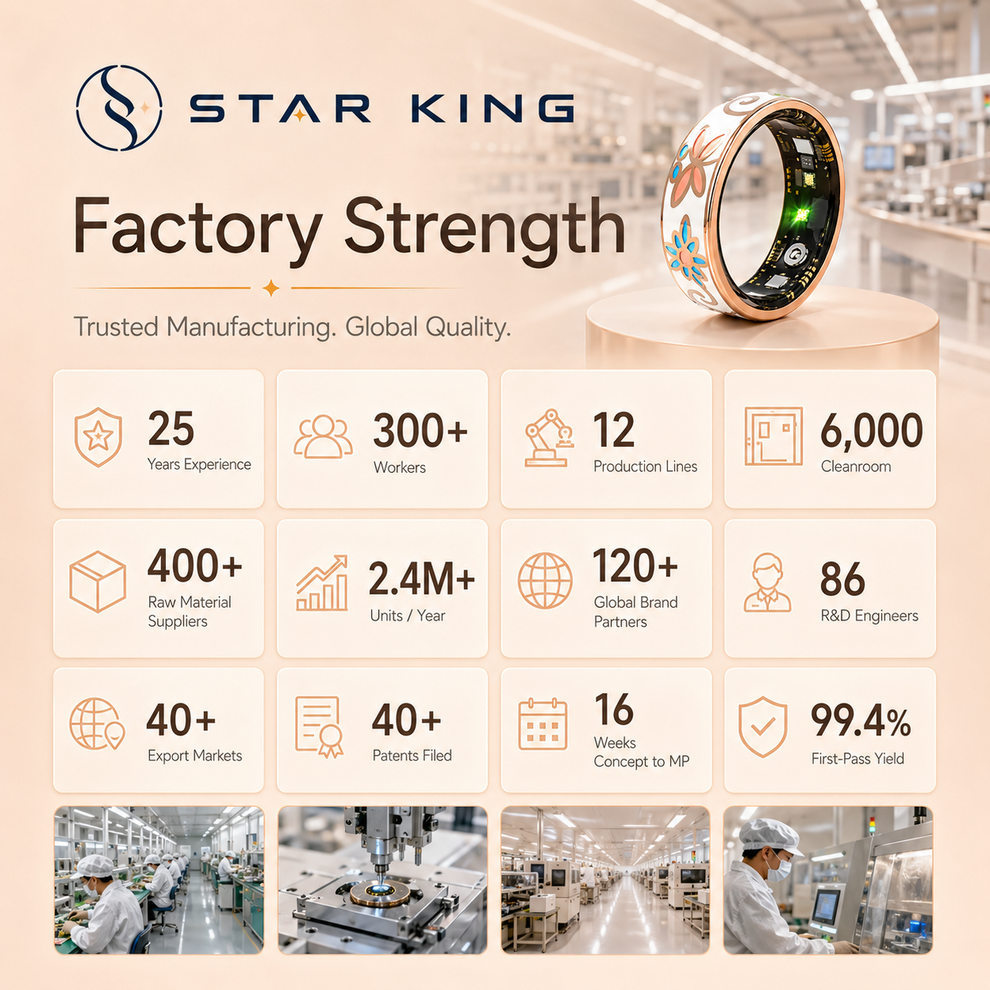
A smart ring supply program is the commercial and technical arrangement under which a manufacturer supplies ring hardware, charging accessories, companion app support and documentation to a distributor or brand. Unlike a simple accessory purchase, the buyer is also taking on responsibility for app availability, firmware updates and after-sales service in the destination market. That is why distributors should evaluate a smart ring supplier as a technology partner with a manufacturing capability, not as a catalog vendor.
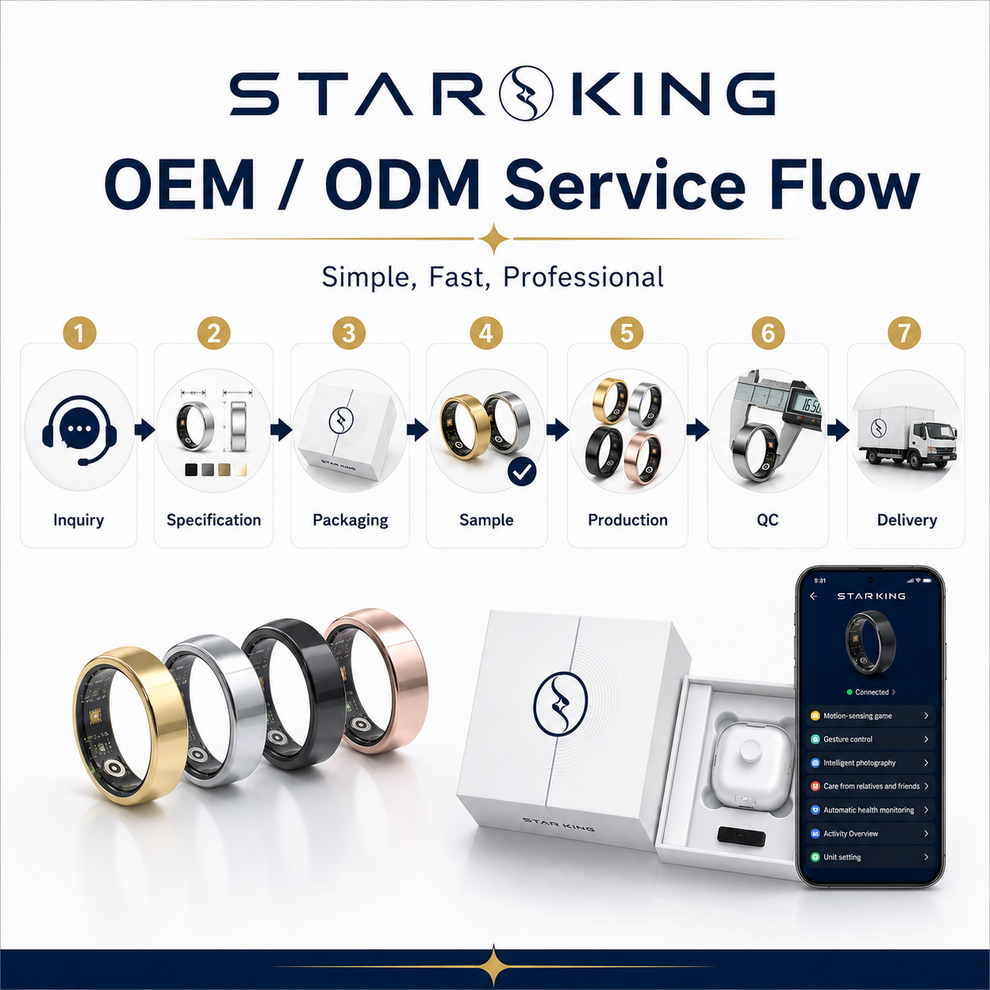
In practice, supply programs fall into three models: buying an existing ODM model with logo and packaging changes, commissioning a semi-custom model with app skinning and feature selection, or developing a private model with tooling and industrial design. Each model carries a different MOQ, timeline and documentation burden.
Check 1: Supplier Type and Manufacturing Model
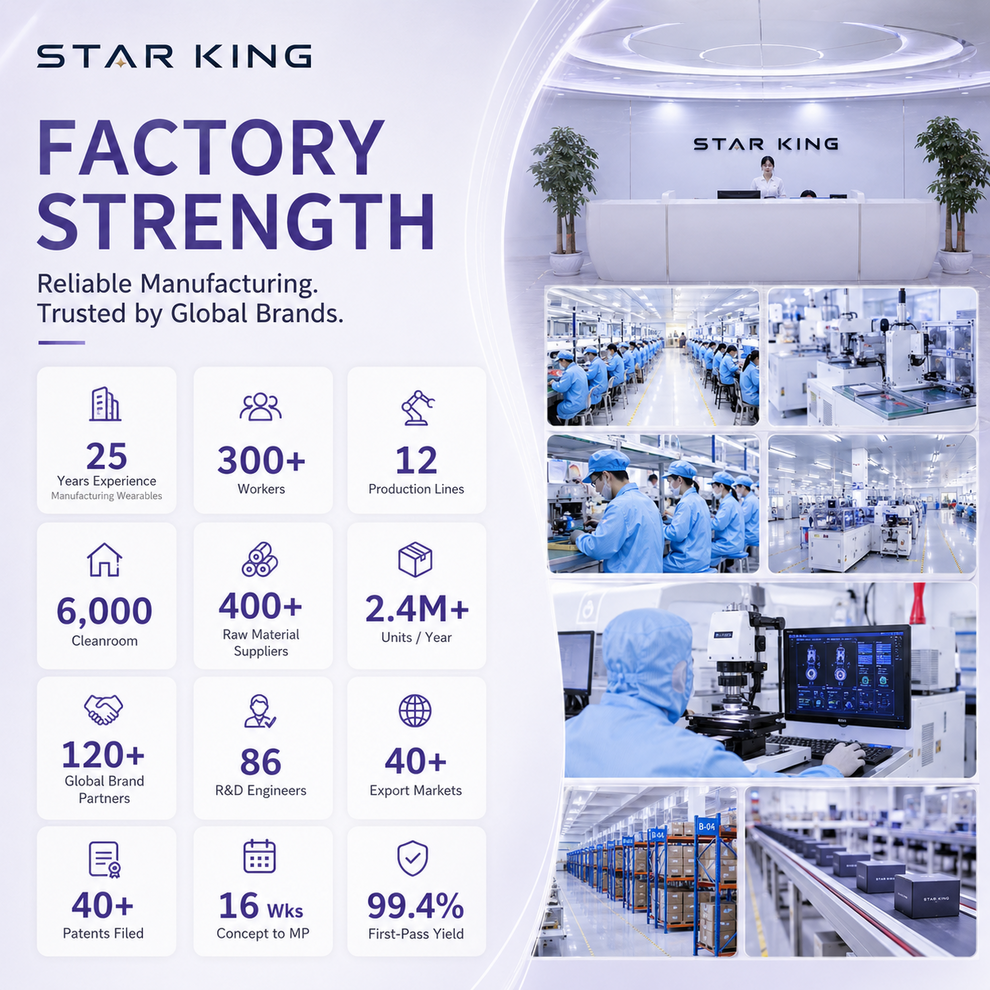
The first question is whether you are talking to a manufacturer or an intermediary. Both can be legitimate, but the answer changes how you negotiate MOQ, customization and problem escalation. A manufacturer can usually adjust firmware, ring sizing and packaging at the source. A trading company may offer a broader catalog but has less control over production changes.
What to ask
- Which smart ring models do you manufacture in-house, and which are sourced from third parties?
- Can you provide a factory audit report or arrange a video walkthrough of the production and testing areas?
- Who handles firmware changes, and how long does a change request take?
- What is your standard warranty policy, and who performs repairs?
For distributors building a multi-category wearable lineup, it also helps to understand whether the same supplier can support smart watches and bands, because a single supplier relationship reduces documentation and logistics overhead across the range.
Check 2: MOQ, Pricing Logic and Landed Cost
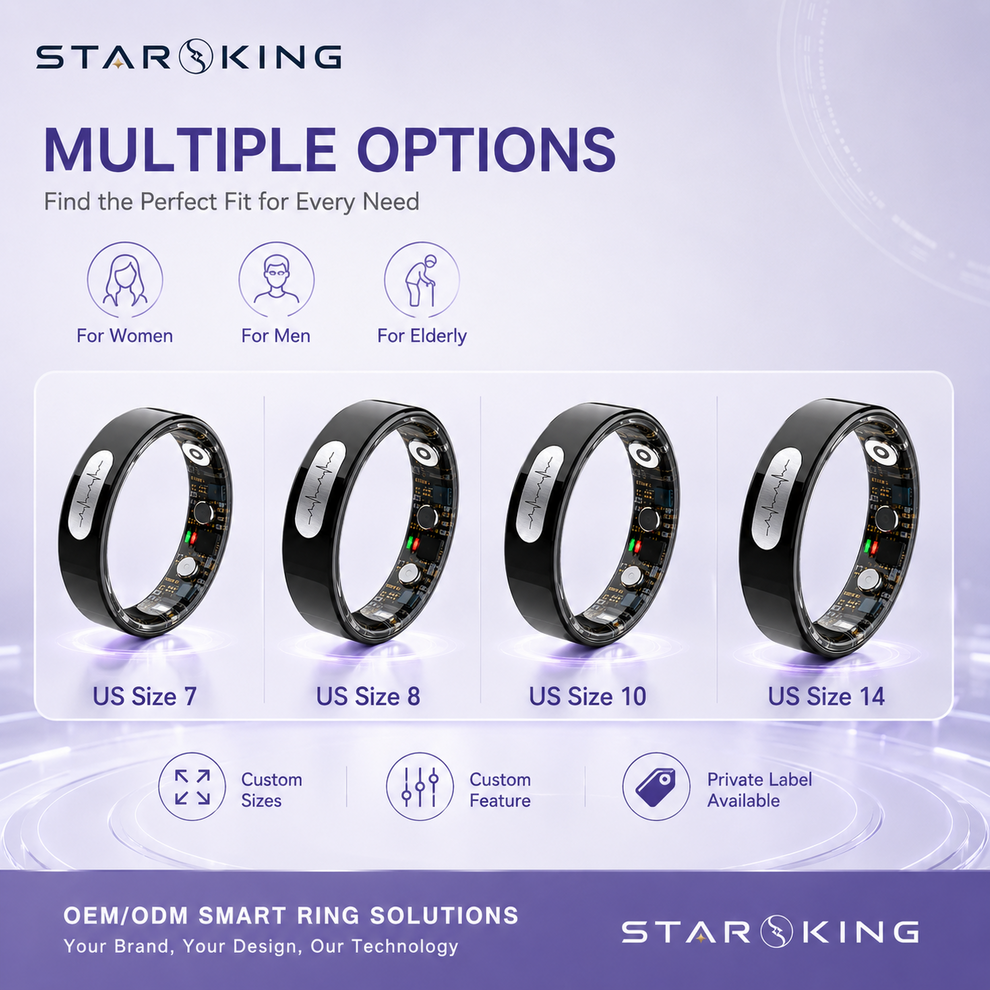
MOQ in the smart ring category is rarely a single number. It is usually a matrix: a minimum per model, a minimum per color, a minimum per ring size and a separate minimum for custom packaging. Distributors who only compare headline MOQ numbers often discover later that their planned size curve cannot be met within the quoted price tier.
How to structure the MOQ negotiation
- Ask for the MOQ per SKU, per color and per size, not just the program total.
- Confirm whether ring sizes can be mixed within one MOQ unit.
- Ask whether custom packaging has its own MOQ and printing setup fee.
- Request price breaks at two or three volume tiers so you can model reorder economics.
- Clarify Incoterms, packaging cost, testing cost and any NRE or tooling fee separately.
Landed cost is the number that actually matters. Add freight, insurance, import duty, certification testing where required, and the cost of a realistic defect and return allowance. A supplier with a slightly higher unit price but a stable size mix and documented testing can produce a better margin than the lowest quote. For a deeper cost breakdown, see this guide to smart retail and e-commerce wearable programs.
Check 3: App, Firmware and Data Continuity
The companion app is where most smart ring distribution problems appear. A ring that pairs reliably in a sample review may still fail in the field if the app is not updated for new phone operating systems, if account creation is unclear, or if health data export is not supported.
Points to verify in writing
- Which app is used, and is it a white-label app or a shared brand app?
- Can the app icon, name and onboarding screens be customized for your brand?
- What is the firmware update process, and can updates be pushed remotely?
- How is user health data stored, and which privacy commitments apply?
- What is the support escalation path for app bugs, and what response time is committed?
For distributors selling into corporate wellness or insurance channels, the app question becomes a procurement question: the buyer will ask how data is handled before they approve a pilot. If that is your target channel, review the corporate wellness application requirements early, because they affect the supplier you can work with.
Check 4: Certification and Import Documentation
Certification is the area where distributor risk is highest, because a missing document can stop a shipment or a retail listing. Requirements depend on the product configuration, radio modules, battery capacity and destination market, so a general statement that a supplier is “CE certified” is not sufficient. Distributors should request documentation for the exact model they intend to import.
Typical documents in this category include CE documentation for EU markets, FCC equipment authorization for the United States, RoHS material compliance, and battery-related documents such as UN38.3 test summaries and an MSDS for shipping. Buyers should verify current requirements with their own compliance advisor and freight forwarder, because rules and accepted document formats change.
Official references are useful starting points: the FCC equipment authorization pages explain the US framework, and the European Commission CE marking guidance sets out the EU obligations. Bluetooth functionality also implies qualification and declaration considerations through the Bluetooth SIG qualification process. These are reference frameworks, not a substitute for supplier documentation.
Check 5: Battery, Charging and Shipping Compliance
Smart rings contain small lithium-based cells, which makes them a regulated shipment by air and, in many markets, a product with specific labeling and documentation expectations. Distributors should confirm how the product is packed, how the charging case is configured, and whether the shipment documentation matches the actual battery specification.
- Confirm the battery capacity and chemistry for each ring model.
- Request UN38.3 test documentation and an MSDS before booking freight.
- Check whether the product can be shipped at a partial state of charge as required by air freight rules.
- Confirm whether the retail packaging includes the required battery warnings and language variants.
These requirements are typically checked by the freight forwarder and, for some markets, by the importer of record. Distributors should confirm the current rules with their logistics provider rather than relying on a supplier statement alone.
Check 6: Quality Control and Sample Validation
Quality control in wearables has two layers: production quality and field durability. Production quality covers incoming component checks, assembly, functional testing and pre-shipment inspection. Field durability covers how the ring behaves after months of wear, sweat exposure and charging cycles.
What a sample evaluation should include
- Pairing and re-pairing on at least two phone operating systems.
- Charging case behavior across multiple full cycles.
- Water exposure testing consistent with the claimed rating, if a rating is claimed.
- App data accuracy review against a reference device over several days.
- Fit and sizing review across the size range you plan to stock.
Aging and drop testing are usually performed by the manufacturer rather than the distributor, so ask for the test method and the acceptance criteria, not just a pass statement. If you need a structured validation process, the private label OEM/ODM program page outlines how sample approval typically fits into a custom project.
Check 7: Lead Time, Warranty and Spare Parts
Lead time should be agreed in stages: sample lead time, production lead time after deposit and artwork approval, and inspection and shipping time. Distributors often underestimate the artwork and packaging approval stage, which can add one to three weeks to a first order.
Warranty and spare parts are equally important for channel credibility. Ask how dead-on-arrival units are handled, whether replacement rings or charging cases can be ordered separately, and how long firmware and app support will continue after the model is superseded. A written after-sales policy protects your retail relationships better than an informal promise.
If you are comparing several suppliers in parallel, requesting product samples against a fixed evaluation scorecard makes the comparison objective rather than impression-based.
Comparison Table: Supply Models for Distributors
| Supply Model | Typical MOQ Profile | Customization Level | Best For | Main Risk |
|---|---|---|---|---|
| Ready ODM model with logo | Lowest | Logo, packaging, manual | Distributors testing the category | Less differentiation in a crowded channel |
| Semi-custom model | Medium | App skin, feature selection, packaging, finish | Distributors with established retail accounts | Longer sample and approval cycle |
| Private label / full ODM | Highest | Industrial design, tooling, firmware, app | Brands with committed volume and channel marketing | Tooling investment and development timeline |
STAR KING’s exact MOQ tiers, customization scope and lead times for each model are [STAR KING TO CONFIRM] and should be requested as a written quotation for your target market and volume plan.
Common Mistakes and Buyer Red Flags
Common mistakes
- Comparing unit price without comparing size mix, packaging cost and freight terms.
- Approving a sample from a different production batch than the bulk order.
- Assuming a catalog certification covers the exact model being imported.
- Ignoring app update responsibility until after the first retail listing.
- Ordering a narrow size curve and later paying for split replenishment.
Red flags in a supplier conversation
- Unwillingness to name the factory or arrange any form of production verification.
- Certification documents that do not show the specific model number.
- Vague answers on firmware support or app ownership.
- Lead time quoted without any dependency on artwork approval or Chinese New Year timing.
- No written warranty, DOA policy or spare-part availability.
- Pressure to pay a large deposit before a documented sample approval.
Practical Buyer Checklist
| # | Item to Confirm | Document or Evidence |
|---|---|---|
| 1 | Supplier identity and production scope | Company profile, audit report, video walkthrough |
| 2 | MOQ per model, color and size | Written quotation matrix |
| 3 | Price tiers and Incoterms | Quotation with FOB/EXW terms and validity period |
| 4 | App name, ownership and update policy | App support statement |
| 5 | Certification for the exact SKU | CE, FCC, RoHS documents; UN38.3 and MSDS for battery |
| 6 | Quality control plan | AQL level, inspection scope, aging and waterproof test method |
| 7 | Sample approval process | Signed golden sample and approval record |
| 8 | Lead time by stage | Written timeline including artwork approval |
| 9 | Warranty and DOA policy | After-sales terms in the supply agreement |
| 10 | Spare parts and support window | Spare-part price list and firmware support commitment |
FAQ
What MOQ should a distributor expect for smart rings?
MOQ varies by model and customization level. Ready ODM models typically carry the lowest minimums, while private label projects with custom tooling require significantly higher volumes. Always ask for MOQ per color and size, because the program total can hide a size-mix constraint.
Do smart rings need certification for every country?
Yes, in most markets radio-emitting and battery-powered products are subject to national requirements. The applicable documents depend on the product configuration and destination, so request SKU-specific documentation and confirm the current rules with a compliance advisor or freight forwarder.
Can a distributor customize the app for its own brand?
Many OEM/ODM suppliers offer app skinning, icon and onboarding customization. The scope varies widely, so confirm in writing what is included, who maintains the app after launch, and how updates are delivered.
How long does a first smart ring order take?
A first order usually includes sample approval, artwork and packaging approval, production and inspection. The production stage itself may be relatively short, but the approval stages can add weeks. Ask for a stage-by-stage timeline rather than a single delivery date.
Is smart ring health data a medical claim?
Consumer smart ring features such as heart rate or sleep tracking are generally wellness features, not medical diagnostics. Distributors should ensure marketing materials do not present them as diagnostic tools, and should check local advertising rules for health-related claims.
How should distributors compare supplier quotes?
Compare landed cost, not unit price: include freight, duty, packaging, testing, defect allowance and the cost of the size mix you actually plan to stock. Then compare the written commitments on app support, certification and warranty.
Conclusion
Smart rings for distributors can be a strong category addition when the supply program is evaluated as a system. The seven checks in this guide — supplier type, MOQ and landed cost, app and firmware, certification, battery shipping compliance, quality control and after-sales — cover the decisions that most often determine whether a first order becomes a repeatable product line. Start with documentation and written commitments, then validate with samples against a fixed scorecard.
Work With STAR KING
If you are evaluating smart ring supply for your channel, the next practical step is to request samples and a written quotation for your target market, volume plan and customization requirements. STAR KING can support product selection, private label and OEM/ODM discussions, and certification documentation requests for the models you intend to import.
Request smart ring samples and a quotation for your market →
Discuss Your Smart Wearable OEM/ODM Project
Planning a smart ring, smart watch, smart band, AI glasses, AI translator, or AI voice mouse project? Contact STAR KING to discuss product positioning, sample testing, customization scope, certification requirements, lead time, and quotation details.

Team Star King

Scan WhatsApp QR code
Leave a Reply